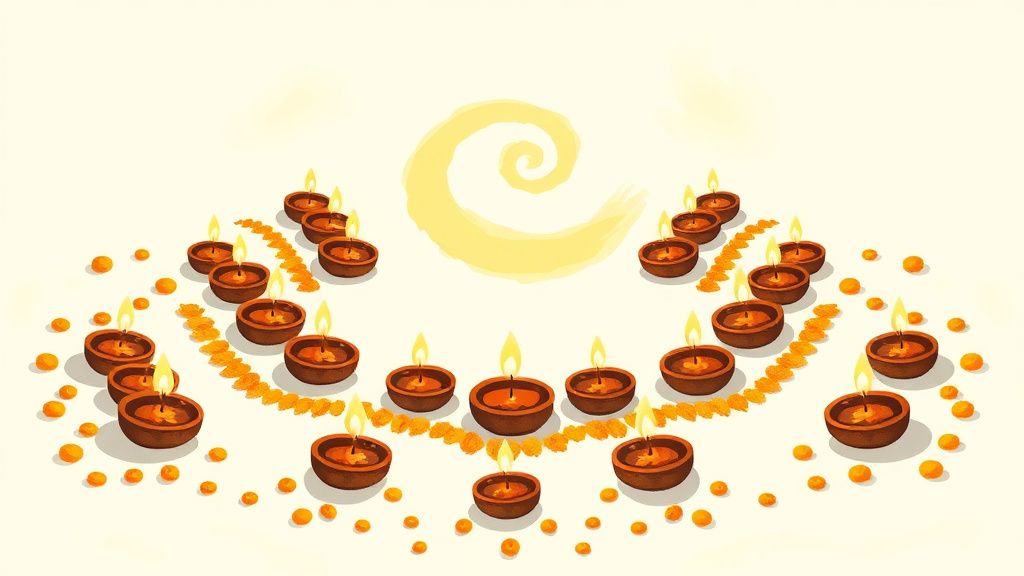
Rangoli is the threshold and floor-art tradition drawn at the entrance of a home during Diwali, with regional forms including kolam in Tamil Nadu, muggu in Andhra Pradesh, alpana in Bengal, mandana in Rajasthan, pookalam in Kerala, aripana in Bihar and the umbrella term rangoli used across Maharashtra and the north. The Diwali rangoli specifically marks the doorway for Lakshmi’s arrival on the evening of Lakshmi Puja, 8 November 2026. Below is the material list, the most common Diwali patterns, the regional variations and the practical considerations.
Why rangoli at the threshold
The rangoli sits at the chowkat (threshold) for a documented reason: in the classical Vastu and Shilpa Shastra texts the threshold is the most charged transitional surface in the house, the boundary between bahir (outside) and antar (inside). A drawn pattern at this surface is read as both a welcome (to Lakshmi) and a protective grid (to repel Alakshmi and inauspicious entry). The lit diya next to the rangoli on Lakshmi Puja evening completes the welcome.
The classical materials are rice flour, white limestone powder, red ochre, turmeric, and natural plant pigments. Modern synthetic gulal in chemical pigments is now widely used; the trade-off is colour brightness against ecological cleanliness. Households serious about the traditional form return to rice flour for the kolam base and natural pigments for colour fills.
The four most common Diwali patterns
- The lotus (kamal): Lakshmi’s seat. An eight-petalled or sixteen-petalled lotus drawn at the centre of the rangoli. The lotus is the single most Lakshmi-coded motif in Hindu iconography; its inclusion at the doorway makes the rangoli explicitly her welcome.
- The diya (clay lamp) row: a row of diyas drawn around the lotus or in a circular frame. Often paired with the placement of actual clay diyas at the corners of the rangoli.
- The footprint rangoli (Lakshmi-padam): small footprints drawn from the threshold leading into the puja room, indicating Lakshmi entering and walking to her seat at the chowki. This is one of the most distinctively Diwali-specific designs; it is not used at other festivals.
- The geometric grid (sarvatobhadra): a symmetric grid of squares and circles, often used as the base frame on which the floral motifs are placed. Common in north India.
Most household Diwali rangolis combine two or three of these: a lotus centre, footprints leading to it, and a row of diya outlines around the edge. The whole takes 30 to 90 minutes for a household scale of about 60 cm to a metre.
Regional traditions of the same art
- Kolam (Tamil Nadu, Karnataka): drawn with rice flour pinched between thumb and forefinger, with a dot grid (pulli) laid first and the design drawn by connecting dots with continuous loops. The mathematical precision is the distinguishing feature. Diwali kolam is the most elaborate of the year.
- Muggu (Andhra Pradesh, Telangana): the Telugu equivalent of kolam, also dot-grid-based, with stronger emphasis on the lotus and Hridya-Kamala (heart-lotus) motifs.
- Alpana (Bengal, Odisha, Assam): drawn with a rice-flour paste rather than dry flour, applied with the fingers. Designs are more curvilinear and include lotus, conch, fish and the swastika.
- Mandana (Rajasthan, Madhya Pradesh): drawn with white chalk-paste on a base of red clay (geru), with floral and peacock motifs. The Marwari Diwali mandana is among the most photographed regional forms.
- Pookalam (Kerala): entirely floral, with concentric circles of flower petals (marigold, rose, chrysanthemum). More associated with Onam than Diwali, but coastal Kerala households use it for Diwali.
- Aripana (Bihar, Mithila): the Maithil tradition, with rice-paste designs incorporating fish, the swastika and the lotus. Particularly distinctive on Bhardutiya (Bhai Dooj) day.
- Rangoli (Maharashtra and the north): the umbrella term; uses dry powdered pigments, often with a freehand approach rather than a dot grid.
Materials and tools
- White base: rice flour (the most traditional), limestone powder or chalk dust.
- Colour fills: turmeric (yellow), kumkum or vermillion (red), indigo or neel (blue), henna (green). Synthetic rangoli powder is sold in packets in the 50 to 100 rupee range per colour.
- Stencils: increasingly used for households without a regular practice; available in plastic in the Mumbai-Delhi market for 100 to 500 rupees per piece.
- Tools: a small funnel (for fine lines), a brush or sieve (for filling large areas), the fingers for the central dotting.
- Surface preparation: sweep the threshold area; some traditions sprinkle a fine water spray to fix the rice-flour base before drawing on it.
Practical points
- Draw the morning of Lakshmi Puja: the rangoli is freshly drawn on the morning of 8 November 2026, after the threshold is washed. Earlier-drawn rangolis are repaired or redrawn that morning.
- Mark the corners: place a small clay diya at each corner of the rangoli. At sunset these are lit and the rangoli reads as illuminated.
- Plan for daily wear: a rangoli at a flat-entrance doorway is walked over; size accordingly, or use a stencil mat that can be lifted and replaced.
- Apartment-block constraints: some housing societies in metro cities now restrict permanent floor markings in common-area lobbies. Stencils, peel-up rangoli stickers, and mat-based designs are the workarounds.
For what it’s worth, the most rewarding household practice is a small daily kolam from Dhanteras through Bhai Dooj rather than one elaborate rangoli on Diwali night alone. The daily rhythm matches the South Indian kolam tradition and is more sustainable than a single one-hour rangoli effort.
Common questions
Is the lotus mandatory?
Not in any binding sense, but it is by far the most common Diwali motif because of the Lakshmi association. Households that use a different central motif (peacock, deepalakshmi, swastika) are within the tradition. The functional requirement is a symmetrical motif at the doorway; the specific symbol is open.
Should rangoli powders be natural?
Where possible, yes. Natural rice flour, turmeric, kumkum, ground rose petals and chalk are non-toxic and biodegradable. Synthetic pigments contain industrial dyes that can stain tiles and pavement; some include mica. The ecological case is for natural materials wherever feasible.
Can a stencil be used by someone who can’t draw?
Yes; stencils are a valid contemporary tool. They reduce the practice to the act of intention rather than artistic skill, which is more important to the tradition than freehand execution. Many households now teach children the freehand kolam separately from the practical stencil-based door rangoli.
One limitation worth noting
Pattern complexity varies enormously by region; the section above is a general orientation rather than a specific design library. For a particular regional pattern (e.g. Tanjore-style kolam, Marwari mandana), consult a local rangoli artist or community art workshop, since the published images on social media are often simplified.
For background reading see Wikipedia on Rangoli and the Wikipedia entry on Kolam for the South Indian dot-grid tradition.
