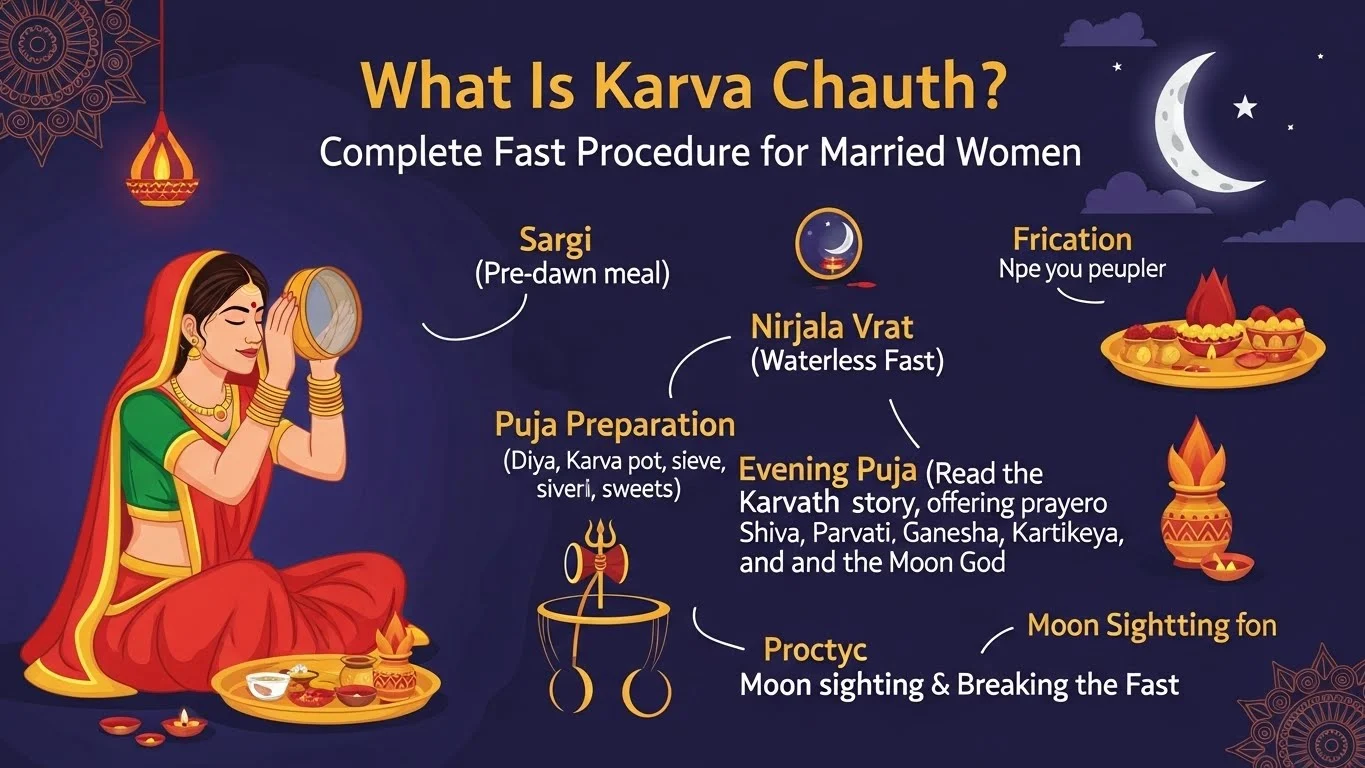
The festival of Karva Chauth Karva Chauth Complete Fast – from Sanskrit [translate:करवा चतुर्थी] (Karva Chauth) where [translate:करवा] (karva) means “earthen pot” used in rituals and [translate:चतुर्थी] (chauth) means “fourth day” after full moon in Kartik month (October-November) – represents one of North India’s most emotionally powerful, visually stunning, and culturally significant festivals where married Hindu women observe rigorous nirjala (waterless) fast from sunrise to moonrise praying for their husbands’ longevity, prosperity, and wellbeing through day-long abstinence from food and water followed by elaborate evening puja rituals, collective
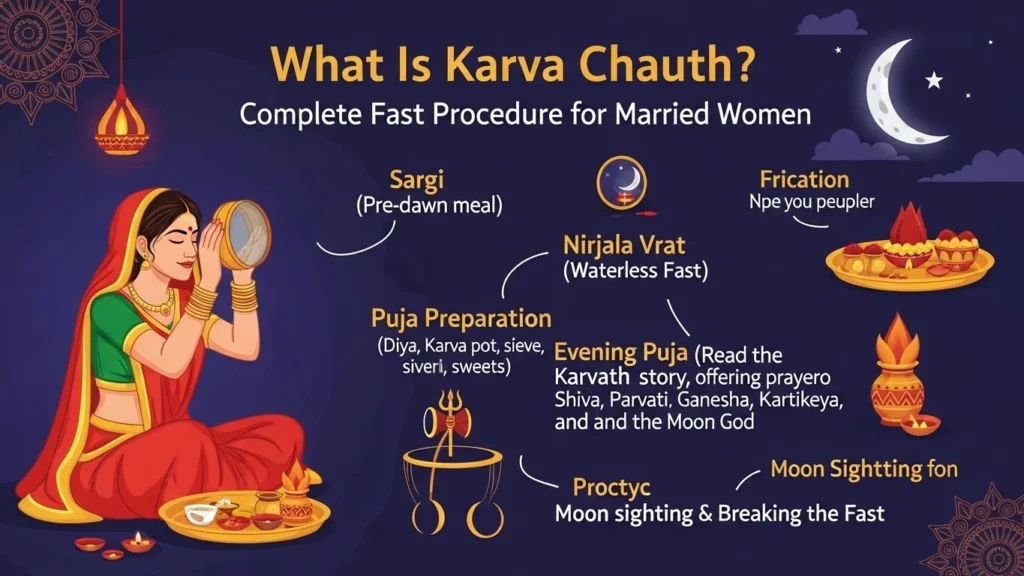
Vrat Katha recitation narrating legendary queens whose devotion saved husbands from death, and romantic moon-sighting ceremony where husbands offer first water and food breaking wives’ fast creating deeply intimate marital bonding experience celebrated through traditional attire, mehndi (henna) application, gift exchanges, and festive gatherings. Unlike ordinary fasting for personal spiritual benefit or health, Karva Chauth embodies unique philosophy of [translate:Pativrata Dharma] (devoted wife’s sacred duty) where woman’s fasting specifically directed toward husband’s welfare based on ancient belief that wife’s spiritual austerity creates protective shield around spouse warding off dangers, illness, and untimely death while simultaneously strengthening marital bond through visible demonstration of love, commitment, and willingness to endure physical hardship for partner’s sake creating powerful emotional connection transcending everyday routine.
The complete Karva Chauth observance encompasses understanding pre-dawn sargi ritual where mothers-in-law prepare elaborate pre-fast meals for daughters-in-law consumed before sunrise establishing familial bonds and providing sustenance for day’s rigors, day-long nirjala vrat’s challenging physical demands requiring mental discipline and devotional focus maintaining consciousness of fast’s sacred purpose beyond mere hunger endurance, evening preparations involving donning bridal-style traditional attire (often red or maroon)
applying intricate mehndi designs, adorning complete Solah Shringar (sixteen beautifications) recreating wedding day splendor, collective puja ceremony where women gather worshipping Goddess Parvati and earthen karva pots arranged in specific patterns while listening to Vrat Katha stories of legendary devotion, moonrise vigil anxiously awaiting moon’s appearance as fast cannot be broken until seeing moon through traditional sieve ([translate:channi]), and climactic fast-breaking ritual where husband
first offers water then food to wife after both view moon together creating deeply romantic tender moment often most cherished aspect of entire observance. For women in 2025 whether newly married brides experiencing first Karva Chauth navigating complex emotions of devotion, family expectations, physical challenge, and romantic anticipation, experienced wives maintaining decades-long tradition connecting annual observance to marital journey’s continuity and renewal, modern feminists questioning practices that place fasting burden only on wives while husbands face no equivalent obligations yet simultaneously finding personal meaning in choosing voluntary participation, mothers-in-law preparing sargi carrying
forward generational traditions while adapting to contemporary daughters-in-law’s varying comfort levels with orthodox practices, or simply observers wanting to understand festival’s profound cultural resonance beyond Bollywood’s romanticized portrayals, recognizing Karva Chauth as complex multidimensional practice embodying devotion’s beauty alongside legitimate questions about gender equity enables approaching this tradition with nuanced appreciation acknowledging both genuine spiritual meaning many women find empowering and valid feminist critiques requiring thoughtful consideration allowing each woman to make informed choice about participation based on personal values rather than blind compliance or external pressure.
What Is Karva Chauth? Origins and Significance
Understanding festival’s historical roots and deeper meaning provides essential context.
The Name: Karva and Chauth
Etymology Breakdown:
[translate:करवा चतुर्थी (Karva Chauth)]
करवा (Karva):
- Earthen pot with spout
- Used in puja rituals
- Symbolizes prosperity and auspiciousness
- Filled with water and sweets during ceremony
चतुर्थी (Chauth/Chaturthi):
- Fourth day
- Specifically: Fourth day after full moon
- In Hindu month of Kartik (October-November)
Combined Meaning:
“Festival of the Earthen Pot on the Fourth Day”
When Is Karva Chauth Celebrated?
Timing:
Kartik Krishna Paksha Chaturthi
- Hindu lunar month: Kartik (Oct-Nov)
- Paksha: Krishna Paksha (waning moon fortnight)
- Tithi: Chaturthi (fourth day after full moon)
Gregorian Calendar:
Typically falls in late October or early November, varying each year based on lunar calendar.
2025 Date: October 20, 2025 (example – verify annually)
The Core Significance
Primary Purpose:
Husband’s Longevity and Wellbeing
Karva Chauth is observed “to pray for the long life, health, and prosperity of their husbands.”
The Belief Karva Chauth Complete Fast:
Wife’s tapasya (austerity):
- Creates spiritual merit
- Forms protective shield around husband
- Wards off dangers and illness
- Ensures marital longevity
Traditional Philosophy: Pativrata Dharma
[translate:पतिव्रता धर्म (Pativrata Dharma)]
Meaning:
- Pati = Husband
- Vrata = Vow, devotion
- Dharma = Sacred duty, righteousness
Concept:
Traditional Hindu ideal of devoted wife whose:
- Husband is supreme deity
- Service to husband = spiritual practice
- His wellbeing = her highest priority
- Devotion ensures both worldly and spiritual success
Karva Chauth as Expression:
Festival embodies Pativrata ideal through:
- Voluntary suffering (fasting) for husband’s benefit
- Devotional ritual directed toward his welfare
- Public demonstration of marital commitment
Modern Perspective:
While traditional Pativrata concept faces feminist critique as patriarchal, many contemporary women reinterpret Karva Chauth as:
- Mutual love expression (some husbands now fast too)
- Personal choice rather than obligation
- Romantic bonding experience
- Cultural heritage connection
Geographical Prevalence
Primarily North Indian Festival:
Strongest Observance:
- Punjab
- Haryana
- Rajasthan
- Uttar Pradesh
- Himachal Pradesh
- Delhi NCR
Limited to Some Observance:
- Madhya Pradesh
- Gujarat (some communities)
Generally NOT Observed:
- South India
- East India (Bengal, Odisha)
- Northeast India
Community Variation:
Even within North India, intensity varies by community, caste, and family tradition.
Historical Origins: Multiple Theories
Theory 1: Army Wives’ Tradition
Ancient Context:
When men went to war leaving wives behind:
Women’s Response:
- Prayed for husbands’ safe return
- Fasted collectively for protection
- Created support community among wives
- Karva Chauth emerged as institutionalized practice
Theory 2: Agricultural Significance
Kartik Month Timing:
Coincides with post-harvest period:
- Crops safely stored in earthen pots (karvas)
- Gratitude for abundance
- Prayer for continued prosperity
- Earthen pot worship symbolizes stored wealth
Theory 3: Mythological Origins
Based on legendary stories (detailed in Vrat Katha section):
- Queen Veervati
- Savitri-Satyavan
- Karva’s devotion
These tales established fasting tradition through exemplary models.
Who Observes Karva Chauth?
Primary Participants:
Married Women:
- Main observers of fast
- From all age groups (young brides to elderly wives)
- Both for living husbands and recently widowed (some traditions)
Engaged Women:
Some communities allow:
- Fiancées to fast for betrothed
- Strengthening pre-marital bond
Modern Adaptation:
Some Men Now Fast:
- Contemporary couples choose mutual fasting
- Husbands support wives by also abstaining
- Shifts from one-sided to reciprocal practice
Not Observed By:
- Unmarried girls (traditionally)
- Widows (traditional restriction, though changing)
- Women from regions/communities where custom doesn’t exist
The Legendary Vrat Katha Stories
The sacred narrative recitation forms essential part of Karva Chauth ritual.
The Story of Queen Veervati
The Most Famous Karva Chauth Legend:
The Beginning:
“A long long time ago, there lived a beautiful girl by the name of Veeravati. She was the only sister of her seven loving brothers, who was married to a king.”
First Karva Chauth:
“On the occasion of the first Karva Chauth after her marriage, she went to her parents’ house. After sunrise, she observed a strict fast.”
The Suffering:
“However, the queen couldn’t stand the rigors of fasting and was desperately waiting for the moon to rise.”
Brothers’ Deception:
“The seven brothers who loved her dearly, were very disturbed watching the distress of their sister and decided to end her fast by deceiving her.”
The Trick:
“Then the brothers reflected a mirror through Pipal tree leaves. The sister, taken it as moon rise, broke the fast and took food.”
The Consequence:
“However, the moment the queen ate her dinner, she received the news that her husband, the king, was seriously ill.”
Divine Intervention:
“The queen rushed to her husband’s palace and on the way, she met Lord Shiva and his consort, Goddess Parvati.”
The Truth Revealed:
“Parvati informed her that the king had died because the queen had broken her fast by watching a false moon.”
The Boon:
“However, when the queen asked her for forgiveness, the goddess granted her the boon that the king would be revived. But to achieve this, she would have to undertake the Karva Chauth fast under strict rituals, then only her husband would come to life.”
The Redemption:
“Thus, by strictly following all the rituals of Karva chauth, queen Veeravati revived her husband.”
The Moral:
Lessons from Veervati’s Story:
- Importance of completing fast properly – Breaking prematurely has consequences
- Devotion’s power – Sincere observance can overcome even death
- Forgiveness and second chances – Goddess’s compassion grants redemption
- Strict ritual adherence – Following proper procedure essential for efficacy
The Story of Savitri and Satyavan
Another Associated Legend:
The Setup:
“There is the story of the Satyavan and Savitri.”
The Crisis:
“When Lord Yama, came to procure Satyavan’s soul, Savitri begged him to grant him life.”
The Devotion:
“When he refused, she stopped eating and drinking and Yamraj finally relented.”
The Victory:
“He granted her, her husband’s life.”
The Legacy:
“To this day, Karva Chauth is celebrated with great faith and belief.”
Connection:
While Savitri-Satyavan story celebrated separately on Vat Savitri Vrat, it’s invoked during Karva Chauth as another example of devoted wife’s power to overcome death through spiritual austerity.
The Story of Karva’s Devotion
The Namesake Legend:
The Crisis:
“According to another legend, a woman named Karva was deeply devoted to her husband. One day while bathing, he was caught by a crocodile.”
Immediate Action:
“Karva came running and bound the crocodile with a cotton yarn.”
Confronting Death:
“She then went to Yama, the Lord of the death, and requested him to send the offending crocodile to hell.”
The Threat:
“When Yama refused, she threatened to curse him.”
Yama’s Fear:
“Afraid of the power of a devoted wife, Yama readily accepted and sent the crocodile to Yamalok or hell, and blessed Karva’s husband with long life.”
The Meaning:
Karva’s Story Teaches:
- Devoted wife’s spiritual power – Her chastity and devotion create immense shakti
- Immediate protective action – Quick-thinking devotion
- Even death deity fears – Pativrata shakti surpasses even Yama’s authority
- Cotton yarn symbolism – Simple sacred thread (like fast) has power when wielded with devotion
Draupadi’s Observance
Mahabharata Connection:
“The belief in this fast and its associated rituals goes back to the pre-Mahabharata times. Draupadi, too, is said to have observed this fast.”
The Context:
“Once Arjun went to the Nilgiris for penance and the rest of the Pandavas faced many problems in his absence.”
Seeking Help:
“Draupadi, out of desperation, remembered Lord Krishna and asked for help.”
Krishna’s Advice:
“Lord Krishna reminded her that on an earlier occasion, when Goddess Parvati had sought Lord Shiva’s guidance under similar circumstances, she had been advised to observe the fast of Karva Chauth.”
The Result:
“Draupadi followed the instructions and observed the fast with all its rituals. Consequently, the Pandavas were able to overcome their problems.”
Significance:
Establishes Karva Chauth as:
- Ancient practice (pre-Mahabharata)
- Observed even by Goddess Parvati (divine precedent)
- Effective for overcoming difficulties
- Not just for husband’s longevity but general welfare
Listening to Vrat Katha During Puja
Essential Ritual Component:
“On this day, fasting women listen to Karva Chauth legends with rapt attention.”
The Practice:
During evening puja gathering:
- One person reads/recites stories
- All fasting women listen devotionally
- Creates collective spiritual energy
- Reinforces fast’s sacred meaning
The Effect:
Hearing legendary examples:
- Inspires devotion
- Validates suffering (queens also endured)
- Connects individual fast to timeless tradition
- Provides spiritual focus during difficult wait for moon
Complete Fast Procedure: Step-by-Step Guide
The detailed observance ritual follows prescribed sequence from pre-dawn to moonrise.
Preparation: Day Before Karva Chauth
Shopping and Arrangements:
Essential Items to Prepare:
- Karva (earthen pot with spout)
- Puja thali (worship plate)
- Diya (oil lamps)
- Incense sticks
- Flowers (fresh, preferably red)
- Kumkum (vermillion)
- Chandan (sandalwood paste)
- Mithai (sweets) for puja
- Fruits
- Channi (decorated sieve for viewing moon)
- New clothes (traditional red/maroon preferred)
- Mehndi (henna for application)
- Sargi items (see below)
Mehndi Application:
Evening Before:
Many women apply mehndi (henna) on hands and feet:
- Auspicious for married women
- Darker color = deeper love belief
- Requires overnight setting
- Creates festive bridal appearance
Step 1: Sargi – Pre-Dawn Meal
The Most Important Preparatory Step:
[translate:सरगी/सरगा (Sargi/Sargā)]
What Is Sargi?
“Sargi is a pre-dawn meal that married women eat before starting their Karwa Chauth fast.”
Who Prepares Sargi?
Traditional:
“Sargi is prepared lovingly by the mother-in-law and sent to her daughter-in-law before sunrise.”
Modern Adaptation:
If living separately:
- Mother-in-law may send sargi items
- Or daughter-in-law prepares herself
- Or own mother provides
Timing:
Critical Window:
Must be consumed before sunrise (typically 4:00-5:30 AM depending on location and season).
After sunrise: Cannot eat or drink anything until moonrise.
What’s Included in Sargi?
Traditional Items:
- Fruits – Especially bananas, apples
- Sweets – Traditionally homemade like kheer, pheni, mathri
- Dry fruits – Almonds, cashews (energy for long day)
- Coconut
- Milk or lassi (hydration for waterless day)
- Paratha or puri with sabzi (substantial food)
- Feni (special sweet vermicelli)
- Singhare ke atte ka halwa (water chestnut flour halwa)
Modern Adaptations:
Some women include:
- Juice
- Nuts and seeds
- Energy-rich foods for sustenance
The Eating:
Wake Before Sunrise:
Set alarm for pre-dawn (check local sunrise time).
Ritual Consumption:
- Bathe first (some traditions)
- Eat sargi mindfully
- Thank mother-in-law (traditional)
- Drink plenty of water (last chance for hydration)
Symbolism:
Sargi represents:
- Mother-in-law’s blessing and care
- Family bond (especially with husband’s mother)
- Preparing body for rigorous fast
- Auspicious start to sacred day
Step 2: The Nirjala Fast – Day-Long Abstinence
From Sunrise to Moonrise:
Strict Nirjala Vrat:
[translate:निर्जला व्रत (Nirjala Vrat)] = Waterless fast
Restrictions:
No Food: Absolutely no eating
No Water: Critically, no water allowed either
No Exceptions: Complete abstinence from all consumption
Duration:
Typically 12-15 hours depending on:
- Sunrise time (when sargi window closes)
- Moonrise time (when fast breaks)
- Season and geographical location
Physical Challenges:
Hunger Management:
- Gurgling stomach after several hours
- Low energy, fatigue
- Mental focus required
Thirst (Harder Challenge):
- Dry mouth, throat
- Headache possible
- Especially difficult in warm weather
- No water even for mouth rinsing (strict observance)
Coping Strategies:
1. Devotional Focus:
- Remember fast’s sacred purpose
- Pray for husband throughout day
- Maintain spiritual consciousness
2. Rest:
- Avoid strenuous activities
- Rest when needed
- Conserve energy
3. Distraction:
- Festive preparations (mehndi, dressing)
- Socializing with other fasting women
- Household tasks (light)
4. Avoiding Triggers:
- Stay away from kitchen if possible
- Don’t watch others eat
- Avoid tempting situations
Mental Discipline:
The real test:
- Overcoming physical discomfort
- Maintaining devotional attitude
- Not complaining or breaking fast
- Completing full duration with willpower
Step 3: Evening Preparations and Beautification
Late Afternoon/Early Evening:
The Transformation:
Women prepare as if for wedding:
1. Bath and Grooming:
- Full bath
- Hair washing, styling
- Complete grooming
2. Traditional Attire:
Preferred Colors:
- Red (most traditional – bridal color)
- Maroon
- Pink
- Orange
- Bright festive colors
Clothing:
- Saree (traditional choice)
- Lehenga
- Salwar kameez (beautiful festive)
- Often new clothes or wedding outfit
3. Complete Solah Shringar:
[translate:सोलह श्रृंगार (Solah Shringar)] = Sixteen traditional adornments
Married women adorn:
- Bindi
- Sindoor
- Mangalsutra
- Earrings
- Necklaces
- Bangles
- Rings
- Toe rings
- Anklets
- Waist belt
- Mehndi (already applied)
- Kajal
- Perfume
- Flowers in hair
- Ornate clothing
- Complete makeup
4. Jewelry:
- All wedding jewelry
- Maximum adornment
- Recreating bridal appearance
The Symbolism:
Looking beautiful for husband:
- Honoring him through appearance
- Celebrating marriage
- Devotion expressed through beautification
Step 4: Evening Puja – Collective Worship
Gathering of Women:
Community Aspect:
“During the evening puja, women gather together—either at a common place, in a temple, or at someone’s home—to perform the puja collectively.”
The Setup:
Puja Arrangement:
- Central Platform:
- Clean area designated
- Often decorated with rangoli
- Karvas Arranged:
- Multiple earthen pots placed
- Filled with water and sweets
- Arranged in specific pattern
- Deity Representation:
- Image/idol of Goddess Parvati
- Sometimes Lord Shiva and Ganesha too
- Puja Items:
- Diya (lamps)
- Incense
- Flowers
- Kumkum, chandan
- Offerings
The Puja Vidhi (Worship Procedure):
Step-by-Step Ritual:
1. Lighting Lamps:
- Women light diyas together
- Invoke divine presence
2. Offerings:
- Present flowers, kumkum, chandan
- Offer sweets, fruits to deity
3. Aarti:
- Collective singing of Karva Chauth aarti
- Circulating lamps before deities
4. Vrat Katha Recitation:
- Someone reads legendary stories
- All listen with devotion and attention
5. Karva Exchange:
Unique Ritual:
“The pot (karva) is passed among the women in a circular manner while they chant specific prayers.”
The Practice:
- Women sit in circle
- Pass karva around (clockwise typically)
- Each woman briefly holds it
- Chanting prayers continuously
Symbolism:
- Sharing blessings
- Collective spiritual energy
- Sisterhood among fasting women
6. Prayers for Husbands:
- Specific prayers for husband’s longevity
- Collective blessing energy
- Individual silent prayers
Duration:
Puja typically 30-60 minutes, timed to complete before moonrise.
Step 5: Moon Sighting – The Culmination
Anxious Wait:
After puja, women wait for moon:
The Anticipation:
- Looking toward horizon
- Checking moon rise time
- Growing excitement mixed with hunger/thirst
- Fast cannot break until moon visible
First Sighting:
“Once the moon is visible in the sky, women eagerly await this moment.”
Moonrise Timing:
Varies by:
- Date and lunar cycle
- Geographical location
- Season
Typically: 8:00 PM – 9:30 PM (varies widely)
The Moon Viewing Ritual:
Sacred Procedure:
1. Gather Outside:
- Women (often with husbands now) go to terrace, balcony, or open area
- Carry puja thali with diya and offerings
- Hold decorated channi (sieve)
2. Viewing Through Sieve:
Traditional Method:
“Women first view the moon through a sieve (channi) and then look at their husbands through the same sieve.”
Why Sieve?
- Traditional implement
- Filters view creating sacred framing
- Symbolic significance (some say seeing moon directly inauspicious)
3. Offering Arghya to Moon:
Water offering:
- Hold karva or kalash (water vessel)
- Offer water to moon
- Pray for husband’s longevity
- Complete the ritual worship
Step 6: Breaking the Fast – Husband’s Offering
The Romantic Ritual:
Most Cherished Moment:
Husband’s Role:
“The husband then offers the first sip of water and the first morsel of food to his wife, thus ending her fast.”
The Procedure:
1. Wife Views Husband:
- After viewing moon through sieve
- Turns sieve to view husband through it
- Looking at him with devotion
2. Husband Touches Feet (Some Traditions):
- Bows to wife honoring her sacrifice
- Shows respect and gratitude
3. First Water:
- Husband offers water
- Wife takes first sip from his hands
- Breaking hours of thirst
The Significance:
- Fast broken BY husband (not self)
- His offering sanctifies fast’s completion
- Symbolizes his care and reciprocation
4. First Food:
- Husband offers first morsel (often sweet)
- Wife eats from his hands
- Completes fast-breaking
5. Full Meal:
- After ritual first sip and bite
- Wife can eat normal meal
- Often festive dinner prepared
The Emotional Moment:
For Many Couples:
- Most romantic part of entire observance
- Tenderness, gratitude exchanged
- Bonding through ritual
- Tears of relief and joy common
Gift Exchange:
Modern Addition:
Many husbands present gifts:
- Jewelry
- Clothes
- Money (traditional sargi envelope)
- Thoughtful presents
Expressing gratitude for wife’s devotion and sacrifice.
Step 7: Post-Fast Celebration
The Feast:
Breaking fast properly:
Start Gently:
- Don’t eat heavily immediately
- Small portions first
- Hydrate gradually
Traditional Foods:
- Sweets first (auspicious)
- Then regular meal
- Often special dishes prepared
Family Celebration:
- Festive dinner with family
- Sharing experiences with other women
- Collective relief and joy
Modern Parties:
Contemporary urban observance:
- Hotel/restaurant celebrations
- Large gatherings with entertainment
- Fashion and social aspects emphasized
Frequently Asked Questions
Can pregnant or menstruating women observe Karva Chauth?
Nuanced answer with health priority: Pregnancy: Traditional perspective varies – some allow, others discourage. Medical reality: Nirjala (waterless) fast potentially risky for pregnancy; dehydration affects fetus. Recommendation: Consult doctor; if observing, consider modified fast (allow water, or partial fasting). Many women skip during pregnancy – health paramount. Menstruation: Traditional taboo: Some orthodox families prohibit fasting during periods. Modern view: Increasingly rejected as baseless restriction. Practical: Physical discomfort already present; adding fast burden difficult. Personal choice: Many menstruating women fast successfully; others postpone. The principle: God values intention over mechanical compliance; health and wellbeing matter more than rigid adherence.
Do husbands fast on Karva Chauth too?
Traditional practice: No. Modern trend: Increasingly yes. Orthodox Karva Chauth: Only wives fast for husbands. One-sided nature: Traditional patriarchal structure where woman’s role emphasizing devotion/sacrifice. Contemporary evolution: Growing number of husbands choosing to fast alongside wives showing: 1) Mutual love and partnership, 2) Rejecting one-sided burden, 3) Supporting wife through shared experience. Not religiously required: No scriptural mandate for husbands fasting. But meaningful gesture: When men voluntarily fast, transforms practice from patriarchal obligation to mutual expression. Middle ground: Some husbands partial fast (skip meals but take water) or fast until wife breaks fast. The shift: From wife’s unilateral austerity toward couple’s shared romantic ritual – positive evolution honoring both tradition and gender equity.
What if moon is not visible due to clouds or weather?
Practical issue with traditional solutions: The problem: Cloudy/rainy weather hiding moon creates dilemma – fast cannot traditionally break without seeing moon. Solutions practiced: 1. Standard timing: Use moonrise time from calendar; assume moon present even if not visible and perform rituals at scheduled time. 2. Peek through clouds: If moon briefly visible between clouds, sufficient for ritual.
3. Faith-based: Some traditions say sincere prayer toward moon’s direction adequate if visibility impossible. 4. Modern technology: Apps/TV showing moon (controversial but some accept). 5. Extended wait: Very orthodox families wait hours hoping for visibility (difficult!). Practical consensus: Most modern observance accepts performing ritual at standard moonrise time regardless of actual visibility – God sees devotion, not necessarily visual confirmation. Health matters; don’t extend dangerously.
What if I accidentally drink water or eat during the fast?
Compassionate traditional response: Intent matters most: Accidental consumption: If genuinely unintentional (forgetfulness, mistake), not considered breaking fast with ill intent. Traditional wisdom: Different views exist: Strict: Fast broken; must complete or restart next year. Moderate: If very minor (sip of water accidentally), continue fast with renewed focus; sincere devotion compensates. Lenient: Accidents forgiven; intention was pure.
Practical approach: Minor accident: Don’t panic; continue if possible, increase devotional focus. Significant breach: Honestly assess – if impossible to continue, accept gracefully; one year’s incomplete fast doesn’t destroy marriage. Important: Don’t make yourself sick; if medical need arises (severe dehydration, dizziness), breaking fast for health is justified. God values your wellbeing over ritual perfection.
Can unmarried women or widows observe Karva Chauth?
Complex traditional restrictions evolving: Unmarried women: Traditional rule: No – Karva Chauth exclusively for married women. Logic: Fasting for (nonexistent) husband’s longevity illogical. Modern exception: Some engaged women fast for fiancés (growing acceptance). Fashion participation: Unmarried women may join festivities (mehndi, dress-up) without fasting. Widows: Traditional prohibition: Widows cannot fast (no living husband). Harsh reality: Part of widow marginalization in traditional society. Modern reform: Changing perspectives: Some widows who remarry observe for new husbands. Progressive view: Widows can fast for late husband’s memory (controversial but growing). The evolution: Restrictions being questioned as unnecessarily exclusionary; personal choice increasingly respected over rigid rules.
Is Karva Chauth observed in South India or only North India?
Predominantly North Indian festival: Strong observance: Punjab, Haryana, Rajasthan, UP, HP, Delhi – deeply rooted tradition. Limited/absent: South India (Tamil Nadu, Kerala, Karnataka, Andhra Pradesh) generally don’t observe Karva Chauth traditionally. Why regional difference? Different cultural traditions: South has other wife-oriented festivals (like Varalakshmi Vratam) serving similar purposes; North Indian diaspora influence growing.
Modern spread: Urban migration bringing North-South cultural exchange; some South Indian women married into North Indian families adopt practice; Bollywood romanticization creating pan-Indian awareness. But: Remains primarily North/Northwest Indian tradition; expecting universal Indian observance inaccurate. Respect regional diversity: Not all Hindu women observe Karva Chauth – geographically and culturally specific practice.
What is the feminist perspective on Karva Chauth?
Complex nuanced debate: Feminist critique: 1. Gender asymmetry: Only wives fast, not husbands – perpetuates unequal burden. 2. Patriarchal values: Reinforces woman’s worth tied to husband’s wellbeing. 3. Physical hardship: Demanding waterless fast potentially harmful, especially peer pressure preventing opt-out. 4. Compulsory compliance: Social expectations making “choice” coerced. Defense/Counterarguments: 1. Empowerment through choice: When freely chosen (not forced), becomes agency expression.
2. Love demonstration: Voluntary suffering for loved one is beautiful devotion (reciprocal if husband appreciates/reciprocates). 3. Cultural pride: Connecting with heritage, tradition, community. 4. Modern evolution: Growing husbands fasting too, addressing asymmetry. Balanced view: “Choice is key” – problematic when forced obligation; meaningful when genuine personal decision. Respectful dialogue: Honoring both women who embrace tradition AND those who reject it without judgment either direction.
What should I do if I feel very weak or dizzy during the fast?
Health is paramount – never compromise wellbeing: Symptoms to watch: Severe dizziness, fainting sensation, extreme weakness, rapid heartbeat, confusion. Immediate action: 1. Sit/lie down immediately – Prevent falling. 2. Tell someone – Don’t suffer silently. 3. Break fast if necessary – Your health matters more than ritual. 4. Drink water first – Dehydration likely culprit. 5. Small amounts of sugar – Low blood sugar common; sweet juice or candy helps. 6. Medical attention – If symptoms don’t improve, seek doctor. No guilt: God doesn’t want suffering causing harm. Sincere intention counted; completing fast to point of medical emergency NOT virtuous. Prevention: Hearty sargi, adequate rest during day, avoiding overexertion. Remember: Festival meant to celebrate marriage, not endanger health; wise judgment part of devotion.
Conclusion
The festival of Karva Chauth represents powerful complex tradition embodying profound marital devotion, cultural heritage, community bonding, and romantic celebration – simultaneously serving as beautiful expression of wives’ loving commitment to husbands’ welfare through rigorous day-long nirjala fast from sunrise to moonrise followed by collective puja rituals and tender moon-sighting ceremony where husbands offer first water and food breaking fast creating deeply intimate bonding experience, while also raising important contemporary questions about gender equity, personal agency, health considerations, and evolving relationship dynamics requiring thoughtful navigation beyond
simple acceptance or rejection. Understanding complete framework – that legendary Vrat Katha stories from Queen Veervati’s redemptive devotion through Karva’s shakti confronting Yama to Savitri conquering death establish powerful models of pativrata dharma inspiring generations of wives to observe this tradition believing their spiritual austerity creates protective shield around beloved husbands, that detailed procedure from pre-dawn sargi lovingly prepared by mothers-in-law through challenging waterless fast requiring mental discipline and devotional focus to elaborate evening beautification recreating bridal splendor and collective puja gathering where women support each other through shared experience culminating in magical moonrise moment of viewing spouse through sieve and receiving
first offerings from his hands creates multi-layered experience engaging body, emotions, spirituality, and community simultaneously, that modern debates surrounding Karva Chauth’s patriarchal implications versus personal empowerment through chosen participation reflect broader conversations about women’s autonomy and cultural tradition’s role in contemporary life acknowledging both valid feminist critiques of one-sided fasting burden and genuine meaning many women
find in voluntarily observing this practice, and that evolving adaptations from increasing husbands’ reciprocal fasting through health-conscious modifications for pregnant/ill women to urban celebration parties blending tradition with contemporary lifestyle demonstrate living tradition’s flexibility rather than rigid fossilization – enables approaching Karva Chauth with nuanced appreciation respecting both those who embrace this tradition as meaningful romantic devotional practice and those who question or reject it as outdated patriarchal custom.
As you engage with Karva Chauth in 2025, whether newly married bride experiencing first fast navigating complex emotions of devotion, family expectations, physical challenge, and romantic anticipation while learning intricate rituals, experienced wife maintaining decades-long tradition where annual observance marks marital journey’s milestones and continuity, modern feminist questioning inherited customs seeking informed choice based on personal values rather than blind compliance, mother-in-law preparing loving sargi carrying forward generational wisdom while respecting daughter-in-law’s individual comfort level, husband supporting fasting wife through appreciation, reciprocal fasting, or thoughtful gifts acknowledging
her sacrifice, or simply observer understanding festival’s profound cultural resonance beyond superficial Bollywood romanticism, remember that tradition’s ultimate value emerges when ancient practice meets informed contemporary choice where observance stemming from genuine devotion, personal meaning, and free will proves far more spiritually powerful than that maintained through social pressure, guilt, or unthinking compliance, that Karva Chauth’s remarkable synthesis of rigorous austerity and joyful celebration, individual discipline and community bonding, traditional ritual and modern romance demonstrates
Hinduism’s capacity for creating practices engaging multiple dimensions of human experience simultaneously serving spiritual, emotional, social, and aesthetic needs, and that whether observing complete traditional fast with full rituals, adopting modified version respecting health needs, participating in cultural aspects without fasting, supporting fasting spouse, or consciously choosing not to participate while respecting others’ choices, approaching this tradition with understanding its complete significance, respecting diverse perspectives, prioritizing health and genuine choice, and maintaining open dialogue about gender equity and personal agency transforms potentially contentious practice into opportunity for conscious engagement with heritage allowing each individual and couple to craft meaningful relationship with tradition serving their unique values and circumstances rather than mechanically following or reflexively rejecting based on incomplete understanding.
[translate:॥ सर्वे भवन्तु सुखिनः सर्वे सन्तु निरामयाः॥]
(May all be happy, may all be healthy – the true spirit underlying Karva Chauth’s prayer for beloved’s wellbeing.)
About the Author
Neha Kulkarni – North Indian Festivals, Traditions, and Regional Customs Expert
Neha Kulkarni is a passionate cultural researcher and practitioner specializing in North Indian festivals, traditional celebrations, regional customs, and the evolution of devotional practices particularly those centered on marital and family relationships. Drawing from personal experience growing up in traditional North Indian family where Karva Chauth was major annual event she witnessed her mother, aunts, and grandmother observe with deep devotion creating lasting impressions of women’s collective spiritual power and familial bonding, combined with academic training in cultural anthropology and women’s studies, her work examines.
how festivals like Karva Chauth encode complex meanings about gender, devotion, community, and tradition while navigating contemporary challenges of health awareness, feminist critique, and individual autonomy. Neha has extensively researched Karva Chauth’s historical evolution from ancient army wives’ collective prayers through regional variations to modern urban adaptations documenting how this tradition simultaneously preserves profound spiritual meaning for many women while also raising legitimate questions about gender equity requiring honest dialogue rather than defensive traditionalism or dismissive rejection.
She regularly counsels newly married women approaching first Karva Chauth helping them understand complete procedure, significance, and options for personalized observance balancing family expectations with personal comfort, teaches workshops on North Indian festival traditions explaining detailed rituals and underlying philosophies, and facilitates intergenerational conversations where mothers-in-law and daughters-in-law navigate different perspectives on traditional practices finding respectful common ground.
Her teaching emphasizes that festivals gain rather than lose vitality when participants understand complete significance and exercise informed choice, that traditions serve communities best when they enhance rather than diminish participants’ wellbeing and agency, and that Karva Chauth’s future depends on honest acknowledgment of both its beautiful devotional aspects and problematic patriarchal elements allowing evolution toward forms honoring marital love and partnership while questioning one-sided burdens, ultimately transforming ancient practice into conscious contemporary choice rather than unexamined obligation.