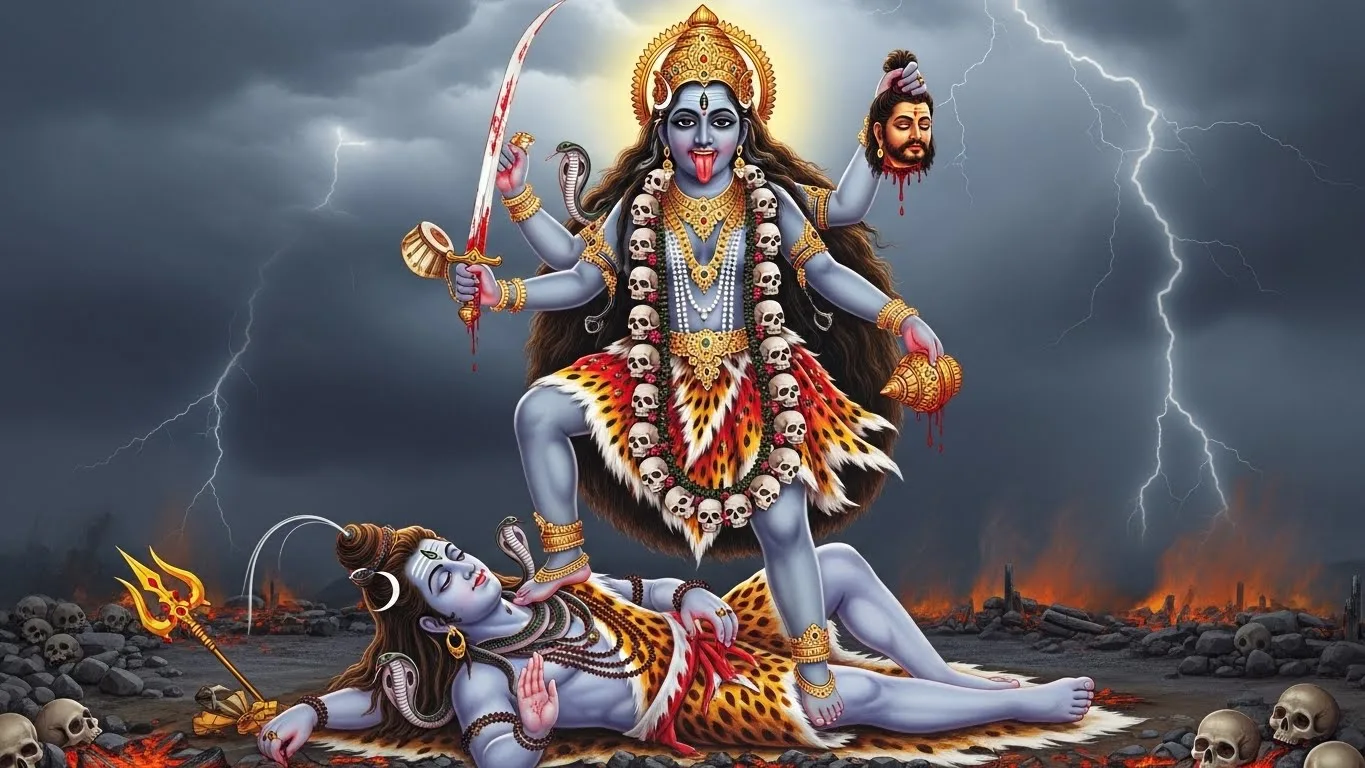
Why Does Kali Stand on Shiva Among Hindu iconography’s most striking and misunderstood images is Goddess Kali standing on Lord Shiva’s chest—her dark complexion contrasting with his ash-white body, her wild hair flowing freely, her tongue protruding dramatically, four arms wielding weapons and severed heads, standing triumphantly over the apparently lifeless form of Mahadeva himself. This powerful imagery, central to Bengal’s Tantric Shaktism and widely worshipped across India, has sparked countless interpretations, misconceptions, and profound theological discussions about the relationship between consciousness and energy, masculine and feminine principles, destruction and creation, power and awareness.
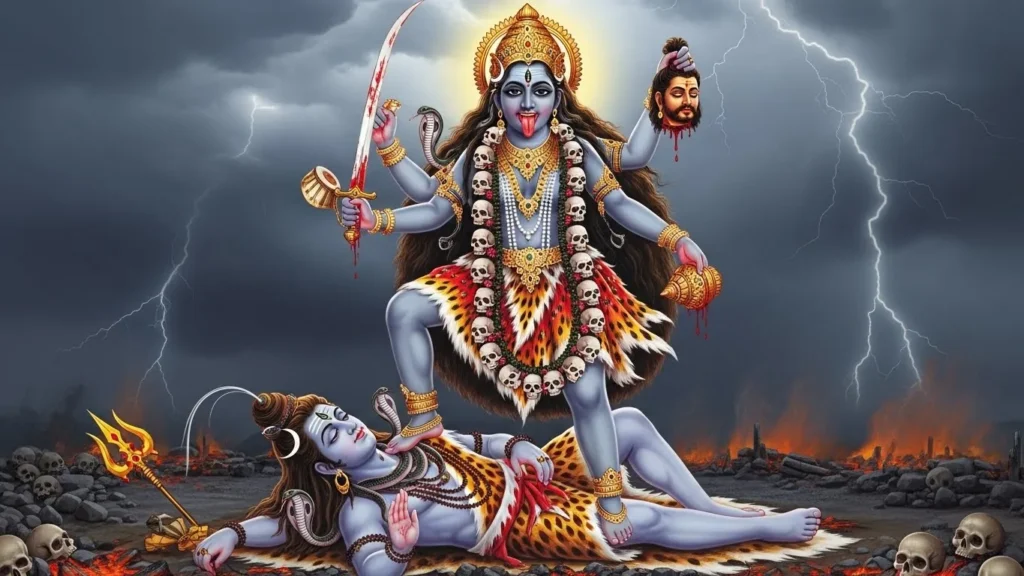
The most popular narrative explains that Kali was created by Goddess Durga to defeat the demon Raktabija, who possessed the terrifying boon that every drop of his blood touching the ground would spawn a thousand identical demons—making him virtually impossible to defeat through conventional warfare. After drinking every drop of Raktabija’s blood to prevent his multiplication and ultimately destroying him, Kali’s bloodlust and destructive fury spiraled out of control—her victory dance became a dance of universal destruction, threatening to annihilate the three worlds and all creation, as she could not distinguish between enemies already defeated and innocent beings.
When all gods fled in terror and the universe teetered on the brink of complete dissolution, Lord Shiva threw himself into her path as the ultimate sacrifice, lying down before his raging consort—the only being whose presence could shock her back to awareness. The moment Kali’s foot touched Shiva’s chest, she realized she had stepped on her beloved husband, and shame, shock, and sudden self-awareness flooded through her—causing her to stick out her tongue in embarrassment and contrition, immediately stopping her destructive rampage and restoring cosmic balance.
Yet beyond this dramatic mythological narrative, the image carries profound tantric and philosophical symbolism representing the relationship between Shiva (pure, unchanging consciousness—purusha) and Shakti/Kali (dynamic, manifesting energy—prakriti), teaching that without Shakti, Shiva becomes “Shava” (corpse)—powerless and inert—while without Shiva’s grounding consciousness, Shakti’s power becomes chaotic and destructive, demonstrating that ultimate reality requires the union of these complementary principles.
This comprehensive exploration examines the complete Raktabija story, the symbolic meanings behind Kali’s iconography, the tantric philosophy of Shiva-Shakti union, the difference between Dakshina Kali and Vama Kali, spiritual interpretations, and contemporary relevance of this powerful imagery.
The Raktabija Story: Battle and Bloodlust
To understand why Kali stands on Shiva, we must first comprehend the terrible battle against the demon Raktabija that created the circumstances requiring Shiva’s dramatic intervention.
The Invincible Demon
Raktabija was a powerful demon general in the army of the asura kings Shumbha and Nishumbha, who had conquered the heavens and driven the gods into exile through their immense power and strategic brilliance. When Goddess Durga (also called Chandika or Ambika) manifested to destroy these demons and restore dharma, she faced numerous fierce battles.
However, Raktabija possessed a unique and terrifying boon that made him virtually invincible: whenever a drop of his blood touched the ground, it would instantly spawn a thousand demons identical to himself in power, ferocity, and size. This meant that wounding him only multiplied the threat—each injury creating an army of duplicates.
The Multiplication Crisis
When Goddess Durga and the Matrikas (divine mothers) engaged Raktabija in battle, they quickly discovered the horrifying nature of his boon. Every strike with their weapons—swords, spears, arrows, and divine missiles—wounded the demon, causing his blood to spray across the battlefield. But instead of weakening him, each wound only made matters worse.
The battlefield became chaotic as thousands of Raktabijas appeared—each equally powerful, each bleeding when struck, each drop creating more demons. The situation spiraled into an exponentially growing nightmare. Where one demon stood moments before, soon hundreds appeared, then thousands, then tens of thousands—an infinite army spawning from their own attacks.
The Devi Mahatmya describes the desperation: “Then from his blood which fell upon the earth were born thousands and thousands of great asuras equal to Raktabija in valor, form, and power.”
Kali’s Creation and Strategic Solution
Recognizing that conventional warfare was futile, Goddess Durga created Kali from her own forehead—a fierce, terrifying manifestation specifically designed to counter Raktabija’s boon. Kali emerged as the embodiment of raw, destructive power—dark as night, adorned with skulls and severed limbs, wielding weapons of annihilation, her tongue lolling out enormously.
Durga and Kali devised a strategic plan: Durga would attack Raktabija with her weapons while Kali would extend her tongue across the entire battlefield like an infinite net. Every drop of blood that fell from Raktabija’s wounds would land directly on Kali’s tongue before touching the ground. Any demon that managed to spawn from blood drops would be immediately devoured whole by Kali.
The Victory and Its Terrible Aftermath
The plan succeeded brilliantly. Durga struck Raktabija repeatedly, and Kali’s tongue caught every drop of his blood. The thousands of duplicate demons already created were swallowed by Kali’s infinite appetite. Slowly but inexorably, all blood was drained from Raktabija’s body, and the seemingly invincible demon finally collapsed, defeated.
However, victory became catastrophe. The blood Kali had consumed—demon blood filled with rage, violence, and destructive energy—drove her into uncontrollable bloodlust. The act of drinking so much blood and devouring thousands of demons transformed her into a force of pure destruction unable to distinguish between enemies and innocents.
Kali’s victory dance became a Tandava of annihilation. She began killing indiscriminately—demons, humans, animals, even innocent beings—unable to stop her rampage. Her footsteps shook the three worlds. Mountains crumbled. Rivers dried up. The earth trembled. The sky darkened. All creation faced imminent destruction from the very goddess who had saved it.
Shiva’s Sacrifice: The Ultimate Intervention
With Kali’s unstoppable rampage threatening universal destruction, the gods desperately sought intervention from the only being who might calm her—Lord Shiva.
The Impossible Dilemma
The gods approached Shiva in panic: “O Mahadeva! The demon is defeated, but now Kali herself threatens all existence! Her rage cannot be stopped by force—any attempt to fight her would only fuel her destruction. She is beyond reasoning, lost in bloodlust. Only you possess the power and wisdom to intervene!”
Shiva understood the impossible situation. Fighting Kali was futile—she was manifestation of Shakti itself, the primordial energy underlying all creation. Overpowering her would require suppressing the fundamental force that makes existence possible. Yet allowing her rampage to continue meant universal annihilation.
The Ultimate Sacrifice
Shiva made a decision that only the supreme yogi—master of detachment and transcendent wisdom—could make. Rather than opposing Kali’s power, he would offer himself as the ultimate sacrifice—throwing his own body into her destructive path, trusting that the shock of recognizing him would pierce through her bloodlust and restore awareness.
Shiva lay down directly in Kali’s path—the Lord of Yogis, the Destroyer of Worlds, the Cosmic Dancer, the Supreme Consciousness—vulnerable and still, offering his own body to be trampled by the raging goddess.
The Moment of Recognition
In her frenzied dance of destruction, Kali did not notice Shiva lying before her. Her foot descended with crushing force toward what she perceived as just another obstacle in her path of annihilation.
But the instant her foot touched Shiva’s chest, everything changed. The contact with her beloved consort—the one being in all existence who was her perfect complement, her eternal partner—shocked her back to awareness. Recognition flooded through her like lightning piercing darkness.
Suddenly, Kali realized: she was standing on Shiva—her husband, her beloved, the consciousness to her energy, the stillness to her motion, the awareness to her power. Horror, shame, and contrition overwhelmed her. She stuck out her tongue in the traditional gesture of embarrassment and shock—a deeply human expression appearing on the cosmic goddess’s face.
Immediately, her destructive rampage ceased. The dance stopped. The weapons lowered. The rage subsided. Balance returned to the cosmos. Creation was saved through Shiva’s willingness to sacrifice himself and Kali’s capacity for self-awareness once reminded of the consciousness underlying her power.
The Iconography: What Each Element Symbolizes
The image of Kali standing on Shiva contains profound symbolism in every detail, each element teaching spiritual truths about existence, consciousness, and energy.
Kali’s Dark Complexion
Kali’s dark or black skin represents several interconnected meanings:
The Formless Absolute: Black absorbs all colors, just as the ultimate reality (Brahman) contains all manifestations while remaining beyond form. Kali’s darkness represents the formless void from which everything emerges and to which everything returns.
Beyond Duality: Black transcends the duality of light and dark, good and evil, beautiful and terrible—representing reality beyond human categories and judgments.
The Night of Dissolution: Kali embodies the cosmic night of dissolution (pralaya) when all forms return to unmanifest potential before the next cycle of creation.
The Protruding Tongue
Kali’s iconic lolling tongue has multiple interpretations:
Drinking the Blood: Literally, her extended tongue enabled her to catch every drop of Raktabija’s blood, preventing his multiplication—representing the power to eliminate desires that multiply endlessly when fed.
Embarrassment and Contrition: After stepping on Shiva, the tongue represents her shock and shame—a deeply human emotional expression on the cosmic goddess, teaching that even divine power must bow to awareness.
Consuming Ego: Spiritually, the tongue represents the consumption and dissolution of ego (symbolized by demon blood), clearing space for pure consciousness.
The Garland of Skulls
Kali wears a garland of fifty skulls or freshly severed heads, representing:
The Alphabet: Each skull represents one letter of the Sanskrit alphabet (there are fifty letters), symbolizing knowledge, wisdom, and the power of sound/vibration underlying creation.
Liberated Souls: The skulls represent beings liberated from the cycle of rebirth through Kali’s grace—death as doorway to moksha rather than tragedy.
Time’s Passage: Skulls represent mortality and time’s inevitable march—Kali as Mahakali (Great Time) who ultimately dissolves all temporal forms.
The Girdle of Severed Arms
The belt of severed human arms or hands symbolizes:
Karma and Action: Hands are the primary instruments of karma (action). Severing them represents liberation from karmic bondage—transcending the cycle of action and consequence through devotion to the Divine Mother.
Surrendered Effort: The arms represent human efforts and struggles that must ultimately be surrendered to divine will.
The Sword and Severed Head
In her upper left hand, Kali holds a sword; in her lower left, a severed demon head dripping blood:
Sword: Represents discrimination (viveka) and knowledge that cuts through ignorance, delusion, and false identification with ego.
Severed Head: Represents the ego itself—the false identity that binds consciousness to illusion. Kali severs this connection, granting liberation.
Blood: Represents pure consciousness (chit) flowing from the destroyed ego, transforming lower urges into spiritual strength.
The Blessing Hands
Kali’s two right hands make gestures of:
Abhaya Mudra (fearlessness): The raised palm signaling “fear not”—despite her terrifying appearance, she protects devotees who approach her as a child approaches mother.
Vara Mudra (boon-giving): The downward-facing palm bestowing blessings, liberation, and fulfillment of righteous desires.
These gestures reveal Kali’s fundamental nature as loving mother despite her fierce appearance—she destroys only to protect and liberate.
Nakedness
Kali’s nudity or minimal clothing symbolizes:
Beyond All Covering: She transcends all coverings, limitations, social conventions, and material attachments—representing absolute freedom.
Pure Nature: Her nakedness represents prakriti (nature) in its most fundamental, unadorned state.
Rejection of Illusion: Clothes represent maya (illusion) and social constructs—Kali’s nakedness shows reality stripped of all pretense.
Standing on Shiva
This central feature deserves extended exploration in the next section.
Tantric Symbolism: Consciousness and Energy
The image of Kali standing on Shiva’s apparently lifeless body is central to Tantric philosophy, representing the relationship between consciousness and energy that underlies all existence.
Shiva as Pure Consciousness (Purusha)
In Tantric metaphysics, Shiva represents purusha—pure, unchanging consciousness:
Static Awareness: Shiva is the witness consciousness that observes all phenomena without participating in or being changed by them—eternal, unchanging, beyond time and space.
Potential: He represents pure potential without manifestation—the unmanifest ground of being from which everything emerges but which itself remains formless.
The Corpse (Shava): Without Shakti, Shiva becomes “Shava” (corpse)—consciousness without energy, potential without manifestation, being without becoming. The very name “Shiva” contains the letter “i” representing Shakti—remove it and you get “Shva” (corpse).
The Horizontal Position: Shiva lying down represents consciousness in its transcendent state—withdrawn from manifestation, beyond activity, resting in absolute stillness.
Kali as Dynamic Energy (Prakriti)
Kali represents Shakti/prakriti—the dynamic, creative energy that manifests the universe:
Active Power: Shakti is the force that creates, maintains, and destroys all forms—the energy underlying every movement, change, and manifestation in existence.
Manifestation: She represents the actualization of Shiva’s potential—turning consciousness’s infinite possibilities into concrete reality.
Transformation: Kali specifically embodies transformation through destruction—clearing away old forms to make space for new creation.
The Vertical Position: Kali standing represents energy in its active, manifesting state—engaged with the world, creating and destroying forms, participating in the cosmic dance.
The Union: Neither Can Function Without the Other
The profound teaching is that Shiva and Shakti are inseparable aspects of one reality:
Without Shakti, Shiva is Shava: Pure consciousness without energy is inert, unable to create, unable to act, unable to manifest—a corpse-like potentiality that never actualizes.
Without Shiva, Shakti is Chaotic: Pure energy without consciousness is blind, destructive chaos without purpose or direction—as demonstrated by Kali’s rampage before Shiva’s intervention reminded her of awareness.
Standing On Equals Standing With: Kali standing on Shiva doesn’t represent domination but union—her feet touching his chest symbolizes their inseparable connection, the contact point where consciousness meets energy, potential meets manifestation.
The Ground of Creation: Together they represent ultimate reality—consciousness empowered by energy, energy guided by awareness. All creation emerges from their union; all existence manifests through their dance.
The Famous Verse
The Soundarya Lahari, attributed to Adi Shankaracharya, expresses this principle perfectly:
“Shivah Shaktya yukto yadi bhavati shaktah prabhavitum
Na chedevam devo na khalu kusalah spanditumapi”
Translation: “If Shiva is united with Shakti, he is able to create. If he is not, he is incapable even of stirring.”
Dakshina Kali vs. Vama Kali: The Significance of Feet
Hindu iconography distinguishes between different forms of Kali based on which foot stands on Shiva:
Dakshina Kali (Right Foot Forward)
When Kali’s right foot rests on Shiva’s chest, she is called Dakshina Kali:
Benign Aspect: Dakshina Kali represents the goddess’s gentler, more auspicious aspect—still fierce but ultimately benevolent and protective.
Auspiciousness: In Hindu tradition, the right side is considered auspicious (dakshina means “right” and also “auspicious”). Right foot forward indicates favorable, life-giving energy.
Household Worship: Dakshina Kali is worshipped in temples and homes across India, particularly in Bengal where she is the primary form of the Divine Mother.
Fertility and Creation: This form emphasizes Kali’s role in fertility, birth, and the protective mother aspect.
Vama Kali (Left Foot Forward)
When Kali’s left foot rests on Shiva’s chest, she is called Vama Kali:
Fierce Aspect: Vama Kali represents the goddess’s more terrifying, destructive aspect—the uncontrolled energy immediately after defeating Raktabija.
Inauspiciousness: The left side (vama) is traditionally considered less auspicious—associated with the path of spiritual practice that breaks conventional rules.
Cremation Ground Worship: Vama Kali is primarily worshipped in cremation grounds (shamshana) by Tantric practitioners seeking to transcend fear and embrace the totality of existence including death and destruction.
Tantric Practices: This form is associated with advanced Tantric sadhana that works directly with transgressive practices to transcend dualistic thinking.
Shamshana Kali (Both Feet)
Some depictions show both of Kali’s feet on Shiva’s body—called Shamshana Kali (Cremation Ground Kali), representing the most extreme manifestation of destructive power fully engaged.
Spiritual Interpretations: The Inner Meaning
Awakening Kundalini
In yogic physiology, Kali represents kundalini shakti—the dormant spiritual energy coiled at the base of the spine:
Shiva as the Soul: The supine Shiva represents the individual soul (jivatman) in its dormant, unawakened state—possessing infinite potential but remaining inactive.
Kali as Awakened Energy: Kali standing on Shiva represents kundalini energy rising through the chakras to meet consciousness in the crown—the awakening that leads to liberation.
The Union: When kundalini (Kali) reaches and unites with consciousness (Shiva) in the sahasrara chakra, enlightenment occurs—the recognition that individual consciousness and cosmic consciousness are one.
Ego Death and Liberation
The Severed Head: Represents ego—the false identity that must be destroyed for liberation.
Standing on Shiva: Represents the necessity of transcending even the spiritual ego—the subtle pride of considering oneself “spiritual” or “awakened.”
The Tongue of Shame: Teaches humility even in victory—true spiritual attainment recognizes its own errors and remains humble.
Balancing Destruction and Awareness
Kali’s Rampage: Represents uncontrolled power, passion, or rage—emotions and energies that serve necessary purposes but become destructive when ungrounded.
Shiva’s Intervention: Represents the grounding power of awareness—mindfulness, meditation, and consciousness that channels energy productively.
The Moment of Recognition: Teaches that even overwhelming emotions can be instantly transformed through awareness—the practice of witnessing one’s own states without identification.
The Mother-Child Relationship
Kali’s stance toward devotees is explicitly maternal:
Fierce Protection: Like a mother bear protecting cubs, Kali’s ferocity aims to destroy threats to her children (devotees).
Unconditional Love: Despite her terrifying appearance, Kali loves devotees who approach her with a child’s trust—promising protection and liberation.
Teaching Through Fear: Her frightening form teaches transcendence of fear itself—approaching what terrifies us as the path to freedom.
Sadhguru’s Perspective: The Fourth Dimensional Energy
Contemporary spiritual teacher Sadhguru offers a unique perspective on Kali as an actual energy form:
Kali as Created Energy Form
Sadhguru explains that yogis created Kali as “a certain energy form” for specific purposes—not merely a symbol or concept but an actual energetic presence:
Specific Dimension: Unlike the Dhyanalinga which includes all dimensions, Kali represents a specific dimension of energy that yogis created and “left loose” in existence.
Living Reality: Kali can become a living reality—not just an idol to believe in but an actual presence that can “walk in front of you” when properly invoked through specific practices.
Powerful Force: Once an energy body is created and enshrined properly, it becomes “a very powerful force in the existence” accessible to those who know how to approach it.
The Esoteric Understanding
This perspective suggests that the Kali-Shiva image represents not just philosophy but actual energetic states that practitioners can experience and work with in advanced spiritual practice.
Contemporary Relevance: Kali’s Modern Significance
In modern times, Kali has emerged as a powerful symbol with multiple contemporary meanings:
Feminist Symbolism
Kali represents:
Female Power Unapologetic: A goddess who is powerful, independent, fierce, and sexual without needing male approval or validation.
Rejection of Patriarchal Standards: Her nakedness, wildness, and refusal to conform to demure feminine ideals challenge patriarchal definitions of acceptable femininity.
Creative Destruction: The power to destroy oppressive structures and relationships to make space for new, liberating possibilities.
Revolutionary Icon
Particularly in Bengal, Kali became associated with resistance and revolution:
Anti-Colonial Symbol: During British rule, Kali represented Indian resistance to colonialism—fierce, uncompromising, and willing to destroy unjust systems.
Social Reform: Reformers invoked Kali when challenging oppressive social structures including caste discrimination and gender inequality.
Psychological Archetype
In Jungian psychology and depth psychology:
The Shadow: Kali represents confronting one’s shadow—the rejected, feared, “dark” aspects of personality that must be integrated for wholeness.
Transformation Through Destruction: The principle that growth requires destroying old patterns, identities, and beliefs that no longer serve.
The Devouring Mother: The archetype of the mother who both gives life and takes it away—nature’s fundamental ambiguity beyond human moral categories.
Frequently Asked Questions
Why does Kali stand on Shiva?
Kali stands on Shiva due to a dramatic mythological event and profound symbolic meaning. After defeating the demon Raktabija by drinking his blood, Kali’s bloodlust spiraled out of control, threatening universal destruction. Lord Shiva threw himself into her path as the ultimate sacrifice. When Kali’s foot touched Shiva’s chest, she realized she had stepped on her beloved husband, causing her to stick out her tongue in embarrassment and immediately stop her rampage. Symbolically, the image represents the inseparable union of consciousness (Shiva) and energy (Shakti)—without Shakti, Shiva is inert like a corpse; without Shiva’s awareness, Shakti becomes chaotic destruction. Their union represents ultimate reality.
What is the story of Raktabija demon?
Raktabija was a powerful demon who possessed a terrifying boon: every drop of his blood touching the ground would spawn a thousand identical demons. When Goddess Durga and the Matrikas fought him, each wound only multiplied the threat exponentially, creating an infinite army. Durga created Kali to counter this boon—Durga would strike Raktabija while Kali extended her tongue across the battlefield, catching every blood drop before it touched ground and devouring any demons that spawned. The strategy succeeded, but drinking demon blood drove Kali into uncontrollable bloodlust, causing her destructive rampage that required Shiva’s intervention. Raktabija symbolizes desires that multiply endlessly when indulged.
What does Kali’s tongue symbolize?
Kali’s protruding tongue has multiple symbolic meanings: practically, her extended tongue enabled her to catch every drop of Raktabija’s blood, preventing his multiplication; emotionally, the tongue represents embarrassment and shame after she realized she had stepped on Shiva—a deeply human expression of contrition on the cosmic goddess’s face; spiritually, the tongue represents the consumption and dissolution of ego (symbolized by demon blood), clearing space for pure consciousness; tantric traditions interpret it as representing the power to eliminate desires that multiply endlessly when fed. The tongue shows that even divine power must bow to awareness and demonstrates the blend of humility and power.
What is the difference between Dakshina Kali and Vama Kali?
The difference lies in which foot stands on Shiva’s chest. Dakshina Kali has her right foot on Shiva, representing the goddess’s benign, auspicious aspect—she is worshipped in temples and homes across India, particularly Bengal, emphasizing fertility, protection, and the loving mother aspect. Vama Kali has her left foot on Shiva, representing her fierce, destructive aspect—she is primarily worshipped in cremation grounds by Tantric practitioners and associated with advanced spiritual practices that transcend conventional boundaries. Right-foot-forward indicates life-giving, protective energy; left-foot-forward indicates transformative destruction and transgressive Tantric paths. Some depictions show both feet on Shiva (Shamshana Kali), representing extreme destructive power.
What does “Shiva without Shakti is Shava” mean?
This famous saying teaches that without Shakti (energy), Shiva becomes “Shava” (corpse)—powerless and inert. The very name “Shiva” contains the letter “i” representing Shakti; remove it and you get “Shva” meaning corpse. Shiva represents pure, unchanging consciousness—eternal potential without manifestation. Shakti represents dynamic energy that creates, maintains, and destroys forms. Consciousness without energy cannot act, create, or manifest—it remains as pure potential that never actualizes. Conversely, energy without consciousness becomes chaotic and destructive, as demonstrated by Kali’s rampage. The teaching emphasizes that consciousness and energy are inseparable aspects of one reality—neither can function without the other.
Is Kali more powerful than Shiva?
This question misunderstands their relationship. Kali and Shiva are not separate competing entities but complementary aspects of one ultimate reality. Kali represents Shakti (energy/power) while Shiva represents consciousness (awareness). Neither is “more powerful” because both are essential—consciousness without energy is inert (Shava/corpse), while energy without consciousness is chaotic destruction. Kali standing on Shiva doesn’t indicate dominance but their inseparable union—the contact point where consciousness meets energy. In Tantric philosophy, they are considered two aspects of Brahman (ultimate reality). The image teaches interdependence rather than hierarchy—together they create, maintain, and transform existence through their eternal dance.
Why does Kali drink blood?
Kali drinks blood in the Raktabija story for strategic necessity—to prevent the demon’s blood from touching ground and spawning infinite copies. However, blood carries deeper symbolic meaning: it represents life force (prana), desires, ego, and karmic attachments. Kali drinking blood symbolizes the spiritual process of consuming and dissolving ego-driven desires that perpetually multiply when indulged. Just as one Raktabija drop created thousands of demons, satisfying one desire creates countless new desires—an endless multiplication. Kali severing this cycle represents liberation from desire-driven existence. The blood she drinks transforms into spiritual power rather than fuel for ego, teaching the tantric principle of transmuting lower energies into higher consciousness.
What is the spiritual meaning of Kali standing on Shiva?
Spiritually, the image teaches multiple profound lessons: the awakening of kundalini shakti (spiritual energy) that must unite with consciousness for enlightenment—Kali represents rising energy, Shiva represents the soul awaiting awakening; the necessity of grounding power in awareness—destructive emotions and energies must be channeled through conscious awareness to avoid chaos; ego transcendence—even spiritual power must surrender to ultimate consciousness; the inseparable nature of consciousness and energy in achieving liberation; humility in victory—Kali’s embarrassed tongue teaches that true spiritual attainment recognizes its own limitations; and the principle that transformation requires both destruction (Kali) and stability (Shiva) working together. The image represents the union necessary for spiritual realization.
About the Author
Arvind Mehta – PhD in Vedic Studies and Ancient Indian History
Arvind Mehta is a distinguished scholar specializing in ancient Indian history, Vedic traditions, and Hindu cultural practices. With over 15 years of research experience focused on decolonizing historical narratives, he has published extensively on Hindu mythology, Tantric philosophy, Shakta traditions, goddess worship, the Devi Mahatmya, Shiva-Shakti theology, feminist interpretations of Hindu iconography, and the intersection of ancient wisdom with contemporary spirituality. His work bridges academic rigor with devotional depth, making complex tantric and philosophical concepts accessible to modern seekers while maintaining scholarly integrity and respect for traditional knowledge systems.