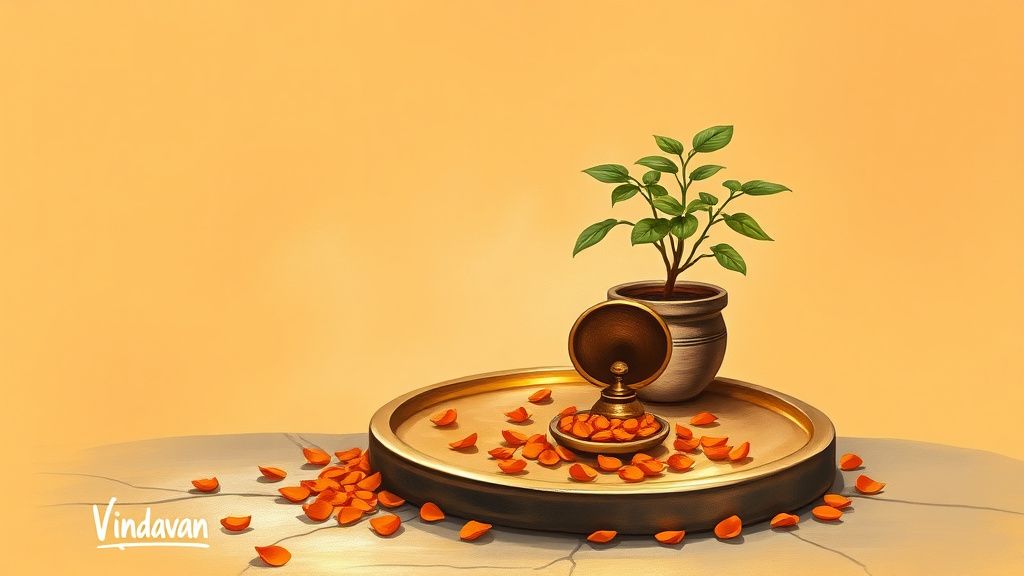
Tulsi Vivah is the ceremonial marriage of the tulsi (holy basil) plant, treated as a form of Lakshmi or as the goddess Vrinda, to Vishnu (or his shaligram-stone form, or to Krishna). The ritual is performed in Hindu households and at Vaishnava temples annually between Prabodhini Ekadashi (the eleventh lunar day of the bright half of Kartik) and Kartik Purnima (the full moon of Kartik), typically falling in October or November. The legend behind the rite is in the Padma Purana and Skanda Purana, telling the story of Vrinda whose tulsi-form was promised to Vishnu after the events involving the demon Jalandhar. The ceremony also marks the start of the post-monsoon Hindu wedding season; many regions consider it inauspicious to hold weddings in Chaturmaas (the four monsoon months), and Tulsi Vivah signals the close of that period.
The legend in the Padma and Skanda Puranas
The Padma Purana (roughly 8th-10th century CE) and the Skanda Purana (compiled over several centuries) tell variations of the same story. The version most commonly used at the Tulsi Vivah ritual runs roughly as follows:
- Vrinda was a pious woman, the wife of the asura king Jalandhar. Her devotion to Vishnu and her chastity gave her husband near-invincibility in battle.
- When the gods could not defeat Jalandhar, Vishnu took the form of Jalandhar himself and approached Vrinda, breaking her chastity unknowingly. This broke the protection she had given Jalandhar, who was then defeated.
- Vrinda, on discovering the deception, cursed Vishnu in two ways: that he would be turned to stone (the shaligram), and that his own wife (Lakshmi) would be separated from him (the Rama-Sita exile in the Ramayana is read as one fulfillment).
- Vrinda then immolated herself; from her ashes grew the tulsi plant. Vishnu, repenting, promised that he would marry Vrinda in her tulsi form, and that the marriage would be re-enacted every year at Prabodhini Ekadashi.
The Tulsi Vivah ceremony is the annual re-enactment of that promised marriage. The story carries layered meanings about devotion, fidelity, divine deception and reconciliation that have been read by commentators in different ways. For what it’s worth, the most accessible reading is that the rite honours tulsi as a sacred presence in the Hindu household, drawing on the Puranic story but extending well beyond it as a household devotional practice.
When the ceremony happens
The window for Tulsi Vivah is the five-day period from Prabodhini Ekadashi (also called Devuthani Ekadashi) to Kartik Purnima. Most households perform the rite on Dwadashi (the twelfth day) or Trayodashi (the thirteenth day), though Ekadashi itself and Purnima are also accepted. The exact date follows the panchang calculation for the Hindu lunisolar calendar; in 2026 the window falls in mid to late November.
The rite is performed at twilight, around or just after sunset. The convention is that Vishnu has just woken from his four-month Chaturmaas sleep on Prabodhini Ekadashi (the name literally means “awakening eleventh”), and the marriage to tulsi follows shortly after his awakening. The lit lamps at twilight are part of the ceremony’s atmosphere.
The ritual sequence at home
For a household Tulsi Vivah the typical sequence is:
- Cleaning and decoration: the tulsi plant and its pot are cleaned. The pot (the tulsi vrindavan) is decorated with rangoli, painted with images, and adorned with flowers. Sugarcane stalks are arranged around the pot to form a small mandap.
- Dressing the bride: a small red or yellow saree (often a child’s saree or a length of cloth) is wrapped around the tulsi plant. Jewellery, a mangalsutra, a small mirror and a bindi-like dot of kumkum are applied to the plant.
- Dressing the groom: the shaligram stone (a black ammonite pebble considered an aniconic form of Vishnu) or a small Krishna idol or an amla branch is bathed, dressed in a yellow dhoti, and placed beside the tulsi.
- Lighting lamps: oil lamps are lit around the mandap, often eleven lamps in a specific arrangement.
- The vivaha rite: the household elder, or a priest if one is engaged, recites short mantras and invokes the marriage. The Mangal Ashtaka (eight auspicious verses) are recited; a cloth is held between the tulsi and the shaligram, then removed.
- The garlanding: a small garland is exchanged between the plant and the shaligram. Rice and turmeric are sprinkled.
- The prasad: a sweet dish (often sheera or panchamrita) is offered and distributed to those present.
The household rite takes 30 to 90 minutes depending on elaboration. Temple Tulsi Vivahs are larger, often with a procession of the deity to the tulsi vrindavan and a fuller wedding-style ceremony.
Regional variations
- Maharashtra: the rite is widely observed, with the Mangal Ashtaka recited by a household priest. Childless couples often sponsor a Tulsi Vivah at a local temple, treated as a meritorious act.
- Gujarat: elaborate temple Tulsi Vivahs are held at Krishna temples, with the deity processed in a palanquin to meet the tulsi. The Pushti Marga tradition has a particularly developed Tulsi Vivah practice.
- Andhra Pradesh and Telangana: the ceremony often uses an amla (gooseberry) branch instead of a shaligram, on Kartik Shukla Dvadashi.
- Karnataka: the rite is observed both at home and at the Madhva-tradition Krishna Math at Udupi.
- Tamil Nadu: Tulsi Vivah is observed in Vaishnava households, with the shaligram and the tulsi pot dressed elaborately; the Iyengar tradition has specific mantra sets.
- Bengal and Odisha: the rite is observed but is less central in Bengali Vaishnava practice; Krishna’s Rasa Lila and Janmashtami carry more household weight.
- North India: widely observed in households of all Vaishnava and Smarta backgrounds; the day after Tulsi Vivah is often when the post-monsoon wedding season formally begins.
Why tulsi specifically
Tulsi (Ocimum sanctum, also called holy basil) holds a special place in Hindu households for several reasons:
- Devotional: tulsi is considered the most beloved offering to Vishnu and Krishna; Vaishnava temple deity worship requires tulsi leaves on the offering plate.
- Medical: the plant has documented antibacterial properties; chewing fresh tulsi leaves was a traditional remedy for cough and respiratory minor complaints. Modern phytochemical research has confirmed mild antiviral and anti-inflammatory effects of tulsi extracts.
- Ecological: tulsi grows easily in household courtyards across most Indian climate zones; the household tulsi pot in the courtyard is a centuries-old fixture.
- Symbolic: the plant’s continuous green presence is read as a daily reminder of Vrinda’s devotion and Lakshmi’s auspicious presence in the home.
Common questions
Can the ceremony be done without a shaligram?
Yes. A small Krishna or Vishnu idol substitutes for the shaligram, as does an amla branch (the convention in Andhra). The shaligram is the orthodox preference in Smarta and many Vaishnava households, but it is a sourced item (the genuine ones come from the Gandaki river in Nepal) and not all households have one. The amla branch is the most common substitute in southern households without a family shaligram.
Why is it considered an auspicious time to begin weddings?
Hindu tradition treats the four monsoon months (Chaturmaas, roughly mid-July to mid-November) as a time when Vishnu sleeps and major auspicious acts (including marriages) are avoided. Prabodhini Ekadashi is when Vishnu wakes; the household and temple wedding season formally begins the following day. Tulsi Vivah is the first wedding-shaped rite of the new season, a kind of consecration of the wedding season itself.
Is sponsoring a Tulsi Vivah a Hindu charitable act?
In traditional practice, yes; sponsoring a Tulsi Vivah is considered equivalent in religious merit to giving the bride away in an actual wedding (Kanyadaan). The convention is particularly strong among childless couples or those without daughters, who treat the sponsored Tulsi Vivah as a religious fulfilment of the Kanyadaan merit. Many Vaishnava temples accept sponsorship donations and conduct the rite on behalf of the sponsor family.
What is done with the tulsi plant after the ceremony?
The tulsi plant continues to grow in the household courtyard; the wedding ornaments and cloth are removed after a few days. The plant is treated with continuing reverence; daily water and a small lamp are common practices. When the plant naturally dies (tulsi is annual or short-lived perennial), the dry stem is treated as sacred and is traditionally buried in a clean place or floated in a river, not thrown in regular household waste.
A limitation worth noting
The legend told here uses the most commonly cited version from the Padma and Skanda Puranas. Variants in the Brahma-vaivarta Purana and in regional bhakti literature differ in the details of Vrinda’s relationship to Jalandhar and Vishnu, and the curse-and-reconciliation sequence reads differently in different texts. The Pushti Marga (Vallabha) tradition has its own elaborated Tulsi Vivah liturgy. For a specific community’s exact format and the variant story, the family priest or the local Vaishnava temple remains the right source.
For wider background see the Wikipedia entries on Tulsi Vivah and tulsi (Ocimum sanctum).
