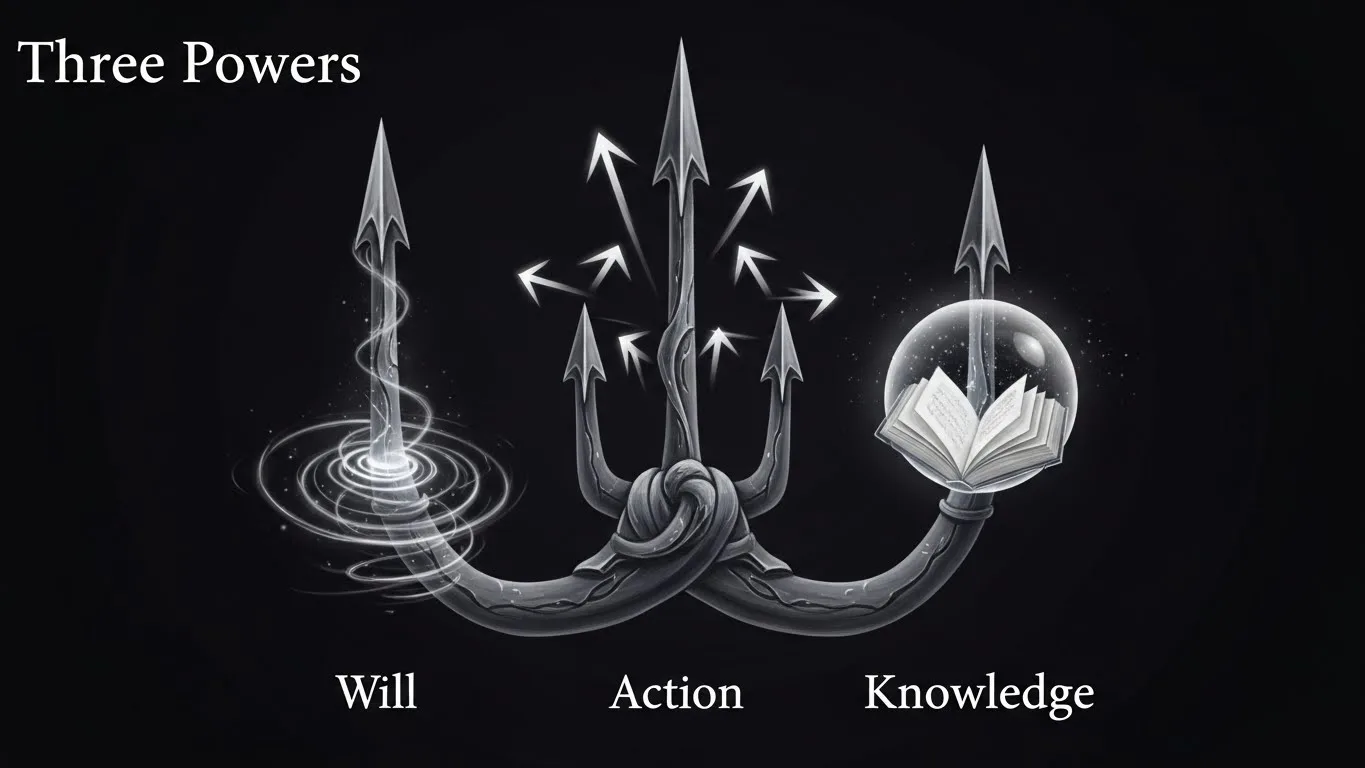
Trishul In Hindu iconography’s pantheon of divine weapons and sacred symbols, Lord Shiva’s Trishul (त्रिशूल) stands as perhaps the most recognizable and philosophically profound implement—a three-pronged trident representing the fundamental triads underlying existence, cosmic authority over creation-preservation-destruction, transcendence of the three gunas (qualities of nature), mastery over the three worlds, and the supreme power to maintain universal equilibrium through both protective compassion and destructive fury.
The Sanskrit term combines “tri” (त्रि) meaning three and “shula” (शूल) meaning spear or sharp pain—literally “three-pronged spear”—though its significance extends infinitely beyond physical weaponry into realms of spiritual philosophy, yogic anatomy, temporal awareness, and metaphysical principles governing manifest reality. According to Vishnu Purana, Vishwakarma—the divine architect and craftsman—forged the Trishul from solar matter shaved from Surya Dev when the Sun God’s excessive heat became unbearable for his wife Sanjana, collecting the removed luminous substance and fashioning it into a blazing three-pronged weapon that he gifted to Lord Shiva, explaining the trident’s solar radiance, unstoppable penetrative power, and association with divine illumination piercing through cosmic darkness.
The Trishul’s three prongs have been interpreted variously as representing the Hindu Trinity itself (Brahma-Vishnu-Shiva), the three fundamental gunas (sattva-rajas-tamas), the three aspects of time (past-present-future), the three worlds (heaven-earth-netherworld), the three states of consciousness (waking-dreaming-deep sleep), and in yogic terms the three primary nadis (Ida-Pingala-Sushumna) converging at the ajna chakra between the eyebrows where duality dissolves into non-dual awareness. Unlike weapons requiring physical contact with enemies, the Trishul operates on multiple simultaneous dimensions—capable of destroying physical demons, piercing through metaphysical ignorance, maintaining cosmic order across three worlds, transmuting negative energies into positive forces, and representing Shiva’s absolute authority as Mahadeva (Great God) who transcends all triadic limitations while simultaneously governing them.
Famous mythological deployments include beheading his own son Ganesha during a misunderstanding, impaling the demon Andhaka for a thousand years until his transformation into a devotee, destroying the three flying cities (Tripura) of demon brothers with a single flaming arrow whose tip was the Trishul, and severing Brahma’s fifth head when the creator deity lied about reaching the top of Shiva’s infinite lingam, demonstrating that divine justice operates beyond familial favoritism, temporal considerations, or hierarchical protections.
Understanding the Trishul reveals fundamental Shaivite theology: that Shiva transcends the very triadic principles his weapon represents, that destruction serves creation through removing obstacles blocking evolutionary transformation, that spiritual authority requires both fierce protection of dharma and compassionate transformation of demons into devotees, and that the ultimate reality operates simultaneously on material, energetic, mental, and transcendent planes requiring integrated rather than compartmentalized approaches.
This comprehensive exploration examines the Trishul’s mythological origins, the multiple symbolic interpretations of its three prongs, famous stories of its deployment, yogic and subtle body connections, spiritual practices involving the trident, and practical teachings for contemporary seekers.
Origin: Forged from Solar Radiance
Vishwakarma and Surya’s Heat
According to the Vishnu Purana, Surya Dev (the Sun God) possessed such intense heat and brilliance that his wife Sanjana (daughter of divine architect Vishwakarma) could no longer bear proximity to him. The solar heat caused her constant discomfort, making marital life unbearable despite their love.
Distressed by his daughter’s suffering, Vishwakarma appealed to Surya to voluntarily reduce his intensity. Understanding the situation’s gravity and desiring his wife’s happiness, Surya agreed to release a portion of his radiant heat for the wellbeing of his family.
Collecting Divine Matter
As Surya released the excess solar energy, Vishwakarma carefully collected this luminous, divine matter—pure concentrated light and heat particles possessing immense destructive and creative potential. This was no ordinary material but the very essence of solar consciousness and power.
Using his unparalleled craftsmanship skills, Vishwakarma forged multiple divine weapons from this solar matter, including:
- Trishul: The three-pronged trident for Lord Shiva
- Sudarshan Chakra: The discus for Lord Vishnu
- Shakti/Vel: The spear for Lord Kartikeya (in some traditions)
Gifting to Shiva
Vishwakarma presented the Trishul to Lord Shiva, recognizing that only the supreme destroyer-transformer could wield such concentrated power appropriately. The weapon’s solar origin explains its blazing appearance in iconography, its ability to illuminate darkness both literal and metaphorical, and its unstoppable penetrative force capable of destroying any obstacle.
Alternative Tradition: Primordial Possession
Some Puranic texts suggest that Shiva always possessed the Trishul as an eternal attribute rather than receiving it from Vishwakarma—representing the timeless nature of divine power that exists before and beyond creation itself, requiring no origin because it IS the origin.
This alternate tradition emphasizes Shiva’s status as the Adi Yogi (first yogi) and Mahakala (beyond time), existing before the universe’s manifestation and continuing after its dissolution, with the Trishul as an inseparable extension of his eternal consciousness.
The Three Prongs: Multiple Symbolic Layers
The Trishul’s distinctive three-pronged structure carries numerous interconnected symbolic meanings, each revealing different aspects of cosmic function and spiritual truth.
1. The Hindu Trinity: Creation-Preservation-Destruction
The most fundamental interpretation is that the three prongs represent the Hindu Trinity (Trimurti):
First Prong – Brahma: Represents creation (srishti)—the origination of all forms, the beginning of cycles, the manifestation of potential into actuality
Second Prong – Vishnu: Represents preservation (sthiti)—the maintenance of cosmic order, the sustaining of dharma, the continuation of existence
Third Prong – Shiva: Represents destruction/transformation (samhara)—the dissolution of forms, the ending of cycles, the transformation enabling renewal
Shiva holding this trident signifies his transcendence over the entire cosmic process—he contains and controls creation, preservation, and destruction simultaneously, standing beyond the triadic division while simultaneously governing it.
2. The Three Gunas: Qualities of Nature
Sattva (First Prong): Purity, harmony, knowledge, enlightenment, balance, clarity—represented by white/light colors, upward movement, and spiritual illumination
Rajas (Second Prong): Activity, passion, desire, movement, ambition, disturbance—represented by red colors, dynamic action, and restless striving
Tamas (Third Prong): Inertia, darkness, ignorance, heaviness, dullness, destruction—represented by black/dark colors, downward movement, and material bondage
Lord Shiva transcending these three gunas demonstrates that ultimate reality (Brahman) exists beyond the qualities defining manifest existence. He wields the Trishul to remind seekers that spiritual liberation requires transcending identification with these ever-changing qualities.
3. The Three Aspects of Time: Trikala
The prongs represent the threefold division of time that structures mortal experience:
Past (Bhuta): First prong represents all experiences, actions, and consequences that have already occurred—our karmic inheritance
Present (Vartamana): Second prong represents the current moment—the only time when action and awareness can manifest
Future (Bhavishya): Third prong represents possibilities, potentials, and consequences yet to unfold—the uncertain realm of becoming
Shiva as Mahakala (Great Time/Beyond Time) holds the Trishul to indicate his mastery over temporal flow. He exists outside linear time while simultaneously governing its cyclical nature, reminding devotees that consciousness transcends temporal limitations.
4. The Three Worlds: Triloka
The three prongs symbolize the three primary realms of existence:
Swarga Loka (Heaven): Upper prong represents celestial realms where devas reside, pleasure dominates, and merit’s fruits are enjoyed
Bhu Loka (Earth): Middle prong represents the mortal realm where karma is created, dharma tested, and spiritual evolution occurs
Patala Loka (Netherworld): Lower prong represents subterranean realms where asuras dwell, darker energies manifest, and karmic consequences unfold
The Trishul’s ability to destroy all three worlds simultaneously demonstrates Shiva’s absolute cosmic authority—no realm exists beyond his jurisdiction, no being escapes his power when cosmic law demands intervention.
5. The Three States of Consciousness
Vedantic philosophy identifies three primary states experienced by consciousness:
Jagrat (Waking): First prong represents ordinary waking consciousness experiencing the external world through senses
Swapna (Dreaming): Second prong represents the dream state where mind creates internal worlds from memories and impressions
Sushupti (Deep Sleep): Third prong represents dreamless deep sleep where individual consciousness temporarily dissolves into undifferentiated awareness
Shiva holding the Trishul represents Turiya—the fourth state beyond these three, pure consciousness witnessing all states without identification with any, the eternal awareness underlying temporary fluctuations.
6. Yogic Interpretation: The Three Primary Nadis
In yogic anatomy, the Trishul represents the three principal energy channels (nadis):
Ida Nadi (Left Prong): The lunar, feminine, cooling channel running along the left side of the sushumna—associated with mental energy, introspection, and receptive consciousness
Pingala Nadi (Right Prong): The solar, masculine, heating channel running along the right side—associated with physical energy, action, and projective consciousness
Sushumna Nadi (Central Prong): The central channel running through the spinal column—the pathway for kundalini awakening and spiritual ascension through the chakras
When Ida and Pingala are balanced and purified, kundalini shakti awakens and rises through the Sushumna, culminating in the sahasrara (crown chakra) where individual consciousness merges with cosmic consciousness—the ultimate yogic realization symbolized by Shiva’s third eye.
Famous Mythological Deployments
The Beheading of Ganesha
Perhaps the most emotionally complex deployment involves Shiva beheading his own son Ganesha during a tragic misunderstanding.
Goddess Parvati created Ganesha from turmeric paste and breathed life into him, instructing him to guard her bathing chamber and allow no one entry. When Shiva returned home, the young Ganesha—not recognizing his father—refused him entry to his own house.
Furious at this obstruction, Shiva commanded his ganas (attendants) to remove the boy, but Ganesha—possessing immense power as Devi’s creation—defeated all of Shiva’s forces. In the escalating confrontation, unable to recognize the divine child’s nature and consumed by rage, Shiva struck Ganesha with his Trishul, severing the boy’s head.
When Parvati discovered her son’s death, her grief and fury threatened universal destruction. To appease her, Shiva sent his ganas to bring the head of the first creature they encountered sleeping with its head facing north. They found a young elephant in that position, brought its head, and Shiva placed it on Ganesha’s body, reviving him and blessing him as Ganapati—lord of ganas, remover of obstacles, first to be worshipped.
This story demonstrates that even divine weapons can cause unintended consequences when wielded in ignorance or rage, that destruction can be transformed into greater blessing through divine grace, and that apparent tragedy often serves higher cosmic purposes.
Impaling Andhaka: Transformation Through Suffering
The demon Andhaka was born from darkness itself when Goddess Parvati playfully covered Shiva’s eyes, temporarily plunging the three worlds into blindness. From the third eye’s mystical sweat emerged Andhaka—a blind demon possessing terrible power.
After performing severe penance and receiving boons, Andhaka grew arrogant and attacked heaven. Most dangerously, he desired to abduct Goddess Parvati, unaware she was his mother. This transgression triggered divine intervention.
In fierce battle, Shiva impaled Andhaka on his Trishul. However, the demon possessed a boon that every drop of his blood touching earth would spawn a thousand identical demons. To prevent this multiplication, Shiva held Andhaka impaled on the Trishul above ground, keeping him suspended for a thousand years while his blood dripped into yoginis’ mouths who consumed it.
During this prolonged impalement, Andhaka’s consciousness gradually transformed. The sustained contact with Shiva’s divine energy, the agony of prolonged suffering, and time for contemplation purified his demonic nature. Eventually, he became a sincere devotee, singing Shiva’s praises. Pleased by this transformation, Shiva granted him liberation and made him one of his gana chiefs.
This story demonstrates the Trishul’s transformative power—capable of destroying demons while simultaneously transmuting their consciousness, using suffering as a purification process rather than mere punishment.
Destroying Tripura: The Three Flying Cities
Three demon brothers—Tarakaksha, Kamalaksha, and Vidyunmali (sons of Tarakasura)—performed severe penance and received boons from Brahma to build three impregnable cities: one of gold in heaven, one of silver in the sky, and one of iron on earth. These Tripura (three cities) could only be destroyed when they aligned once every thousand years, and only by a single arrow.
Protected by this nearly impossible condition, the demon brothers attacked the devas, conquered celestial realms, and spread terror across the three worlds. The gods approached Shiva for help.
When the prophesied alignment occurred, Shiva manifested as Tripurantaka—the destroyer of Tripura. Using the earth as his chariot, Mount Meru as his bow, and Vasuki serpent as his bowstring, he created a special arrow—its shaft was Vishnu, its tip was Agni fire, and its target was guided by the Trishul’s cosmic alignment.
Shiva released the blazing arrow which pierced through all three cities simultaneously, reducing them to ashes and destroying the demon brothers. This act demonstrated that no matter how secure evil becomes through boons and protections, divine justice eventually manifests at the cosmically appointed moment.
Severing Brahma’s Fifth Head
According to Puranic tradition, Brahma originally possessed five heads. Once, competing with Vishnu to prove superiority, they searched for the top and bottom of Shiva’s infinite lingam (cosmic pillar). Vishnu honestly admitted defeat, but Brahma lied, claiming to have reached the top with the help of a Ketaki flower as witness.
Enraged by this falsehood, Shiva manifested as Bhairava and used his Trishul to sever Brahma’s fifth head—the head that had lied. The severed head stuck to Shiva’s hand as Kapala (skull), and he wandered as Bhikshatana (naked beggar) until reaching Varanasi where the skull finally fell.
This story teaches that lying—especially about spiritual realization—invites divine punishment even for creator deities, and that the Trishul represents ultimate truth-enforcement transcending all hierarchical considerations.
Spiritual Significance and Practices
Beyond mythology and symbolism, the Trishul serves as a powerful spiritual tool in Shaivite practices.
Overcoming the Three Afflictions
[In Buddhist-influenced Hindu thought, the three prongs represent overcoming three fundamental afflictions (kleshas)](https://www.facebook.com/Vedism10/posts/meaning-of-trishul-tri-means-threeshul-means-problems-or-sufferingwhen-unified-t/5126439 … [TRUNCATED, (original length: 137 chars)]):
Raga (Attachment): Excessive desire binding consciousness to objects, relationships, and experiences—creating suffering through inevitable loss
Dvesha (Aversion): Hatred, anger, and rejection creating suffering through resistance to unavoidable experiences
Moha (Delusion): Fundamental ignorance about reality’s true nature—the root affliction from which attachment and aversion arise
Meditating on the Trishul helps practitioners recognize and dissolve these three poisons, cultivating equanimity, wisdom, and liberation from reactive patterns.
Dakshina (Right-Handed) Trishul
Most depictions show Shiva holding the Trishul in his right hand—the dakshina (auspicious) side associated with dharmic action, positive energy, and protective power. This placement indicates that divine destruction serves righteous purposes rather than chaotic evil.
The right-hand holding suggests conscious, deliberate, and purposeful application of destructive power aligned with cosmic law rather than random violence.
Meditation and Visualization
Devotees incorporate Trishul visualization in meditation practices:
Physical Trishuls: Placing small Trishul symbols on home altars or wearing Trishul pendants to invoke Shiva’s protection and strength
Visualization: Imagining a blazing Trishul in the third eye (ajna chakra) destroying negative thoughts, karmic obstacles, and egoic limitations
Mantra Practice: Chanting “Om Namah Shivaya” while visualizing the Trishul penetrating through layers of ignorance, illuminating consciousness with divine wisdom
Pranayama: Coordinating breath with Trishul visualization—seeing the three prongs as Ida, Pingala, and Sushumna nadis being purified and balanced
Protection and Blessing
The Trishul serves as a powerful protective symbol—considered capable of:
- Warding off negative energies and evil influences
- Destroying obstacles blocking spiritual and material progress
- Granting courage, strength, and determination
- Maintaining balance amid life’s turbulent circumstances
- Connecting devotees to Shiva’s transformative grace
Frequently Asked Questions
Why does Shiva hold a Trishul?
Shiva holds the Trishul (trident) as a symbol of his supreme cosmic authority and multifaceted power to maintain universal equilibrium. The three prongs represent fundamental triads: the Hindu Trinity (Brahma-Vishnu-Shiva/creation-preservation-destruction), the three gunas (sattva-rajas-tamas), the three aspects of time (past-present-future), the three worlds (heaven-earth-netherworld), and in yogic terms the three primary nadis (Ida-Pingala-Sushumna).
Holding the Trishul demonstrates Shiva’s transcendence over these triadic principles—he contains and controls all divisions while existing beyond them. According to Vishnu Purana, Vishwakarma forged the Trishul from solar matter shaved from Surya Dev’s excessive heat, explaining its blazing appearance and unstoppable power. The Trishul represents both protective compassion and destructive fury serving dharmic purposes.
What is the origin story of Shiva’s Trishul?
According to Vishnu Purana, Surya Dev (Sun God) possessed such intense heat that his wife Sanjana (Vishwakarma’s daughter) could no longer bear proximity to him. Vishwakarma appealed to Surya to voluntarily reduce his intensity for his daughter’s wellbeing. As Surya released excess solar energy, Vishwakarma collected this luminous divine matter and forged multiple weapons including the Trishul for Shiva, the Sudarshan Chakra for Vishnu, and potentially other celestial weapons.
The Trishul’s solar origin explains its blazing appearance, illuminating power, and unstoppable destructive force. An alternative tradition suggests Shiva always possessed the Trishul as an eternal attribute existing before creation, emphasizing his status as Adi Yogi (first yogi) and Mahakala (beyond time) whose power requires no origin because it IS the origin.
What do the three prongs of Trishul symbolize?
The three prongs carry multiple interconnected symbolic meanings: 1) The Hindu Trinity—Brahma (creation), Vishnu (preservation), Shiva (destruction); 2) The three gunas—Sattva (purity/harmony), Rajas (passion/activity), Tamas (inertia/darkness); 3) Three aspects of time—Past, Present, Future; 4) Three worlds—Swarga Loka (heaven), Bhu Loka (earth), Patala Loka (netherworld); 5) Three states of consciousness—Waking, Dreaming, Deep Sleep; 6) Three primary nadis—Ida (lunar/left), Pingala (solar/right), Sushumna (central); 7) Three afflictions to overcome—Raga (attachment), Dvesha (aversion), Moha (delusion). Shiva holding the Trishul signifies his transcendence over all these triadic divisions while simultaneously governing them, representing ultimate reality beyond dualities and multiplicities.
What is the story of Andhaka and Shiva’s Trishul?
Andhaka was a demon born from darkness when Parvati playfully covered Shiva’s eyes, temporarily plunging the universe into blindness. After gaining power through penance, Andhaka grew arrogant and attempted to abduct Goddess Parvati, unaware she was his mother. Shiva impaled Andhaka on his Trishul during battle. However, Andhaka possessed a boon that every blood drop touching earth would spawn a thousand demons.
To prevent multiplication, Shiva held Andhaka suspended on the Trishul above ground for a thousand years while yoginis consumed his dripping blood. During this prolonged impalement, sustained contact with divine energy and suffering gradually transformed Andhaka’s consciousness, purifying his demonic nature. He became a sincere devotee, singing Shiva’s praises. Pleased, Shiva granted liberation and made him a gana chief, demonstrating the Trishul’s transformative power.
How is the Trishul connected to yogic anatomy?
In yogic anatomy, the Trishul represents the three primary nadis (energy channels): Ida nadi (left prong)—the lunar, feminine, cooling channel associated with mental energy and introspection; Pingala nadi (right prong)—the solar, masculine, heating channel associated with physical energy and action; Sushumna nadi (central prong)—the central channel running through the spinal column, the pathway for kundalini awakening. When Ida and Pingala are balanced and purified through pranayama and yoga practices, kundalini shakti awakens and rises through Sushumna, ascending through the chakras from Muladhara (root) to Sahasrara (crown) where individual consciousness merges with cosmic consciousness. This represents the ultimate yogic realization symbolized by Shiva’s third eye—the dissolution of duality into non-dual awareness.
Why did Shiva behead Ganesha with the Trishul?
Parvati created Ganesha from turmeric paste and instructed him to guard her bathing chamber, allowing no entry. When Shiva returned home, the young Ganesha—not recognizing his father—refused him entry. Furious at this obstruction and unable to recognize the divine child’s nature, Shiva’s ganas failed to remove the powerful boy. In escalating confrontation consumed by rage, Shiva struck Ganesha with his Trishul, severing the boy’s head.
When Parvati’s grief threatened universal destruction, Shiva sent ganas to bring the first creature’s head found sleeping with head facing north. They found a young elephant, brought its head, and Shiva placed it on Ganesha, reviving him and blessing him as Ganapati—remover of obstacles. This story demonstrates that even divine weapons can cause unintended consequences when wielded in ignorance or rage, and apparent tragedy often serves higher cosmic purposes.
What is the significance of Tripura destruction?
Three demon brothers (sons of Tarakasura) performed penance and received boons to build three impregnable cities—Tripura (gold in heaven, silver in sky, iron on earth)—that could only be destroyed when aligned once every thousand years by a single arrow. Protected by this condition, they terrorized the three worlds.
When prophesied alignment occurred, Shiva manifested as Tripurantaka (destroyer of Tripura) using earth as chariot, Mount Meru as bow, and Vasuki serpent as bowstring. He created a special arrow—shaft of Vishnu, tip of Agni fire, guided by Trishul’s cosmic alignment—and released it, piercing all three cities simultaneously and reducing them to ashes. This demonstrated that regardless of boons and protections securing evil, divine justice eventually manifests at cosmically appointed moments, and the Trishul represents power to destroy evil across all three worlds simultaneously.
How is the Trishul used in spiritual practices today?
Contemporary Shaivite practices incorporate the Trishul through: 1) Physical symbols—placing small Trishul icons on home altars or wearing pendants invoking Shiva’s protection; 2) Visualization meditation—imagining a blazing Trishul in the third eye (ajna chakra) destroying negative thoughts, karmic obstacles, and egoic limitations; 3) Mantra practice—chanting “Om Namah Shivaya”
while visualizing the Trishul penetrating ignorance layers; 4) Pranayama—coordinating breath with Trishul visualization, seeing three prongs as Ida, Pingala, and Sushumna nadis being purified; 5) Protection rituals—invoking Trishul to ward off negative energies, destroy obstacles, grant courage and strength; 6) Overcoming afflictions—meditating on three prongs as dissolution of Raga (attachment), Dvesha (aversion), and Moha (delusion). The Trishul serves as reminder of transformation, transcendence, and divine protection.
About the Author
Neha Kulkarni – PhD in Vedic Studies and Ancient Indian History
Neha Kulkarni is a distinguished scholar specializing in ancient Indian history, Vedic traditions, and Hindu cultural practices. With over 15 years of research experience focused on decolonizing historical narratives, he has published extensively on Shaivite theology, Hindu iconography, weapon mythology, Puranic literature, yogic anatomy, subtle body systems, symbolic interpretation, and the intersection of material culture with spiritual philosophy. His work bridges academic rigor with devotional accessibility, making complex mythological, philosophical, and yogic concepts understandable to contemporary audiences seeking authentic knowledge about Hindu wisdom traditions and their transformative potential for understanding divine attributes, cosmic principles, and practical spiritual development.
