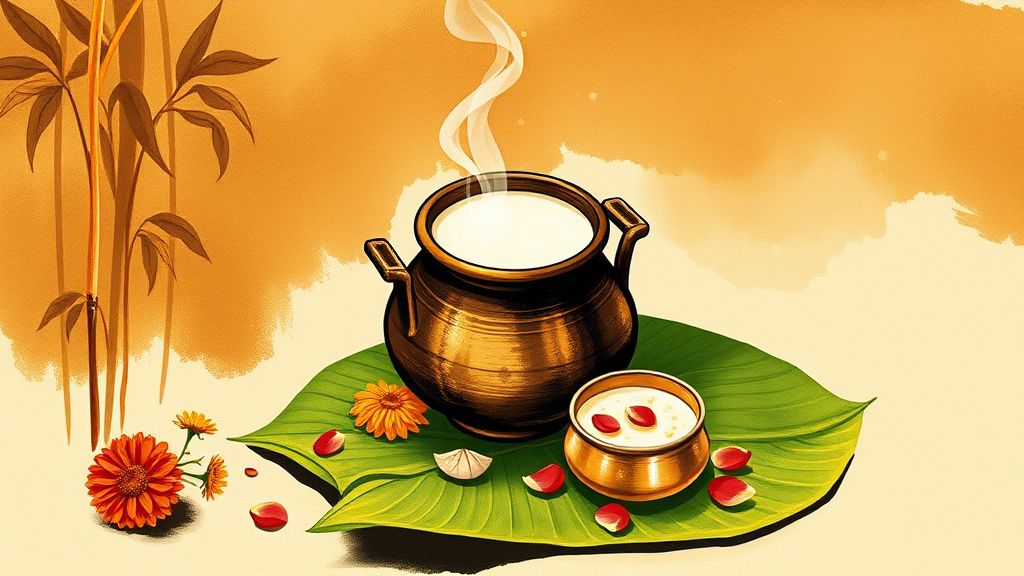
Sakkarai Pongal (also called Chakkara Pongal in Telugu or Chakkara Pongali) is the sweet rice-and-jaggery prasad most associated with the Pongal festival of Tamil Nadu (the four-day harvest festival running 13 to 16 January in 2026). It is also the standard naivedya for Surya, Vishnu and Lakshmi at major Tamil temples through the year. The dish is made with new-harvest raw rice, split moong dal, milk, jaggery, ghee, cardamom, and a few aromatic accents, slow-cooked to a thick, sticky, dense consistency. This article gives the recipe in the temple-style (kovil-style) form, with the regional variations and the practical points that matter.
The temple-style recipe
For a family-size pot serving six to eight, the kovil-style ratio:
- Raw rice: 1 cup (ponni rice, sona masoori, or any short-grain raw rice; the new-harvest rice is preferred for Thai Pongal day itself)
- Split moong dal (pasi paruppu): 1/4 cup
- Milk: 2 cups (full-fat preferred)
- Water: 2 cups (some variations use 3 cups water and 1 cup milk; the rule is 4 cups of liquid total for 1 cup of rice plus 1/4 cup dal)
- Jaggery: 1 cup, grated or chopped finely; the dark country jaggery (karuppatti) gives the most authentic flavour and colour
- Ghee: 3 to 4 tablespoons (more for richer versions)
- Cardamom powder: 1/2 teaspoon
- Cashews: 2 tablespoons
- Raisins (kishmish): 2 tablespoons
- Edible camphor (pacha karpooram): a pinch (one or two small crystals; this is the temple distinguishing aroma)
- Dry ginger powder (sukku): 1/4 teaspoon (used at Srirangam and at most Vaishnava temple Pongal)
- Grated nutmeg: 1/4 teaspoon
- One clove: ground in (occasional addition; the Kanchipuram-Tirupati variant)
The cooking sequence
- Prepare the dal: dry-roast the split moong dal in a heavy pan over low flame until it turns slightly fragrant and pale gold. Do not let it darken. Set aside.
- Cook the rice and dal: wash the rice once. In a heavy-bottomed pot or pressure cooker, combine the rice, roasted dal, milk, and water. Bring to a boil over medium flame. Reduce flame, cover, and let cook. In a pressure cooker, allow 4 to 5 whistles. In an open pot, simmer 25 to 30 minutes. The rice and dal should be soft and mushy, the liquid mostly absorbed but still slightly wet.
- Mash gently: when the rice is cooked, mash it gently with the back of a spoon. The texture should be soft and slightly clumped, not entirely smooth.
- Prepare the jaggery syrup: in a separate pan, add the grated jaggery with 1/2 cup water. Heat over low flame, stirring, until the jaggery dissolves fully. Strain through a fine mesh to remove any impurities (the country jaggery often has small dirt particles); return the strained syrup to a clean pan. Boil briefly until it reaches a slightly sticky one-thread consistency (test by dropping a small amount on a plate; if it forms a soft thread when pulled apart, it is ready).
- Combine: add the strained jaggery syrup to the cooked rice-dal mixture. Stir well over low flame. The colour will deepen to a rich golden-brown. Cook, stirring constantly, for 4 to 5 minutes until the jaggery is fully incorporated and the mixture begins to leave the sides of the pot.
- Add ghee in stages: add one tablespoon of ghee, stir until absorbed, then add the next. The ghee should be added gradually, with the mixture allowed to absorb each portion. By the third or fourth tablespoon, the mixture will become glossy and rich.
- Fry the nuts: in a small separate pan, heat a teaspoon of ghee. Fry the cashews until golden, then add the raisins, frying briefly until they puff. Pour the fried nuts and ghee into the Pongal.
- Add the aromatics: stir in the cardamom powder, dry ginger powder, and grated nutmeg. Finally, add the tiny pinch of edible camphor and stir lightly; the aroma should be fragrant but not overpowering.
- Rest and serve: the Pongal is ready when it has a soft, sticky, slightly clumped consistency that holds its shape but is not too dry. The texture should be like a thick, slightly wet pudding.
Why each ingredient matters
- Raw rice (not parboiled, not basmati): short-grain raw rice (ponni or sona masoori) gives the right starchy mush that holds the jaggery. Parboiled rice does not absorb the jaggery the same way; basmati is too long and aromatic.
- Moong dal: the dal adds protein, texture, and a slight nutty note. Without dal, the dish is just sweet rice; with dal, it has the temple-style body.
- Jaggery (not sugar): jaggery’s deep molasses-like flavour is the dish’s signature. White sugar makes a paler, less complex version. Country jaggery (karuppatti) is the most authentic; standard yellow jaggery is acceptable.
- Ghee (not oil): ghee gives the dish its richness and aroma. Oil-based versions are not classical and miss the dish’s central character.
- Edible camphor: the pinch of pacha karpooram is what makes temple Pongal recognisable. It is sold in small crystal form by Hindu provision stores. The amount is tiny; one or two small crystals (about the size of a peppercorn each) is sufficient for the entire pot. More than this is overpowering.
- Dry ginger and nutmeg: these warm spices balance the sweetness and aid digestion of the jaggery-and-rice mixture, which is otherwise dense.
Common mistakes
- Adding unstrained jaggery: impurities turn the final dish gritty. Strain first.
- Not roasting the dal: dry-roasting removes the raw smell and gives the characteristic nutty depth.
- Too much camphor: a small pinch is sufficient; excess makes the dish medicinal-tasting.
- Cooking on high heat after the jaggery goes in: heat must stay low or the sugar burns. Constant stirring is required.
- Letting the rice dry out: Pongal should be moist when served. Add a few tablespoons of warm milk if the mixture is too dry.
Regional variations
- Srirangam Sri Ranganatha Temple style: uses a higher dal-to-rice ratio (1:3 instead of 1:4), and includes dry ginger powder prominently. The Srirangam Pongal is considered among the finest Vaishnava temple prasadams in India.
- Tirupati Sri Venkateswara Temple style: uses extra cashews and includes one or two cloves, ground. The colour is slightly darker than the standard.
- Madurai Meenakshi Amman Temple style: the Sakkarai Pongal here is offered to the goddess; the recipe uses pacha karpooram more liberally and the texture is firmer.
- Andhra Chakkara Pongali: the Telugu version often adds cow’s ghee (gow ghritham) and a higher proportion of dal; the consistency is slightly more porridge-like.
- Karnataka huggi: the Karnataka version often skips the dry ginger and uses more cardamom.
- Tamil household Bhogi version: made on Day 1 of Pongal in some households, slightly less rich than the Thai Pongal version.
The offering on Pongal day
On Thai Pongal day specifically, the Sakkarai Pongal is offered to Surya at the moment of the first overflow of the pot. The traditional sequence:
- The pot of new rice and milk is allowed to come to a boil; family members watch.
- The moment the milk-rice overflows the pot’s rim, the family calls “Pongal-O-Pongal” three times.
- The jaggery, ghee, cashews, raisins, cardamom and camphor are added.
- A small portion is taken on a fresh banana leaf to the eastern threshold of the house, placed facing the rising sun.
- An arghya (small libation of water with sesame seeds) is offered to Surya.
- The Pongal becomes prasad after the offering and is shared with the family, with neighbours, and with anyone who visits the house through the day.
For what it’s worth, the most defensible single technique improvement that makes home Sakkarai Pongal taste closer to the temple version is the use of strained jaggery rather than direct dissolution. The straining step takes ten minutes and removes the impurities that compromise the texture; this single change probably accounts for more of the difference between household and temple Pongal than any other variable.
Common questions
Can I use white sugar instead of jaggery?
Technically yes, but the result is not Sakkarai Pongal in the traditional sense. The dish’s signature flavour comes from jaggery’s molasses content; sugar produces a paler, less complex version that is sometimes called “Sakkarai Pongal” in restaurant menus but does not match the temple or traditional household form. Use jaggery if at all possible; the country jaggery is best, but standard yellow jaggery is acceptable.
How long does it keep?
Refrigerated, two to three days. The dish can be reheated by adding a tablespoon of milk and warming gently. Frozen, up to two weeks; thaw overnight in the refrigerator before reheating. The freshly-made version on the day itself is the most flavourful; the temple-distributed prasad version is meant to be eaten within hours.
Where do I get edible camphor?
Pacha karpooram (edible camphor) is sold by Hindu provision stores and online by South Indian grocery suppliers. It is sold in small crystals or as a fine powder. Look specifically for “edible camphor” or “pacha karpooram”; the ordinary camphor used for puja flames (made from synthetic camphor) is not the same and should not be eaten. The two have similar appearance but different chemical composition.
A limitation worth noting
Specific temple Sakkarai Pongal recipes (Srirangam, Tirupati, Madurai) are closely held by the temple kitchens; the versions above are reconstructed from publicly available recipes and from comparison with temple prasadam tastings. The exact temple ratios and the specific spice quantities may differ from what is published. Sub-regional Tamil household recipes also vary by community (Brahmin, Chettiar, Vellala, Mudaliar) and by district; the version above is the broad classical Tamil household form. For an overview see the Wikipedia entry on Sweet Pongal and the Tamil Nadu Tourism Development Corporation’s traditional recipes archive at tamilnadutourism.tn.gov.in.