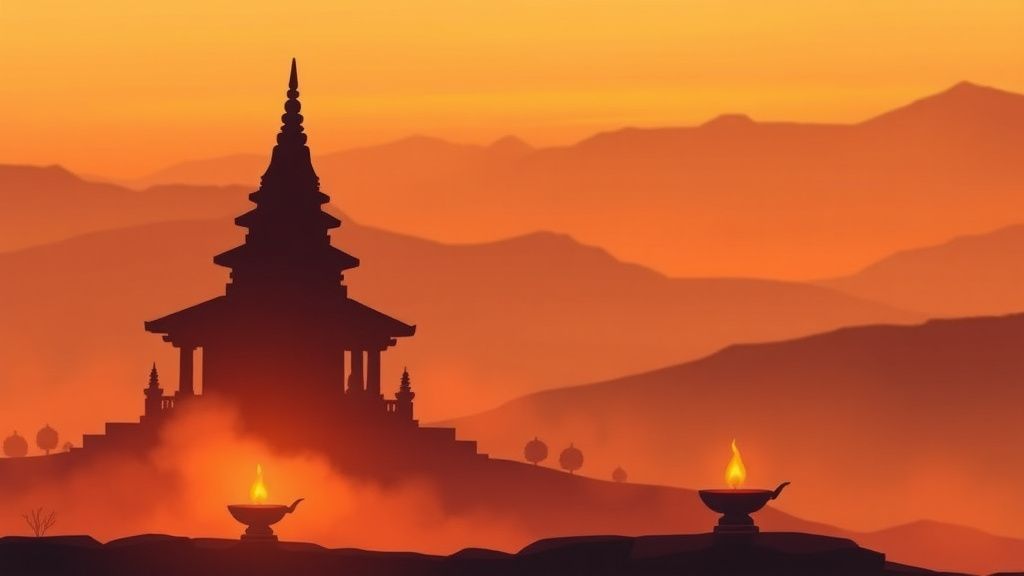
Somnath Temple stands on the Arabian Sea coast at Prabhas Patan, near Veraval in Gir Somnath district of Gujarat. It is the first of the twelve Jyotirlingas in the traditional Dwadasa Jyotirlinga stotra (“Saurashtre Somanatham”). The current structure, in the Maru-Gurjara (Chalukya) style, was completed in May 1951 and inaugurated by President Rajendra Prasad on 11 May 1951, after Sardar Vallabhbhai Patel ordered the reconstruction following Independence. The shrine has a documented history of repeated destruction and rebuilding across roughly 1,000 years, beginning with Mahmud of Ghazni’s 1026 CE raid. The sanctum opens daily at 6:00 AM and stays open through to about 9:30 PM, with one of India’s most-attended evening sound-and-light shows on the temple grounds. This article covers the daily timings, the destruction-and-reconstruction history, the post-1947 rebuild under Sardar Patel, and the Somnath pilgrim circuit.
Daily timings
- Temple opens: 6:00 AM
- Aarti times: 7:00 AM (Mangal aarti), 12:00 noon (Madhyaan aarti), 7:00 PM (Sandhya aarti)
- General darshan: 6:00 AM to 9:30 PM continuously
- Sound and light show: 8:00 PM to 9:00 PM (English commentary on alternate days)
The sandhya aarti at 7:00 PM is the most-attended of the day, performed at the same time the setting sun is visible from the temple terrace over the Arabian Sea. The temple is open seven days a week. Photography is not allowed inside the sanctum but is permitted in the outer precincts.
The destruction and rebuilding cycle
The site has been destroyed at least six times in recorded history and rebuilt each time. The major destructions:
- 1026 CE: Mahmud of Ghazni’s raid; the lingam was broken and treasures (reported at 20 million dinars) were carried off
- 1299 CE: Alauddin Khalji’s general Ulugh Khan during the Khalji conquest of Gujarat
- 1395 CE: Sultan Muzaffar Shah I of Gujarat
- 1413 CE: Ahmed Shah I of Gujarat
- 1665-69 CE: Aurangzeb ordered conversion of the temple into a mosque
Each destruction was followed by rebuilding by a successive Hindu king. Kumarapala of the Chalukya dynasty rebuilt the temple in dressed stone in 1169 CE, replacing an earlier wooden version. The Solankis, Vaghelas, and later the Junagadh state continued the line of repair. The pre-1947 structure was an interim post-Aurangzeb rebuild on a different site nearby.
The 1950 reconstruction under Sardar Patel
Sardar Vallabhbhai Patel, India’s first Deputy Prime Minister and Home Minister, visited Junagadh on 12 November 1947, shortly after the integration of the princely state into the Indian Union. At Veraval he ordered the reconstruction of Somnath. The ruins were cleared in October 1950. Architect Prabhashankar Sompura, of the hereditary Sompura family of temple architects, designed the present structure in the Maru-Gurjara (Chalukya) style. The shikhara is 49 m (160 feet) tall; the temple is in the Kailash Mahameru Prasada plan with a sabhamandap, nritya mandap and garbhagriha. The new structure was completed in May 1951 and inaugurated by President Rajendra Prasad on 11 May 1951. The Shree Somnath Trust, established in 1949, has administered the temple since.
The Somnath pilgrim circuit
The Somnath site is the centre of a small but dense pilgrim cluster on the Saurashtra coast:
- Triveni Sangam: the confluence of Hiran, Kapila, and the mythical Saraswati rivers, 500 m east of the temple
- Bhalka Tirtha: 4 km north-east, the traditional site of Krishna’s departure from earth (the hunter’s arrow at his foot)
- Gita Mandir: at the same spot as Bhalka Tirtha, with the Bhagavad Gita inscribed in stone panels
- Surya Mandir: 1 km from Somnath, an ancient sun temple in poor preservation
- Prabhas Patan museum: ASI museum with sculptures from earlier Somnath phases
- Veraval port: the historic Saurashtra fishing port, 7 km from Somnath
A practical opinion on the visit window
For what it’s worth, plan a Somnath visit around the sandhya aarti at 7:00 PM, followed by the sound-and-light show at 8:00 PM. The temple from the seaward terrace at sunset is the iconic image of Somnath; arriving for an afternoon visit and leaving before sunset misses the principal attraction. October to February is the most comfortable window for a Saurashtra coastal visit; summer (April-June) is hot and humid. Maha Shivaratri (February-March) and Kartik Purnima (November) are the festival surges.
Reaching Somnath
- By rail: Somnath railway station is 1 km from the temple; Veraval Junction is 7 km away on the Ahmedabad-Veraval line.
- By air: Rajkot Airport is the nearest, about 200 km north; flights from Mumbai, Delhi, Bengaluru.
- By road: Ahmedabad is about 400 km north-west; Junagadh is 82 km north; Diu is 90 km south-east.
- From Dwarka: 230 km north-west via NH-51 along the Saurashtra coast.
Common questions
Is darshan free?
Yes, general darshan and the sandhya aarti are free. Special abhishekam, sponsorship of the daily archana, and Mahapooja sevas are paid; the rate-card is published at the Shree Somnath Trust counter and at somnath.org. The sound-and-light show has a separate paid ticket at the on-site counter.
Where to stay?
The Shree Somnath Trust runs a yatri niwas adjacent to the temple. Several private hotels operate within walking distance, including Hotel Somnath Sagar and Mayuram. Veraval (7 km) has additional mid-range options. For Maha Shivaratri and Kartik Purnima, book at least a month in advance.
What is the Sompura family’s role?
The Sompura family of Ahmedabad is a hereditary line of stapathi (temple architects) in the Maru-Gurjara tradition. Prabhashankar Sompura designed the 1951 Somnath reconstruction; his grandson Chandrakant Sompura designed the Ayodhya Ram Mandir. The Sompura tradition continues to apply the classical agama and shilpa shastra rules to modern temple construction across India.
One limitation worth noting
Specific aarti slot times and the sound-and-light show schedule are revised periodically by the Shree Somnath Trust. The timings above are the consistently published windows. Photography rules inside the sanctum are strictly enforced; deposit cameras and mobile phones at the cloakroom near the entrance.
For background see Somnath Temple on Wikipedia and the official Shree Somnath Trust portal.