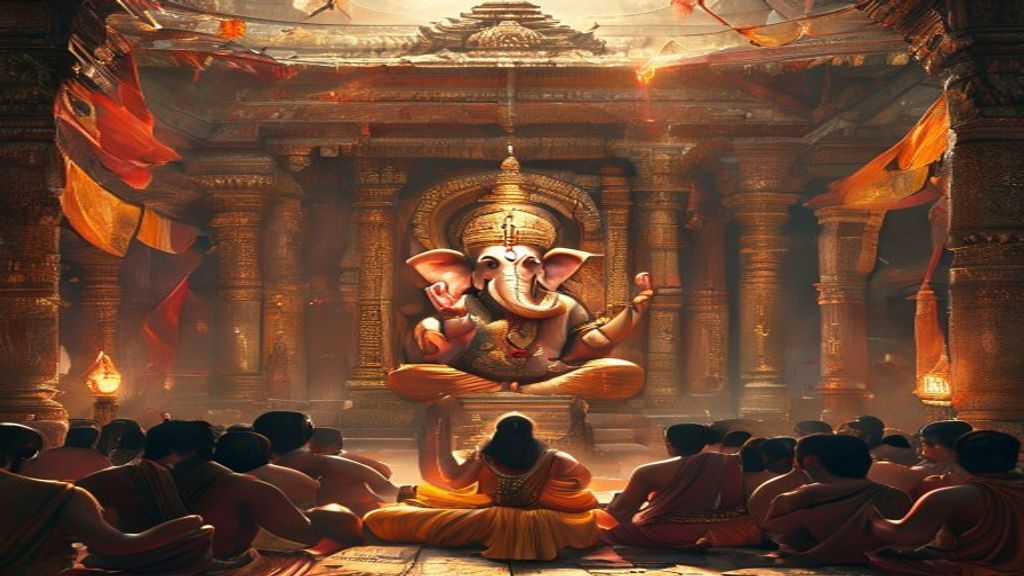
Ganesha worship for obstacles is the revered practice of invoking Bhagavan Ganesha, the Vighnaharta (Remover of Obstacles), at the commencement of any new endeavor or spiritual pursuit. Devotees seek His divine grace to clear impediments, ensure successful completion of tasks, and overcome challenges on both material and spiritual paths, thereby ensuring auspiciousness and prosperity.
| Attribute | Details |
|---|---|
| Deity | Bhagavan Ganesha (Ganapati, Vighneshwara, Vinayaka) |
| Origin | Divine son of Mahadev Shiva and Devi Parvati |
| Key Festivals | Ganesh Chaturthi, Sankashti Chaturthi, Vinayaka Chaturthi |
| Scripture Reference | Ganesha Purana, Mudgala Purana, Shiva Purana, Brahma Vaivarta Purana |
The Primacy of Ganesha: Vighnaharta for Every Seeker
In Sanatan Dharma, Bhagavan Ganesha occupies a unique and exalted position as the Pratham Pujya, the first deity to be worshipped before the commencement of any ritual, ceremony, or new undertaking. This tradition is not merely a custom but a profound spiritual injunction, deeply embedded in our Vedic wisdom. Ganesha, with His benevolent elephant head, embodies wisdom, auspiciousness, and the divine power to remove all obstacles (Vighnaharta). His worship is a spiritual insurance, a powerful invocation ensuring that our paths – whether material pursuits, academic endeavors, business ventures, or spiritual sadhana – are cleared of all hindrances, allowing for smooth progress and ultimate success. He is the guardian of thresholds, ensuring that only the auspicious enters our lives and that our intentions manifest without impediment. For sincere devotees seeking guidance and robust spiritual insight, understanding this ancient practice is paramount for a fulfilling life aligned with Dharma.
Puranic History & The Legend of the Vighnaharta
The origin and eminence of Bhagavan Ganesha as the Vighnaharta are beautifully narrated across various Puranas, illuminating His divine role. The most widely cherished account, found in the Shiva Purana and Brahma Vaivarta Purana, describes Devi Parvati’s creation of Ganesha. Desiring a personal attendant, Parvati fashioned Ganesha from the unguents and dirt from her body, infusing him with life. She appointed him as the guardian of her abode, instructing him to permit no one to enter without her permission. When Bhagavan Shiva Himself sought entry while Parvati was bathing, Ganesha, dutifully upholding his mother’s command, obstructed Him. In the ensuing cosmic confrontation, Shiva, unaware of Ganesha’s identity, severed His head.
Upon learning of the tragedy, Parvati was overcome with grief and fury, threatening to destroy creation. To pacify her, Shiva commanded the Devas to find the head of the first creature facing north. They returned with the head of an elephant, which Shiva then affixed to Ganesha’s body, restoring him to life. Furthermore, Shiva bestowed upon him the boon that he would be worshipped first among all deities, proclaiming him the Ganapati, the chief of His celestial ganas, and the ultimate Vighnaharta – the remover of all obstacles and giver of success. From that moment, Ganesha became the lord of all beginnings, ensuring that no rite or enterprise could succeed without His prior invocation. This fundamental principle ensures the smooth functioning of cosmic order and human endeavors, a truth powerfully resonated across all Sanatan traditions, including the profound teachings available at Hindutva.online.
Another profound narrative highlighting Ganesha’s wisdom and role as a remover of impediments is His role in transcribing the Mahabharata. Sage Vyasa needed a scribe to rapidly record the epic poem. Ganesha agreed, but with the condition that Vyasa would not pause, and Ganesha would transcribe only if he understood the verses. Vyasa, in turn, stipulated that Ganesha must understand before writing. This divine challenge ensured the uninterrupted flow of wisdom, with Ganesha expertly navigating the complex verses, overcoming the immense task through sheer intellect and unwavering focus, thus enabling the birth of one of humanity’s greatest spiritual texts.
Symbolic Architecture: The Iconography of Obstacle Removal
While Ganesha’s primary worship centers on His aniconic or iconic form within temples and homes, His very iconography serves as a profound architectural blueprint of spiritual principles for obstacle removal. Every element of His form is a meticulously crafted symbol, guiding the devotee towards inner strength and clarity, which are essential for navigating life’s challenges.
- Large Head: Symbolizes profound wisdom, vast knowledge, and the ability to think big. To overcome obstacles, one needs sagacity and foresight.
- Large Ears: Indicate a keen ability to listen, absorb, and discriminate between truth and falsehood. A devotee must listen carefully to advice and internal guidance.
- Small Mouth: Represents speaking less, emphasizing the power of silence and thoughtful communication, avoiding unnecessary strife.
- Small Eyes: Signify concentration and focus on the task at hand. Distraction is a major obstacle to progress.
- Single Tusk (Ekadanta): The broken tusk, often used by Ganesha to write the Mahabharata, symbolizes sacrifice, the ability to overcome duality, and the retention of good while discarding the bad. It teaches resilience and self-sacrifice for a greater purpose.
- Four Arms: Represent His divine power and ability to bestow blessings from all directions.
- Pasha (Noose): To gently curb desires and attachments, which are primary obstacles to spiritual growth.
- Ankusha (Goad): To propel the devotee forward on the path of Dharma, much like an elephant is guided. It signifies control and leadership over one’s own mind.
- Modaka (Sweet): Represents the sweetness of spiritual realization and the rewards of devotion, reminding devotees of the ultimate goal.
- Abhaya Mudra (Blessing Hand): Grants protection, fearlessness, and reassurance that He will remove all obstacles.
- Large Belly: Signifies the capacity to digest everything – good and bad – in life, embodying peace and equanimity.
- Mouse (Mooshika): Ganesha’s vehicle, representing controlled desires and the ability to navigate through the smallest crevices, indicating His omnipresence and subtle power to overcome even the most minute obstacles.
Thus, Ganesha’s divine form itself is a sacred architecture of spiritual psychology, instructing us on how to cultivate the inner qualities necessary to dissolve external impediments.
Rituals & Puja Vidhi for Obstacle Removal
Performing Ganesha Puja with sincerity and devotion is a powerful way to invoke His blessings for obstacle removal. While elaborate temple rituals involve specific priests, a simplified, yet potent, home puja can be performed by any devotee. The key is sincere intention (Sankalpa) and reverence.
Preparations:
- Cleanse yourself by taking a bath and wearing clean clothes.
- Select a clean space for the puja, preferably facing East or North.
- Gather Puja Samagri: Ganesha idol/picture, small bell, lamp (ghee/oil), incense sticks, camphor, fresh water in a kalash, spoon, small plates.
- Specific offerings: 21 blades of fresh Durva grass, red flowers (hibiscus is preferred), Modaka or Ladoo (sweet offerings), fruits, sandalwood paste (Chandan), vermillion (Sindoor), Akshat (uncooked rice mixed with turmeric).
Step-by-Step Puja Vidhi:
- Sankalpa: Sit comfortably before the deity. Hold a little water in your right palm and make your intention (Sankalpa) clear – state your name, purpose of the puja (e.g., “for removal of obstacles in my professional life”), and then release the water onto the ground.
- Dhyanam (Meditation): Meditate upon the form of Bhagavan Ganesha.
- Avahanam (Invocation): Invoke Ganesha by chanting “Om Gam Ganapataye Namaha, Avahayami” while offering a flower to the deity.
- Asanam (Seating): Offer a symbolic seat by placing Akshat before the idol.
- Padya & Arghya (Washing Feet & Hands): Offer a spoon of water to symbolically wash His feet and hands.
- Achamanam (Sipping Water): Offer a spoon of water for symbolic sipping.
- Snanam (Bathing): Offer a spoon of water for symbolic bathing.
- Vastram & Yagnopaveetam (Clothing & Sacred Thread): Offer a piece of red cloth or Akshat as symbolic clothing, and a sacred thread if applicable.
- Chandan & Sindoor (Sandalwood Paste & Vermillion): Apply Chandan and Sindoor to the forehead of the idol.
- Pushpam (Flowers): Offer fresh red flowers and especially 21 blades of Durva grass (tied in bunches of 3 or 5) while chanting mantras.
- Dhupam (Incense): Light incense sticks and offer their fragrance to the deity.
- Deepam (Lamp): Light a ghee lamp and offer its light to Ganesha.
- Naivedyam (Food Offering): Offer Modaka, Ladoo, or other fruits/sweets. Place a tulsi leaf on the offering (optional, some traditions omit tulsi for Ganesha).
- Phala Samarpana (Fruit Offering): Offer a fruit.
- Tamboolam (Betel Leaf Offering): Offer a betel leaf with betel nut.
- Karpura Nirajana (Camphor Aarti): Light camphor and perform Aarti, circling it clockwise before the deity.
- Pradakshina (Circumambulation): Stand up and circumambulate the deity three times clockwise, or symbolically turn around yourself.
- Kshama Pranam (Apology & Prostration): Seek forgiveness for any errors in the puja and offer sincere prostrations, expressing your devotion and prayers for obstacle removal.
Powerful Mantras & Chants for Vighnaharta
Chanting Ganesha mantras with devotion amplifies the efficacy of the worship and directly invokes His blessings. These vibrations resonate deeply, clearing mental and spiritual blockages.
- Moola Mantra (Primary Seed Mantra):
ॐ गं गणपतये नमः
Om Gam Ganapataye Namaha
(This is the most fundamental and potent mantra for Ganesha, used for all purposes, especially obstacle removal.)
- Vakratunda Mahakaya Mantra (Dhyana Sloka):
वक्रतुण्ड महाकाय सूर्यकोटि समप्रभ।
निर्विघ्नं कुरु मे देव सर्वकार्येषु सर्वदा॥
Vakratunda Mahakaya Suryakoti Samaprabha |
Nirvighnam Kurume Deva Sarvakaryeshu Sarvada ||
(Meaning: “O Ganesha, of the curved trunk, gigantic body, and the radiance of a million suns, please make all my endeavors free of obstacles, always.”)
- Ganesha Gayatri Mantra:
ॐ एकदंताय विद्महे वक्रतुण्डाय धीमहि तन्नो दंति प्रचोदयात्॥
Om Ekadantaya Vidmahe Vakratundaya Dhimahi Tanno Danti Prachodayat ||
(Meaning: “Om, Let us meditate on the one-tusked Lord, the one with the curved trunk. May that Ganesha enlighten our intellects and inspire us.”)
- Ganesha Ashtottarashata Namavali (108 Names): Chanting the 108 names of Ganesha, each followed by “Namaha,” is highly auspicious and covers various aspects of His divine attributes.
Regular chanting of these mantras, especially during the puja, reinforces one’s connection to Bhagavan Ganesha and strengthens the spiritual shield against all forms of adversity.
Dos and Don’ts in Ganesha Worship
To ensure the sanctity and efficacy of Ganesha worship, certain cultural and spiritual etiquettes must be observed:
Dos:
- Maintain utmost cleanliness and purity, both physically and mentally.
- Offer fresh, red flowers, especially hibiscus, and Durva grass.
- Offer Modaka, Laddoo, or other traditional sweets as Naivedyam.
- Perform puja with sincere devotion (Bhakti) and a clear, positive intention (Sankalpa).
- Always include Ganesha puja before commencing any other major ritual or undertaking.
- Meditate on Ganesha’s form and qualities to internalize His wisdom.
Don’ts:
- Do not offer Tulsi (holy basil) leaves to Ganesha, as per some Puranic accounts, He cursed Tulsi Devi.
- Avoid performing puja in an unclean environment or with an impure mind/body.
- Do not use broken or chipped idols for worship.
- Refrain from egoistic or negative prayers; Ganesha blesses those who seek righteousness.
- Do not turn your back to the deity immediately after Darshan; always step back respectfully.
Why is Ganesha always worshipped first?
As detailed in the Shiva Purana, Bhagavan Shiva Himself granted Ganesha the boon to be the Pratham Pujya, meaning the first to be worshipped. This ensures that any endeavor, spiritual or material, begins under His auspicious guidance, removing all obstacles and ensuring success.
What is the significance of Durva grass and Modaka in Ganesha Puja?
Durva grass (Cynodon dactylon), especially 21 blades, is considered Ganesha’s favorite offering, symbolizing fertility, abundance, and purification. Modaka, a sweet dumpling, represents the sweetness of self-realization and the abundant joy found in Dharma, making it His preferred delicacy.
Can anyone perform Ganesha Puja at home?
Absolutely. Ganesha worship is inclusive. Any sincere devotee, regardless of gender or caste, can perform a simple Ganesha Puja at home. The key elements are faith, clean intention, and adherence to basic rituals and offerings.
What is Sankashti Chaturthi?
Sankashti Chaturthi is a significant fasting day observed monthly on the fourth day (Chaturthi) after the full moon, specifically dedicated to Bhagavan Ganesha. Devotees fast throughout the day and break it after sighting the moon in the evening, praying to Ganesha for the removal of difficulties (Sankashta).
Dharmic Significance: Preserving Sanatan Values Through Ganesha Worship
The practice of Ganesha worship for obstacle removal is far more than a mere ritual; it is a foundational pillar of Sanatan Dharma, preserving and transmitting profound spiritual truths across generations. It teaches us the importance of humility, discipline, and the unwavering faith in a higher cosmic order that governs success and failure. By invoking Ganesha, we acknowledge that true strength lies not just in our efforts, but in aligning our will with the divine. This tradition imbues seekers with a sense of purpose, reminding them that every journey, every aspiration, begins with seeking blessings from the source of all auspiciousness. It reinforces the understanding that obstacles are not insurmountable but can be overcome with divine assistance and righteous conduct. This unwavering faith in the Vighnaharta empowers individuals to face life’s challenges with courage and equanimity, ensuring the continuous flow of Dharma in personal and collective consciousness. This vital understanding is consistently emphasized in the teachings disseminated by Hindutva.online, guiding devotees towards an enriched spiritual life.
