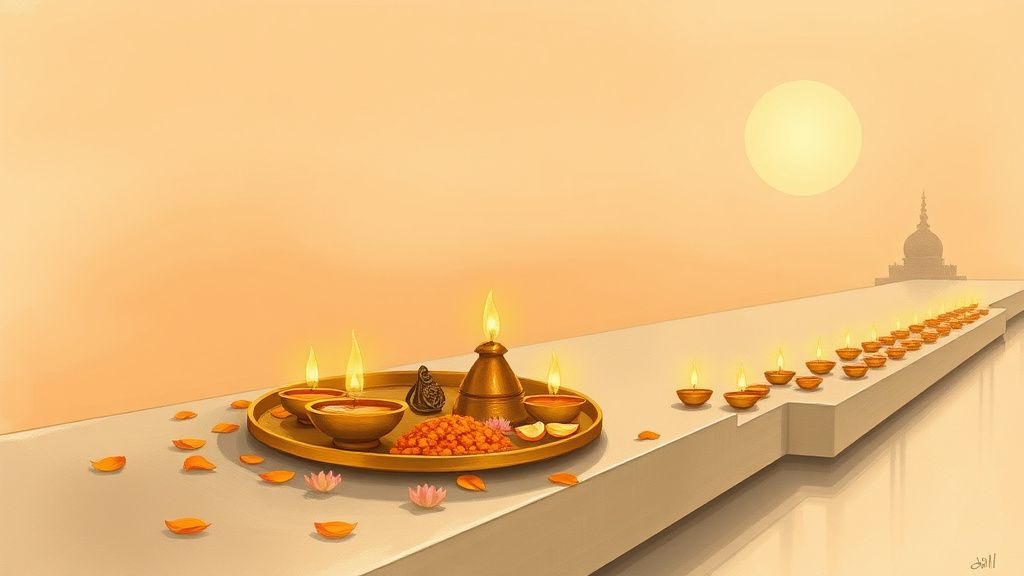
A pooja room in the southwest (Nairutya) corner of the house is the classical avoidance in Vastu Shastra. The southwest is governed by Nirriti and is the heaviest, most stable quadrant of the house; the classical placement of the household shrine is in the northeast, the opposite quadrant. The Manasara, Mayamatam and Vishwakarma Vastu Shastra are uniform in placing the pooja in the northeast and the master bedroom in the southwest. A pooja room in the southwest reverses this elemental allocation and is read as discordant. The standard fix is to relocate the shrine to the northeast; where relocation is impossible, the mitigation route is taken and the southwest shrine is treated as a long-standing dosha.
Why southwest is not the right placement
- Elemental mismatch: the southwest is the heaviest, earth-element quadrant. The shrine is associated with light, water and the rising sun, which are the northeast attributes.
- Nirriti’s reading: Nirriti is the deity associated with decay and decline. The shrine of the household’s chosen deity placed in Nirriti’s quadrant is read as misaligned, since the principal deity is for vitality and Nirriti is for completion.
- Worshipper’s direction: the worshipper sits facing east or north while at the shrine. A southwest-placed shrine puts the worshipper facing northeast or southeast, away from the shrine’s classical alignment.
- Master bedroom conflict: the southwest is reserved for the master bedroom (head of family). A pooja room in the southwest displaces the master bedroom, which is the second related dosha.
When does this come up in practice
The southwest-pooja problem appears in three common situations.
- Apartments built without vastu input: developers in the 1990s and 2000s sometimes placed a small store room or alcove in the southwest, and the household later converted it into a pooja room because of available space. The placement is not deliberate but accidental.
- Inherited homes with a long-standing southwest shrine: a grandparent’s pooja room continues in the southwest because the family does not want to disturb a shrine that has been in use for decades. The classical reading is restrained here: a long-active shrine carries its own settled energy, and the relocation calculation has to weigh tradition.
- Flats where the only available quiet corner is the southwest: in small flats the northeast is sometimes a noisy zone (near the lift, near the kitchen drain), and the southwest is the only quiet corner. The dedicated shrine is placed where the household can actually sit quietly, which sometimes means the southwest.
Mitigation when the southwest shrine stays
- Place the principal deity on the east or north wall of the southwest room. Even in the southwest room, the deity within the room faces west or south (with the worshipper facing east or north). This preserves the worshipper’s east-facing posture even within the wrong-quadrant room.
- Keep the southwest pooja room small and dedicated. A small alcove with one deity, a lamp and a mat is more vastu-compliant than a large pooja room that doubles as a storage space.
- Light the lamp daily. The morning and evening diya at the southwest shrine is the active daily mitigation. An unused southwest shrine reads worse than an actively used one.
- Add a Tulsi plant in the northeast of the house. Even if the shrine is in the southwest, the household maintains a small Tulsi or sacred plant in the northeast to honour the directional convention.
- Avoid heavy storage in the pooja room. The southwest is the heaviness zone, but the pooja room within it should still be kept light and uncluttered.
- Do not place the shrine on a wall that backs onto a bathroom. The bathroom-behind-shrine dosha is independent of and stronger than the southwest dosha.
When relocation is the right call
Relocating a household shrine is a deliberate ritual act and not a casual move. The classical procedure is: choose an auspicious day (a Thursday or a major puja day), perform a brief udvasa ritual where the deity is symbolically requested to move, carefully transport the murti to the new location, install the murti with a fresh abhishekam and a small avahana ritual at the new shrine, and light the new lamp at the new location while extinguishing the old one. The whole procedure takes about two hours and is performed by the household priest or by the senior member of the family. The relocation from a southwest shrine to a northeast shrine is the most common direction shift; the reverse is rare.
What the popular literature overstates
Some popular vastu literature attaches specific bad outcomes to a southwest pooja room (financial loss, family conflict, illness). The classical texts are restrained: the southwest pooja is an elemental misallocation, which the texts read as not the right configuration. The classical texts do not specify outcomes. The extrapolations to specific misfortunes do not have textual support. Households living with a southwest shrine for years should not be alarmed; the dosha is a layout fault to be considered, not a curse to be feared.
A practical opinion on southwest pooja rooms
For what it’s worth, a southwest pooja room is the kind of vastu fault that is worth a one-time effort to fix and then not to worry about. If the household can relocate the shrine to the northeast with a half-day ritual procedure and a wall-mounted cabinet, that is the clean fix. If the relocation is impractical (the only quiet corner is the southwest, the family has long association with the existing shrine), the mitigation route is the realistic path: keep the deity facing west or south, keep the room small and clean, light the lamp daily, plant a Tulsi in the northeast of the house. The active daily practice matters more than the directional optimisation.
Common questions
If my grandparents’ pooja is in the southwest, should I move it?
That depends on the active state of the shrine. A long-active southwest shrine with daily puja by senior family members is treated by most household priests as a settled configuration that does not require relocation. A neglected southwest shrine (no daily worship, dusty murtis, unused for years) is the case where relocation to a fresh northeast shrine with a re-installation ritual is the cleaner option. The decision is made in consultation with the family priest and the senior members of the household.
Is a wall-mounted cabinet in the northeast better than a southwest pooja room?
Yes, the small wall-mounted shrine in the northeast is the cleaner classical configuration than the larger southwest room. A wall-mounted teak cabinet in the northeast wall of the living room, with shutters that close when not in use, holds the principal deity and the daily puja items and reads as classically placed. The smaller dedicated shrine in the right direction outranks the larger shrine in the wrong direction.
Can a southwest-corner shrine be temporarily acceptable during renovation?
Yes. During renovation work the shrine is sometimes temporarily moved to a quiet corner that may be in the southwest of the house. The temporary placement is treated as a transit arrangement and is not subject to the full vastu reading. The household should restore the shrine to its northeast position once the renovation is complete, ideally on a Thursday or a major puja day, with a small re-installation ritual.
One limitation worth noting
These are traditional architectural conventions, not empirically validated rules. The southwest-pooja dosha has clear classical textual basis, but the specific outcomes attached to it in popular literature do not. The defensible reading is that the southwest is the wrong elemental quadrant for the household shrine and that relocation or mitigation is worth considering; the popular reading that southwest poojas cause specific misfortunes is an extrapolation without textual support. Treat the layout fault as worth fixing where practical, not as a curse to be feared.
For background see Vastu shastra on Wikipedia and the entry on Ishana.
