Govardhan Puja, celebrated on the day immediately following Diwali, commemorates one of the most profound episodes in Hindu sacred literature—Lord Krishna’s lifting of Govardhan Hill to protect the people of Vrindavan from the destructive fury of Indra, the king of gods. This festival, also known as Annakut (mountain of food), represents far more than a mythological remembrance. It embodies timeless teachings about humanity’s relationship with nature, the triumph of devotion over ego, and the divine protection available to those who surrender to higher consciousness. In 2025, as ecological challenges intensify globally, the wisdom encoded in Govardhan Puja offers contemporary relevance alongside its profound spiritual significance for practicing Hindus worldwide.
The observance of Govardhan Puja after Diwali continues the five-day festival cycle that begins with Dhanteras, creating a comprehensive celebration that honors wealth, knowledge, light, familial bonds, and ecological consciousness. Understanding the Govardhan Puja story and its multilayered significance connects practitioners to essential dimensions of Hindu dharma while providing frameworks for addressing modern environmental concerns.
The Sacred Narrative: Krishna Lifts Govardhan Hill
The story of Govardhan Puja finds its authoritative source in the Bhagavata Purana (Srimad Bhagavatam), one of Hinduism’s most revered texts, which provides detailed accounts of Lord Krishna’s earthly manifestation. According to this sacred narrative, the people of Vrindavan and Gokul had maintained a long-standing tradition of performing elaborate yajna (fire sacrifices) to honor Indra, believing that the rain god’s blessings were essential for their agricultural prosperity.
Young Krishna, exhibiting divine wisdom in his childhood form, questioned this practice before the assembled villagers. He argued that Mount Govardhan itself deserved their worship and gratitude rather than the distant celestial deity Indra, as the mountain provided them with direct, tangible benefits—grazing lands for their cattle, herbs and medicinal plants, water sources, and the ecological foundation for their entire pastoral economy. The hill sustained their livelihood through its natural resources, making it the true source of their prosperity.
Persuaded by Krishna’s compelling theological and practical arguments, the villagers redirected their worship toward Govardhan Hill, preparing elaborate food offerings and expressing gratitude to the mountain and to nature itself. This revolutionary shift from abstract celestial worship to reverence for the immediate natural environment represented a profound theological innovation within Vedic religious practice.
Indra, observing this abandonment of his worship from the heavens, responded with wounded pride and fury. He commanded the clouds of destruction (Samvartaka clouds) to unleash catastrophic rainfall upon Vrindavan, intending to destroy the people and their cattle as punishment for their perceived disrespect. Torrential rains fell continuously, threatening to drown the entire region and vindicate Indra’s divine authority through destructive power.
The Divine Protection: Krishna’s Miraculous Act
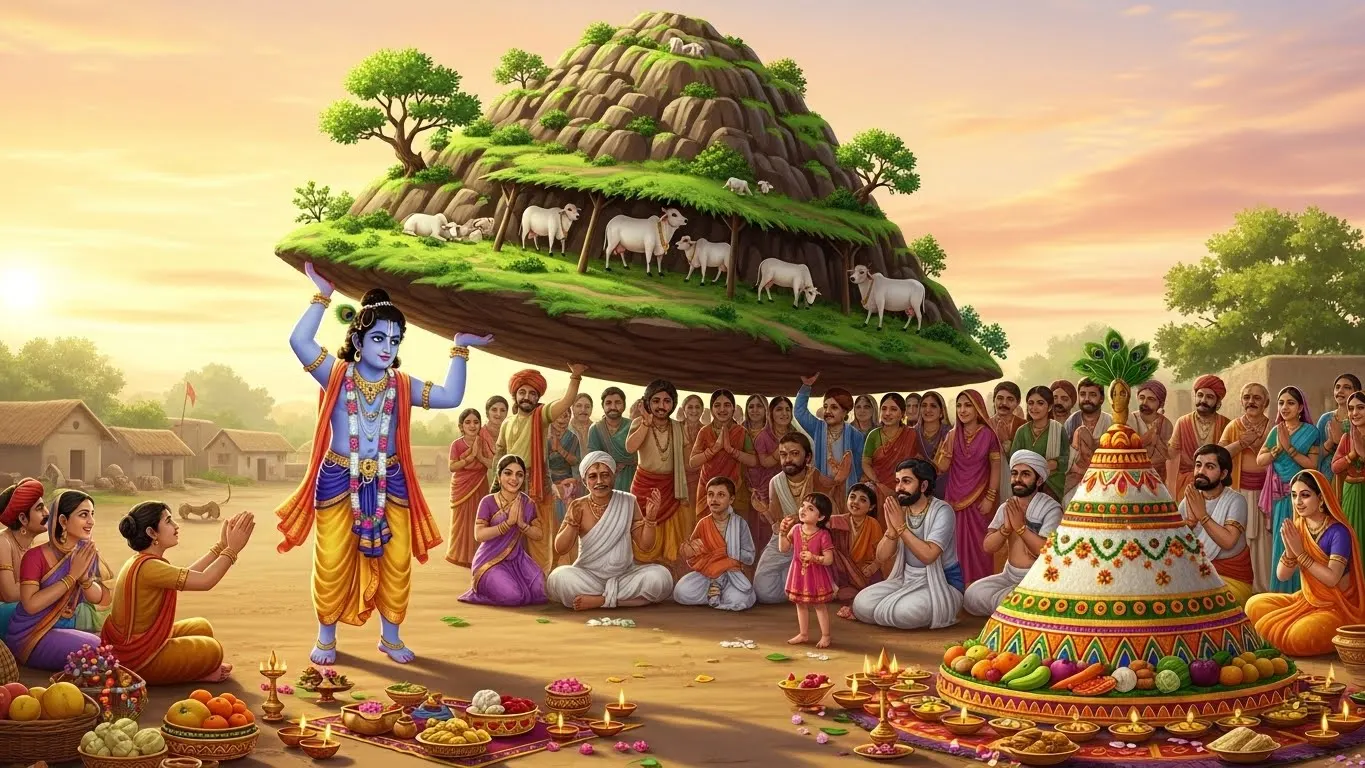
Witnessing the terror of his devotees as floodwaters rose and hurricane winds destroyed their shelters, Krishna revealed his divine nature through an extraordinary act. With his little finger alone, he lifted the massive Govardhan Hill, creating a vast umbrella that sheltered all the people, cattle, and animals of the region from the devastating storm. For seven consecutive days and nights, Krishna held the mountain aloft effortlessly while the assembled community took refuge beneath it.
The image of young Krishna standing with one hand raised, supporting an entire mountain on his fingertip while protecting his devotees, has become one of the most iconic and beloved representations in Hindu iconography. This divine leela (cosmic play) demonstrated several profound theological principles simultaneously—Krishna’s supreme power over natural and supernatural forces, his intimate care for devotees, and the futility of ego-driven authority when confronted with divine consciousness.
After seven days of continuous downpour without achieving his intended destruction, Indra finally recognized the divine nature of the child he had sought to punish. Realizing that Krishna was no ordinary cowherd boy but the Supreme Personality of Godhead himself, Indra descended from the heavens with folded hands, seeking forgiveness for his arrogance and acknowledging his mistake. Krishna, ever compassionate and magnanimous, forgave Indra and imparted wisdom about the true duties of those in positions of power—to serve with humility rather than demand subservience through fear.
This narrative conclusion carries significant philosophical weight, demonstrating that even celestial beings are subject to the corrupting influence of ego and must learn humility before divine consciousness. The story establishes that true authority derives from service and protection rather than from dominance and punishment.
Theological Significance: Nature Worship and Divine Consciousness
The Govardhan Puja story encodes multiple layers of theological and philosophical significance that have sustained scholarly interpretation across centuries. At its most accessible level, the narrative teaches the importance of gratitude toward nature and recognition of humanity’s dependence on ecological systems. By directing worship toward Govardhan Hill rather than a distant deity, Krishna established the principle that divinity manifests directly through natural elements that sustain life.
This theological framework positions Hinduism as inherently ecological in its spiritual orientation. The mountain, cows, trees, water sources, and earth itself are understood not merely as resources to be exploited but as manifestations of divine consciousness deserving reverence and protection. Contemporary Hindu environmental thinkers emphasize that Govardhan Puja provides scriptural foundation for ecological activism and sustainable living practices grounded in traditional dharmic principles.
The concept of “Prakriti Puja” (nature worship) embedded in the Govardhan narrative challenges anthropocentric religious frameworks that position the natural world as separate from or subordinate to human spiritual concerns. Instead, the festival affirms that honoring nature constitutes authentic spiritual practice, equal in merit to temple worship or scriptural study. This principle gains increasing relevance as humanity confronts climate change and ecological degradation in 2025.
The story also illustrates the superiority of devotion (bhakti) over ritualistic practice. While the traditional Indra yajna represented elaborate but ultimately mechanical religious observance, the simple act of offering food to Govardhan Hill with sincere gratitude demonstrated authentic spiritual consciousness. This teaching aligns with broader Hindu philosophical developments, particularly within the Bhakti movement, that emphasized heartfelt devotion over formal ritual orthodoxy.
Additionally, Govardhan Puja demonstrates divine protection for devotees who surrender to Krishna consciousness. The seven days of shelter beneath the mountain symbolize the complete security available to those who take refuge in divine grace, regardless of the threatening forces arrayed against them. This theological assurance has provided immense psychological and spiritual comfort to Hindu practitioners across centuries of historical challenges.
Annakut: The Mountain of Food Offering
The ritual centerpiece of Govardhan Puja is the Annakut offering—a spectacular display of food items prepared and offered to Krishna and Govardhan Hill. The term “Annakut” literally translates as “mountain of food,” referring to the tradition of preparing and arranging 56 different food items (Chappan Bhog) in elaborate displays that replicate the form of a mountain.
The number 56 carries symbolic significance, representing the eight daily meals Krishna traditionally consumed multiplied by the seven days he held up Govardhan Hill—though scholarly interpretations vary on this calculation. Regardless of numerical precision, the Annakut tradition emphasizes abundance, gratitude, and the offering of one’s best culinary creations to the divine.
The 56 Bhog items typically include:
- Various types of grains and breads (rice, wheat preparations, puris, rotis, mathri)
- Multiple vegetable preparations (saag, mixed vegetables, stuffed items)
- Dairy products (milk, yogurt, butter, ghee, paneer dishes, kheer, rabri)
- Sweets (laddoos, pedas, jalebis, rasgullas, ghevar, halwa, malpua)
- Savory items (pakoras, kachoris, tikkis, papad, chutney)
- Fruits (bananas, apples, pomegranates, mangoes, coconuts)
- Dry fruits and nuts (almonds, cashews, pistachios, raisins)
- Beverages (almond milk, coconut water)
- Special preparations (panchamrit, mishri, murabba, shakkarpaara)
Families and temple communities invest considerable effort in preparing this elaborate feast, with women often beginning preparations days in advance. The cooking process itself becomes a devotional activity, with each dish prepared while chanting Krishna’s names and maintaining ritual purity. The resulting display, arranged in mountainous formations and decorated with flowers and leaves, creates a visual and aromatic feast that honors both the deity and the natural abundance that sustains human life.
After the formal puja and arti ceremonies, the food is distributed as prasadam (sanctified offering) to all assembled devotees regardless of caste, economic status, or social position. This democratizing aspect of Annakut reflects the principle that divine grace and natural abundance belong equally to all beings, breaking down hierarchical barriers through the act of communal sharing.
Rituals and Observances of Govardhan Puja
The traditional observance of Govardhan Puja involves several interconnected ritual elements that together create a comprehensive worship experience honoring both Krishna and the natural world.
Creating the Symbolic Govardhan Hill forms the central ritual act. Families gather fresh cow dung, considered pure and auspicious in Hindu tradition, and use it to construct a representation of Govardhan Hill in their homes or courtyards. This mound is decorated with flowers, leaves, grass, and small figures of cows, recreating the pastoral landscape of Krishna’s Vrindavan. Some families use clay, food items, or other natural materials instead of cow dung while maintaining the symbolic intent.
The puja samagri (worship materials) for Govardhan Puja includes earthen diyas (oil lamps), ghee, cotton wicks, Gangajal or pure water for purification, mango leaves, coconut, betel nuts, coins symbolizing prosperity, red cloth, panchamrit (sacred mixture of milk, curd, ghee, honey, and sugar), camphor, incense, flowers, tulsi leaves, turmeric, roli (vermillion), betel leaves, and a bell.
The puja vidhi (worship procedure) typically follows this sequence: After ritual bathing and wearing clean clothes, devotees create the Govardhan Hill representation and place it in the puja area. The area is purified with Gangajal and decorated. A kalash (sacred pot) is established with water, mango leaves, coconut, betel nuts, and coins. Invocation mantras call upon Lord Krishna and Govardhan Hill. The 56-item Annakut feast is arranged around the symbolic mountain. Flowers, tulsi leaves, roli, and turmeric are offered while chanting Krishna mantras and devotional hymns. Elaborate arti is performed with ghee lamps, camphor, and incense. Devotees circumambulate the Govardhan representation clockwise (parikrama). Finally, prasadam is distributed to all participants.
Many families also engage in Dyuta Krida (ritual game-playing) during the evening hours of Govardhan Puja, a tradition that celebrates the playful aspect of Krishna’s nature and creates opportunities for family bonding through friendly competitions and games.
Govardhan Parikrama: The Sacred Circumambulation
One of the most significant expressions of devotion associated with Govardhan Puja is the Govardhan Parikrama—the ritual circumambulation of the actual Govardhan Hill located in the Mathura district of Uttar Pradesh. This sacred hill, approximately 23 kilometers (14 miles) in circumference, attracts hundreds of thousands of pilgrims annually, with numbers surging dramatically during Govardhan Puja and other significant occasions.
The parikrama involves walking the entire distance around the hill in a clockwise direction while maintaining devotional consciousness, typically completed in 5-6 hours by most pilgrims. Devotees walk barefoot regardless of the season, demonstrating physical sacrifice as an expression of spiritual commitment. Throughout the journey, pilgrims chant Krishna’s names, sing devotional bhajans, and stop at numerous shrines and sacred sites that dot the circumambulation path.
The theological understanding holds that Mount Govardhan is a direct manifestation of Krishna himself in the form of stone and earth. Pilgrims seek darshan (sacred viewing) and sparshan (sacred touching) of the mountain throughout their journey, communion with the divine through visual and tactile connection. The very stones and earth of Govardhan Hill are considered deeply sacred, with many devotees collecting small pebbles as blessed objects.
The parikrama path includes several significant locations: Manasi-Ganga Kund (where Krishna is said to have created a sacred pond), the Dan Ghati area, Radha Kund and Shyama Kund (sacred ponds associated with Radha and Krishna), Govinda Kund, Airavat Kund, and the Harideva temple. Each site carries its own mythological associations and receives specific devotional attention from circumambulating pilgrims.
Contemporary practitioners who cannot physically journey to Govardhan Hill perform symbolic parikrama around the cow dung or clay representation in their homes, maintaining spiritual connection with the sacred site through intentional devotion while acknowledging geographical constraints.
Environmental and Ecological Significance
The Govardhan Puja narrative and its associated rituals encode profound ecological wisdom that gains increasing relevance amid contemporary environmental crises. Krishna’s instruction to worship Govardhan Hill rather than a distant deity constitutes a revolutionary reorientation toward environmental consciousness within religious practice.
The story teaches that ecosystems provide the actual foundation for human prosperity, not abstract divine intervention disconnected from natural processes. By honoring the mountain, villagers acknowledged their dependence on soil fertility, water sources, grazing lands, biodiversity, and the complex web of ecological relationships that sustained their pastoral economy. This recognition mirrors contemporary ecological understanding about ecosystem services and humanity’s existential dependence on functioning natural systems.
Several environmental principles emerge from the Govardhan narrative: Recognition that nature deserves reverence and protection rather than merely instrumental exploitation; understanding that local ecosystems require active stewardship and conscious relationship-building; acknowledgment that ecological destruction brings inevitable consequences (Indra’s destructive storm); and affirmation that living in harmony with natural cycles produces sustainable prosperity.
Modern Hindu environmental movements increasingly draw upon Govardhan Puja’s ecological teachings to ground conservation activism in traditional dharmic principles. Many communities now organize tree-planting ceremonies, river and pond cleaning initiatives, wildlife protection efforts, and sustainable agriculture workshops in conjunction with Govardhan Puja celebrations. These activities translate the festival’s spiritual message into practical environmental action appropriate for contemporary ecological challenges.
The emphasis on cow protection within the Govardhan narrative also carries ecological significance. In traditional Indian agriculture, cows provided not merely dairy products but also organic fertilizer, draft power, leather, and fuel (dried dung), functioning as lynchpins in sustainable agricultural systems. Krishna’s protection of both people and cattle under Govardhan Hill recognized this integral relationship between human communities and domesticated animals within functioning agricultural ecosystems.
Govardhan Puja 2025: Date, Muhurat, and Celebrations
For practitioners planning their 2025 Govardhan Puja observances, precise timing calculations ensure maximum spiritual benefit from ritual activities. Govardhan Puja in 2025 falls on Wednesday, October 22nd, occurring one day after Diwali as per the traditional Hindu lunisolar calendar.
The auspicious muhurat timings for Govardhan Puja 2025 are calculated based on the Pratipada Tithi (first lunar day) of Shukla Paksha (bright fortnight) in the month of Kartik. The Pratipada Tithi begins on October 21st at 5:54 PM and ends on October 22nd at 8:16 PM, creating the temporal window for festival observances.
Morning Muhurat: 6:26 AM to 8:42 AM (Duration: 2 hours 16 minutes)
Evening Muhurat: 3:29 PM to 5:44 PM (Duration: 2 hours 16 minutes)
The morning muhurat is considered especially auspicious for performing the primary puja rituals, creating the Govardhan Hill representation, and offering the Annakut. Many temples begin their elaborate celebrations during pre-dawn hours, with continuous arti and darshan opportunities throughout the day. The evening muhurat is traditionally associated with Dyuta Krida (ritual gaming) and family activities that continue the celebratory atmosphere.
Major celebration centers include Mathura and Vrindavan (Krishna’s traditional homeland, where massive crowds gather), Nathdwara in Rajasthan (home to the famous Shrinathji temple), ISKCON temples worldwide (which organize elaborate Annakut celebrations), and Hindu communities globally who maintain these traditions regardless of geographic location.
In 2025, with growing awareness of Hindu festivals’ deeper spiritual and cultural significance, many practitioners are rediscovering Govardhan Puja’s relevance beyond its immediate devotional context, recognizing its environmental message and community-building potential.
Philosophical Dimensions: Ego, Humility, and Divine Grace
Beyond its narrative and ritual dimensions, the Govardhan Puja story carries profound philosophical teachings that address universal human concerns about ego, authority, humility, and the nature of divine consciousness.
Indra’s transformation from arrogance to humility provides the central philosophical arc of the narrative. As king of the gods and controller of essential life-giving rain, Indra had developed an inflated sense of self-importance and entitlement to worship. His violent response to perceived disrespect revealed how ego-consciousness, even in celestial beings, distorts perception and leads to destructive actions.
The seven days of futile storm-making forced Indra to confront his limitations. Despite wielding tremendous natural power, he could not overcome the simple act of a child lifting a mountain through divine grace. This humbling recognition that authority and power ultimately derive from consciousness rather than force represents a crucial philosophical insight applicable far beyond religious contexts.
Krishna’s compassionate forgiveness of Indra, despite the deity’s attempt to destroy innocent people and animals, demonstrates the principle of divine mercy that transcends justice. Rather than punishing Indra for his transgression, Krishna used the situation as a teaching opportunity, imparting wisdom about proper use of authority and the dangers of ego-identification. This response models the spiritual ideal of responding to aggression with enlightened compassion rather than retaliatory violence.
The story also illustrates the philosophical principle that authentic spiritual consciousness manifests through protection and service rather than domination. Krishna’s authority derived not from demanding worship but from providing shelter and security to vulnerable beings. This model of divine kingship and legitimate authority has influenced Hindu political philosophy across centuries, establishing ideals against which temporal rulers are measured.
Contemporary Relevance and Modern Observances
Govardhan Puja continues to hold vital significance for Hindu communities worldwide in 2025, though observances naturally adapt to contemporary circumstances while maintaining traditional essence. Urban practitioners who lack space for elaborate cow-dung hill constructions often create smaller symbolic representations or focus primarily on the Annakut food offering and puja ceremonies.
The festival’s message about environmental stewardship resonates powerfully with younger generations concerned about climate change and ecological degradation. Many Hindu organizations now frame Govardhan Puja as an “ecological awakening” that bridges ancient wisdom and modern conservation imperatives. Educational programs during the festival increasingly emphasize sustainable living, organic farming, water conservation, and biodiversity protection as practical expressions of Govardhan worship.
The communal aspect of Annakut celebrations provides opportunities for strengthening social bonds within Hindu diaspora communities. Temples and cultural organizations host large-scale events where families contribute dishes for the collective offering, creating shared experiences that transmit cultural values to younger generations while building community cohesion. The democratic distribution of prasadam, where everyone regardless of status receives equal portions, enacts principles of social equality and shared abundance.
Digital technologies have also transformed how geographically dispersed practitioners participate in Govardhan Puja. Virtual darshan of major temple celebrations, online puja tutorials, social media sharing of home celebrations, and streaming of devotional music create global participation networks that transcend physical location while maintaining authentic devotional engagement.
Frequently Asked Questions About Govardhan Puja
What is the story behind Govardhan Puja?
Govardhan Puja commemorates Lord Krishna’s lifting of Govardhan Hill to protect the people and cattle of Vrindavan from Indra’s destructive rainstorm. When Krishna convinced villagers to worship the mountain instead of Indra, the offended deity sent torrential rains. Krishna lifted the entire hill on his little finger, providing shelter for seven days until Indra recognized Krishna’s divine nature and sought forgiveness. This story teaches devotion, humility, nature reverence, and divine protection.
Why is Govardhan Puja celebrated after Diwali?
Govardhan Puja occurs on Pratipada, the first day of Shukla Paksha in Kartik month, which falls immediately after Diwali’s main celebration. This timing integrates Govardhan Puja into the five-day Diwali festival cycle, creating a comprehensive celebration sequence: Dhanteras (wealth), Naraka Chaturdashi (victory over evil), Diwali (light and prosperity), Govardhan Puja (nature and devotion), and Bhai Dooj (sibling bonds). Each day addresses different dimensions of dharmic life.
What is Annakut and why is it important?
Annakut, meaning “mountain of food,” refers to the elaborate offering of 56 different food items arranged in mountainous displays during Govardhan Puja. This tradition recreates the feast villagers offered to Govardhan Hill under Krishna’s guidance. The Annakut symbolizes gratitude for nature’s abundance, devotional offering of one’s best efforts, and the principle of sharing divine blessings equally when food is distributed as prasadam. It transforms cooking into devotional practice.
How do I perform Govardhan Puja at home?
Create a symbolic Govardhan Hill using cow dung or clay in your puja area. Gather traditional puja materials (diyas, incense, flowers, tulsi leaves, fruits). Prepare as many food items as feasible, ideally including dairy, grains, vegetables, sweets, and fruits. After ritual bathing, establish a kalash, invoke Krishna and Govardhan through mantras, offer the food items while chanting devotional hymns, perform arti with lamps and incense, circumambulate the representation, and distribute prasadam to family members.
What is the significance of Govardhan Parikrama?
Govardhan Parikrama—circumambulating the actual Govardhan Hill in Mathura district—is considered an extremely meritorious act of devotion. The 23-kilometer barefoot walk around the mountain, which devotees understand as Krishna’s direct manifestation, allows pilgrims to commune with the divine through physical dedication. The journey includes multiple sacred sites and typically takes 5-6 hours. Those unable to travel to Govardhan perform symbolic parikrama around home representations while maintaining devotional consciousness.
What foods are traditionally offered in Annakut?
The traditional 56 Bhog (Chappan Bhog) includes diverse items: various grains and breads (rice, puris, parathas, mathri), multiple vegetable preparations (saag, mixed vegetables, stuffed items), dairy products (milk, yogurt, butter, ghee, kheer, rabri, paneer dishes), sweets (laddoos, pedas, jalebis, rasgullas, halwa, malpua), savory items (pakoras, kachoris), fruits, dry fruits, and special preparations like panchamrit. The emphasis is on variety and quality rather than strict adherence to specific items.
What is the environmental message of Govardhan Puja?
Govardhan Puja teaches that nature deserves reverence as a direct manifestation of divine consciousness. By instructing villagers to worship the mountain that actually sustained their livelihood rather than a distant deity, Krishna established ecological awareness as authentic spiritual practice. The festival emphasizes humanity’s dependence on functioning ecosystems, the importance of environmental stewardship, and the principle that living in harmony with nature produces sustainable prosperity—teachings gaining crucial relevance amid contemporary environmental crises.
When is Govardhan Puja in 2025 and what are the auspicious timings?
Govardhan Puja in 2025 falls on Wednesday, October 22nd. The auspicious morning muhurat is from 6:26 AM to 8:42 AM, ideal for performing the primary puja rituals and offering Annakut. The evening muhurat from 3:29 PM to 5:44 PM is traditionally associated with Dyuta Krida (ritual gaming) and family celebrations. These timings are based on the Pratipada Tithi which begins on October 21st at 5:54 PM and ends on October 22nd at 8:16 PM.
About the Author
Dr. Aryan Mishra – PhD in Vedic Studies and Ancient Indian History
Aditya Chauhan is a distinguished scholar specializing in ancient Indian history, Vedic traditions, and Hindu cultural practices. With over 15 years of research experience focused on decolonizing historical narratives, he has published extensively on temple architecture, Hindu philosophy, and the continuity of Sanatana Dharma traditions. His work bridges academic rigor with accessible presentation, making complex historical and philosophical concepts understandable to contemporary audiences seeking authentic knowledge about Hindu civilization.