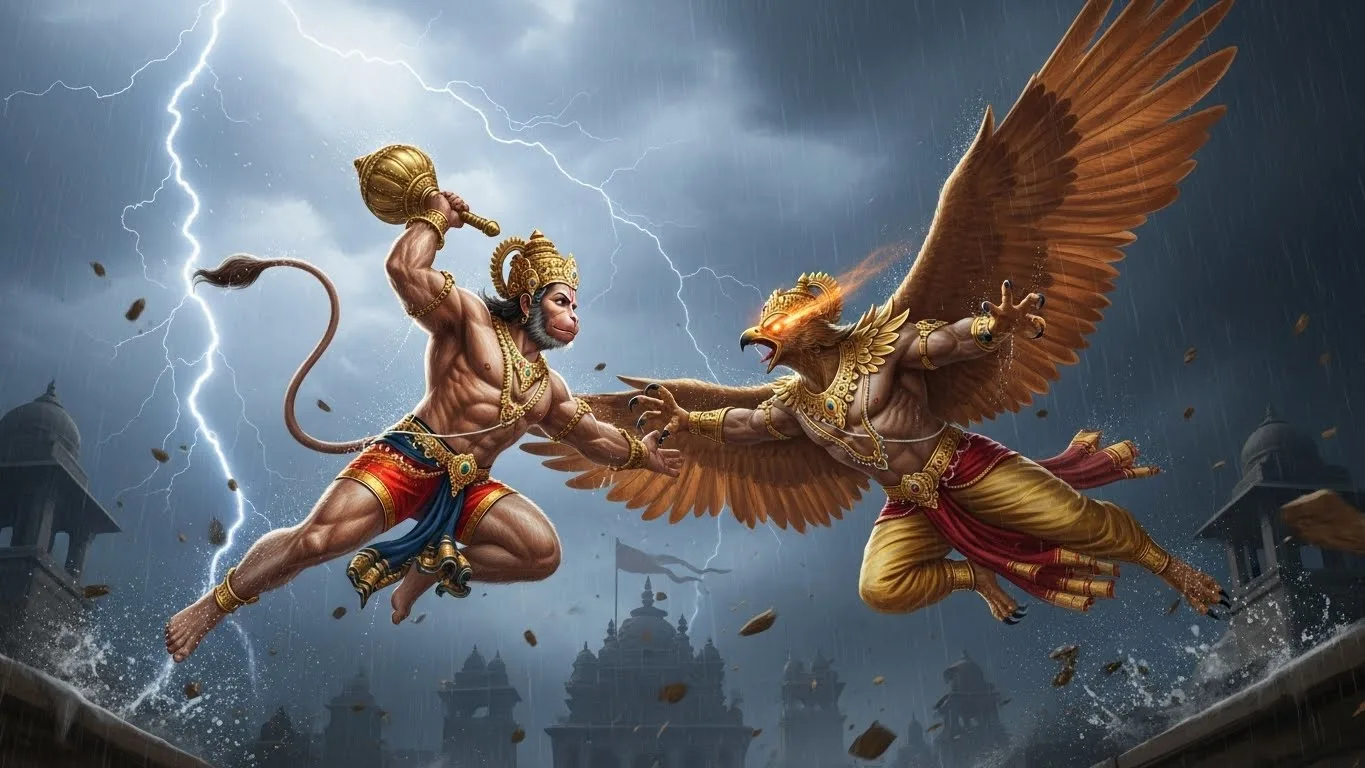
Hanuman vs Garuda In the vast landscape of Hindu mythology, few questions inspire as much debate and fascination as comparing the relative power of two supremely mighty beings—Hanuman, the immortal monkey devotee of Lord Rama, and Garuda, the majestic eagle vehicle of Lord Vishnu. Both represent extraordinary strength, supernatural abilities, and unwavering devotion to divine principles, yet their powers manifest in distinctly different ways serving unique cosmic functions. Hanuman, recognized as one of the seven Chiranjivis (immortals) destined to live through all yugas, embodies devotion (bhakti) as the ultimate source of limitless power, demonstrating that faith and selfless service can overcome any obstacle.
Garuda, born as the king of birds and chosen as Vishnu’s eternal vahana (divine vehicle), represents martial prowess, speed, cosmic authority, and the disciplined application of divine power against evil forces. The question of who is more powerful cannot be answered through simple comparison, as both beings transcend ordinary measurement and serve different aspects of divine will within Hindu cosmology. However, examining their origins, legendary feats, the famous encounter between them, and their distinct qualities reveals profound insights into Hindu philosophical teachings about the nature of true strength—whether it derives from position, physical might, or spiritual devotion.
This comprehensive exploration examines both divine beings’ lineages, their most impressive feats, the story of their direct confrontation, and what this comparison reveals about different manifestations of divine power accessible within Hindu tradition.
Divine Origins: Lineage and Birth Stories
Understanding the power of both Hanuman and Garuda requires recognizing their celestial origins and the circumstances of their births.
Garuda: Son of Kashyapa, King of Birds
Garuda’s lineage traces to sage Kashyapa, one of the Saptarishis (seven great sages), who married Vinata, daughter of Daksha. Vinata’s sister and co-wife Kadru, mother of serpents (nagas), tricked Vinata into becoming her slave through deceit. When Garuda was born from an egg after a thousand years of incubation, he emerged with such radiance and power that even the gods mistook him for Agni, the fire god.
Learning of his mother’s enslavement, Garuda approached the serpents and negotiated her freedom in exchange for bringing them amrita (the nectar of immortality) from the heavens. This mission would demonstrate Garuda’s extraordinary capabilities and establish his cosmic significance.
The Amrita Mission: Garuda flew to the celestial realm where amrita was guarded by the full assembly of gods, elaborate defensive mechanisms, and supernatural protections. He fought and defeated the entire army of gods—including the Adityas, Vasus, Rudras, Sadhyas, and Gandharvas—single-handedly. Even Indra’s thunderbolt Vajra, which had destroyed countless demons, proved ineffective against Garuda’s impenetrable body. He extinguished the protective fire, killed guardian serpents, and seized the amrita without consuming it himself.
Lord Vishnu, impressed by Garuda’s strength and, more importantly, his restraint in not drinking the nectar despite proximity to immortality, offered him any boon. Garuda requested immortality without drinking amrita, freedom from all disease, and the position above Vishnu. Vishnu granted all three, making Garuda his eternal vahana, placing him on his flag, and establishing their inseparable partnership. This origin story established Garuda as possessing god-defeating power, tactical brilliance, and divine favor from the preserving aspect of the cosmic trinity.
Hanuman: Son of Vayu, Avatar of Shiva
Hanuman’s birth involved multiple divine agencies, making him uniquely powerful. His mother Anjana, a celestial apsara cursed to be born as a vanara (monkey), performed intense penance to Lord Shiva for a son. Pleased by her devotion, Shiva promised she would bear a son who was his own avatar.
Simultaneously, King Dasharatha performed the Putrakameshti yajna seeking sons, receiving divine payasam (sacred pudding) to be distributed among his wives. A portion of this pudding, carried by an eagle, was intercepted by Vayu (wind god), who delivered it to Anjana. She consumed it and conceived Hanuman, making him:
- Son of Vayu, inheriting the wind god’s speed and ability to traverse anywhere
- Avatar of Lord Shiva, specifically the eleventh Rudra manifestation
- Recipient of Dasharatha’s divine blessing, connecting him to Rama before birth
- Born with tremendous inherent power as a partial incarnation of divine consciousness
The Sun Incident: As a child, Hanuman saw the rising sun and, thinking it a ripe fruit, flew toward it to eat it. When Indra struck infant Hanuman with his thunderbolt to protect Surya, Hanuman fell to earth with a broken jaw (hence the name Hanuman from “hanu” meaning jaw). Vayu, enraged, withdrew all air from the universe until the gods revived Hanuman and granted him numerous boons:
- Immortality (chiranjivi status)
- Invulnerability to all weapons
- Ability to change form at will
- Unmatched strength that would increase when needed
- Speed exceeding all beings
- Supreme intelligence and wisdom
These divine blessings, combined with his inherent nature as Shiva’s avatar, established Hanuman as uniquely powerful among all beings.
Legendary Feats: Demonstrations of Power
Comparing their most impressive accomplishments reveals both beings’ extraordinary capabilities.
Garuda’s Mighty Achievements
Defeating the Divine Assembly: Garuda’s most celebrated feat remains his single-handed defeat of all gods defending the amrita. This included:
- Overwhelming Indra, king of gods, whose Vajra weapon proved ineffective
- Routing entire battalions of celestial warriors simultaneously
- Navigating past supernatural defenses designed to be impenetrable
- Displaying such speed that gods could not track his movements
- Carrying the amrita vessel without succumbing to its temptation
Freeing Rama and Lakshmana: During the Ramayana war, when Ravana’s son Indrajit used Nagapasha (serpent weapons) to bind Rama and Lakshmana, Garuda appeared and his mere presence caused all serpents to flee, instantly freeing the divine brothers. His natural enmity with serpents—inherited from his mother’s conflict with Kadru—made him the perfect solution to this crisis.
Cosmic Transportation: Garuda regularly carries Vishnu across the universe at speeds transcending normal physical limitations, traversing cosmic distances instantaneously. His ability to bear the weight of the universe’s preserver while maintaining perfect stability demonstrates extraordinary strength.
Destroying Demonic Forces: Throughout Hindu texts, Garuda serves as Vishnu’s warrior, participating in countless battles against asuras, providing aerial superiority, and using his tremendous talons and beak as devastating weapons.
Hanuman’s Supreme Accomplishments
Lifting Dronagiri Mountain: Perhaps Hanuman’s most iconic feat occurred when Lakshmana fell unconscious from Ravana’s son Indrajit’s deadly weapon. The physician Sushena identified Sanjeevani herb from Dronagiri mountain as the only cure, but specified it must arrive before sunrise or Lakshmana would die. When Hanuman reached the mountain but could not identify the specific herb among thousands of species, he made a momentous decision: he would carry the entire mountain.
Using his divine strength, Hanuman lifted the massive Himalayan peak—estimated at thousands of feet tall and immeasurable weight—on his palm and flew hundreds of miles from the Himalayas to Lanka before dawn. This feat demonstrated not merely physical strength but problem-solving intelligence, absolute determination, and devotion-driven power that transcended normal limitations. After Sushena identified and used the herb, Hanuman carried the mountain back to its original location, restoring nature’s balance.
Leaping to Lanka: When Rama’s vanara army reached the southern shore seeking Sita, they needed someone capable of crossing the hundred-yojana (approximately 800 miles) ocean to Lanka. Only Hanuman possessed the necessary capability. Invoking his divine powers and Rama’s name, Hanuman expanded his form to mountainous size and leaped across the vast ocean in a single bound—a feat requiring tremendous strength, aerial mastery, and sustained power.
Burning Lanka: After locating Sita, Hanuman allowed himself to be captured to test Ravana’s forces. When they set his tail on fire, Hanuman expanded it to enormous proportions, broke free, and used the flames to burn significant portions of Lanka’s golden city, demonstrating his indestructibility and tactical intelligence.
Carrying the Entire Mountain Range: Beyond the Sanjeevani incident, various texts describe Hanuman lifting and transporting entire mountain ranges when necessary, treating these geological formations as humans would handle stones.
Swallowing the Sun: In another version of his childhood exploits, Hanuman actually succeeded in swallowing the sun, plunging the worlds into darkness until the gods negotiated its release.
The Sudarshan Chakra Incident: According to some traditions preserved in the Bhagavata Purana, when Hanuman arrived at Dwarka to meet Krishna (Rama’s later avatar), the Sudarshan Chakra attempted to stop him at the gate. Hanuman, not wanting to be delayed when Rama had called him, simply swallowed the divine weapon and continued into the palace. This feat—consuming Vishnu’s most powerful weapon without harm—demonstrates Hanuman’s transcendent nature.
The Epic Encounter: When Hanuman Met Garuda
The most revealing comparison comes from a famous story where Krishna deliberately orchestrated a meeting between Hanuman and Garuda to teach both a profound lesson.
Garuda’s Growing Pride
According to Puranic accounts, Garuda had become increasingly proud of his achievements and position. He had defeated the gods, obtained amrita, become Vishnu’s vahana, and enjoyed unmatched status among all beings. His wife Satyabhama and he both developed arrogance, believing no one could equal Garuda’s power or devotion to Vishnu.
Krishna’s Test
Noticing this pride, Krishna decided to shatter it through a direct demonstration. He summoned Hanuman to Dwarka but instructed him to create chaos in the royal orchards, destroying trees and consuming fruits without permission. When palace guards reported this unruly monkey creating havoc, Garuda volunteered to remove the intruder, confident in his superiority.
The Confrontation
Garuda flew to the orchard and ordered Hanuman to leave immediately and present himself before Krishna. Hanuman, following Krishna’s instructions, casually refused: “Go away, bird! Don’t pick a quarrel with me. Let me eat these delicious fruits in peace.”
Enraged that a mere monkey would dare dismiss him, Garuda attacked. The battle was shockingly brief. Hanuman caught Garuda by the nape with his tail, swung him around effortlessly, and threw him far into the ocean. Garuda, thoroughly humiliated and barely escaping with his life, struggled back to the palace soaking wet, defeated by what he had dismissed as an insignificant creature.
The Divine Lesson
When Garuda complained to Krishna about the monkey’s disrespect, Krishna revealed the truth: “That ‘monkey’ was Hanuman, the greatest devotee of Rama. Tell him Rama calls him, and see what happens.”
Garuda flew to Mount Gandhamadana where Hanuman resided and delivered the message: “Krishna, who is Rama himself, calls you to Dwarka.” Hanuman’s eyes immediately lit with devotion. “If Lord Rama needs me, I will go at once!”
Garuda, still smarting from defeat, raced ahead using his legendary speed, determined to prove his superiority in at least one domain. Yet when he reached Dwarka, Hanuman was already there, seated humbly before Krishna. Devotion had enabled Hanuman to transcend even Garuda’s unmatched velocity.
Krishna then revealed the profound teaching: “Garuda, power needs to be accompanied by humility. Hanuman’s strength comes not from pride in his abilities but from his complete surrender to Rama. True devotion multiplies power infinitely, while arrogance diminishes even the greatest strength.”
Garuda bowed before Hanuman, his pride shattered, learning that spiritual hierarchy transcends physical capabilities or divine appointments.
Panchamukhi Hanuman: Five Faces Including Garuda
An intriguing aspect revealing Hanuman’s transcendent nature is his Panchamukhi (five-faced) form, which includes Garuda as one of his five aspects.
The Origin Story
During Rama’s battle with Ravana’s son Ahiravana, the demon king of Patala (underworld), Ahiravana kidnapped Rama and Lakshmana through trickery. Hanuman pursued them into Patala, where he discovered that Ahiravana’s life force was protected by five lamps burning in five different directions. All five had to be extinguished simultaneously—an impossible task.
To accomplish this, Hanuman assumed the Panchamukhi form, manifesting five heads:
- Hanuman (East/Center): His original monkey face representing devotion and strength
- Narasimha (South): The fierce lion-man avatar representing protection and destruction of evil
- Garuda (West): The eagle face representing freedom and removal of negativity
- Varaha (North): The boar avatar representing stability and overcoming obstacles
- Hayagriva (Skyward): The horse-faced form representing knowledge and wisdom
Using all five faces simultaneously, Hanuman extinguished all five lamps, killed Ahiravana, and rescued Rama and Lakshmana. The fact that Hanuman can manifest Garuda as one aspect of his being suggests a theological hierarchy where Hanuman’s nature encompasses Garuda’s qualities while transcending them.
Comparative Analysis: Different Types of Power
Rather than declaring one definitively “more powerful,” understanding the distinct nature of their respective powers proves more illuminating.
Garuda’s Power: Position and Martial Prowess
Cosmic Authority: Garuda’s power derives significantly from his position as Vishnu’s vahana, granting him:
- Access to divine protection and favor
- Authority to act on Vishnu’s behalf
- Immunity from most weapons and forces
- Recognition and deference from all celestial beings
Physical Supremacy: His natural capabilities include:
- Speed exceeding all other beings in normal circumstances
- Strength sufficient to defeat divine armies
- Impenetrable body resistant to divine weapons
- Mastery of aerial combat and cosmic navigation
Limitations: Despite tremendous power, Garuda operates within the cosmic hierarchy’s structure. His strength, though vast, remains bounded by his nature as a created being serving a specific function.
Hanuman’s Power: Devotion Transcending Limits
Devotion-Based Strength: Hanuman’s power uniquely derives from bhakti (devotion) rather than merely inherent capability:
- His strength increases infinitely when invoking Rama’s name
- Devotion enables him to transcend normal physical laws
- His power has no theoretical upper limit when serving Rama
- He can accomplish what appears impossible through faith alone
Avatar Status: As the eleventh Rudra (manifestation of Shiva), Hanuman represents:
- A direct divine incarnation, not merely a powerful being
- Destruction and transformation principles inherent in his nature
- The ability to manifest multiple forms simultaneously (Panchamukhi)
- Transcendence of the created order that constrains other beings
Immortality: Unlike Garuda whose immortality came through boon, Hanuman’s chiranjivi status means he eternally exists throughout all yugas, making him functionally unlimited by time—a quality even Garuda doesn’t possess in the same absolute sense.
Humility Multiplier: Hanuman’s complete lack of ego means his power faces no self-imposed limitations. He never acts from pride, always from service, allowing divine grace to flow through him without obstruction.
Theological Significance: What This Comparison Teaches
The Hanuman-Garuda comparison offers profound spiritual teachings central to Hindu philosophy.
Devotion vs. Position
The story demonstrates that divine position (Garuda as Vishnu’s vahana) does not automatically confer superiority over pure devotion (Hanuman’s surrender to Rama). Spiritual achievement transcends cosmic appointments.
Humility as True Strength
Garuda’s defeat came not from lack of power but from pride contaminating that power. Hanuman’s humility—never claiming credit, always attributing success to Rama’s grace—actually magnifies his effectiveness infinitely.
Vishnu’s Non-Dual Nature
Both serve the same divine principle—Garuda serves Vishnu directly, Hanuman serves Rama (Vishnu’s avatar). Their apparent competition reveals that God transcends all forms, and different devotees relate to different manifestations without any actual contradiction.
The Power of the Name
Hanuman constantly chants “Rama, Rama,” demonstrating that divine name carries power exceeding even cosmic weapons. This teaching emphasizes bhakti yoga’s efficacy—that devotional practice accessible to anyone can grant capabilities surpassing those requiring divine birth or cosmic position.
Frequently Asked Questions
Who is more powerful, Hanuman or Garuda?
Based on scriptural accounts, Hanuman demonstrates greater power than Garuda. When they fought directly, Hanuman effortlessly defeated Garuda by catching him with his tail and throwing him into the ocean. Hanuman’s power derives from devotion to Rama, which multiplies his strength infinitely when needed, while Garuda’s considerable might comes from his position as Vishnu’s vahana and his inherent abilities. Hanuman is also the eleventh Rudra (Shiva’s avatar) and one of the seven immortal Chiranjivis, giving him transcendent status. The theological teaching emphasizes that devotion-based power (bhakti) transcends position-based authority.
What happened when Hanuman fought Garuda?
Krishna orchestrated their encounter to humble Garuda’s growing pride. He instructed Hanuman to destroy the royal orchards at Dwarka, then sent Garuda to remove the intruder. When Garuda arrogantly ordered Hanuman to leave, Hanuman refused. Garuda attacked, but Hanuman caught him by the nape with his tail, swung him around effortlessly, and threw him far into the ocean. Garuda barely escaped, returning to Krishna soaked and humiliated. Krishna then revealed Hanuman’s identity and taught Garuda that “power needs to be accompanied by humility”—that devotion multiplies strength while arrogance diminishes even the greatest capabilities.
Is Hanuman an avatar of Shiva or Vishnu?
Hanuman is primarily recognized as the eleventh Rudra, an avatar of Lord Shiva, according to texts like the Shiva Purana, Skanda Purana, and Mahabhagavata Purana. However, his birth involved Vayu (wind god) and divine pudding from Dasharatha’s yajna intended for Rama’s birth, creating complex connections. More significantly, Hanuman embodies perfect devotion to Rama (Vishnu’s avatar), making him functionally serve Vishnu’s purposes while being Shiva’s manifestation. This dual nature exemplifies Hindu theology’s non-dualistic principle that Shiva and Vishnu represent the same ultimate reality, and their apparent separation dissolves at the highest spiritual level.
Why does Panchamukhi Hanuman have Garuda’s face?
Panchamukhi (five-faced) Hanuman includes Garuda as his western face, manifested when rescuing Rama and Lakshmana from Ahiravana in Patala. Ahiravana’s life force was protected by five lamps burning in five directions that had to be extinguished simultaneously. Hanuman assumed five heads—his own (center), Narasimha (south), Garuda (west), Varaha (north), and Hayagriva (skyward)—to accomplish this impossible task. The inclusion of Garuda as one aspect of Hanuman’s being suggests theological hierarchy where Hanuman’s comprehensive nature encompasses Garuda’s qualities while transcending them, demonstrating his supremacy.
What are Garuda’s greatest feats?
Garuda’s most impressive accomplishments include: defeating the entire assembly of gods single-handedly when retrieving amrita (nectar of immortality), with even Indra’s thunderbolt Vajra proving ineffective against him; obtaining amrita from the heavily guarded celestial realm without consuming it despite proximity to immortality; freeing his mother Vinata from serpent slavery; becoming Vishnu’s eternal vahana after impressing the Lord with his strength and restraint; instantly freeing Rama and Lakshmana from Nagapasha (serpent weapons) through his mere presence during the Ramayana war; and transporting Vishnu across cosmic distances at speeds transcending physical limitations.
What are Hanuman’s greatest feats?
Hanuman’s supreme accomplishments include: lifting the entire Dronagiri mountain (thousands of feet tall) and flying it from the Himalayas to Lanka to save Lakshmana’s life; leaping approximately 800 miles across the ocean to Lanka in a single bound; burning significant portions of Ravana’s golden capital after allowing capture; swallowing the Sudarshan Chakra (Vishnu’s supreme weapon) when it attempted to stop him; defeating Garuda effortlessly in direct combat; being granted immortality (chiranjivi status) ensuring his eternal existence; possessing the ability to assume Panchamukhi form manifesting five divine aspects simultaneously; and demonstrating infinite strength that increases whenever needed for Rama’s service.
Why is Hanuman immortal but Garuda is not?
Hanuman received immortality (chiranjivi status) from the gods after Indra struck infant Hanuman with his thunderbolt for attempting to swallow the sun. When Vayu (Hanuman’s father) withdrew all air from the universe in grief, the gods revived Hanuman and granted numerous boons including eternal life. His chiranjivi status means he exists throughout all yugas (cosmic ages) eternally. While Garuda obtained immortality without drinking amrita and freedom from disease through Vishnu’s boon, his immortality differs from Hanuman’s absolute chiranjivi nature. Additionally, as Shiva’s eleventh Rudra avatar, Hanuman possesses inherent divine immortality transcending boon-granted longevity.
What does the Hanuman vs Garuda story teach spiritually?
The comparison teaches profound spiritual lessons: devotion (bhakti) transcends cosmic position and inherent power; humility multiplies strength while arrogance diminishes even the greatest capabilities; divine grace flowing through selfless service exceeds power obtained through status or achievement; the name of God (“Rama, Rama”) carries force surpassing cosmic weapons; spiritual achievement measured by surrender and service supersedes martial prowess; pride contaminates power making it ineffective; and Vishnu/Rama’s non-dual nature means serving any true manifestation ultimately serves the same divine reality. The story emphasizes that accessible devotional practice grants capabilities surpassing those requiring divine birth.
About the Author
Sunita Reddy – PhD in Vedic Studies and Ancient Indian History
Sunita Reddy is a distinguished scholar specializing in ancient Indian history, Vedic traditions, and Hindu cultural practices. With over 15 years of research experience focused on decolonizing historical narratives, he has published extensively on Hindu mythology, comparative deity studies, bhakti traditions, Puranic literature, and the philosophical teachings encoded in epic narratives. His work bridges academic rigor with accessible presentation, making complex theological, mythological, and spiritual concepts understandable to contemporary audiences seeking authentic knowledge about Hindu wisdom traditions and their transformative teachings.