Rama and Krishna are the seventh and eighth avatars of Vishnu in the standard Dashavatar list. They are both reckoned as Purna avatars (full avatars, in whom the divine principle is fully present) in the Bhagavata Purana 1.3, distinguishing them from the partial avatars in the same list. They appear in different yugas (Rama in the Treta Yuga, Krishna at the end of the Dwapara Yuga), come from different family contexts (a royal palace at Ayodhya, a cowherd household at Vrindavan that turns out to be the displaced royalty of Mathura), use different dharma strategies (Rama works by rule-following, Krishna by rule-bending), and offer different teachings (Rama’s life is the teaching, Krishna’s Bhagavad Gita is). This article compares the two across the principal axes, drawing on the Valmiki Ramayana and the Bhagavata Purana Canto 10.
Yuga and historical placement
Rama is placed in the Treta Yuga, the second of the four cosmic ages, when dharma stood on three of its four legs (the traditional metaphor for cosmic order’s gradual decline). Krishna is placed at the end of the Dwapara Yuga and his death marks the transition to the Kali Yuga, in which dharma stands on one leg. By traditional reckoning Krishna’s death is dated to 3102 BCE, the start of the Kali Yuga in the Surya Siddhanta. Rama’s date is much earlier; traditional accounts place it many thousands of years before, with no single agreed numerical date.
Family context
Rama is the eldest son of Dasharatha, king of Ayodhya, and Kaushalya. He is the heir-apparent throughout his early life and is trained as a kshatriya prince in arms, in rule, and in Vedic learning. He has three brothers: Bharata (son of Kaikeyi), Lakshmana and Shatrughna (the twin sons of Sumitra). His marriage to Sita is arranged through the swayamvara at the court of Janaka of Mithila, where Rama strings (and breaks) the bow of Shiva. He has one wife throughout his life.
Krishna is the eighth and last son of Vasudeva and Devaki. His maternal uncle Kamsa, who had killed Krishna’s six elder brothers in infancy because of a prophecy that one of them would kill him, attempts to kill Krishna too; the infant is smuggled out of the prison and raised at Vrindavan by Nanda and Yashoda, foster parents and cowherds. Krishna’s early life is in the cowherd village; his royal lineage is recovered only when he and Balarama return to Mathura and kill Kamsa. He has eight principal queens at Dwarka (the Ashtabharya) and 16,100 other wives freed from Narakasura’s prison.
Approach to dharma
Rama works within rules. The Ramayana’s principal teaching is the upholding of rules even at the cost of personal happiness. He goes into exile because his father gave a promise to his stepmother; he does not contest the promise. He fights Ravana through a formally declared war. He sends Sita away from Ayodhya not because he doubts her but because his subjects do, and a king must rule by his subjects’ confidence. Rama is the canonical maryada-purushottama (the model man of rules).
Krishna works around rules when rules and dharma are not aligned. The Mahabharata is full of episodes where Krishna’s intervention is technically irregular: Drona is killed because Krishna instructs Yudhishthira to lie about Ashwatthama’s death; Karna is killed by Arjuna while reloading his chariot wheel, on Krishna’s instruction; Duryodhana is struck on the thigh, below the legitimate target zone, again on Krishna’s instruction. Each of these violates a specific war-rule. Krishna’s argument is that strict observance of the war-rules would have led to dharma’s defeat; the rules are subordinate to the larger purpose. Krishna is the canonical lila-purushottama (the model man of play).
For what it’s worth, the most useful way to hold the two avatars together is the one Vaishnava commentary takes: Rama and Krishna are the same divine principle answering different cosmic conditions. In Treta Yuga, when dharma is mostly intact and the work is to defend specific transgressions (Ravana’s abduction of Sita), the rule-following approach is correct. In Dwapara, when dharma has weakened further and the structural integrity of the kshatriya class is itself compromised, the rules of the system are part of the problem and the avatar has to work around them. Different yugas call for different methods. The same divinity uses both.
Teaching
Rama does not give a teaching text. The Ramayana is a record of his life and the teaching is the life itself. The closest Rama comes to a verbal teaching is the various advice he gives to Lakshmana, to Bharata, to Sugriva, to Vibhishana at specific moments; these are scattered through the text and form no continuous doctrine. The Yoga Vasishtha, a 10th-century work attributed to the sage Vasishtha, presents itself as the philosophical teaching Vasishtha gave to the young Rama, but the text is later than the Valmiki Ramayana and is not part of Rama’s own discourse.
Krishna gives a continuous teaching text. The Bhagavad Gita (the Song of the Lord), 700 verses across 18 chapters embedded in the Bhishma Parva of the Mahabharata (Chapters 25-42), is Krishna’s direct teaching to Arjuna at the start of the Kurukshetra war. The Gita systematises the relationships between karma yoga (the path of action), jnana yoga (the path of knowledge), and bhakti yoga (the path of devotion), and it is the most cited single text in Hindu philosophical and devotional literature. Krishna also gives the Uddhava Gita (Bhagavata Purana 11.6-29), a more elaborated teaching to his cousin Uddhava near the end of his life.
Iconography
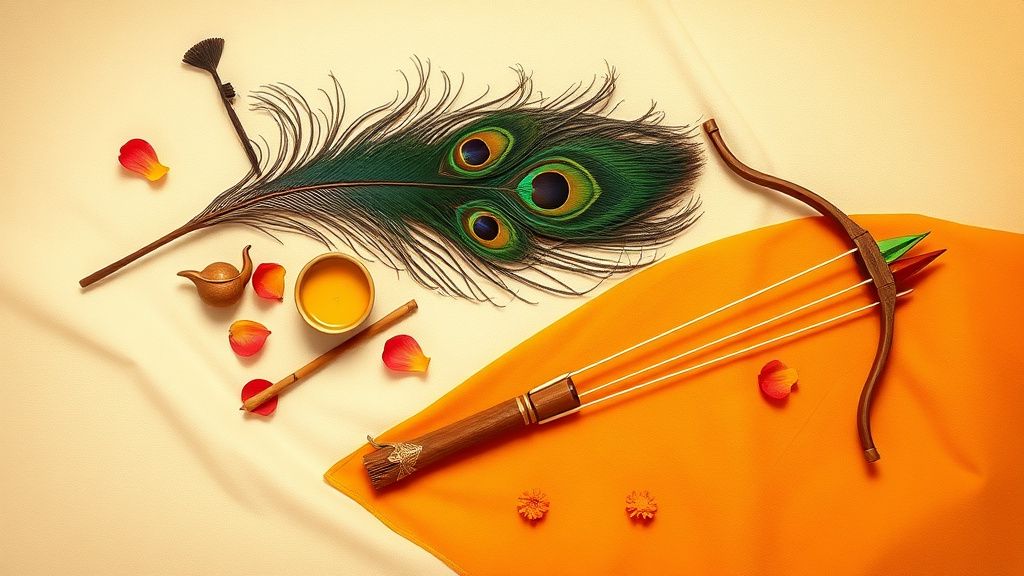
Rama is depicted as a young man holding the bow and arrow, standing with Sita on his left and Lakshmana on his right. Hanuman is shown at his feet or to one side. The colour of his skin is described as syama (dark blue or dark green) in the Valmiki Ramayana. The standard composition is the Rama Pattabhishekam (the coronation scene) which is the closing image of the Ramayana’s Yuddha Kanda.
Krishna is depicted in many forms across his life-stages: the infant on a swing, the butter-thief, the cowherd boy with the flute, the lover of Radha, the charioteer of Arjuna, the king of Dwarka, the speaker of the Gita. The flute and the peacock feather are the most distinctive Krishna iconographic markers. His colour is also described as syama. The Vrindavan-form (flute, cowherd) and the Kurukshetra-form (charioteer, royal) are usually distinguished in temple iconography.
Death and departure
Rama’s departure (in the Uttara Kanda) is ceremonial. He prepares his sons (Lava and Kusha) for the succession, addresses his subjects in court, walks into the river Sarayu, and is absorbed back into Vishnu. The Mahaprasthana is a planned departure of a fulfilled life. Krishna’s death (in the Mausala Parva of the Mahabharata) is by accident. After the Yadava clan destroys itself in an internal brawl at Prabhasa, Krishna sits under a tree in meditation; the hunter Jara mistakes his foot for a deer and shoots an arrow. Krishna accepts the wound, blesses Jara (identified as Vali of the Ramayana returning to balance the karmic exchange), and ascends.
Devotion to each
Both avatars have large devotional traditions, but they have different shapes:
- Rama bhakti: centred on Tulsidas’s Ramcharitmanas (16th-century Awadhi), on the daily Sundara Kanda parayana, on the Hanuman Chalisa, and on the festival of Ram Navami. The mode is generally dasya (the devotee as servant) modelled on Hanuman’s relationship to Rama.
- Krishna bhakti: centred on the Bhagavata Purana Canto 10, on the Gita Govinda of Jayadeva, on the works of the six Goswamis at Vrindavan (16th century), on the Chaitanya tradition in Bengal, on Vallabha’s Pushtimarg in Gujarat. The mode is generally madhurya (the devotee as gopi-lover) but includes sakhya (friendship, modelled on Arjuna) and vatsalya (parental, modelled on Yashoda).
Common questions
Which avatar is more important?
The Bhagavata Purana 1.3.23 places Krishna as svayam bhagavan (the Lord himself), with the implication that Krishna is the source of which Rama and the other avatars are partial manifestations. The Rama-centric traditions (north Indian bhakti following Tulsidas) hold Rama in the same supreme position. Most Vaishnava traditions hold both as equally divine and distinguish them by yuga and function rather than by rank.
Did Krishna know about Rama?
The Bhagavata Purana 10.16, in the Kaliya-mardana episode, has Krishna affirm to the serpent Kaliya that he is the same divinity who, in an earlier yuga, had killed Vali as Rama. The two avatars are continuous in the divine principle even though they are separated by yugas in narrative time. The Mausala Parva’s identification of Jara as Vali returned makes the same continuity from the Krishna side.
Why do Rama and Krishna have such different family lives?
The Treta Yuga and Dwapara Yuga are different cosmic settings and the avatars adopt different family patterns to fit them. Rama’s monogamy is the Treta pattern of strict marital dharma. Krishna’s eight queens at Dwarka and his earlier rasa relationship with the gopis of Vrindavan are read in Vaishnava commentary as Dwapara-yuga conditions where the avatar gathers multiple aspects of Lakshmi (and multiple modes of devotion) into single household and into single bhakti relationship. The two patterns are not meant to be applied universally; they are yuga-specific.
One limitation worth noting
Any comparison of two avatars risks flattening the texts that present them. The Valmiki Ramayana and the Bhagavata Purana Canto 10 are works of enormous narrative complexity that cannot be reduced to a checklist of differences. The summary above is a pedagogical comparison; it is useful for orientation but should not be mistaken for the texts themselves. Readers should consult the primary texts for the actual material; a comparison is a guide to where to look.
For deeper textual treatment, see the Wikipedia entries on Rama and on Krishna.
