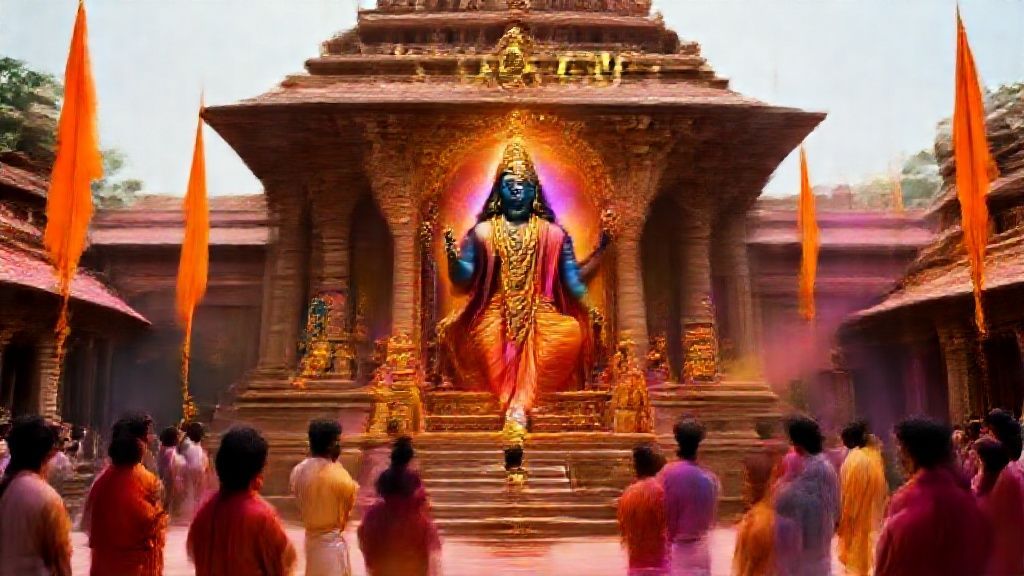
Holi 2026 will be celebrated with Holika Dahan on Tuesday, March 13th, and Rangwali Holi (Dhulandi) on Wednesday, March 14th. This sacred festival of vibrant colors signifies the triumphant victory of Dharma over Adharma, the arrival of spring, and the profound power of devotion, fostering unity and spiritual renewal across Bharatavarsha.
| Attribute | Details |
|---|---|
| Deity(ies) Central to Legends | Lord Vishnu (as Narasimha), Prahlada, Holika, Kama Deva, Lord Shiva, Radha-Krishna |
| Primary Festival Dates (2026) | Holika Dahan: Tuesday, March 13th Rangwali Holi (Dhulandi): Wednesday, March 14th |
| Key Observances | Holika Dahan (Bonfire), Rangwali Holi (Playing with colors), Puja, Feasting, Singing, Dancing |
| Scriptural References | Vishnu Purana, Bhagavata Purana, Bhavishya Purana, Narada Purana, Matsya Purana, Skanda Purana |
| Astrological/Lunar Basis | Phalgun Purnima (Full Moon of the Hindu month Phalguna) |
The Auspicious Advent of Phalgunotsava: A Celebration of Sanatan Dharma
Holi, known reverently as Phalgunotsava, is far more than a mere festival of colors; it is a profound spiritual and cultural awakening that marks the arrival of spring and the rekindling of joy in every heart. Celebrated on the Purnima (full moon) of the Hindu calendar month of Phalguna, this ancient observance embodies the very essence of Sanatan Dharma: the eternal triumph of good over evil, the power of unwavering faith, and the cyclical renewal of life. Across Bharatavarsha, from the sacred banks of the Ganga to the serene temples of the South, devotees immerse themselves in the spirit of Holi, transcending caste, creed, and social barriers to embrace universal brotherhood and bliss.
This festival is a vivid reminder that even in the darkest of times, light, truth, and devotion ultimately prevail. It encourages us to cast away inner impurities, symbolized by the burning of the Holika pyre, and to embrace the vibrant hues of divine love and harmony that color our existence. For every sincere seeker, Holi offers a unique opportunity for introspection, purification, and heartfelt communion with the divine, strengthening their connection to the timeless traditions preserved on platforms like Hindutva.online.
Puranic History & Sacred Legends of Holi
The genesis of Holi is deeply rooted in the sacred Itihasas and Puranas, presenting a tapestry of divine narratives that illuminate its multifaceted significance.
The Legend of Prahlada and Holika: Triumph of Bhakti
The most celebrated legend, detailed extensively in the Vishnu Purana and Bhagavata Purana, revolves around the unwavering devotion of Prince Prahlada. His father, the Asura king Hiranyakashipu, through severe penance, received a boon from Brahma making him virtually immortal – he could not be killed by man or beast, day or night, indoors or outdoors, on earth or in the sky. Blinded by arrogance, Hiranyakashipu demanded worship as God. However, his own son, Prahlada, remained an ardent devotee of Lord Vishnu. Enraged by Prahlada’s steadfast Bhakti, Hiranyakashipu subjected him to myriad tortures. When all failed, he enlisted his sister, Holika, who possessed a boon to be immune to fire. Holika sat on a pyre with Prahlada in her lap, intending to burn him. By divine grace, Prahlada chanted “Om Namo Bhagavate Vasudevaya,” and the boon reversed: Holika perished, while Prahlada emerged unscathed. This event, known as Holika Dahan, symbolizes the destruction of evil and the protection of true devotion by Lord Vishnu.
Kama Deva and Lord Shiva: The Burning of Desire
Another significant legend, found in the Matsya Purana and Shiva Purana, recounts the tale of Kama Deva, the deity of love and desire. During Lord Shiva’s deep meditation after the demise of Sati, the Devas conspired to awaken Him to marry Parvati and father Kartikeya, who alone could defeat the formidable demon Tarakasura. Kama Deva, at the behest of the Devas, shot an arrow of desire at Shiva. Enraged, Shiva opened His third eye, reducing Kama Deva to ashes. Rati, Kama’s consort, pleaded for her husband’s life. Touched by her devotion, Shiva resurrected Kama Deva, granting him an ananga (bodiless) form. This event is commemorated as one of the origins of Holika Dahan, representing the burning away of worldly desires and the path to spiritual awakening.
The Ogress Dhundi: Overcoming Malevolent Forces
The Skanda Purana narrates the story of the ogress Dhundi, a troublesome creature who plagued children. She was immune to weapons and fire, unaffected by cold or heat, yet had a specific vulnerability: the pranks and shouts of mischievous boys. On the day of Phalguna Purnima, the children of the kingdom, encouraged by Sage Narada, gathered together, played pranks, and made loud noises, ultimately driving Dhundi away. This legend highlights the power of collective joy and innocent mischief in banishing negativity, resonating with the playful spirit of Holi.
Radha and Krishna: The Divine Leela of Colors
In Braj Bhoomi, the land of Lord Krishna, Holi holds a special significance, steeped in the divine romance and playful antics of Krishna and Radha. As depicted in the Garg Samhita and Brahma Vaivarta Purana, young Krishna, feeling self-conscious about his dark complexion compared to Radha’s fair skin, complained to his mother Yashoda. She playfully suggested he color Radha’s face with any color he liked. Krishna, along with his cowherd friends (Gopas), then smeared colors on Radha and her companions (Gopis), initiating the tradition of playing with colors. This enchanting Leela transformed Holi into a festival of love, equality, and unbridled joy, especially vibrant in places like Vrindavan and Mathura.
Cosmic Timings & Ayurvedic Wisdom: The Science of Holi
While Holi is deeply spiritual, its timing and traditional practices reveal a profound understanding of cosmic cycles and natural science embedded in Sanatan Dharma. The festival coincides with the Uttarayana Punya Kala, the northward journey of the sun, and the vibrant transition from winter to spring. This seasonal shift is a critical period in Ayurveda, making the traditional aspects of Holi scientifically significant.
The timing of Holika Dahan on Phalguna Purnima is meticulously calculated by the Panchang (Hindu calendar), ensuring the bonfire is lit during the most auspicious muhurta (propitious time) to invoke positive cosmic energies. The ash from the Holika fire is traditionally applied to the body, believed to cleanse and protect against seasonal ailments. This practice stems from an ancient understanding of purifying properties and elemental balance.
Furthermore, the traditional colors, particularly the dry powder known as Gulal, were historically derived from natural sources. Turmeric (Haldi), Neem leaves, Tesu flowers (Palash), Sandalwood, and Henna were used to create vibrant hues, each possessing medicinal properties. For instance, turmeric is an antiseptic, Neem an antibacterial, and Tesu flowers a natural skin conditioner. Playing with these natural colors, often mixed with water, provided a therapeutic effect, protecting the skin from spring allergies and strengthening immunity. This ancient wisdom, often overlooked in modern celebrations, highlights the integral connection between Dharma, nature, and well-being, reflecting the holistic knowledge found on Hindutva.online.
Rituals & Puja Vidhi: Performing Holi with Devotion
Holi is a multi-day festival, with specific rituals performed to honor its profound spiritual significance.
1. Holika Dahan (The Bonfire Ritual)
Observed on the evening of Phalguna Purnima, this ritual signifies the triumph of good over evil.
- Preparation: A pyre is constructed, typically on an open ground, using wood, dried cow dung cakes (Gobar Upla), and effigies of Holika. Sometimes a small idol of Prahlada, made of non-combustible material, is placed within the pyre, to be retrieved unharmed.
- Puja: Before lighting, devotees perform a special puja. Offerings include water, rice (Akshat), unhusked green gram (Moong), flowers, turmeric, coconut, and raw cotton thread (Moli). The Moli is tied around the pyre seven times, symbolizing protection.
- Lighting the Pyre: The pyre is lit at an auspicious time, chanting mantras that invoke divine protection and purity.
- Circumambulation (Parikrama): Devotees walk clockwise around the burning pyre, offering grains, especially barley, into the fire, symbolizing the burning of negativity and seeking blessings.
- Collecting Ash: After the fire subsides, some devotees collect the holy ash (Bhasma) and apply it to their foreheads, believing it wards off evil and brings good fortune.
2. Rangwali Holi (Dhulandi – The Festival of Colors)
Celebrated the morning after Holika Dahan, this is the joyful playing with colors.
- Offerings: Many begin the day by offering colorful powders to the family deity, seeking blessings for a joyous year.
- Playing with Colors: People gather with friends and family, applying Gulal (dry colored powder) and splashing colored water (using Pichkaris) on each other.
- Feasting: Special delicacies like Gujiya, Mathri, Malpua, and Thandai are prepared and shared, symbolizing the sweetness of life and communal bonds.
- Visiting: Families visit relatives and friends, exchanging greetings and sweets, reinforcing community ties.
Sacred Mantras & Chants for Holi
Chanting during Holi enhances its spiritual vibrations, connecting the devotee with the divine.
- For Protection & Devotion (Prahlada’s Mantra):
“ॐ नमो भगवते वासुदेवाय” (Om Namo Bhagavate Vasudevaya)
This powerful Vaishnava mantra invokes Lord Vishnu and bestows protection and unwavering faith.
- For the Holika Fire (Agni Mantra):
“त्वमग्ने सर्वभूतानां अन्तरात्मा सनातनः” (Tvam Agne Sarvabhutanam Antaratma Sanatanah)
This verse from the Vedas acknowledges Agni (fire) as the eternal inner soul of all beings, seeking its purifying energy.
- For Peace and Auspiciousness:
“सर्वे भवन्तु सुखिनः सर्वे सन्तु निरामयाः । सर्वे भद्राणि पश्यन्तु मा कश्चित् दुःखभाग् भवेत् ॥”
(Sarve Bhavantu Sukhinah, Sarve Santu Niramayah | Sarve Bhadrani Pashyantu, Ma Kashchit Dukha Bhag Bhavet ||)
May all be happy, may all be free from illness. May all see what is auspicious, may no one suffer.
Dos and Don’ts for a Dharmic Holi Celebration
To celebrate Holi in its true spirit, adhering to certain cultural and ethical guidelines is essential.
- DO use natural, organic colors (Gulal) to protect skin and the environment.
- DO ensure consent before applying color to anyone, especially strangers.
- DO share traditional sweets and delicacies with everyone, fostering community harmony.
- DO participate in Holika Dahan with devotion, understanding its symbolic cleansing.
- DO respect elders and seek their blessings during the festivities.
- DON’T use synthetic, harmful chemical colors, which can cause skin irritation or damage.
- DON’T waste water excessively, especially in regions facing scarcity.
- DON’T consume intoxicating substances that lead to unruly behavior, which goes against the spirit of the festival.
- DON’T throw water balloons or colors at animals or unwilling individuals.
- DON’T engage in any behavior that disrespects women or public property.
Why is Holi Celebrated?
Holi is celebrated primarily to commemorate the victory of good over evil, epitomized by the triumph of devotion in the story of Prahlada and Holika. It also signifies the arrival of spring, the burning away of negative energies and past grievances, and the renewal of friendships and relationships through the playful exchange of colors and sweets. It’s a vibrant expression of joy, equality, and spiritual purification.
What is the Significance of Holika Dahan?
Holika Dahan is the ceremonial lighting of a bonfire on the eve of Holi. It symbolizes the burning of the demonic Holika and, by extension, the destruction of all forms of evil, negativity, and ego within ourselves. It is an act of purification, where devotees offer grains into the fire, signifying the letting go of old attachments and embracing a fresh, pure beginning under divine protection.
Are there different ways Holi is celebrated across India?
Indeed. While the core essence remains the same, regional variations abound. In Braj (Mathura, Vrindavan), Lathmar Holi involves women playfully beating men with sticks. In Punjab, Hola Mohalla is a martial display by Nihang Sikhs. In Bengal, it’s Basanta Utsav (Spring Festival) with cultural performances. In parts of South India, Holi is linked to the legend of Kama Dahan. These diverse celebrations highlight India’s rich cultural tapestry.
Holi: Preserving the Sanatan Spirit for Generations
Holi is not merely an annual event; it is a profound testament to the enduring principles of Sanatan Dharma. It teaches us the eternal truth that Dharma Vijaya – the victory of righteousness – is inevitable, even in the face of insurmountable odds. The narrative of Prahlada instills unwavering faith, while the colorful celebrations remind us of the joy inherent in unity and brotherhood. By observing Holi with reverence and understanding its deep scriptural roots, we actively participate in preserving a cultural heritage that transcends millennia. It is a time to shed our inner Holikas of ego, anger, and prejudice, and to embrace the vibrant hues of love, compassion, and spiritual awakening. Thus, Holi continues to illuminate the path of Dharma, guiding us towards a more harmonious and spiritually enriched existence.