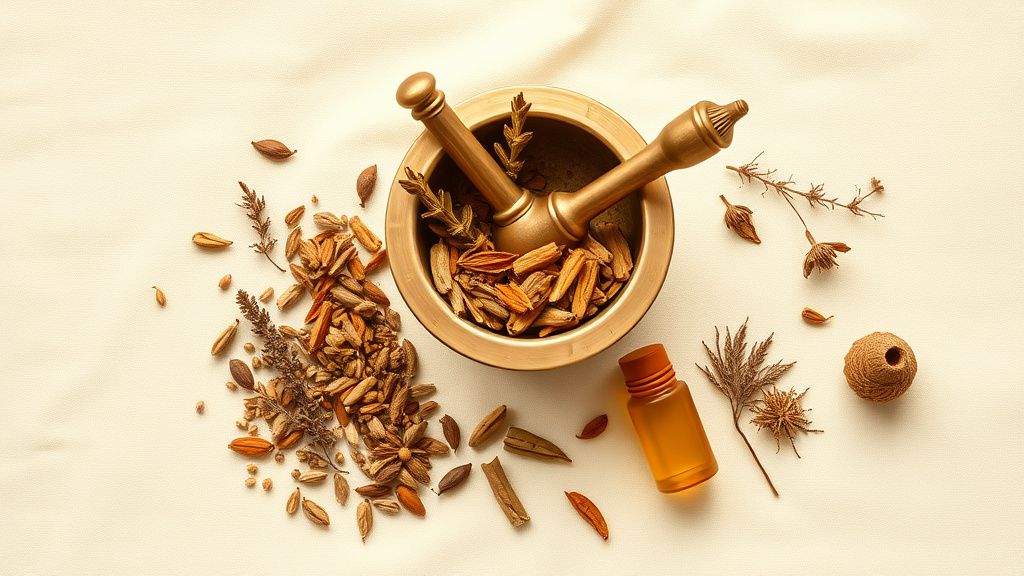
Ojas in Ayurveda is the refined essence of all bodily tissues, the substance that gives stable immunity, calm vitality, and what the classical texts call bala (strength). The Charaka Samhita Sutrasthana 17.74–75 describes ojas as the byproduct of the seventh and final dhatu (shukra) and locates its primary seat in the heart. The Sushruta Samhita Sutrasthana 15.19 specifies that pure ojas is white, oily, slightly cool, and stable, present in the body in roughly the quantity of eight drops. The classical view is that ojas is built slowly by good food, good sleep, good company, and right action, and depleted quickly by stress, overwork, late nights, and grief. This article sets out what the texts say and what they recommend for building ojas.
What ojas is
Charaka distinguishes two forms of ojas:
- Para ojas: the superior, fixed form, residing in the heart, eight drops, described as the substance that sustains life itself. Its complete loss is described as death.
- Apara ojas: the secondary, mobile form, circulating in the body in approximately a half-ounce. Apara ojas can be increased or decreased through diet, lifestyle, and emotion.
The classical analogy is honey: para ojas is the comb’s reserve, slow to fill and slow to empty; apara ojas is the day’s nectar, gathered and used. The signs of strong ojas are stable energy, deep sleep, clear skin and eyes, regular digestion, calm under pressure, and resistance to common infections. Signs of depleted ojas include fatigue that does not lift with rest, frequent colds, anxiety, restlessness, dry skin, and a feeling of being thin in body or spirit.
Foods that build ojas
The classical ojas-building foods (ojas-vardhaka ahara) are sweet, oily, heavy, and freshly prepared. Charaka Sutrasthana 27 lists:
- Cow’s milk: warm, ideally fresh, with a pinch of cardamom or saffron. Taken at night before bed in the classical recommendation.
- Ghee: a teaspoon to a tablespoon a day, ideally added to rice, dal, or vegetables.
- Soaked almonds: ten to twelve almonds soaked overnight, peeled in the morning, eaten on an empty stomach.
- Dates and figs: two to three soaked dates or figs as a midday snack.
- Honey: a teaspoon of raw, unheated honey in warm (not hot) water.
- Saffron: a few strands in warm milk; classically used to nourish heart and reproductive tissue.
- Whole grains: basmati rice, wheat (if tolerated), oats cooked with milk and a small amount of ghee.
- Ojas-building herbs: ashwagandha, shatavari, bala, gokshura, amalaki, used as rasayanas in classical formulas like Chyavanprash.
Daily practices that build ojas
- Sleep before 10 p.m.: the classical texts treat sleep, specifically deep early sleep, as the principal time of ojas formation. Late nights are the single most cited cause of ojas depletion.
- Abhyanga: daily warm oil self-massage. Sesame oil in cooler weather, coconut in summer. Twenty minutes before the bath.
- Moderate exercise: to half of one’s capacity, leaving energy left over. Exercise to exhaustion depletes ojas rather than building it.
- Pranayama and meditation: twenty minutes of nadi shodhana or bhramari pranayama, followed by meditation, is the classical ojas-building prescription.
- Time in nature: early-morning walks, time near water, time near plants.
- Good company: the classical texts specify satsanga, time with people of stable, kind, and elevated temperament, as ojas-building. Conversely, agitated, harsh, or fearful environments deplete it.
What depletes ojas
- Chronic insufficient sleep, especially late-night work or screens past 11 p.m.
- Sustained anger, fear, anxiety, or grief; the texts treat sustained negative emotion as the fastest ojas-depleter after physical exhaustion.
- Overexertion, especially endurance training without recovery.
- Excessive sexual activity. Classical Ayurveda treats reproductive tissue (shukra) as the immediate source of ojas; overuse is treated as direct depletion.
- Irregular meals, skipping meals, processed and stale food.
- Excessive talking, screen time, and travel.
- Loss of a loved one, prolonged caregiving, and other life events the texts call shoka (grief).
Chyavanprash and the classical rasayanas
Chyavanprash is the most widely used ojas-building preparation in modern Ayurveda. The recipe, attributed to the sage Chyavana and described in the Charaka Samhita Chikitsasthana 1, uses amalaki (Phyllanthus emblica) as the principal ingredient, combined with thirty to forty additional herbs cooked into a jam with ghee and honey. The classical dose is one to two teaspoons in the morning with warm milk. Other rasayanas include Brahma rasayana, Amalaka rasayana, and the formula called Triphala rasayana. The Central Council for Research in Ayurvedic Sciences (CCRAS) has documented monographs on each of these formulations.
A practical opinion on ojas
For what it’s worth, the change with the largest payoff in most modern lives is moving bedtime from after midnight to before 10 p.m. Ojas builds during the early hours of sleep, particularly between 10 p.m. and 2 a.m., and no amount of golden milk and almond paste compensates for chronic late nights. The classical texts are not subtle about this; they treat early sleep as the single most powerful ojas-building habit, more important than any food or herb.
Common questions
How long does it take to build ojas?
Apara ojas, the mobile form, recovers in days to weeks with consistent sleep, food, and rest. The slow recovery of full vitality after a long depletion (a difficult work period, an illness, a bereavement) typically takes three to six months of consistent ojas-building practice. The classical view is that para ojas, the fixed reserve, builds across decades and is the cumulative result of how one has lived.
Are ojas-building foods always heavy?
The classical ojas foods are described as snigdha (oily), guru (heavy), madhura (sweet), and shita (cooling in effect). For someone with strong agni, this is appropriate and well digested. For someone with weak agni, heavy ojas-building foods sit undigested and produce ama rather than ojas. Restoring agni first, then introducing ojas-building foods, is the classical sequence.
Can pure vegetarians build ojas?
Yes. The classical ojas-building diet is largely lacto-vegetarian: milk, ghee, soaked nuts, dried fruit, whole grains, sweet vegetables, and rasayana herbs. Meat is not required in the classical formulations and is in fact considered ama-producing in the context of weak agni.
One limitation worth noting
Ojas is a classical Ayurvedic concept describing a refined essence behind immunity, vitality, and stable emotion. It does not map onto a single modern medical measurement. The signs of ojas depletion overlap with several diagnoses (chronic fatigue, anaemia, depression, hypothyroidism) that have specific clinical workups and treatments. Persistent depletion of energy and vitality warrants medical evaluation rather than reliance on the classical model alone.
For further reading see the Charaka Samhita Online entry on Ojas and the Central Council for Research in Ayurvedic Sciences.