Manipuri Vaishnavism: Radha Krishna Dance Drama is a profoundly devotional art form from Manipur, India, embodying the ecstatic love of Radha and Krishna through graceful movements, intricate music, and vibrant costumes. Rooted deeply in Gaudiya Vaishnava philosophy, it serves as a living Bhagavata-dharma, conveying sacred narratives and spiritual emotions directly to the heart of the devotee.
| Attribute | Details |
|---|---|
| Deity Central to Worship | Shri Radha-Krishna (the divine Jugal Jodi) |
| Origin/Geographical Hub | Manipur, Northeast India |
| Key Festivals & Occasions | Sharad Purnima Rasa (most significant), Vasant Purnima Rasa, Maha Rasa, Nitya Rasa, Kunja Rasa, Janmashtami, Holi |
| Primary Scriptural References | Bhagavata Purana (especially Rasa Panchadhyayi), Gita Govinda by Jayadeva, Brahma Vaivarta Purana |
| Traditional Music Ensemble | Pung (Manipuri drum), Kartal (cymbals), Harmonium, Flute, Pena (string instrument), Esraj |
Introduction to Manipuri Vaishnavism: The Rasa Lila Tradition
In the sacred land of Manipur, nestled amidst verdant hills, an unparalleled tradition of spiritual devotion blossomed, manifesting as the sublime Radha Krishna Dance Drama, universally known as the Rasa Lila. This art form is not merely a performance; it is a profound Yajna, an offering of love and devotion at the lotus feet of the Divine Couple, Shri Radha and Shri Krishna. Unlike other classical Indian dance forms often characterized by sharp angular movements and robust footwork, Manipuri Rasa Lila emanates an ethereal grace, characterized by soft, undulating movements, fluid transitions, and a pervasive sense of serene devotion, or Shanta Rasa, combined with the ecstatic Madhura Bhava.
The essence of Manipuri Vaishnavism lies in its fervent adherence to the Gaudiya Vaishnava school of thought, specifically the worship of Radha and Krishna as the Supreme Personalities of Godhead. The dance drama serves as a living scripture, visually narrating the divine pastimes (Lilas) of the Lord, fostering a deep emotional connection (bhava) between the devotee and the divine. For generations, this tradition has been the spiritual heartbeat of Manipur, weaving together community, culture, and fervent Bhakti into a seamless tapestry of devotion.
Puranic History and Legend: The Divine Unfolding
The journey of Vaishnavism into Manipur is a fascinating chronicle, deeply interwoven with its royal history and spiritual awakenings. While Vaishnavism, particularly the worship of Rama and later Krishna, had existed in pockets of Manipur for centuries, its transformation into the dominant religious and cultural force, profoundly influencing the dance drama, began in earnest from the 15th century. King Kiyamba (1467-1508 CE) is credited with establishing the first Vishnu temple, but it was King Garib Niwaj Pamheiba (1709-1748 CE), under the influence of the Ramanandi tradition, who initiated widespread Vaishnava practices, though some historical accounts also mention the influence of Bengal’s Gaudiya Vaishnavism even before his reign.
The definitive codification and popularization of the Rasa Lila dance drama, however, is attributed to the saintly King Bhagyachandra, also known as Jai Singh (1759-1761, 1763-1798 CE). During a period of political turmoil and personal distress, King Bhagyachandra sought solace in devotion. As narrated in the Cheitharol Kumbaba, the Manipuri Royal Chronicle, and further detailed in the treatise Govinda Sangeeta Lila Vilasa (attributed to the King), he received a divine vision. In this transcendental dream, Lord Krishna appeared and revealed the celestial Rasa Lila, instructing the King to sculpt the deity of Govindaji from a particular jackfruit tree and to choreograph the divine dance as he had witnessed it. This divine command led to the creation of the first Govindaji Temple and the meticulous development of the Manipuri Rasa Lila, including the distinct costumes such as the iconic Potloi for Radha and Gopis.
This historical narrative is not merely a secular account but a spiritual saga, emphasizing the direct divine inspiration behind the art form. The themes and narratives for the Rasa Lila are primarily drawn from the Tenth Canto of the Bhagavata Purana, particularly the Rasa Panchadhyayi, which describes Krishna’s ecstatic dance with the Gopis in Vrindavan. Jayadeva’s Gita Govinda, an exquisite lyrical poem detailing the love of Radha and Krishna, also provides profound thematic material, enriching the emotional depth of the performances. Thus, the Manipuri Rasa Lila is a direct manifestation of these revered scriptures, brought to life through devotional art.
Architectural and Philosophical Marvels of the Rasa Lila
While Manipuri Vaishnavism’s primary marvel isn’t found in monumental stone structures, its true architectural brilliance lies in the meticulously structured, spiritually engineered form of the Rasa Lila performance itself. It is a carefully constructed ritualistic drama that seeks to recreate the celestial Vrindavan and invoke the direct presence of Radha and Krishna.
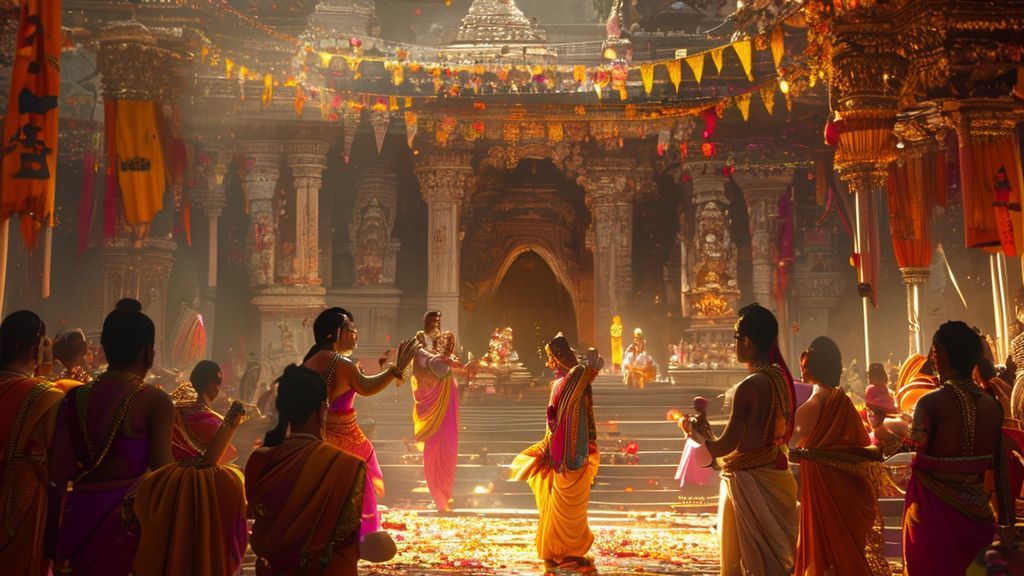
The Rasa Lila performance is typically enacted in a temple’s mandapa (pavilion) or a specially constructed open-air theatre, often under a canopy of stars on auspicious full moon nights. The “architecture” of the performance sequence is deeply spiritual:
- Nata Sankirtana: The Rasa Lila always commences with an elaborate Nata Sankirtana, a congregational singing and drumming session led by male vocalists and drummers playing the Pung. This creates the initial devotional atmosphere, purifying the space and minds of the audience. It is an integral prelude, not a mere warm-up.
- Raga and Tala: The music is intricate, utilizing specific ragas (melodies) and talas (rhythms) meticulously designed to evoke the nine rasas (emotions), especially Shringara Rasa (love) in its divine form. The gentle, almost whispering quality of the music, dominated by the Pung and Kartal, guides the emotional journey.
- Choreography and Mudras: The dance emphasizes soft, graceful, and flowing movements (Lasya), often with dancers moving in circles, symbolizing the cosmic dance. The mudras (hand gestures) are subtle yet profound, conveying intricate emotions and narratives from the Puranas. Unlike the sharp, decisive movements of Bharatanatyam or Odissi, Manipuri dance is characterized by its ethereal, almost meditative quality, embodying the humility and surrender of a Gopi.
- Costumes as Devotional Art: The costumes are a visual spectacle and a crucial part of the drama’s “marvel.” Radha and the Gopis wear the Potloi, a cylindrical, stiff skirt adorned with intricate embroidery and mirror work, often in vibrant reds and greens. This symbolizes their unwavering commitment and purity. Krishna’s attire, with its yellow dhoti, dark blue or green upper garment, and peacock feather crown, immediately invokes the playful Lord of Vrindavan. The colors and designs are not arbitrary; they are prescribed, deeply symbolic, and meant to transport the viewer to the divine realm.
This “architectural” precision in crafting every element—from the introductory kirtan to the final arati—ensures that the Manipuri Rasa Lila functions as a spiritual conduit, a living temple where devotees can directly experience the Lila of the Lord. For more insights into the interconnectedness of art and devotion, one can explore various articles on Hindutva.online.
Rituals and Puja Vidhi: Engaging with the Divine Dance
For the devotee, participating in or witnessing a Manipuri Rasa Lila is akin to performing a Mahayajna. The dance itself is a form of profound worship, with every step, gesture, and expression an offering to the Divine Couple.
- Preparation of the Space: Before a Rasa Lila, the performance area is consecrated. The deities of Radha and Krishna (usually Govindaji and His consort) are prominently placed on an altar, beautifully adorned with flowers, lamps, and offerings (bhog).
- Nata Sankirtana: The ritual commences with the vibrant Nata Sankirtana. This is not merely music but a deeply spiritual practice involving devotional singing, rhythmic drumming (Pung cholom), and synchronized cymbals (Kartal cholom). It is a call to the divine, awakening the spiritual consciousness of all present.
- Entry of the Dancers: Dancers, who are devout Vaishnavas and consider themselves Gopis (female cowherd devotees) or Sakhis (friends of Radha), enter the performance space with utmost reverence. Their elaborate costumes, especially the Potloi, are part of their spiritual transformation into their divine roles.
- Performance of the Lila: The dance drama unfolds, narrating specific episodes from Krishna’s life – the yearning of the Gopis for Krishna’s presence (Gopi Abhisar), Radha’s emotional states (Radha Abhisar), their playful interactions, and ultimately, the ecstatic union in the Maharasa. The performers embody the bhava (emotional state) of the characters with profound sincerity.
- Arati and Prasad Distribution: At the conclusion, an arati (waving of lamps) is performed for the deities and the performers, followed by the distribution of prasad (sanctified food) to all attendees. This signifies the completion of the spiritual offering and the sharing of divine grace.
For those witnessing, the ritual is to surrender to the beauty, absorb the devotional energy, and allow the stories of Radha and Krishna to purify the heart and awaken love for the Divine.
Mantras and Chants for Devotion
The spiritual potency of Manipuri Rasa Lila is greatly enhanced by the chanting of sacred mantras and kirtans. Devotees often engage in these chants during the performance or in their personal sadhana:
- Hare Krishna Maha-mantra: This supreme chant is central to Gaudiya Vaishnavism and is often sung during the Nata Sankirtana and other devotional gatherings:
Hare Krishna, Hare Krishna, Krishna Krishna, Hare Hare
Hare Rama, Hare Rama, Rama Rama, Hare Hare
- Radha-Krishna Kirtans: Numerous devotional songs dedicated to the Divine Couple are performed, evoking various bhava. Examples include:
Radhe Radhe Govinda, Govinda Radhe
Jaya Radhe, Jaya Krishna, Jaya Vrindavan
- Gita Govinda Verses: Poetic verses from Jayadeva’s Gita Govinda are often sung, particularly those describing Radha’s longing or Krishna’s charming attributes. For example, a verse from Canto I, Dashavatara Stotra:
Pralaya-payodhi-jale dhṛtavān asi vedaṁ
Vihita-vahitra-caritram akheḍam
Keśava dhṛta-mīna-śarīra jaya jagadīśa hare
(O Kesava, You assumed the form of a fish and by Your great prowess protected the Vedas in the turbulent water of devastation. O Lord of the universe, Hari, all glories to You!)
These chants are not mere sounds; they are transcendental vibrations that purify the mind and connect the soul to the divine realm, preparing one to fully receive the grace invoked by the Rasa Lila.
Dos and Don’ts: Cultural Etiquette for Devotees
To fully experience and respect the sanctity of Manipuri Rasa Lila, devotees should observe certain cultural and spiritual etiquettes:
- Dos:
- Dress Modestly: Wear traditional or conservative attire, covering shoulders and knees, as a sign of respect for the sacred performance.
- Maintain Silence and Reverence: The Rasa Lila is a form of worship. Maintain silence throughout the performance, reflecting the solemnity and devotion.
- Arrive on Time: The Nata Sankirtana prelude is integral to the spiritual buildup; arriving early allows for full immersion.
- Offer Respects: Bow or offer silent prayers to the deities and the performers, recognizing their roles as conduits of divine energy.
- Absorb the Bhava: Focus on the expressions and movements, allowing the divine emotions of Radha and Krishna to permeate your heart.
- Accept Prasad: Humbly accept any prasad offered at the conclusion.
- Don’ts:
- Disturb the Performance: Avoid talking loudly, using mobile phones, or moving unnecessarily during the dance.
- Use Flash Photography: Flash photography is often prohibited as it can distract performers and diminish the sacred atmosphere. Check rules beforehand.
- Enter Intoxicated: Consuming alcohol or other intoxicants before or during the performance is strictly forbidden.
- Leave Prematurely: Try to stay for the entire duration, including the final arati, to receive the full blessings.
- Sit with Feet Towards Deities/Performers: It is considered disrespectful to point your feet towards the altar or the stage.
What is the primary philosophical basis of Manipuri Rasa Lila?
The primary philosophical basis of Manipuri Rasa Lila is the Gaudiya Vaishnava tradition, specifically the concept of Madhura Bhava Bhakti, or conjugal love for God. This philosophy emphasizes the devotional path where the devotee identifies with the Gopis, particularly Shri Radha, in their intense, selfless, and ecstatic love for Shri Krishna. This approach, as elucidated in scriptures like the Brahma Vaivarta Purana and the Bhagavata Purana, views Radha as Krishna’s internal potency (Hladini Shakti) and the embodiment of supreme love, making her worship paramount in understanding the highest form of devotion.
How does Manipuri dance differ from other classical Indian dance forms?
Manipuri dance distinctly differs from other classical Indian dance forms like Bharatanatyam or Odissi primarily in its execution and aesthetic. It is characterized by gentle, fluid, and undulating movements, largely avoiding sharp lines, strong leaps, or aggressive foot stamping. The footwork is soft and gliding, almost a ‘creeping’ motion, with minimal or no ankle bells for the female dancers, contributing to its ethereal quality. Its focus is predominantly on Lasya (feminine grace and tenderness) rather than Tandava (masculine, vigorous movements). The entire body moves as a unit, creating a lyrical flow that aims to evoke a serene and devotional bhava, contrasting with the often more dynamic and intricate rhythmic patterns of other styles.
Who was King Bhagyachandra and what was his pivotal role?
King Bhagyachandra (Jai Singh) of Manipur, reigning in the 18th century, was the seminal figure in the codification and popularization of the Manipuri Rasa Lila. He received a divine vision of Radha-Krishna’s celestial Rasa Lila, which he then meticulously recreated and formalized. He not only designed the distinct costumes, such as the iconic Potloi for Radha and the Gopis, but also composed the foundational treatise Govinda Sangeeta Lila Vilasa, which details the choreography, music, and philosophical underpinnings of the dance. His profound devotion and artistic vision transformed a local devotional practice into a globally recognized classical dance form, establishing the spiritual and artistic lineage that continues to thrive today.
Dharmic Significance: A Living Testament to Sanatan Dharma
Manipuri Vaishnavism’s Radha Krishna Dance Drama is far more than an artistic expression; it is a living testament to the enduring vibrancy and profound depth of Sanatan Dharma. It embodies the core principle that art, when infused with devotion, becomes a powerful vehicle for spiritual realization. The Rasa Lila preserves ancient narratives from the Puranas, transmitting them across generations not as mere stories, but as tangible experiences of divine love and sacrifice.
This dance form serves as a profound means for rasanubhava – the experience of divine bliss. By witnessing the Rasa Lila, devotees are transported to the spiritual realm of Vrindavan, allowing them to participate emotionally in the pastimes of Radha and Krishna. It fosters Bhakti (devotion), cultivates Vairagya (detachment from material pursuits), and instills Dharma (righteous conduct) by inspiring a life dedicated to spiritual values.
In an increasingly materialistic world, the Manipuri Rasa Lila stands as a beacon of spiritual truth, demonstrating how tradition, aesthetics, and devotion can converge to elevate human consciousness. It is a vibrant reminder that the path to God is often found not just in silent meditation, but also in the ecstatic communal celebration of divine love, maintaining the eternal flow of Sanatan Dharma.