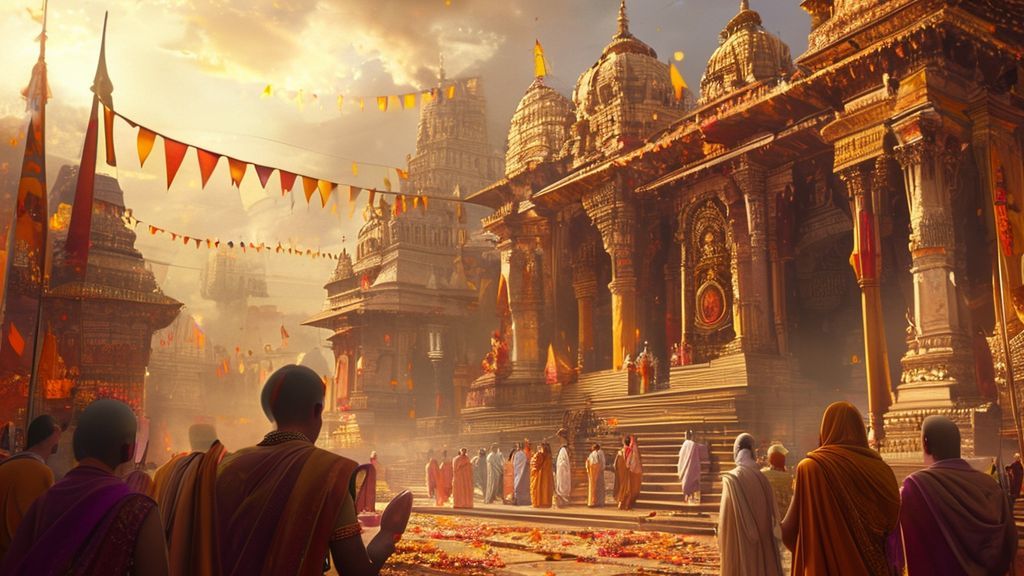
Mathura Janmashtami marks the divine appearance of Lord Krishna at the sacred Krishna Janmabhoomi, the revered birthplace in Mathura, Uttar Pradesh, Bharat. Celebrated with unparalleled devotion, this festival embodies the triumph of Dharma over Adharma, drawing millions of devotees to relive the transcendental moment of the Supreme Lord’s descent. It is a profound spiritual experience, deeply rooted in Sanatan Dharma’s Puranic traditions.
| Attribute | Details |
|---|---|
| Deity | Bhagavan Shri Krishna |
| Location/Origin | Krishna Janmabhoomi, Mathura, Uttar Pradesh, Bharat |
| Key Festival | Janmashtami (Krishna Jayanti) |
| Scripture Reference | Bhagavata Purana (10th Canto), Vishnu Purana, Harivamsa Purana |
The Spiritual Heartbeat of Braj Bhoomi
Mathura, nestled on the banks of the sacred Yamuna River, is not merely a city; it is a profound spiritual continuum, the very heart of Braj Bhoomi. Every grain of its dust is sanctified by the Lotus Feet of Bhagavan Shri Krishna. Janmashtami, the celebration of His divine advent, transforms Mathura into a celestial realm, where the past and present merge in a symphony of devotion. Devotees from across the globe converge here, driven by an unshakeable faith to witness and participate in the festivities at the very spot where the Supreme Personality of Godhead chose to descend. This festival is a vibrant reminder of Sanatan Dharma’s eternal truths: the cyclical nature of time, the Lord’s unwavering promise to protect His devotees, and the ultimate triumph of righteousness.
The Puranic Narrative of Divine Descent
The saga of Lord Krishna’s birth, meticulously narrated in the Bhagavata Purana (especially the 10th Canto), the Vishnu Purana, and the Harivamsa Purana, forms the bedrock of Janmashtami’s spiritual significance. Millennia ago, the tyrannical king Kamsa, Devaki’s brother, terrorized the Vrishni dynasty in Mathura. A celestial voice (Akashvani) prophesied that Devaki’s eighth child would be his slayer. Consumed by fear, Kamsa imprisoned Devaki and her husband Vasudeva, brutally murdering their first six children. The seventh child, Balarama, was miraculously transferred to Rohini’s womb.
On the auspicious Ashtami (eighth day) of the Krishna Paksha (dark fortnight) in the month of Bhadrapada, at the stroke of midnight, the eighth child appeared. This was no ordinary birth. The texts describe a glorious vision: the newborn child manifested with four arms, holding a conch, disc, mace, and lotus, adorned with the Srivatsa mark and the Kaustubha jewel, radiating divine effulgence. Vasudeva and Devaki recognized Him as the Supreme Lord. As described in Bhagavata Purana (10.3.9-10), the Lord instructed Vasudeva to take Him across the Yamuna to Gokul, where Nanda Baba and Yashoda had just given birth to a daughter. Miraculously, the prison doors opened, the guards fell asleep, and the Yamuna parted ways. Vasudeva, carrying the divine infant in a basket, reached Gokul, exchanged Krishna with Yashoda’s daughter, and returned to Mathura before dawn. This clandestine, miraculous birth and transfer highlight the Lord’s omnipotence and His intricate divine play (Lila).
Architectural Significance of Krishna Janmabhoomi Mandir
The Shri Krishna Janmabhoomi Temple complex stands on the hallowed ground believed to be the exact birthplace of Lord Krishna. The site has a profound and turbulent history, mirroring the challenges faced by Sanatan Dharma over millennia. Historically, a magnificent temple built by King Vajranabha (Krishna’s great-grandson) stood here, later rebuilt by Vikramaditya. However, it faced repeated destruction by invaders, most notably by Aurangzeb in 1669, who built a mosque adjacent to the spot. The current grand temple complex is a testament to the unwavering faith and resilience of Hindu devotees. Initiated by Pandit Madan Mohan Malaviya and realized through the dedicated efforts of industrialist Seth Jugal Kishore Birla, the construction began in 1951 and was completed in 1982.
The complex houses several shrines, including the Keshavadeva Temple, the Garbha Griha (the actual prison cell where Krishna was born), and the Bhagavat Bhavan. The Garbha Griha is the most sacred spot, a small, reverent space adorned with a deity of the infant Krishna. While it may not showcase a singular classical Dravidian or Nagara style in its modern iteration, its significance lies in preserving the ancient spiritual locus. The architectural design of the Bhagavat Bhavan incorporates elements of traditional North Indian temple architecture, creating an atmosphere conducive to devotion and contemplation, allowing devotees to experience the profound presence of the Lord right at His birthplace.
Rituals and Puja Vidhi: Celebrating the Divine Appearance
The celebrations at Mathura for Janmashtami are elaborate and deeply spiritual, drawing millions into a collective tide of devotion.
Pre-Janmashtami Preparations
- Nirjala Vrat (Fasting): Devotees observe a stringent fast, often without water (Nirjala), from sunrise on Janmashtami day until midnight, when Lord Krishna is believed to have been born.
- Decoration: Homes, temples, and especially the Krishna Janmabhoomi are meticulously decorated with flowers, lights, and vibrant artistic displays. Swings (Jhulas) are prepared for the infant Krishna deities.
- Prasad Preparation: A variety of traditional sweets, savories, and Chhappan Bhog (56 food items) are prepared, representing the diverse culinary offerings for the Lord.
The Main Celebration at Midnight
- Vigraha Sthapana: An idol of infant Krishna (Laddu Gopal) is placed in a beautifully decorated cradle (Jhula) or a small, symbolic prison cell tableau at the Janmabhoomi.
- Abhishekam: At the stroke of midnight, priests and devout followers perform a grand ritual bathing (Abhishekam) of the infant deity with Panchamrita (a mixture of milk, yogurt, ghee, honey, and sugar), followed by holy water, rose water, and various auspicious liquids.
- Shringar: After the Abhishekam, the deity is adorned with new, exquisite clothes, ornaments, and garlands, a process known as Shringar.
- Archana and Arati: Elaborate prayers (Archana) are offered, followed by the waving of lamps (Arati) amidst the fervent chanting of mantras, bhajans, and kirtans.
- Sankirtan: The entire complex resonates with continuous chanting of “Hare Krishna, Hare Krishna, Krishna Krishna, Hare Hare / Hare Rama, Hare Rama, Rama Rama, Hare Hare,” devotional songs, and the blowing of conch shells.
- Prasad Distribution: After the midnight rituals, the fast is broken by consuming the Panchamrita and other consecrated food items (Prasad).
- Nandotsav: The following day, Mathura celebrates Nandotsav, commemorating the joy and celebrations at Nanda Baba’s house in Gokul after Krishna’s birth. Sweets and gifts are distributed.
Mantras and Chants for Janmashtami
Devotion to Lord Krishna is incomplete without heartfelt chanting of His sacred names and mantras. During Janmashtami, devotees immerse themselves in these powerful vibrations:
- The Hare Krishna Mahamantra:
हरे कृष्ण हरे कृष्ण कृष्ण कृष्ण हरे हरे |
हरे राम हरे राम राम राम हरे हरे ||
(Hare Krishna, Hare Krishna, Krishna Krishna, Hare Hare / Hare Rama, Hare Rama, Rama Rama, Hare Hare)
This is considered the greatest mantra for spiritual liberation in the Kali Yuga. - Om Namo Bhagavate Vasudevaya:
ॐ नमो भगवते वासुदेवाय ||
This twelve-syllable mantra is a potent salutation to Lord Vasudeva (Krishna), the son of Vasudeva. - Om Kleem Krishnaya Namaha:
ॐ क्लीं कृष्णाय नमः ||
A Bija (seed) mantra invoking Lord Krishna’s divine energy and charm.
Chanting these mantras with sincerity purifies the mind, invokes divine grace, and connects the devotee directly with Lord Krishna’s transcendental presence.
Cultural Etiquette: Dos and Don’ts for Devotees
Visiting Mathura for Janmashtami or any pilgrimage requires respectful adherence to Dharmic etiquette.
Dos
- Maintain Purity (Shaucha): Bathe and wear clean, modest clothing. Observe the fast with devotion and sincerity.
- Participate Wholeheartedly: Engage in bhajans, kirtans, and prayers. The collective energy enhances individual spiritual experience.
- Show Reverence: Be respectful towards priests, other pilgrims, and the sacredness of the temple premises.
- Stay Hydrated (if not Nirjala): If observing a non-Nirjala fast, ensure to drink water and consume permitted fruits.
- Plan Ahead: Janmashtami attracts massive crowds. Book accommodations and transport well in advance.
- Contribute to Dharma: Support the temple’s activities and upkeep through humble donations. Further information on such initiatives can be found at Hindutva.online.
Don’ts
- Consume Non-Vegetarian Food or Alcohol: Strictly avoid these throughout the Janmashtami period, especially in Mathura.
- Engage in Impure Thoughts or Actions: Maintain a spiritual demeanor, avoiding gossip, anger, or disrespectful behavior.
- Litter or Defile Sacred Spaces: Keep the surroundings clean and preserve the sanctity of the holy land.
- Disrupt Rituals: Do not interrupt ongoing pujas or ceremonies.
- Overcrowd: Be mindful of others in crowded spaces. Maintain decorum and patience.
Frequently Asked Questions
What is the significance of “Nandotsav”?
Nandotsav is the joyous festival celebrated on the day following Janmashtami. It commemorates the immense happiness and festivities that took place at Nanda Baba’s home in Gokul upon the news of Krishna’s birth. Devotees participate in singing, dancing, and distributing sweets and gifts, symbolizing the celebration of Lord Krishna’s arrival in their lives.
Can anyone visit the Shri Krishna Janmabhoomi Temple?
Yes, the Shri Krishna Janmabhoomi Temple is open to all devotees regardless of their background. However, due to its historical significance and sensitive location, there are stringent security checks. Photography inside the Garbha Griha is generally prohibited, and devotees are advised to follow all security instructions and temple rules.
Why is Mathura called Braj Bhoomi?
Braj Bhoomi (also known as Vraja) refers to the sacred region in and around Mathura, encompassing places like Vrindavan, Govardhan, Gokul, and Barsana. It is called Braj Bhoomi because it is the pastoral land where Lord Krishna spent His childhood and performed numerous divine pastimes (Lilas) with the Gopis and cowherd boys. The word “Braj” itself implies a ‘cow-pen’ or ‘pasture land,’ reflecting Krishna’s identity as a cowherd and protector of cows.
Dharmic Significance: Why This Matters for Every Hindu
Mathura Janmashtami is far more than an annual festival; it is a profound reaffirmation of Sanatan Dharma’s eternal values and an umbilical cord connecting humanity to the divine. It reminds us that whenever unrighteousness prevails, the Supreme Lord manifests to protect the pious and annihilate the wicked, re-establishing Dharma. The celebrations at Krishna Janmabhoomi not only preserve ancient traditions but also infuse future generations with unwavering faith, cultural pride, and spiritual wisdom. By participating in these sacred observances, devotees strengthen their bond with Lord Krishna, understand the deeper philosophy of His descent, and contribute to the preservation of Hindu heritage for posterity. It is a powerful testament to the enduring presence of God in our lives and the eternal promise of deliverance. To delve deeper into the rich tapestry of Sanatan Dharma, visit Hindutva.online.