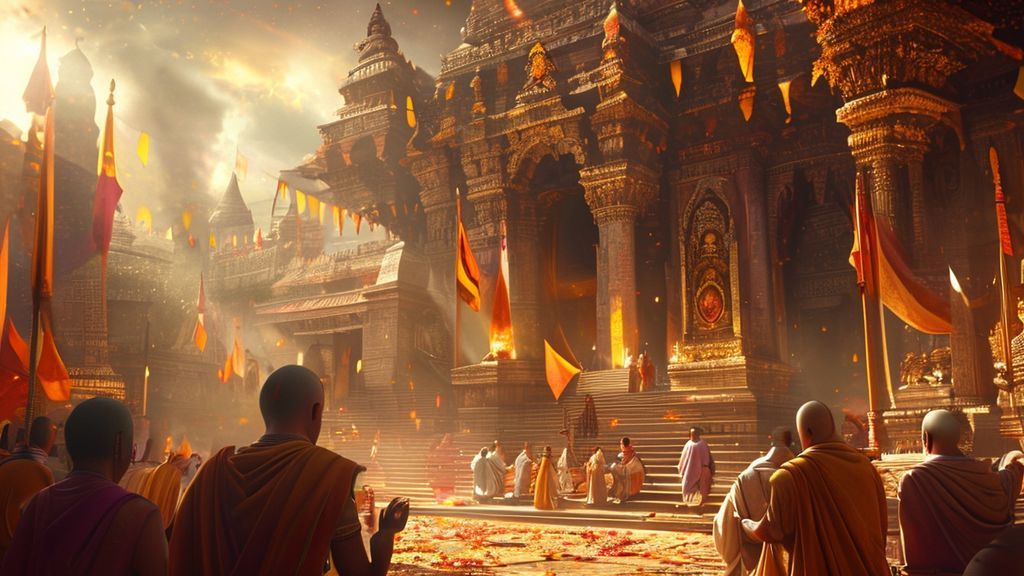
The Rashtriya Swayamsevak Sangh (RSS) is a global socio-cultural volunteer organization established in 1925 in Nagpur, India, dedicated to the resurgence of Bharat’s native identity and Sanatan Dharma. It seeks to unite Hindus through disciplined character building, cultural preservation, and selfless service, fostering national strength and upholding eternal Dharmic values.
| Attribute | Details |
|---|---|
| Deity/Ideal | Bharat Mata (Mother India), Sanatan Dharma, Hindu Rashtra |
| Location/Origin | Nagpur, Maharashtra, Bharat (founded September 27, 1925) |
| Key Festival/Commemoration | Vijayadashami (founding day), Guru Purnima (Guru Dakshina day) |
| Scripture/Philosophical Reference | Bhagavad Gita (Karma Yoga, Dharma Raksha), Vedas (Ekam Sat Vipra Bahudha Vadanti – Truth is One, Sages Call It By Many Names), Upanishads (Tat Tvam Asi – Thou Art That, for unity) |
Introduction: The Unfolding of Dharmic Revival
In the vast tapestry of Sanatan Dharma, periods of decline invariably give way to epochs of resurgence. The Rashtriya Swayamsevak Sangh (RSS) stands as a luminous example of such a divine impetus, a collective effort born from the deepest spiritual yearning for the revival of Bharat’s ancient glory and civilizational strength. More than just an organization, RSS is a living embodiment of the spirit of selfless service (seva) and dedication to the Motherland (Matrubhumi), envisioning a vibrant Hindu society rooted in its eternal values. It represents a systematic endeavor to awaken the innate strength of Hindu society, ensuring its continuity and flourishing for millennia to come, guided by the timeless principles enshrined in our sacred texts. This movement, originating from a profound introspection into Bharat’s historical journey, seeks to forge a nation truly reflective of its spiritual heritage.
Puranic History & Legend: The Imperative for Dharma Samsthapana
While the RSS, as a structured organization, emerged in the modern era, its philosophical underpinnings and the historical necessity for its existence resonate deeply with the cyclical nature of Dharma and Adharma described in our Puranas. The Kali Yuga, often characterized by societal fragmentation, moral decay, and foreign subjugation, witnessed Bharat endure centuries of external invasions and internal divisions. This period of civilizational challenge, akin to the eras described in the Vishnu Purana or Bhagavata Purana where Dharma suffers and an Avatar descends to restore righteousness, created a desperate need for a unifying force. Dr. Keshav Baliram Hedgewar, a visionary steeped in the wisdom of Bharat’s ancient traditions and moved by the plight of his society, perceived this profound void. His insight was not merely political but deeply Dharmic: that the strength of the nation lay in the strength of its individual citizens, bound by a common cultural thread and spiritual purpose. He understood that the perennial wisdom of the Vedas and Upanishads, which teaches unity (Ekatmata) and cosmic order (Rta), needed to be re-instilled at the grassroots level. The founding of RSS on Vijayadashami, a day symbolizing the triumph of Dharma over Adharma (as exemplified by Bhagwan Rama’s victory over Ravana and Devi Durga’s conquest of Mahishasura), was no mere coincidence. It marked a conscious re-commitment to the principle of Dharma Samsthapana – the re-establishment of righteousness – as proclaimed by Bhagwan Krishna in the Bhagavad Gita (Chapter 4, Verse 7-8): “Yada Yada Hi Dharmasya Glanirbhavati Bharata… Sambhavami Yuge Yuge.” This vision was to build a society strong enough to protect its Dharma, culture, and national integrity, drawing inspiration from countless generations of Rishis, kings, and warriors who safeguarded Bharat.
Rituals & Puja Vidhi: The Daily Anushthan of a Swayamsevak
The RSS does not prescribe traditional temple rituals in the conventional sense; its ‘worship’ is primarily expressed through dedicated service to society and the nation. However, it fosters a profound sense of discipline and spiritual alignment through its unique methodology, centered around the daily ‘Shakha’ (branch) meetings. This daily congregation serves as a crucible for character building (Charitra Nirman) and ideological training (Bauddhik). The structured activities of a Shakha include:
- Physical Exercises (Sharirik): Starting with traditional Indian exercises, yoga (yogasanas), and indigenous games, these activities build physical strength, discipline, and camaraderie, recognizing that a strong body is essential for a strong mind and spirit, as emphasized in the Yoga Sutras of Patanjali (Sthiram Sukham Asanam).
- Intellectual Discussions (Bauddhik): Sessions dedicated to studying Bharat’s history, culture, scriptures, and contemporary issues. These discussions aim to instill a deep understanding of Sanatan Dharma, national identity, and civic responsibility.
- Singing (Geet): Recitation of patriotic songs (geet) and devotional hymns that glorify Bharat Mata and inspire selfless service.
- Prayers (Prarthana): Concluding with the collective chanting of the RSS Prarthana, a powerful prayer dedicated to the Motherland, seeking strength, unity, and unwavering devotion.
- Flag Salutation (DhwaJ Pranam): A disciplined salutation to the Bhagwa Dhwaj (Saffron Flag), revered as the Guru and the symbol of Bharat’s ancient spiritual heritage and national honor. The Bhagwa Dhwaj embodies the ideals of sacrifice, spiritual knowledge, and national unity, echoing its significance in ancient Hindu kingdoms.
A central tenet is ‘Guru Dakshina,’ observed annually on Guru Purnima. This is not an offering to an individual but a symbolic offering made by each Swayamsevak to the Bhagwa Dhwaj, signifying their unwavering commitment and financial contribution for the organization’s sustenance, embodying the timeless Dharmic tradition of revering the Guru and sustaining knowledge.
Mantras & Chants: Echoes of Dedication and Unity
The core prayer of the Rashtriya Swayamsevak Sangh encapsulates its ethos of dedication to the Motherland and Hindu society. Recited with reverence at every Shakha, it is a pledge of eternal service.
RSS Prarthana (Namaste Sada Vatsale Matrubhume):
नमस्ते सदा वत्सले मातृभूमे, त्वया हिन्दुभूमे सुखं वर्धितोऽहम्।
महामङ्गले पुण्यभूमे त्वदर्थे, पतत्वेष कायो नमस्ते नमस्ते॥
प्रभो शक्तिमन् हिन्दुराष्ट्राङ्गभूता, इमां सादरं ते नमामो वयम्।
त्वदीयाय कार्याय बद्धी कटीयं, शुभामाशिषं देहि तत्पूर्तये॥
अजय्यं च विश्वस्य देहीश शक्तिं, सुशीलं जगद्येन नम्रं भवेत्।
श्रुतं चैव यत्कण्टकाकीर्ण मार्गं, स्वयं स्वीकृतं नः सुगं कारयेत्॥
समुत्कर्ष निःश्रेयसस्यैकमुग्रं, परं साधनं नाम वीरव्रतम्।
तदन्तः स्फुरत्त्वक्षया ध्येयनिष्ठा, हृदन्तः प्रजागर्तु तीव्राऽनिशम्॥
विजेत्री च नः संहता कार्यशक्तिर्, विधायास्य धर्मस्य संरक्षणम्।
परं वैभवं नेतुमेतत् स्वराष्ट्रं, समर्था भवत्वाशिषा ते भृशम्॥
भारत माता की जय॥
This powerful invocation embodies the spirit of surrender to Bharat Mata, seeking strength and blessings for the fulfillment of the mission to elevate the nation to its supreme glory, echoing the ancient Vedic prayers for collective well-being (Sarve Bhavantu Sukhinah).
Dos and Don’ts: The Code of a Swayamsevak
- DO uphold the highest standards of personal character (Sheela) and integrity.
- DO practice selfless service (Nishkama Karma) in all endeavors, prioritizing the collective good over individual gain, as advocated in the Bhagavad Gita.
- DO maintain discipline (Anushasan) and punctuality in all activities, especially Shakha attendance.
- DO foster unity and brotherhood (Bandhutva) among all members of society, transcending artificial divisions.
- DO respect all faiths and traditions while remaining steadfast in Hindu identity and values.
- DO NOT engage in public display of personal ego or self-aggrandizement.
- DO NOT participate in partisan politics as an RSS member, though individual Swayamsevaks are free to exercise their civic rights. The organization’s primary focus remains cultural and national reconstruction.
- DO NOT tolerate caste discrimination or any form of social inequality, actively working towards a harmonious and egalitarian Hindu society.
- DO NOT compromise on national interest or cultural pride.
What is the primary goal of RSS?
The primary goal of RSS is the comprehensive revitalization of Hindu society and the ultimate establishment of Hindu Rashtra – a nation rooted in its indigenous spiritual and cultural identity. This involves fostering individual character, promoting social harmony, strengthening national unity, and ensuring the protection and propagation of Sanatan Dharma, leading to a glorious, self-reliant Bharat.
How does RSS contribute to Sanatan Dharma?
RSS contributes to Sanatan Dharma by actively working for its preservation, promotion, and practical application in daily life. It instills Dharmic values like honesty, integrity, discipline, selfless service, and respect for all creation (Vasudhaiva Kutumbakam). Through its activities, RSS strengthens the cultural fabric of Bharat, ensures the continuity of Hindu traditions, and provides a robust organizational framework for Dharma Raksha (protection of Dharma) in the modern age, making it a critical force for Hindu resurgence, as detailed on Hindutva.online.
Is RSS a political organization?
No, the RSS explicitly defines itself as a socio-cultural organization, not a political one. Its foundational objective is national reconstruction through cultural and character building. While it inspires individuals to participate actively in all spheres of national life, including politics, it does not directly engage in electoral politics or dictate political affiliations. Its influence is cultural and ideological, aiming to shape the national consciousness from a Dharmic perspective, ensuring that the spirit of Bharat remains true to its roots. Further insights can be found at Hindutva.online.
Dharmic Significance: The Continuum of Sanatan Dharma
The existence and sustained growth of the Rashtriya Swayamsevak Sangh over nearly a century is a testament to the enduring power and adaptability of Sanatan Dharma. In an era marked by rapid global changes and ideological challenges, RSS serves as a steadfast anchor, preserving the timeless wisdom of our ancestors and translating it into practical action for national good. It embodies the Vedic ideal of “Sangachhadhwam Samvadadhwam” – walk together, speak together – fostering collective consciousness and action. By meticulously cultivating character, promoting unity, and inspiring a profound sense of devotion to Bharat Mata, RSS ensures that the flame of Dharma continues to burn brightly, illuminating the path for future generations. Its work is an ongoing Yajna, a sacred offering for the resurgence of Hindu civilization, affirming that Sanatan Dharma is not merely a religion, but an eternal way of life, inextricably linked to the destiny of Bharat.
