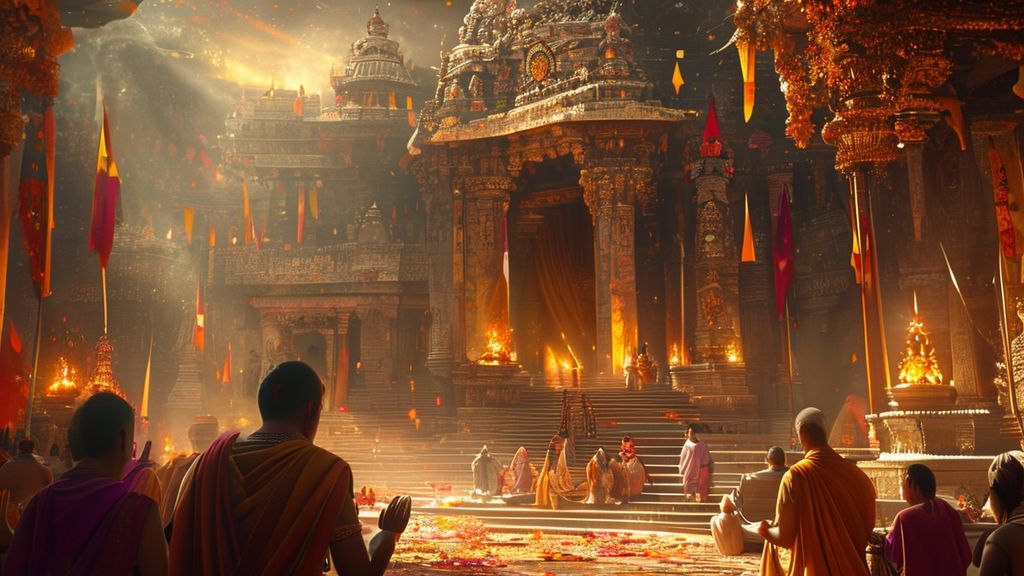
Kaal Sarp Dosha is a profound astrological configuration in Vedic Jyotisha where all seven principal planets are encircled between the shadowy nodes of Rahu (the serpent’s head) and Ketu (the serpent’s tail). This celestial alignment is believed to bring about various challenges, delays, and spiritual lessons in a native’s life, urging them towards karmic purification and deeper introspection according to Sanatan Dharma.
| Attribute | Details |
|---|---|
| **Origin** | Vedic Astrology (Jyotisha Shastra), derived from ancient principles concerning planetary positions and karmic influences. |
| **Associated Grahas** | Rahu (North Lunar Node) and Ketu (South Lunar Node), embodying serpentine energies and karmic debts. |
| **Primary Effects** | Obstacles, struggles, sudden downfalls, health issues, relationship discord, professional instability, and a strong push towards spiritual awakening. |
| **Scripture Reference** | While not explicitly named, its principles are rooted in the wisdom of **Brihat Parashara Hora Shastra**, **Phaladeepika**, and other classical Jyotisha texts which describe Rahu-Ketu’s influences and planetary configurations. The Puranas narrate the genesis of Rahu and Ketu. |
Introduction to Kaal Sarp Dosha: A Karmic Blueprint
In the vast ocean of Vedic Astrology, known as Jyotisha Shastra, certain planetary alignments are deemed particularly potent, carrying significant karmic implications. Among these, Kaal Sarp Dosha stands as a formidable configuration, frequently discussed and often misunderstood. It is not merely a curse, but a profound indicator of a soul’s journey, reflecting unresolved karmas from past lives that manifest as specific challenges in the current incarnation. This dosha, literally meaning “time-serpent affliction,” signifies a period where the native experiences delays, obstacles, and an intense process of self-discovery, ultimately guiding them towards spiritual evolution and righteous living. Understanding Kaal Sarp Dosha is crucial for every sincere seeker on the path of Dharma, for it offers not only a diagnosis of life’s hurdles but also a clear pathway to mitigation and spiritual transcendence. It is an invitation to engage deeply with one’s destiny and to embrace the transformative power of divine grace, aligning with the timeless wisdom propagated by revered platforms like Hindutva.online.
The Puranic Genesis of Rahu and Ketu: The Cosmic Serpent
To truly grasp the essence of Kaal Sarp Dosha, one must first comprehend the profound mythology surrounding Rahu and Ketu, the two shadow planets central to this astrological condition. Their origin is beautifully chronicled in the sacred Puranas, particularly the **Vishnu Purana** and the **Bhagavata Purana**, as part of the epochal event known as the Samudra Manthan, the churning of the cosmic ocean.
During this divine endeavor, Devas (demigods) and Asuras (demons) collaborated to extract Amrita, the nectar of immortality. When the Amrita finally emerged, Lord Vishnu, in His enchanting form as Mohini, began distributing it exclusively to the Devas, ensuring their invincibility against the Asuras. However, an astute Asura named Svarbhanu, disguised himself as a Deva and managed to partake of a drop of the sacred nectar. The Sun (Surya) and Moon (Chandra) immediately recognized the deception and alerted Lord Vishnu.
Before the Amrita could fully descend into Svarbhanu’s throat, Lord Vishnu, wielding His divine Sudarshana Chakra, severed the Asura’s head. Since a portion of the Amrita had touched his throat, Svarbhanu’s head and body attained immortality. The head became Rahu, the ascending lunar node, perpetually resentful of the Sun and Moon, leading to eclipses as he attempts to swallow them. The body, headless and powerful, became Ketu, the descending lunar node. Together, Rahu and Ketu represent the karmic axis, the past and future karmic imprints that heavily influence a soul’s journey. This serpent-like duality, constantly moving in retrograde motion, forms the very foundation of the Kaal Sarp Dosha, symbolizing being ‘caught’ or ‘hemmed in’ by these potent karmic forces.
Astrological Principles and Their Scientific Basis
In the venerable science of Jyotisha, Kaal Sarp Dosha is observed when all seven visible planets – Surya (Sun), Chandra (Moon), Mangal (Mars), Budha (Mercury), Guru (Jupiter), Shukra (Venus), and Shani (Saturn) – are positioned within the axis created by Rahu and Ketu in a birth chart. This means the planets are literally “sandwiched” between the serpent’s head and tail. The astrological implication is that the individual’s life energies and planetary influences become somewhat constrained or overshadowed by the intense karmic agenda of Rahu and Ketu.
There are twelve primary types of Kaal Sarp Dosha, each named after a legendary serpent and determined by the house Rahu occupies in the birth chart. For instance, if Rahu is in the 1st house and Ketu in the 7th, with all other planets between them, it’s called Anant Kaal Sarp Dosha, affecting personality, health, and relationships. If Rahu is in the 2nd and Ketu in the 8th, it’s Kulik Kaal Sarp Dosha, impacting wealth, family, and longevity. Other types include Vasuki, Shankhapal, Padma, Mahapadma, Takshak, Karkotak, Shankhnad, Patak, Vishadhar, and Sheshnag. Each type brings specific challenges related to the houses involved, highlighting areas of life where past karmas require attention and resolution.
The “scientific basis” in Jyotisha refers to its systematic application of astronomical observations and mathematical calculations to predict planetary influences on human life, a correlation observed and refined over millennia. While not a science in the modern empirical sense, its intricate system of dasha periods, planetary aspects, and house significations demonstrates a profound understanding of cosmic rhythms and their subtle effects on our existence, akin to a spiritual physics of karma.
Rituals and Puja Vidhi for Kaal Sarp Nivaran
Addressing Kaal Sarp Dosha requires sincere and systematic remedial measures, primarily through the performance of the Kaal Sarp Dosha Nivaran Puja. This sacred ritual aims to appease Rahu and Ketu, mitigate the dosha’s negative effects, and invoke divine blessings for peace and progress. The most renowned places for performing this puja are Trimbakeshwar Temple near Nashik, Maharashtra (a prominent Jyotirlinga), Ujjain (another Jyotirlinga city), and Srikalahasti Temple in Andhra Pradesh, revered for its Rahu-Ketu Puja.
Here is a general outline of the Puja Vidhi:
- Sankalpa: The devotee, guided by the priest, takes a solemn vow (Sankalpa) to perform the puja for the mitigation of Kaal Sarp Dosha and for general well-being.
- Ganesh Puja: Worship of Lord Ganesha, the remover of obstacles, is performed at the outset to ensure the smooth completion of the ritual.
- Navagraha Puja: A comprehensive worship of all nine planets (Navagrahas) is conducted to balance their energies and receive their blessings.
- Rahu-Ketu Jaap: Chanting specific mantras for Rahu and Ketu (at least 1,25,000 times over a prescribed period, often performed by qualified priests) to pacify their malefic influences.
- Shiva Puja & Abhishek: Lord Shiva is considered the supreme deity who controls Rahu and Ketu. An elaborate Abhishek (ritual bathing) of the Shiva Lingam, often with milk, water, honey, and other sacred ingredients, is performed, accompanied by the chanting of Om Namah Shivaya and Mahamrityunjaya Mantra.
- Offering of Silver Serpents: Small idols of silver serpents (Nagas) are offered into a flowing river or consecrated in the temple, symbolizing the surrender and pacification of the serpentine energies.
- Purnahuti & Aarti: The ritual culminates with a Homa (fire sacrifice) where offerings are made to the divine, followed by Aarti (waving of lamps) and distribution of Prashad (consecrated food).
- Donations: Offering food, clothes, or money to Brahmins and the needy is an important aspect of mitigating karmic debts.
Sincerity, faith, and adherence to Vedic injunctions are paramount for the efficacy of this puja.
Mantras and Chants for Pacification
Chanting specific mantras is a powerful way to connect with divine energies and mitigate the effects of Kaal Sarp Dosha. Regular and devoted recitation purifies the mind, strengthens the aura, and invokes grace.
- Rahu Beej Mantra: ॐ भ्रां भ्रीं भ्रौं सः राहवे नमः (Om Bhram Bhreem Bhroum Sah Rahave Namaha) – Chant 108 times daily.
- Ketu Beej Mantra: ॐ स्रां स्रीं स्रौं सः केतवे नमः (Om Sram Sreem Sroum Sah Ketave Namaha) – Chant 108 times daily.
- Mahamrityunjaya Mantra: This powerful mantra dedicated to Lord Shiva bestows health, longevity, and protection from untimely death and severe afflictions. ॐ त्र्यम्बकं यजामहे सुगन्धिं पुष्टिवर्धनम्। उर्वारुकमिव बन्धनान् मृत्योर्मुक्षीय मामृतात्॥ (Om Tryambakam Yajamahe Sugandhim Pushtivardhanam Urvarukamiva Bandhanan Mrityor Mokshiya Maamritat) – Chanting this daily is highly beneficial.
- Shiva Panchakshari Mantra: ॐ नमः शिवाय (Om Namah Shivaya) – Constant remembrance of Lord Shiva, who controls Rahu and Ketu, is a potent remedy.
- Vishnu Sahasranamam: Reciting the thousand names of Lord Vishnu invokes His protection and helps in overcoming all adversities.
Dos and Don’ts for Natives with Kaal Sarp Dosha
Living with Kaal Sarp Dosha involves not just performing pujas but also adopting a lifestyle aligned with Dharmic principles. Adherence to these guidelines can significantly enhance the efficacy of remedies and foster inner peace.
Dos:
- Perform Kaal Sarp Nivaran Puja: With utmost faith and devotion at a consecrated place like Trimbakeshwar or Srikalahasti.
- Regular Mantra Chanting: Dedicate time daily to chant Rahu-Ketu Beej Mantras, Mahamrityunjaya Mantra, and Shiva Panchakshari Mantra.
- Worship Lord Shiva: Visit Shiva temples regularly, offer water (Abhishek) to the Lingam, especially on Mondays and during Mahashivaratri.
- Worship Lord Vishnu: Recite Vishnu Sahasranamam and offer prayers to Lord Vishnu to strengthen divine protection.
- Charity and Donations: Regularly donate food, clothes, and other necessities to the poor and needy, particularly on Saturdays. Feeding birds and animals is also considered auspicious.
- Respect Serpents: Avoid harming snakes; instead, offer milk and prayers on Nag Panchami.
- Fasting: Observe fasts on Mondays (for Lord Shiva) and Saturdays (for Shani Dev and Rahu/Ketu).
- Consult a Qualified Astrologer: Seek guidance from an experienced Vedic astrologer for personalized remedies and gem recommendations (e.g., Gomed for Rahu, Cat’s Eye for Ketu, if suitable).
Don’ts:
- Engage in Unethical Conduct: Avoid falsehood, deceit, greed, and any actions that generate negative karma.
- Disrespect Elders: Always show reverence to parents, gurus, and elders.
- Harm Animals: Especially snakes or any creature associated with Rahu and Ketu.
- Fear the Dosha: While its effects can be challenging, fear paralyzes. Approach it with faith, courage, and a proactive attitude towards remedies.
- Procrastinate on Remedies: Do not delay performing the prescribed pujas and spiritual practices.
Frequently Asked Questions About Kaal Sarp Dosha
What are the common symptoms or effects of Kaal Sarp Dosha in a native’s life?
Natives with Kaal Sarp Dosha often experience a range of challenges, including sudden financial losses, persistent health issues, marital discord, lack of peace of mind, career stagnation, delays in auspicious events like marriage or childbirth, betrayal from trusted individuals, and a general feeling of unfulfillment despite sincere efforts. They might also have vivid, often disturbing dreams involving snakes.
Is Kaal Sarp Dosha always detrimental, or can it have positive aspects?
While often associated with challenges, Kaal Sarp Dosha is not entirely negative. Many great personalities in history have had this dosha. It can act as a catalyst for profound spiritual growth, forcing individuals to confront their inner selves, develop resilience, and turn towards spirituality. If remedies are sincerely performed, the individual can attain great spiritual insight, develop strong intuition, and achieve significant success after initial struggles, transforming challenges into stepping stones for higher consciousness.
Can Kaal Sarp Dosha be completely removed from a birth chart?
The astrological alignment of Kaal Sarp Dosha, being a part of one’s birth chart (a snapshot of the heavens at birth), cannot be physically “removed.” However, its negative effects and karmic burdens can be significantly mitigated, pacified, and transformed through sincere and consistent remedial measures, including specialized pujas, mantra chanting, righteous living, and charity. The aim is to balance the planetary energies and purify the associated karma, allowing the native to navigate life’s challenges with greater ease and spiritual fortitude.
The Dharmic Significance: A Path to Karmic Purification
Kaal Sarp Dosha, far from being a mere astrological anomaly, serves as a profound indicator of our intricate karmic journey within Sanatan Dharma. It highlights the principle of Karma Vipaka—the ripening of past actions. This dosha urges us to understand that life’s challenges are not random but are often reflections of unresolved spiritual lessons or debts from previous births. By acknowledging and addressing Kaal Sarp Dosha through prescribed remedies, a devotee engages in a conscious act of karmic purification (Karma Kshyaya).
The emphasis on worshipping Lord Shiva, who holds the cosmic serpent Vasuki around His neck, and Lord Vishnu, the sustainer of Dharma, underscores the profound truth that ultimate liberation from any dosha lies in surrender to the Divine. It reinforces the importance of Bhakti (devotion), Seva (service), and Daan (charity) as integral components of spiritual growth. Ultimately, Kaal Sarp Dosha, when understood and approached with faith, becomes a powerful tool for self-transformation, guiding the individual towards a life of greater Dharma, spiritual awakening, and ultimately, Moksha, aligning perfectly with the profound teachings preserved and shared by portals like Hindutva.online for seekers worldwide. It reminds us that every challenge is an opportunity for grace, and every struggle a step closer to the divine.
