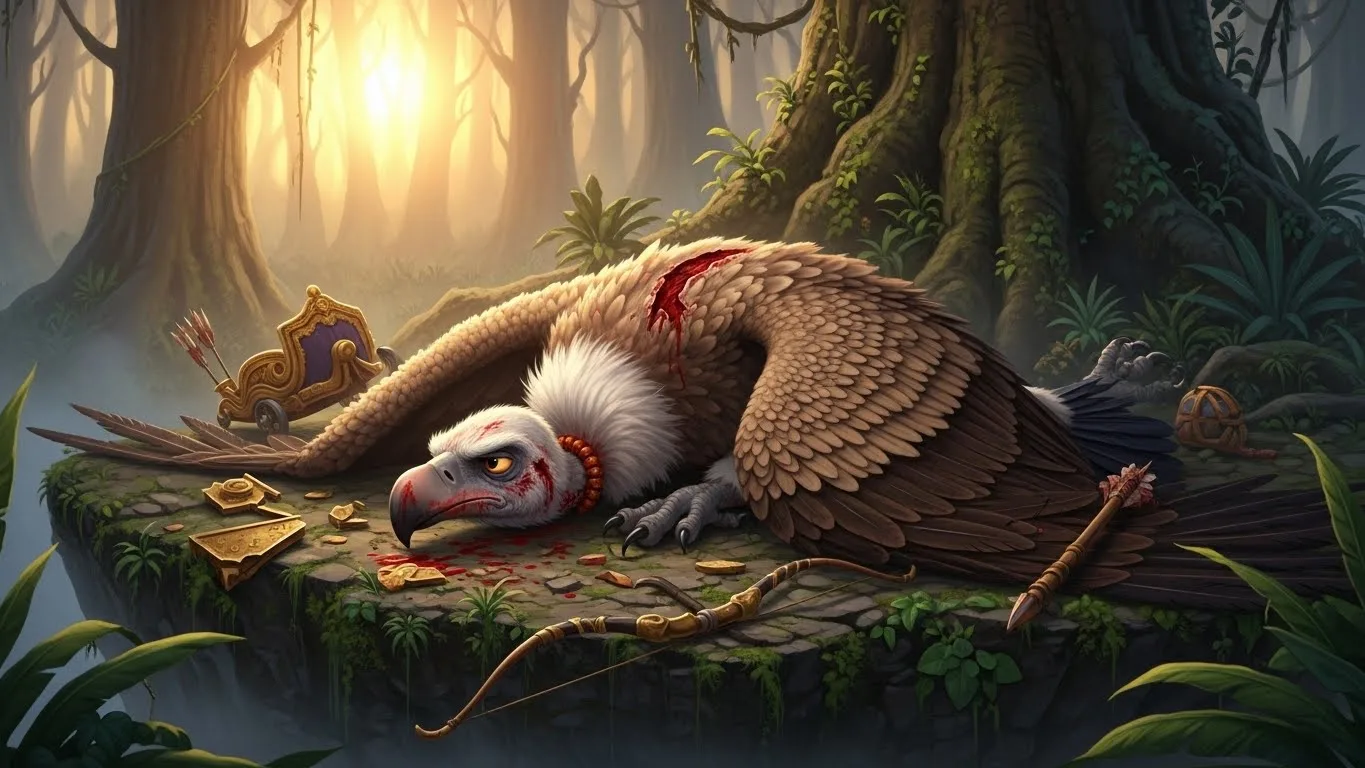
Who Was Jatayu in Ramayana In the vast tapestry of the Ramayana, one of humanity’s greatest epic narratives, countless characters embody heroic virtues and spiritual teachings. Yet few inspire as much reverence and emotional resonance as Jatayu—the noble vulture king who sacrificed his life attempting to prevent Sita’s abduction by the demon king Ravana. Though not a central protagonist like Rama, Lakshmana, or Hanuman, Jatayu’s brief but luminous appearance in the epic represents one of its most profound teachings about duty (dharma), loyalty, courage, and the ultimate rewards of selfless sacrifice.
His story, particularly his fierce aerial battle with Ravana and his dying moments in Rama’s arms, continues to move devotees and readers across millennia, demonstrating that heroism requires not physical might alone but moral courage—the willingness to stand against injustice even when victory appears impossible. In 2025, as the values of dharma and sacrifice remain central to Hindu civilization, Jatayu’s tale offers timeless lessons about choosing righteousness over safety, honoring commitments despite personal cost, and understanding that death in service of dharma represents the highest fulfillment of life’s purpose.
This comprehensive exploration examines Jatayu’s divine lineage, his relationship with King Dasharatha and Lord Rama, the dramatic circumstances of his heroic battle with Ravana, his final moments granting crucial information to Rama, and the spiritual significance of his moksha (liberation) achieved through Rama’s grace.
Divine Lineage: Son of Aruna, Nephew of Garuda
Understanding Jatayu’s significance requires recognizing his celestial origins and divine heritage, which elevated him far above ordinary birds.
The Lineage of Sage Kashyapa
Jatayu was born into an illustrious celestial lineage tracing back to Prajapati Daksha, one of the sons of Lord Brahma. His grandfather was the great sage Kashyapa, one of the Saptarishis (seven great sages) who married thirteen daughters of Daksha, each mother to different species of beings. Kashyapa’s union with Tamra produced lineages of birds, including the mighty Garuda line.
Aruna: Charioteer of the Sun God
Jatayu’s father was Aruna, the celestial charioteer who drives the sun god Surya’s chariot across the sky each day. Aruna himself was born from sage Kashyapa and Vinata, making him the elder brother of Garuda—the mighty eagle who serves as Lord Vishnu’s vehicle (vahana). Aruna represents the reddish glow of dawn, the transitional moment between darkness and full daylight, symbolizing hope, renewal, and the dispelling of ignorance through divine light.
This illustrious parentage established Jatayu as no ordinary vulture but a demigod (devata) in avian form, possessing divine consciousness, extraordinary powers, and spiritual wisdom befitting his celestial heritage.
Sampati: The Elder Brother’s Sacrifice
Jatayu had an elder brother named Sampati, with whom he shared youthful adventures that would profoundly affect both their destinies. According to legend preserved in the Ramayana, the two brothers once engaged in a competition to determine who could fly higher. In their youthful exuberance and competitive spirit, they soared higher and higher, approaching dangerously close to the sun itself.
As they neared Surya’s blazing sphere, the intense heat began scorching their wings. Sampati, recognizing the mortal danger his younger brother faced, immediately spread his own wings protectively over Jatayu, shielding him from the sun’s devastating rays. This selfless act saved Jatayu’s life but completely destroyed Sampati’s wings. He fell to earth near the Vindhya Mountains by the southern sea, unable ever to fly again, spending the remainder of his life grounded—a tremendous sacrifice for a creature born to soar through the heavens.
This early episode established the family tradition of selfless sacrifice for others’ welfare—a quality Jatayu would later demonstrate in his own ultimate sacrifice. The bond between the brothers, marked by Sampati’s protective love, foreshadowed Jatayu’s similar protective instinct toward Sita when he witnessed her abduction.
The Role of Garuda
As nephew of Garuda—the king of birds and vehicle of Lord Vishnu—Jatayu inherited connections to the highest divine authorities. Garuda represents speed, martial prowess, and the destruction of serpents (symbolizing ego and ignorance), qualities that partially manifested in Jatayu’s own character. This relationship to Garuda also established Jatayu’s natural allegiance to divine forces opposing evil, making his intervention against Ravana not merely personal but cosmically ordained.
Friendship with King Dasharatha: The Sacred Promise
Jatayu’s connection to Rama’s family predated Rama’s exile, rooted in a deep friendship with Rama’s father, King Dasharatha of Ayodhya.
The Bond of Friendship
Jatayu was a close friend and companion of King Dasharatha, having known him for many years. Ancient texts suggest they had fought battles together, with Jatayu providing aerial support and intelligence during Dasharatha’s military campaigns. Their friendship transcended the boundaries between species, demonstrating that dharmic bonds unite all beings committed to righteousness regardless of form.
When Dasharatha learned that Rama would be exiled to the forest for fourteen years—a consequence of promises made to his wife Kaikeyi—he was devastated. Unable to prevent the exile due to his binding oath, Dasharatha sought other ways to ensure his beloved son’s safety during the dangerous forest sojourn.
Who Was Jatayu in Ramayana The Meeting at Panchavati
When Rama, Sita, and Lakshmana traveled through the forest toward their exile destination at Panchavati, they encountered a massive vulture who initially appeared threatening. Rama, ever vigilant in protecting Sita, confronted the bird, demanding to know his identity and purpose.
Jatayu respectfully introduced himself, revealing his identity as Jatayu, son of Aruna, and dear friend of King Dasharatha. He explained that he had been searching for them, honoring a promise made to Dasharatha. The old king, unable to accompany and protect his son in exile, had requested his friend Jatayu to watch over Rama, Sita, and Lakshmana during their forest sojourn.
The Sacred Vow of Protection
Jatayu pledged to serve as their guardian, particularly to protect Sita during times when the brothers might be absent hunting or performing other duties. Rama gratefully accepted this offer, recognizing the honor of being protected by such a noble being of divine heritage. This vow—made out of love for Dasharatha and respect for dharma—would ultimately cost Jatayu his life, transforming a promise of protection into an act of supreme sacrifice.
The relationship between Jatayu and Rama’s family exemplifies the Hindu principle that dharmic commitments create bonds stronger than death itself, and that honoring one’s word, especially to deceased friends, represents the highest expression of integrity.
The Abduction of Sita: Context for Jatayu’s Sacrifice
To understand Jatayu’s heroic intervention, we must recognize the context of Sita’s abduction—one of the Ramayana’s pivotal events setting in motion the epic war between Rama and Ravana.
The Golden Deer Deception
The demon king Ravana, ruler of Lanka, had become obsessed with possessing Sita after encountering her in the forest. To abduct her, Ravana devised a cunning plan involving his uncle Maricha, who possessed the power to assume any form. Maricha transformed into an extraordinarily beautiful golden deer, enchanting Sita with its supernatural radiance and graceful movements.
Sita, captivated by the magical creature, requested Rama to capture it for her. Though Rama suspected deception—recognizing that such an unnatural creature likely represented demonic trickery—he could not refuse his beloved wife’s request. Instructing Lakshmana to remain vigilant in protecting Sita, Rama pursued the golden deer deep into the forest.
Rama’s Absence and Lakshmana’s Departure
When Rama killed the deer (Maricha), the dying demon cried out in Rama’s voice, “Oh Sita! Oh Lakshmana! Help me!” This desperate cry, perfectly imitating Rama’s tone, reached Sita and Lakshmana at their dwelling. Sita, terrified that Rama was in mortal danger, urged Lakshmana to rush to his brother’s aid immediately.
Lakshmana, understanding the trickery, initially refused to leave Sita unprotected, knowing this was precisely what their enemies wanted. However, Sita—overwhelmed with fear for Rama and not understanding the demonic deception—accused Lakshmana of harboring improper desires for her and caring more about possessing her than saving his brother. Unable to bear these unjust accusations and seeing her extreme distress, Lakshmana reluctantly departed, first drawing a protective line (Lakshmana Rekha) around the dwelling that Sita must not cross.
Ravana’s Approach and Abduction
With both brothers absent, Ravana approached disguised as a wandering ascetic seeking alms. When Sita crossed the protective line to offer him food, Ravana revealed his true terrifying form, grabbed her forcibly, and placed her in his celestial flying chariot (Pushpaka Vimana), soaring into the sky toward Lanka.
Sita cried out desperately for help, her screams echoing through the forest. Though no human could hear her distress, one being did—the vigilant Jatayu, who from his perch had been fulfilling his promise to watch over Rama’s family.
The Epic Battle: Jatayu vs. Ravana
What followed represents one of the Ramayana’s most emotionally powerful episodes—an elderly vulture king confronting the universe’s most powerful demon in defense of dharma and a helpless woman’s honor.
Jatayu’s Decision to Intervene
Upon witnessing Ravana’s abduction of Sita, Jatayu faced a critical choice. He was old, far past his prime, and Ravana was arguably the most powerful being in creation—having defeated even the gods and conquered the three worlds. Logic suggested that any intervention would prove futile and fatal. Yet Jatayu never hesitated.
Multiple factors compelled his intervention: his sacred promise to Dasharatha to protect Rama’s family, his dharmic duty as a king to protect the innocent and helpless, his natural revulsion at witnessing a woman being abducted against her will, and his understanding that remaining passive would constitute moral cowardice, making him complicit in evil.
The Confrontation Begins
Jatayu flew at tremendous speed to intercept Ravana’s chariot. Positioning himself in Ravana’s path, he declared boldly: “Halt! I am Jatayu, king of vultures and friend of King Dasharatha. How dare you commit such an unrighteous act? Kings are sworn to protect women’s honor, not violate it! You act like a common thief, abducting a princess while her protector is absent. This is beneath even demons! Release Sita immediately, or face the consequences!”
Ravana, confident in his invincibility and angered by this unexpected challenge from a mere bird, dismissed Jatayu’s warnings with contempt. “Old bird, you dare obstruct Ravana, conqueror of the three worlds? Move aside or perish! This matter does not concern you.”
The Fierce Combat
Jatayu’s response was immediate action. He attacked Ravana’s chariot with tremendous force, his powerful talons tearing at the vehicle’s structure, his massive wings battering Ravana, and his sharp beak striking repeatedly at the demon king. The intensity of the assault forced Ravana to land and fight on foot.
The battle that ensued was fierce and prolonged. Despite his advanced age, Jatayu fought with extraordinary valor and skill, drawing upon his divine heritage and martial training. He:
- Tore at Ravana with razor-sharp talons, inflicting deep wounds
- Struck repeatedly with his powerful beak, drawing blood
- Used his massive wings as weapons, battering Ravana with tremendous force
- Damaged Ravana’s weapons and ornaments
- Protected Sita from harm while maintaining his attack
For a time, the tide of battle seemed uncertain. Jatayu’s ferocity and righteous fury enabled him to wound even the mighty Ravana, who bled from numerous gashes and realized this opponent was far more formidable than expected.
Ravana’s Terrible Retaliation
However, Ravana possessed not merely physical strength but magical weapons and supernatural powers accumulated through thousands of years of penance and conquest. Enraged that a mere bird had wounded him and delayed his journey, Ravana drew his sword Chandrahas (Moon-blade)—a divine weapon gifted by Lord Shiva himself.
With brutal efficiency, Ravana struck at Jatayu’s wings—the source of a bird’s power and freedom. The blessed sword sliced through flesh, bone, and feather, severing both of Jatayu’s mighty wings. The king of vultures, who had soared through the heavens for countless years, fell to the earth like a stone, his life’s blood flowing from grievous wounds.
Ravana, leaving the dying bird crumpled on the ground, continued his flight toward Lanka with Sita, whose anguished cries and desperate attempts to leave markers for Rama’s benefit went unheeded by the pitiless demon king.
The Final Meeting: Jatayu’s Information and Moksha
Though mortally wounded, Jatayu’s consciousness remained focused on completing his mission—providing Rama with crucial information about Sita’s fate.
Clinging to Life with Purpose
Gravely injured and in tremendous pain, Jatayu fought death itself, refusing to surrender his life until he could fulfill one final duty. He knew that without information about Sita’s abduction, Rama would search blindly, wasting precious time while Sita suffered in captivity. Jatayu’s determination to survive long enough to inform Rama demonstrates that consciousness directed by dharmic purpose can transcend even mortal injury.
The location where Jatayu fell—believed to be present-day Chadayamangalam in Kerala’s Kollam district—became a sacred site, later commemorated by the world’s largest bird sculpture at Jatayu Earth’s Center.
Rama and Lakshmana’s Discovery
When Rama and Lakshmana returned to their dwelling to find Sita missing, they began desperately searching the forest, calling her name and examining every possible location. Their search eventually brought them to the spot where Jatayu lay dying, surrounded by broken feathers and pools of blood.
Initially, Rama wondered if this massive wounded bird might itself be the abductor. But Jatayu, using his remaining strength, spoke: “Rama, my son, it is I—Jatayu, friend of your father Dasharatha. Do not mistake me for your enemy. I fought to protect Sita, but I have failed.”
The Crucial Information
With labored breath, Jatayu provided the critical intelligence that would enable Sita’s eventual rescue:
- Sita had been abducted by Ravana, the demon king of Lanka
- The abduction occurred while both brothers were absent, fulfilling Ravana’s clever plan
- Ravana flew southward toward his island kingdom
- Sita remained alive and had not been harmed beyond the trauma of abduction
- Ravana’s power was immense, requiring careful planning to defeat him
This information proved invaluable, focusing Rama’s search southward and identifying his adversary, enabling the strategic alliances and preparations that would ultimately lead to Ravana’s defeat and Sita’s rescue.
The Gift of Moksha
Having delivered this crucial message, Jatayu’s life force began failing. Rama, recognizing the nobility of Jatayu’s sacrifice and his deep connection to Dasharatha, was moved to tears. He held the dying vulture king tenderly, honoring him as he would his own father.
Understanding that Jatayu’s death was imminent, Rama invoked his divine powers. He drove an arrow into the ground, summoning the seven sacred rivers (Ganga, Yamuna, Godavari, Saraswati, Narmada, Sindhu, and Kaveri) to that spot, creating a sacred tirtha (pilgrimage site). As the holy waters flowed, Rama sprinkled them over Jatayu while chanting sacred mantras.
Jatayu achieved moksha—complete liberation from the cycle of birth and death—directly from Rama’s hands. A celestial chariot of fire descended from Vaikuntha (Vishnu’s heaven), and Jatayu’s soul, freed from its wounded body, ascended to the divine realm, receiving the highest spiritual reward.
The Funeral Rites
Rama then performed Jatayu’s last rites with the same respect and ritual precision he would have accorded his own father. He instructed Lakshmana to gather wood for the funeral pyre, then personally placed Jatayu’s body on the pyre and ignited the sacred fire. Following cremation, Rama performed all necessary pinda (food offerings) and tarpana (water offerings) for Jatayu’s soul, completing the comprehensive funeral ceremonies.
This extraordinary honor—receiving funeral rites from Lord Rama himself, an avatar of Vishnu—demonstrated the supreme value Rama placed on Jatayu’s sacrifice. It established the principle that spiritual nobility transcends species, and that selfless action in defense of dharma earns the highest divine recognition.
Spiritual Significance and Symbolism
Jatayu’s story carries profound spiritual teachings that extend far beyond the narrative itself.
Dharma Over Self-Preservation
Jatayu exemplifies the principle that dharmic duty supersedes personal safety. He knew confronting Ravana would likely prove fatal, yet never considered allowing evil to proceed unopposed. His example teaches that moral courage—standing against wrongdoing despite personal risk—represents life’s highest purpose.
The Value of Keeping One’s Word
Jatayu’s promise to Dasharatha, made to a dying friend, bound him even unto death. Hindu tradition emphasizes that a person’s word constitutes their integrity’s foundation. Breaking commitments, especially those made to protect others, represents spiritual degradation regardless of circumstances. Jatayu’s unwavering adherence to his promise exemplifies satya (truth) as a non-negotiable principle.
Protection of the Vulnerable
Jatayu’s intervention specifically focused on protecting Sita—a woman being forcibly abducted. His sacrifice reinforces the dharmic principle that the strong must protect the vulnerable, that women’s honor and autonomy deserve defense at any cost, and that remaining passive while witnessing injustice constitutes complicity in evil.
Old Age and Heroism
Jatayu was elderly, well past his physical prime, yet his age did not excuse him from dharmic duty. His example teaches that moral obligation continues throughout life, physical limitations do not absolve one from standing against evil, and spiritual courage derives from character, not youthful vigor.
Divine Grace and Liberation
Jatayu’s moksha achieved through Rama’s blessing demonstrates that selfless sacrifice in service of dharma grants the highest spiritual reward—liberation from samsara (the cycle of rebirth). His direct ascension to Vaikuntha without intermediate stops illustrates the principle that dying while performing one’s dharmic duty represents the most auspicious death possible.
Jatayu’s Legacy: Remembrance and Inspiration
Jatayu’s sacrifice continues to inspire devotion and serve as a moral exemplar across Hindu civilization.
The Jatayu Earth’s Center
In modern Kerala, the Jatayu Earth’s Center at Chadayamangalam features the world’s largest bird sculpture—a massive representation of Jatayu in his dying moments, sprawled across the rocks where legend states he fell. Created by sculptor Rajiv Anchal, this 200-foot-long, 150-foot-wide, 70-foot-high monument attracts pilgrims and tourists, keeping Jatayu’s memory alive and making his sacrifice tangible for contemporary audiences. The site includes a museum, cable car, and multimedia presentations depicting the epic battle.
Literary and Artistic Depictions
Jatayu appears prominently in countless Ramayana adaptations across Indian languages, theatrical performances, dance dramas (including Kathakali and Kuchipudi), paintings and sculptures throughout South and Southeast Asia, and modern films and television series. Each generation rediscovers his story, finding renewed relevance in his example of sacrificial heroism.
Spiritual Teachings
Hindu spiritual teachers frequently invoke Jatayu’s example when discussing the willingness to sacrifice for others, the importance of honoring commitments, the nature of true courage, and the spiritual rewards of dharmic action. His story serves as a counterpoint to cowardice masked as prudence, demonstrating that some battles must be fought regardless of probable outcome.
Frequently Asked Questions
Who was Jatayu in the Ramayana?
Jatayu was the noble vulture king, son of Aruna (Surya’s charioteer) and nephew of Garuda, making him a demigod in avian form. He was a close friend of King Dasharatha who promised to protect Rama, Sita, and Lakshmana during their forest exile. When Ravana abducted Sita, Jatayu fought the demon king fiercely in an epic aerial battle, attempting to rescue her. Though Ravana severed his wings, Jatayu survived long enough to inform Rama of the abduction and Ravana’s southward direction, providing crucial intelligence. Rama granted Jatayu moksha (liberation) and performed his last rites with supreme honor.
Why did Jatayu fight Ravana if he knew he would lose?
Jatayu fought Ravana because dharmic duty superseded personal safety considerations. He had promised King Dasharatha to protect Rama’s family, witnessed an innocent woman being forcibly abducted, and understood that remaining passive while evil occurred would constitute moral cowardice. Jatayu exemplifies the principle that some battles must be fought regardless of probable outcome—that standing against injustice represents life’s highest purpose even when victory appears impossible. His sacrifice demonstrates that moral courage derives from choosing righteousness over self-preservation, earning him moksha directly from Rama’s hands.
What information did Jatayu give to Rama before dying?
Before dying, Jatayu provided Rama with crucial intelligence: Sita had been abducted by Ravana, the demon king of Lanka (not some random demon); Ravana flew southward toward his island kingdom; the abduction exploited Rama and Lakshmana’s absence through clever deception; and Sita remained alive though traumatized. This information focused Rama’s search in the correct direction, identified his adversary, and enabled the strategic alliances (particularly with Sugriva and Hanuman) that ultimately led to Sita’s rescue. Without Jatayu’s intelligence, Rama would have searched blindly, wasting precious time.
How did Jatayu achieve moksha?
Rama granted Jatayu moksha (liberation from the cycle of rebirth) as reward for his selfless sacrifice. After Jatayu delivered his crucial message, Rama—recognizing the vulture king’s nobility—drove an arrow into the ground, summoning the seven sacred rivers to create a holy tirtha. He sprinkled holy waters over dying Jatayu while chanting sacred mantras. Jatayu’s soul was freed from his wounded body, and a celestial chariot of fire descended from Vaikuntha (Vishnu’s heaven) to carry him directly to the divine realm. Rama then performed complete funeral rites, honoring Jatayu as he would his own father.
What is the relationship between Jatayu and Sampati?
Sampati was Jatayu’s elder brother, also son of Aruna. In their youth, the brothers competed to see who could fly higher, approaching dangerously close to the sun. When the intense heat began scorching their wings, Sampati selflessly spread his wings protectively over Jatayu, shielding him but completely destroying his own wings in the process. Sampati fell to earth near the Vindhya Mountains, unable to fly again. This sacrifice established the family tradition of selfless protection. Later in the Ramayana, Sampati—grounded by his missing wings—provided crucial information about Sita’s location in Lanka to Hanuman’s search party.
Where did Jatayu fall after fighting Ravana?
Jatayu fell at a location traditionally identified as present-day Chadayamangalam in Kollam district of Kerala, India. This site, believed to be where the wounded vulture king crashed after Ravana severed his wings, has become sacred in Hindu tradition. The modern Jatayu Earth’s Center features the world’s largest bird sculpture (200 feet long, 150 feet wide, 70 feet high) commemorating Jatayu’s sacrifice. The sculpture, created by Rajiv Anchal, depicts Jatayu in his dying moments sprawled across rocks, with an accompanying museum, temple, and cultural center honoring his legacy.
Why did Rama perform funeral rites for a bird?
Rama performed elaborate funeral rites for Jatayu—treating him with the same respect accorded to his own father—because Jatayu’s spiritual nobility and selfless sacrifice transcended species boundaries. Hindu dharma recognizes that consciousness and character, not physical form, determine spiritual worth. Jatayu had fulfilled his dharmic duty perfectly, keeping his promise to Dasharatha, fighting to protect an innocent woman, and providing crucial intelligence despite mortal wounds. Rama’s performance of last rites acknowledged this nobility, demonstrated gratitude for Jatayu’s sacrifice, and established the principle that dharmic action earns divine recognition regardless of one’s birth or form.
What does Jatayu symbolize in Hindu philosophy?
Jatayu symbolizes dharma over self-preservation—choosing righteousness despite personal cost; unwavering loyalty to promises and commitments; protection of the vulnerable and innocent; moral courage transcending physical limitations; the principle that old age does not excuse one from duty; selfless sacrifice in service of higher principles; and the spiritual reward (moksha) granted to those who die fulfilling dharmic obligations. His story teaches that some battles must be fought regardless of probable outcome, that remaining passive while evil occurs constitutes complicity, and that death in service of dharma represents the most auspicious culmination of life’s purpose.
About the Author
Sandeep Vohra – PhD in Vedic Studies and Ancient Indian History
Sandeep Vohra is a distinguished scholar specializing in ancient Indian history, Vedic traditions, and Hindu cultural practices. With over 15 years of research experience focused on decolonizing historical narratives, he has published extensively on the Ramayana, Mahabharata, epic characters and their philosophical significance, dharmic principles in Hindu civilization, and the enduring relevance of ancient wisdom for contemporary life. His work bridges academic rigor with accessible presentation, making complex mythological, philosophical, and spiritual concepts understandable to contemporary audiences seeking authentic knowledge about Hindu wisdom traditions.
