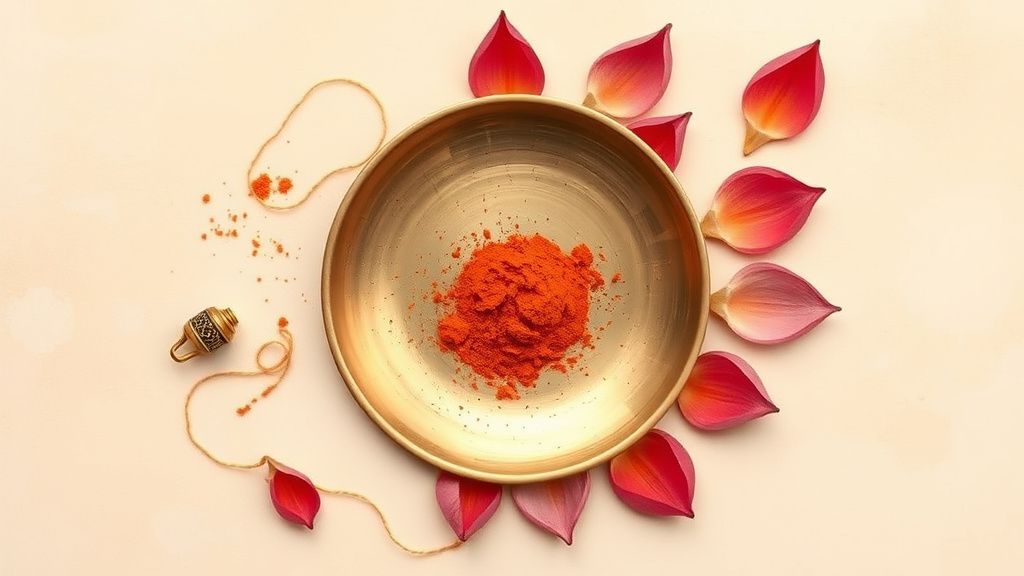
Applying tilak or bindi at the centre of the forehead has both a ritual rationale (the location is read in Hindu tradition as the ajna chakra, the sixth chakra, said to be the seat of intuition and inner sight) and a frequently quoted set of “scientific” claims that the practice stimulates pressure points or specific nerves. The tradition-side claims are documented in the Tantric texts and the Hatha Yoga Pradipika (15th century). The scientific-side claims are more recent and modestly supported. This article separates the two clearly, explains what each tradition actually says about the practice, and notes where the popular “science of tilak” articles overstate the empirical case.
The spiritual rationale: the ajna chakra
In the chakra system codified in texts like the Sat Chakra Nirupana (16th century), the Shiva Samhita and the Hatha Yoga Pradipika, the ajna chakra is the sixth of seven main chakras and is located between and slightly above the eyebrows. It is associated with the syllable Om, two petals, the colour indigo or white, and the deity Shiva-Shakti in union. In yogic discourse the ajna is the seat of the inner teacher and the gateway to higher states of meditation.
The forehead marking at this point is read as a focus aid: it makes the location of the ajna palpable, drawing the wearer’s attention back to it during the day. The practical use during meditation is documented in the Hatha Yoga Pradipika’s discussion of bhrumadhya drishti (gazing at the centre of the eyebrows). The tilak or bindi here functions as a physical anchor for that gaze in informal practice.
The chakra location vs the anatomical location
The ajna chakra is described in the Tantric texts as located in the sushumna nadi at the level of the brow centre. In gross anatomy this maps approximately to:
- The pineal gland: a pea-sized endocrine gland in the brain, posterior to the brow centre. Sometimes referenced in the modern “third eye” literature.
- The trigeminal nerve: the fifth cranial nerve, with the ophthalmic branch supplying the forehead area.
- The supratrochlear nerve: a small branch of the trigeminal supplying the centre of the forehead specifically.
The claim sometimes made that pressing or touching the tilak point stimulates the pineal gland is anatomically loose; the pineal sits roughly at the centre of the brain, not directly under the forehead skin, and is not reachable by surface pressure. The supratrochlear nerve is at the surface and can be touched; whether tilak application produces any measurable nervous response is not well studied.
The cooling and antiseptic claims for the materials
The materials used in tilak have some independently supported properties:
- Chandan (sandalwood paste): contains alpha-santalol, with mild cooling and anti-inflammatory effects on skin documented in several studies. The cooling effect on the forehead is genuine and noticeable.
- Vibhuti (sacred ash): sterile when produced from a clean fire, with mild absorbent properties. No special chemical activity beyond that of any clean ash.
- Kumkum (turmeric and slaked lime): turmeric contains curcumin, documented to have antimicrobial and anti-inflammatory effects. The lime alters the colour. Daily forehead application gives a small topical exposure that is unlikely to produce significant systemic effect.
- Gopichandan (Dwarka clay): a fine clay with absorbent and mildly cooling properties. No specific medical claims supported.
For what it’s worth, the defensible version of the “science of tilak” claim is that the materials used (especially chandan) have mild cooling and antiseptic properties, and that the practice places those materials at a focal point of attention; the version that claims tilak activates the pineal gland or stimulates specific cranial nerves is not well supported empirically and should be treated as folk-scientific commentary rather than research-backed fact.
The lead concern for commercial sindoor and kumkum
One scientific finding around forehead application that does deserve attention: commercial sindoor and some commercial kumkum products have been found to contain lead at levels well above safety limits. A 2017 study by Rutgers University researchers tested 95 sindoor samples from the US and India and found more than a third contained lead above the FDA threshold of 20 ppm, with some samples above 30,000 ppm. The US FDA recalled batches in 2008 and 2016 for this reason.
The traditional preparation of kumkum (turmeric plus slaked lime, possibly with alum) is safe; the unsafe products are synthetic red oxide of lead or mercury sulphide sold under the same name. Daily applicators should check the ingredient label and avoid loose-bulk vermilion of unknown composition. This is a documented concern with empirical support, unlike the broader “pressure points” claims.
When the application is most beneficial in tradition
- Before puja: tilak is applied before religious worship as preparation, signalling the wearer’s intent.
- Before meditation: the forehead focus is used as an anchor for bhrumadhya drishti.
- At samskaras: wedding, naming, thread ceremony and other rites of passage feature ceremonial tilak application.
- Daily after bath: in observant Hindu households the tilak or bindi is applied after the morning bath as a marker of the day’s beginning.
- At temple visits: received as prasad, a small kumkum dot is applied by the temple priest to visitors.
Common questions
Does tilak actually activate the pineal gland?
The pineal gland sits roughly at the centre of the brain and is not reachable by surface application. The claim that tilak activates the pineal is widely repeated in popular literature but is not supported by any peer-reviewed neuroscience study. The defensible claim is that tilak application is a focus aid that draws attention to the brow centre, which is the area associated with the ajna chakra in yogic tradition. The neurochemistry of the pineal is influenced by light exposure (via the retinohypothalamic tract), not by topical paste application.
Is there any medical benefit to the practice?
Mild ones, mostly from the materials. Sandalwood paste cools the skin and has documented anti-inflammatory effects. Turmeric in kumkum has antimicrobial properties on contact. These are small benefits at small doses. The larger benefits claimed in popular literature (improved concentration, reduced anxiety, headache relief) are not supported by controlled studies. The cultural and meditative benefit (the practice as part of a focused daily routine) is real but not specifically medical.
Is daily tilak application safe?
Yes, when the materials are traditional. Chandan, vibhuti from a clean source, and turmeric-and-lime kumkum are safe for daily application. The safety concern is with synthetic red sindoor and commercial kumkum that may contain lead or mercury; buyers should check labels and avoid loose-bulk vermilion. People with known allergies to sandalwood essential oils should patch-test before regular use. Vibhuti from an unclean source can cause skin irritation; using fresh ash from a clean fire is preferred.
Is the tilak shape arbitrary, or does it convey meaning?
The shape conveys clear meaning: the urdhva pundra (vertical U) is a Vaishnava marker, the tripundra (three horizontal lines) is a Shaiva marker, a red kumkum dot or vertical line is a Shakta marker, the combined tripundra with kumkum centre is Smarta. Within these, sub-traditions have finer-grained shapes. A trained observer reads the wearer’s sampradaya from the shape alone. The choice is community and lineage-determined, not personal taste.
A limitation worth noting
The “science of tilak” claims circulating in modern Hindu literature are uneven in their empirical support. The cooling and mild antiseptic effects of the traditional materials are real; the broader claims about pineal activation, nerve stimulation, and pressure-point health benefits are mostly folk-scientific assertions that do not rest on controlled studies. The lead-contamination concern with commercial sindoor is, however, well documented. Readers should treat traditional-rationale claims and empirical claims as separate categories, not collapse them into a single “scientifically proven” frame. This article makes the separation; many other sources on this topic do not.
For broader background see the Wikipedia overviews of tilaka, the ajna chakra, and sindoor.
