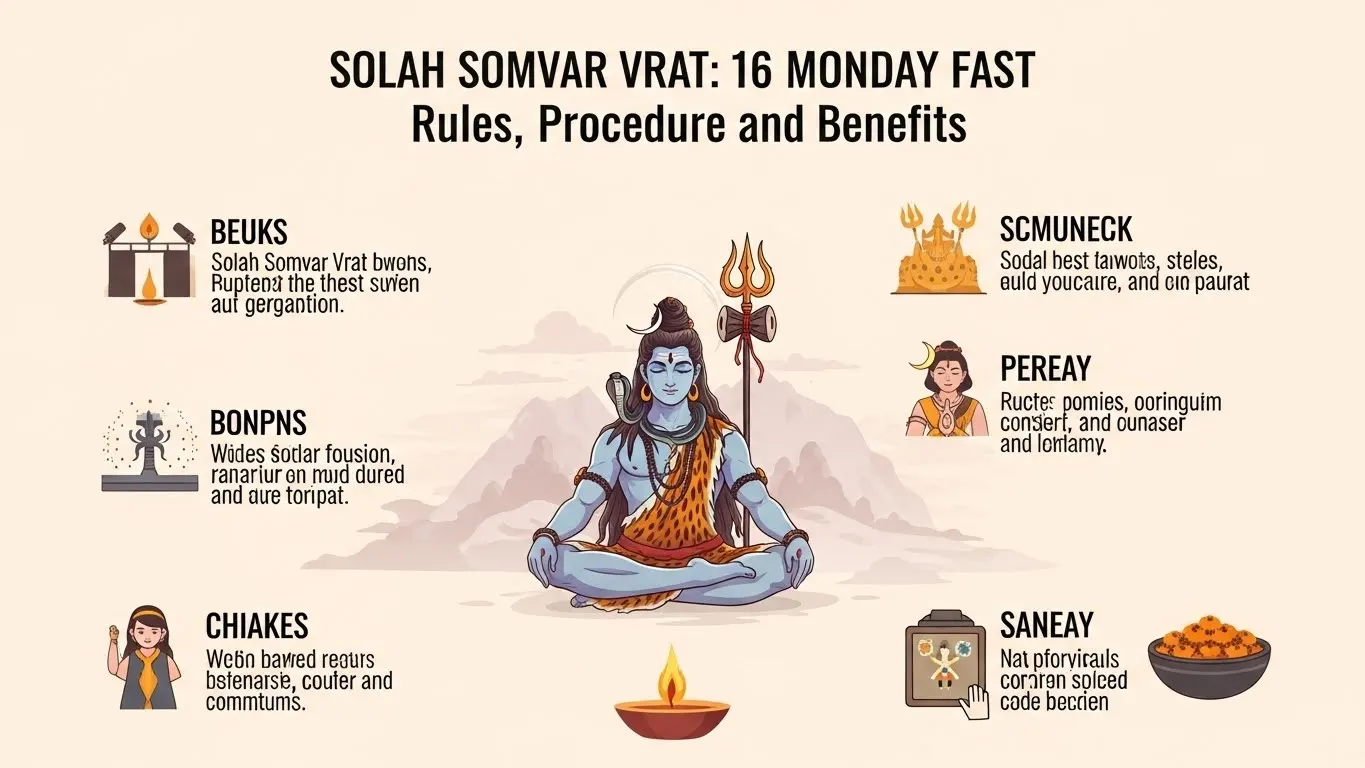
The Solah Somvar Vrat – literally meaning “sixteen Monday fasts” – represents one of Hinduism’s most powerful and popular devotional practices dedicated to Lord Shiva, the cosmic deity whose grace remains accessible to sincere devotees regardless of their social status, spiritual advancement, or material circumstances. Among the numerous vratas (religious vows) prescribed in Hindu tradition for various purposes,
Solah Somvar holds special prominence for its reputation of fulfilling heart’s deepest desires – particularly those related to finding suitable life partners, resolving marital difficulties, overcoming health challenges, achieving career success, and removing persistent obstacles that block progress in any life dimension. Monday (Somvar or Somavara) is considered Lord Shiva’s most auspicious day, as it’s ruled by the Moon (Chandra/Som), which adorns Shiva’s matted locks and represents.
His cooling, compassionate grace that soothes life’s burning anxieties and sorrows. The practice involves observing ritualistic fast for sixteen consecutive Mondays, typically commencing during the auspicious month of Shravan (July-August) though it can be initiated on any Shukla Paksha (waxing moon phase) Monday, followed by elaborate puja procedures including Rudrabhishek (bathing the Shiva Linga), chanting sacred mantras like
Om Namah Shivaya and the Mahamrityunjaya Mantra, offering specific items dear to Lord Shiva including Bel Patra (sacred wood apple leaves), white flowers, milk, honey, and Bhang (cannabis leaves traditionally offered to Shiva), and crucially, reading or listening to the Solah Somvar Katha – the sacred narrative explaining the vrata’s origin and power through the story of Goddess Parvati’s curse on a priest and his subsequent miraculous healing through this sixteen-week devotional discipline.
For 2025 practitioners, whether Hindu tradition followers seeking to honor ancient wisdom or contemporary spiritual seekers attracted to practices offering tangible life improvements through conscious devotional engagement, understanding the complete Solah Somvar procedure proves essential – not just the mechanical ritual steps but the deeper spiritual philosophy recognizing that sincere devotion combined with disciplined practice creates powerful transformation in both outer circumstances and inner consciousness, aligning individual will with divine grace in manner that removes karmic obstacles and attracts auspicious outcomes.
when the heart’s intention remains pure and the worship conducted with proper reverence, regularity, and faith that sustains through all sixteen weeks regardless of immediate visible results, culminating in the seventeenth Monday’s Udyapan (conclusion ceremony) that formally completes the vrata and releases its accumulated spiritual power into manifestation.
Origins and Significance: The Sacred Story
The Solah Somvar Vrat Katha – the sacred narrative explaining this practice’s origin and power – provides both historical context and spiritual validation for the sixteen-week devotional commitment, teaching profound lessons about divine compassion, the consequences of hasty speech, and the transformative power of sincere worship.
The Divine Game and the Priest’s Curse:
According to traditional accounts, the story begins when Lord Shiva and Goddess Parvati descended from their celestial abode on Mount Kailash to visit the mortal realm. During their earthly sojourn, they stopped at a beautiful Shiva temple in the ancient city of Amaravati. While resting there, Goddess Parvati expressed desire to play Chaupar (an ancient Indian dice game similar to Pachisi), and Lord Shiva agreed to amuse his beloved consort.
As the divine couple sat engaged in their game, a temple priest – a humble Brahmin who served the shrine – entered and observed them playing. Goddess Parvati, in playful mood, turned to the priest and asked: “Who will win this game?” The priest, without much thought and perhaps seeking to please the Divine Mother, immediately responded: “Lord Shiva will certainly win.”
However, as the game progressed, Goddess Parvati emerged victorious – directly contradicting the priest’s prediction. The Goddess, known for Her Shakti (fierce divine feminine power) as well as Her compassion, became angry upon winning. She believed the priest’s prediction had somehow influenced the game negatively for Her, or that he had spoken falsely to curry favor with Lord Shiva.
In Her anger, Parvati cursed the innocent priest, declaring that he would immediately suffer from leprosy – a dreaded disease that caused extreme physical suffering, social ostracization, and was considered incurable in that era. The moment the curse left Her lips, the unfortunate Brahmin’s skin began to show signs of the terrible affliction.
Lord Shiva, witnessing this scene, tried to counsel His consort to control Her anger and withdraw the curse. However, once spoken by a deity, curses follow immutable law and cannot be easily reversed. The poor priest, devastated and covered with painful lesions, left the temple carrying the burden of this divine curse for what he considered an innocent statement.
The Celestial Intervention:
Days turned into weeks and weeks into months as the priest suffered terribly from leprosy. His body covered with sores, shunned by society, unable to perform his priestly duties, he lived in misery wondering what karma from past lives had brought such terrible fate. He regularly prayed to Lord Shiva for relief, but received no immediate response.
One day, as the afflicted priest sat near the same Shiva temple where he had been cursed, a celestial Apsara (heavenly nymph) appeared before him in radiant, divine form. The Apsara, moved by compassion for the priest’s undeserved suffering, revealed to him the powerful secret of Solah Somvar Vrat – the sixteen Monday fasting and worship practice dedicated to Lord Shiva.
The Apsara provided detailed instructions: “If you observe fast and worship Lord Shiva with complete devotion for sixteen consecutive Mondays, your leprosy will be cured. Begin your fast from the first Monday of Shukla Paksha (waxing moon phase). Each Monday, perform abhishekam of Shiva Linga with milk, honey, and pure water. Offer Bel Patra, white flowers, fruits, and prepare sweet offerings using wheat flour, jaggery, and ghee. Most importantly, narrate or listen to the Solah Somvar Katha with full faith. Complete this practice for sixteen weeks, and on the seventeenth Monday, perform elaborate Udyapan ceremony with multiple offerings and feed Brahmins. Your curse will be lifted through Lord Shiva’s infinite grace.”
The Miraculous Healing:
The desperate priest grasped this opportunity like a drowning man clutching a lifeline. With nothing to lose and everything to gain, he began the Solah Somvar Vrat with utmost devotion. Every Monday without fail, despite his painful condition, he bathed, wore clean white clothes, visited the Shiva temple, and performed the prescribed worship with whatever resources he could manage. He recited the katha, offered his humble prayers, and maintained unwavering faith that Lord Shiva would relieve his suffering.
As the weeks progressed, miraculous changes began manifesting. The painful lesions gradually healed, the skin discoloration faded, and his overall health improved dramatically. By the sixteenth Monday, the priest appeared completely cured – his body restored to full health, his face glowing with the radiance of one who has experienced divine grace directly.
When Goddess Parvati and Lord Shiva returned to the same temple, they were astonished to see the priest perfectly healthy, his leprosy completely vanished. Upon learning that he had been healed through the Solah Somvar Vrat, Goddess Parvati was deeply impressed by this practice’s power. She realized that Her hasty curse had ultimately led to the revelation of this potent spiritual practice that would benefit countless devotees across ages.
The Practice Spreads:
Parvati shared this knowledge with Her sons – Lord Ganesha and Lord Kartikeya. Lord Kartikeya, in turn, taught the Solah Somvar Vrat to a close friend who was struggling to find a suitable bride despite his good qualities. After completing the sixteen-week vrata, the friend’s fortune changed dramatically – he was selected as groom for a princess through divine intervention.
The princess, learning about her husband’s success through Solah Somvar Vrat, observed the practice seeking a son. Her wish was fulfilled. The son, when grown, observed it seeking a kingdom, and became a king. However, his queen, who had delegated the puja arrangements to servants rather than doing it herself, suffered exile as a consequence. Only after she personally observed Solah Somvar Vrat with proper devotion was she reunited with her husband and kingdom.
Thus the practice spread through divine and human channels, becoming one of the most popular vratas for fulfilling legitimate desires through Lord Shiva’s grace.
Spiritual Lessons from the Katha:
Beyond the narrative surface, the story teaches profound truths:
- Hasty words carry consequences – even unintentional statements can create karma
- Divine grace is accessible – Lord Shiva responds to sincere devotion regardless of one’s condition
- Discipline and regularity matter – sixteen weeks of consistent practice, not sporadic effort, brings results
- Personal engagement essential – delegating spiritual practice to others (as the queen did) lacks the same power as personal devotion
- Faith through challenges – maintaining the vrata despite no immediate results demonstrates true devotion
The Sixteen-Week Fasting Rules
Understanding and following proper Solah Somvar fasting rules ensures the vrata’s full spiritual benefit while maintaining physical health throughout the sixteen-week period. The rules balance religious discipline with practical sustainability, recognizing that the practice should enhance rather than endanger wellbeing.
Starting the Vrata:
Timing: Begin on any Monday during Shukla Paksha (waxing moon fortnight), ideally the first Monday of Shravan month (July-August) which is considered most auspicious for Shiva worship. However, Solah Somvar can commence any time based on personal need or auspicious dates confirmed by consulting a Hindu calendar or priest.
Sankalpa (Sacred Vow): On the first Monday, formally make sankalpa – the spiritual resolution to complete all sixteen Mondays without break. This mental commitment strengthens willpower and invokes divine support. Speak your intention before Lord Shiva: “O Mahadev, I resolve to observe Solah Somvar Vrat for sixteen consecutive Mondays with full devotion, seeking Your grace for [state your specific wish]. Please grant me strength to complete this vrata properly.”
The Monday Fast Schedule:
The fast technically runs from Monday sunrise to Tuesday sunrise – encompassing the full 24-hour Monday period according to Hindu timekeeping where days transition at sunrise rather than midnight.
Early Morning Routine:
- Wake during Brahma Muhurta (approximately 4:30-5:30 AM, 90 minutes before sunrise) if possible
- Complete full bath/shower using pure water; add turmeric or sandalwood paste if desired
- Wear clean clothes – white is preferred for Shiva worship, though any clean traditional attire acceptable
- Apply Vibhuti (sacred ash) or sandalwood paste as tilak on forehead
- Wear Rudraksha beads if available (Lord Shiva’s sacred seeds)
Worship Timing:
Morning puja typically performed between 6:00-9:00 AM, though anytime during Monday daylight hours proves acceptable if morning not feasible due to work or other obligations. The key: complete puja on Monday itself, not delaying to evening when Dwadashi (Tuesday tithi) may have already begun according to lunar calendar.
Fasting Intensity Options:
Solah Somvar Vrat allows different fasting intensities based on individual capacity, health, and life circumstances:
| Fasting Type | Description | Suitable For | Restrictions |
|---|---|---|---|
| Complete Fast (Nirjala) | No food or water entire day | Very healthy, experienced fasters | Most austere; break fast Tuesday morning |
| Fruit and Milk Fast (Phalahari) | Fruits, milk, nuts only | Most common practice | No grains, salt, or cooked food |
| Single Meal (Ekahara) | One grain-free meal | Those with health concerns, working professionals | One meal after puja or in evening |
| Grain-Free Diet | Avoid grains/beans only | Elderly, children, health issues | Normal sattvic food minus grains |
Recommended Approach: Most devotees follow Phalahari (fruit and milk) fast as it maintains energy for daily responsibilities while demonstrating meaningful discipline. This balanced approach proves sustainable across sixteen weeks without causing health complications.
Foods Allowed During Phalahari Fast:
✅ Fruits: All fresh fruits – bananas, apples, pomegranates, grapes, oranges, mangoes, papayas, etc.
✅ Dairy: Milk, yogurt, buttermilk, butter, ghee (pure dairy without grain additives)
✅ Nuts: Almonds, cashews, walnuts, pistachios, peanuts
✅ Vegetables (specific): Potatoes, sweet potatoes, pumpkin, bottle gourd, cucumber
✅ Beverages: Pure water, coconut water, fruit juices (fresh, no added sugar)
✅ Special Items: Rock salt (sendha namak) instead of regular salt; sabudana (tapioca pearls); singhara atta (water chestnut flour)
✅ Sweets: Makhana kheer, fruit kheer, any sweet made without grains
Foods to Strictly Avoid:
❌ All Grains: Rice, wheat, oats, barley, corn, millet, etc.
❌ All Pulses: Lentils (dal), chickpeas, beans of any kind
❌ Regular Salt: Use only rock salt (sendha namak)
❌ Onion and Garlic: Avoided during all Hindu fasting
❌ Non-Vegetarian: Meat, fish, eggs completely prohibited
❌ Alcohol and Tobacco: Absolute prohibition
❌ Spices (certain): Avoid turmeric in food (though used in worship); minimize hot spices
Breaking the Fast (Parana):
The fast is formally broken on Tuesday morning after sunrise, ideally during the auspicious morning hours. The breaking procedure:
- Offer water to the Sun God (Surya Narayana) with prayer for obstacle-free completion of the vrata
- Visit Shiva temple if possible, or worship at home altar
- Consume light sattvic food – ideally begin with fruits, then proceed to simple cooked meal
- Avoid immediately eating heavy or tamasic foods; reintroduce regular diet gradually
Special Rules for All Sixteen Weeks:
Maintain Regularity: Do not skip any Monday. If you’re travelling, sick, or facing emergencies, still attempt to perform at least minimal puja and maintain the fast to the extent possible. Missing even one Monday technically breaks the vrata’s continuity.
Celibacy Observance: Traditional texts recommend observing brahmacharya (celibacy) on Monday nights for the sixteen-week duration, channeling sexual energy toward spiritual practice. This remains personal choice based on individual circumstances and capacity.
Sattvic Living: Beyond fasting on Mondays, maintain sattvic (pure) lifestyle throughout: truthful speech, non-violence in thought and action, minimal sensory indulgence, regular meditation, and charitable acts.
Consistency in Routine: Try to maintain similar puja timing, offerings, and procedures across all sixteen weeks, creating ritualistic rhythm that deepens spiritual impact.
The Seventeenth Monday – Udyapan:
After completing sixteen Mondays successfully, the seventeenth Monday marks Udyapan – the formal conclusion ceremony. This requires more elaborate worship:
- Prepare larger quantities of special offerings (traditionally 10 times the normal amount)
- Invite and feed Brahmins or distribute prasad to poor and needy
- Perform elaborate puja with multiple priests if feasible
- Express profound gratitude to Lord Shiva for allowing completion
- Formally release the sankalpa, acknowledging vrata completion
Udyapan proves essential – it marks the practice’s spiritual culmination and official completion, allowing accumulated merit to fully manifest.
Complete Step-by-Step Puja Procedure
Performing the Solah Somvar puja correctly each Monday creates the devotional foundation upon which the vrata’s power rests. While the procedure can be simplified based on circumstances, understanding the traditional complete format ensures you can perform as elaborate worship as time and resources allow.
Pre-Puja Preparation:
Space Preparation:
- Clean the puja area thoroughly using water mixed with Gangajal (Ganges water) if available
- Spread clean cloth (white, red, or saffron) on raised platform or clean floor space
- Position Shiva Linga, Shiva picture, or Shiva murti facing east or north
- Arrange all puja materials on trays for organized worship
Materials Required (Puja Samagri):
| Category | Items |
|---|---|
| Deity Items | Shiva Linga, Shiva murti, or framed Shiva photo |
| Abhishekam | Pure water, Gangajal, unboiled milk, honey, sugar, curd, ghee |
| Sacred Leaves | Fresh Bel Patra (wood apple leaves), Tulsi leaves, Dhatura leaves |
| Flowers | White flowers (jasmine, lotus, marigold), garlands |
| Puja Essentials | Sandalwood paste, Vibhuti (sacred ash), Kumkum, turmeric, unbroken rice |
| Lamp Items | Clay lamps, cotton wicks, sesame oil or ghee, camphor |
| Incense | Agarbatti (incense sticks), Dhoop (resin incense) |
| Offerings | Seasonal fruits, coconut, betel leaves and nuts, sweet prasad |
| Sacred Items | Rudraksha beads for chanting, bell, Kalash (water vessel) |
The Complete Puja Sequence:
Step 1: Invocation and Achamana
Sit facing deity with materials arranged before you. Perform Achamana (purification ritual): Take small amount of water in right palm, sip while chanting:
ॐ विष्णवे नमः (sip water)
ॐ विष्णवे नमः (sip water)
ॐ विष्णवे नमः (sip water)
Wash hands and sprinkle water on all puja items while chanting ॐ.
Step 2: Guru and Ganesha Invocation
Before worshipping Shiva, offer prayers to guru and Lord Ganesha:
ॐ गुरुभ्यो नमः। ॐ गणेशाय नमः।
ॐ कुल देवताभ्यो नमः। ॐ इष्ट देवताभ्यो नमः॥
“I offer my obeisances to my guru, to Lord Ganesha, to family deities, and to personal deities.”
Step 3: Dhyana (Meditation on Lord Shiva)
Close eyes and meditate on Lord Shiva’s form:
करचरणकृतं वाक् कायजं कर्मजं वा
श्रवणनयनजं वा मानसंवापराधम्।
विहितं अविहितं वा सर्वमेतत् क्षमस्व
जय जय करुणाब्धे श्री महादेव शम्भो॥
“Whatever sins I’ve committed through hands, feet, speech, body, actions, ears, eyes, or mind – whether deliberately or accidentally – please forgive all. Victory to You, O ocean of compassion, Mahadeva Shambhu!”
Step 4: Shiva Avahana (Invocation)
Invite Lord Shiva’s presence into the Linga/murti:
ॐ महादेवाय देवता आवाहयामि स्थापयामि।
ॐ शिवाय नमः॥
“Om, I invoke and establish Mahadeva. Om, salutations to Shiva.”
Step 5: Abhishekam (Sacred Bathing)
This is the most important part of Solah Somvar puja. Bathe the Shiva Linga systematically with various substances while continuously chanting ॐ नमः शिवाय:
A. Water Abhishekam:
Pour pure water mixed with Gangajal over Linga while chanting:
ॐ शिवाय नमः जलाभिषेकं समर्पयामि॥
B. Milk Abhishekam:
Pour unboiled cow’s milk:
ॐ शिवाय नमः दुग्धाभिषेकं समर्पयामि॥
C. Panchamrita Abhishekam:
Mix milk, yogurt, honey, sugar, and ghee. Pour this sacred mixture:
ॐ शिवाय नमः पञ्चामृताभिषेकं समर्पयामि॥
D. Sugarcane Juice/Coconut Water:
If available, pour these natural sweet liquids
E. Final Water Abhishekam:
Conclude bathing sequence with pure water to cleanse away all previous substances
After abhishekam, gently wipe the Linga with clean cloth and re-establish it on its platform.
Step 6: Vastram (Offering Cloth)
Drape clean white cloth over or around the Linga:
ॐ शिवाय नमः वस्त्रं समर्पयामि॥
Step 7: Gandha (Sandalwood Paste)
Apply sandalwood paste making three horizontal lines (Tripundra) on Linga/photo:
ॐ शिवाय नमः गन्धं समर्पयामि॥
Step 8: Pushpa (Flowers)
Offer flowers, particularly Bel Patra (wood apple leaves) which are extremely dear to Shiva. Offer in sets of three or multiples of three:
ॐ शिवाय नमः बिल्वपत्रं समर्पयामि॥
ॐ शिवाय नमः पुष्पाणि समर्पयामि॥
Step 9: Akshat (Unbroken Rice)
Sprinkle unbroken rice grains mixed with turmeric:
ॐ शिवाय नमः अक्षतान् समर्पयामि॥
Step 10: Dhupa (Incense)
Light incense sticks and wave in clockwise circles before deity:
ॐ शिवाय नमः धूपं समर्पयामि॥
Step 11: Deepa (Lamp)
Light ghee/oil lamp and wave in traditional aarti pattern (typically 1-2-3-2-1 circles):
ॐ शिवाय नमः दीपं समर्पयामि॥
Step 12: Naivedya (Food Offering)
Offer fruits, coconut, and special sweet prasad (traditionally wheat-based sweet like halwa or pua, but during fasting prepare with singhara atta or sabudana):
ॐ शिवाय नमः नैवेद्यं समर्पयामि॥
Sprinkle water around food three times, then mentally offer to five life airs:
ॐ प्राणाय स्वाहा। ॐ अपानाय स्वाहा। ॐ व्यानाय स्वाहा।
ॐ उदानाय स्वाहा। ॐ समानाय स्वाहा॥
Step 13: Tambula (Betel Offering)
Offer betel leaves with betel nuts:
ॐ शिवाय नमः ताम्बूलं समर्पयामि॥
Step 14: Mantra Japa (Chanting)
Using Rudraksha mala (rosary), chant Lord Shiva’s mantras. Minimum 11 times each, ideally 108 times:
Primary Mantra:
ॐ नमः शिवाय॥ (Om Namah Shivaya)
Mahamrityunjaya Mantra:
ॐ त्र्यम्बकं यजामहे सुगन्धिं पुष्टिवर्धनम्।
उर्वारुकमिव बन्धनान्मृत्योर्मुक्षीय मामृतात्॥
“We worship the three-eyed Lord Shiva who is fragrant and nourishes all beings. May He liberate us from death for immortality, as cucumber is severed from its bondage to the vine.”
Step 15: Aarti (Final Offering)
Light camphor in aarti plate and wave before deity while singing Shiva aarti or chanting:
कर्पूर गौरं करुणावतारं संसारसारं भुजगेन्द्रहारम्।
सदा वसन्तं हृदयारविन्दे भवं भवानीसहितं नमामि॥
“I bow to Shiva, white as camphor, incarnation of compassion, essence of existence, adorned with serpent king, who eternally dwells in the lotus of the heart along with Parvati.”
Step 16: Pradakshina (Circumambulation)
Perform pradakshina – walk around the deity three times clockwise (or rotate in place if space limited) while chanting:
यानि कानि च पापानि जन्मान्तरकृतानि च।
तानि तानि विनश्यन्ति प्रदक्षिणा पदे पदे॥
Step 17: Namaskara (Prostration)
Offer final prostrations – full body on ground if able, or simply bow with folded hands:
ॐ नमः शिवाय। ॐ शान्तिः शान्तिः शान्तिः॥
Step 18: Reading/Listening to Solah Somvar Katha
This is absolutely essential – read or listen to the complete Solah Somvar Vrat Katha (the story narrated earlier in this article). You can read from a book, listen to audio recording, or someone in family can narrate. This story reading/listening completes the spiritual circuit and activates the vrata’s power.
Step 19: Prayer for Wish Fulfillment
Conclude with personal prayer stating your specific desire to Lord Shiva:
“O Mahadev, I’ve completed this Monday’s worship with devotion. I pray for [state your specific wish]. Please bless me with Your grace and remove all obstacles from my path. Guide me toward righteous living and ultimate liberation.”
Step 20: Prasad Distribution
Distribute the blessed food offerings as prasad to all family members and any guests present. Consuming prasad with reverence completes the worship cycle.
Simplified Version for Busy Devotees:
If time extremely limited, minimum essential practice includes:
- Brief meditation on Shiva
- Simple abhishekam with water and milk
- Offer Bel Patra and flowers
- Light lamp and incense
- Chant Om Namah Shivaya 108 times
- Read/listen to Solah Somvar Katha
- Maintain the fast properly
Even this simplified version, when done with sincere devotion for sixteen consecutive weeks, brings Lord Shiva’s grace.
Benefits and Results of Solah Somvar Vrat
The benefits of observing Solah Somvar Vrat extend across spiritual, material, and psychological dimensions, making it one of Hinduism’s most comprehensive devotional practices offering tangible life improvements alongside spiritual advancement. Traditional texts and countless practitioners across generations report remarkable results when the vrata is observed with proper faith and dedication.
Spiritual Benefits:
Karmic Purification:
The sixteen-week discipline of regular worship, fasting, and devotion helps burn accumulated negative karma (papa) from past actions and lifetimes. The practice’s austerity creates spiritual heat (tapas) that purifies consciousness, making devotee more receptive to divine grace.
Enhanced Devotion (Bhakti):
Regular engagement with sacred rituals deepens emotional connection with Lord Shiva, transforming worship from mechanical obligation into genuine love and surrender. This authentic bhakti proves far more valuable than any material benefit.
Spiritual Protection:
Lord Shiva’s grace creates protective shield around devotee, warding off negative energies, evil influences, and spiritual obstacles. The practice of wearing Rudraksha and chanting Mahamrityunjaya Mantra particularly strengthens this protection.
Progress Toward Liberation (Moksha):
While most undertake Solah Somvar for material desires, the practice also accelerates spiritual evolution. Regular meditation on Shiva, disciplined lifestyle, and reduced attachment to worldly pleasures move consciousness toward ultimate liberation.
Material Benefits:
Marriage and Partnership:
This remains the most famous benefit for which Solah Somvar is primarily observed. Countless unmarried individuals – particularly women facing marriage delays or obstacles – have reported finding suitable life partners within months of completing the vrata. The practice is believed to remove astrological afflictions, family karma, or other hidden obstacles preventing marriage.
Marital Harmony:
Couples experiencing discord, communication problems, or serious relationship issues observe Solah Somvar to invoke Shiva-Parvati’s blessings for their marriage. The divine couple represents ideal marriage partnership, and their grace helps resolve conflicts and restore love.
Health and Healing:
As the original katha demonstrates through the priest’s leprosy cure, Solah Somvar possesses powerful healing properties. Devotees suffering from chronic illnesses, especially those related to Chandra (Moon) in astrological chart, find relief through this practice. The Mahamrityunjaya Mantra chanted during puja specifically protects from untimely death and serious health threats.
Financial Prosperity:
Lord Shiva, though renowned for His ascetic nature, also embodies Ardhanarishvara – the half-male, half-female form united with Shakti (Parvati), who represents material prosperity. Worshipping Shiva properly attracts Shakti’s grace, removing financial obstacles and bringing career advancement, business success, and wealth accumulation.
Obstacle Removal:
Whether in education, career, business, legal matters, or any life area where progress feels blocked, Solah Somvar removes persistent obstacles. Lord Shiva as Vighnaharta (obstacle destroyer) clears the path for sincere devotees.
Childbirth Blessings:
Couples struggling with infertility or women desiring children observe Solah Somvar seeking Shiva’s blessings for healthy progeny. Traditional accounts include numerous instances of childless couples conceiving after completing this vrata.
Astrological Remediation:
Moon (Chandra) Related Issues:
Since Monday is governed by Moon, Solah Somvar particularly benefits those with:
- Weak or afflicted Moon in birth chart
- Mental health challenges (anxiety, depression)
- Emotional instability or mood disorders
- Mother-related karmic issues
- Memory and concentration problems
General Planetary Afflictions:
Lord Shiva, as cosmic deity transcending planetary influences, can mitigate negative effects of malefic planets or challenging transit periods. The vrata serves as powerful remedial measure for various astrological issues.
Psychological and Emotional Benefits:
Mental Peace and Clarity:
The discipline of regular worship combined with fasting creates mental space free from constant sensory stimulation. This cultivates inner peace, reduces anxiety, and improves decision-making capacity.
Confidence and Self-Efficacy:
Successfully completing a challenging sixteen-week commitment builds tremendous confidence and demonstrates capacity for sustained discipline. This psychological strength transfers to other life areas.
Emotional Regulation:
The practice teaches delayed gratification, impulse control, and emotional management – skills that benefit all relationships and life circumstances beyond the specific wish motivating the vrata.
Stress Reduction:
Regular devotional practice activates parasympathetic nervous system, reducing stress hormones and creating physiological calm that supports overall health and wellbeing.
Community and Social Benefits:
Family Bonding:
When families observe Solah Somvar together, shared devotional practice strengthens family unity and creates positive traditions transmitted across generations.
Social Support:
Participating in temple worship on Mondays connects devotees with broader spiritual community, providing social support network and reducing isolation.
When Results Manifest:
Traditional wisdom suggests results begin manifesting either:
- During the sixteen weeks – gradual improvements noticed as practice continues
- On the seventeenth Monday – after Udyapan completion, accumulated spiritual power releases
- Within a year – maximum time frame for significant life changes
The key understanding: timing depends on individual karma, divine will, and purity of intention. Some experience immediate miracles; others see gradual positive shifts; a few may not receive exact desired outcome but gain something better suited to their ultimate wellbeing.
Maintaining faith through the complete sixteen weeks regardless of immediate visible results demonstrates the authentic devotion that attracts Lord Shiva’s grace most powerfully.
Frequently Asked Questions
Can women observe Solah Somvar Vrat during menstruation?
Yes, women can observe Solah Somvar Vrat during menstruation with certain modifications. Traditional restrictions discouraged temple visits and direct deity contact during periods, but these customs are being reconsidered in contemporary practice. During menstruation, women can: maintain the fast (if health permits), perform puja at home without physically touching the Shiva Linga, chant mantras, read the katha, and maintain devotional consciousness. The key is sincerity rather than physical ritual. Many modern teachers emphasize that divine grace responds to devotion, not ritual purity defined by outdated social customs. However, follow your family tradition and personal comfort level.
What happens if I miss one Monday during the sixteen weeks?
Missing even one Monday technically breaks the vrata’s continuity, as the power lies in uninterrupted sixteen-week sequence. If you miss a Monday due to genuine emergency, unavoidable circumstances, or serious illness, you have two options: 1) Start completely fresh sixteen-week cycle from next Shukla Paksha Monday, or 2) Seek Lord Shiva’s forgiveness, perform special expiatory puja, and continue the sequence (though traditional purists consider this improper). Prevention proves best – even when traveling, sick, or facing challenges, attempt minimal puja and maintain fast to extent possible rather than skipping entirely.
Can Solah Somvar be observed for someone else?
Yes, you can observe Solah Somvar on behalf of family members – sick parent, unmarried sibling, troubled child, etc. When performing puja and making sankalpa, clearly state you’re observing for specific person: “I am performing this Solah Somvar Vrat for my [relationship]’s [specific need].” The devotion and spiritual merit transfer to that person. This practice demonstrates love and spiritual responsibility for family wellbeing. However, whenever possible, the person directly benefiting should observe the vrata themselves, as personal engagement creates stronger karmic impact.
Is it necessary to visit temple or can puja be done at home?
Either location proves acceptable. Temple worship has advantages – sanctified space, powerful deity installations, community energy, priest guidance. Home worship offers convenience, privacy, control over timing and materials. If you can visit Shiva temple regularly during these sixteen weeks, excellent. If work, distance, or other factors prevent temple visits, home worship remains completely valid. Lord Shiva responds to devotional sincerity regardless of location. Ensure home altar is clean, dedicated space where deity is treated with respect. You can combine approaches – temple visits on some Mondays when convenient, home worship when necessary.
Can I start Solah Somvar during Krishna Paksha or must it be Shukla Paksha?
Traditionally, Solah Somvar should begin on Monday during Shukla Paksha (waxing moon phase) as this represents growing, auspicious energy aligned with manifestation and growth – appropriate for attracting desired outcomes. Krishna Paksha (waning moon phase) is generally associated with dissolution and reduction, making it less auspicious for practices aimed at gaining something. However, if specific astrologer recommends starting during Krishna Paksha for your unique chart, or if special circumstances make Shukla Paksha start infeasible, proceed with whatever timing allows you to maintain sixteen uninterrupted weeks. Devotional consistency matters more than perfect astrological timing.
What specific wish should I make – can I have multiple wishes?
While you can have general prayer for overall wellbeing, specific focused wish proves more powerful – particularly for Solah Somvar’s primary purposes: marriage, marital harmony, child, health recovery, or major obstacle removal. Make your wish clear and specific during initial sankalpa and maintain that same intention throughout sixteen weeks. Avoid changing wishes midway through. Multiple scattered wishes dilute focused energy. After completing one sixteen-week cycle for specific wish, you can observe another cycle later for different purpose. Some devotees observe Solah Somvar regularly as lifelong practice rather than for specific wishes, seeking Lord Shiva’s continuous grace and guidance.
Do I need a priest or can I perform puja myself?
You can absolutely perform Solah Somvar puja yourself using the procedures outlined in this article. Priests offer advantages – authentic mantra pronunciation, traditional knowledge, elaborate rituals – but personal devotion matters most. If you can read transliterated Sanskrit and follow step-by-step instructions, self-conducted puja works perfectly. For Udyapan (seventeenth Monday conclusion), hiring priest for elaborate ceremony proves beneficial if finances allow, though not mandatory. Many successful Solah Somvar devotees have completed all sixteen weeks plus Udyapan independently. Lord Shiva famously responds to sincere devotion regardless of ritual sophistication or brahminical mediation.
What should I do with leftover puja materials after sixteen weeks?
Treat all materials used in Shiva worship with reverence. Flowers, leaves, and organic offerings should be immersed in flowing water (river, ocean) or composted – never discarded in regular trash. Leftover ghee, honey, milk from abhishekam can be poured under sacred trees. Rudraksha beads, cloth, and reusable items should be cleaned and stored properly for future worship or worn/used with respect. Sacred ash (vibhuti), kumkum, and sandalwood paste can be distributed as prasad to family members or applied to your own forehead. Clay lamps can be cleaned and reused or reverently disposed. The key principle: never treat sacred items casually or throw them away like garbage.
Conclusion
The Solah Somvar Vrat represents one of Hindu tradition’s most accessible yet powerful spiritual practices, requiring neither elaborate resources nor advanced spiritual attainment – only sincere devotion, willingness to observe disciplined fasting for sixteen consecutive weeks, and faith in Lord Shiva’s compassionate grace that responds to genuine prayers from devotees of all backgrounds regardless of their material status, educational qualifications, or past mistakes.
Whether you’re seeking resolution to specific life challenges – finding suitable life partner, healing troubled marriage, conceiving child, recovering from illness, advancing stagnant career, or removing persistent obstacles blocking progress – or simply desiring to deepen your spiritual connection with Lord Shiva while developing the discipline and devotional capacity that sustains long-term spiritual practice, this ancient vrata offers proven methodology transmitted across generations and validated through countless practitioners’ experiences of remarkable transformations following proper observance.
As you undertake Solah Somvar Vrat in 2025, remember that while the ritual procedures, fasting rules, and material offerings matter, the essence lies in your consciousness – approaching Lord Shiva with humility, surrender, and pure heart free from ego demands or attachment to specific outcomes while simultaneously maintaining clear intention about your genuine need.
The sixteen-week journey teaches patience, persistence, and the understanding that divine grace operates according to cosmic wisdom that may grant exactly what you seek, something better than you imagined, or the inner strength to accept current circumstances with grace. Trust the process, complete all sixteen weeks without break, perform proper Udyapan on the seventeenth Monday, and then surrender the results to Lord Shiva’s infinite wisdom and compassion. May Mahadeva’s blessings shower upon you, removing all obstacles from your path and fulfilling your heart’s righteous desires while ultimately leading you toward the supreme liberation that transcends all temporary worldly fulfillments.
ॐ नमः शिवाय। हर हर महादेव। ॐ त्र्यम्बकं यजामहे॥
(Om Namah Shivaya. Hara Hara Mahadeva. Om, we worship the three-eyed One.)
About the Author
Neha Kulkarni – Hindu Rituals and Cultural Traditions Expert
Neha Kulkarni is a respected authority on Hindu rituals, festivals, ceremonial practices, and the living traditions that sustain Hindu spiritual life across India’s diverse regions and communities. With academic training in Religious Studies and Anthropology combined with decades of personal practice and family tradition transmission, her work focuses on preserving authentic ritual knowledge while making it accessible to contemporary practitioners navigating modern lifestyle demands.
Neha has extensive experience guiding devotees through various vratas (religious vows) including Solah Somvar, Karva Chauth, Satyanarayan Puja, and seasonal festivals, ensuring they understand both proper procedures and deeper spiritual significance. She regularly publishes on topics including puja methodologies, fasting practices, festival observances, life-cycle ceremonies, and the integration of traditional rituals with contemporary consciousness. Her teaching emphasizes that authentic Hindu practice combines accurate knowledge of traditional procedures with sincere devotion and understanding of symbolic meanings, creating complete spiritual experience rather than mechanical ritual performance that has lost connection to its transformative purpose.