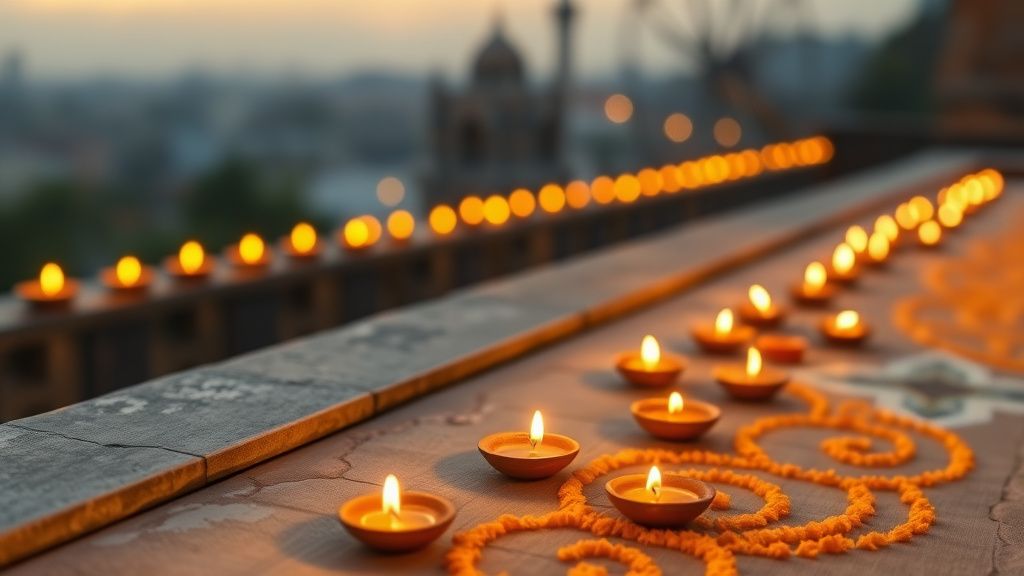
Diwali Chopda Pujan (also called Sharda Pujan or Muhurat Pujan) is the ceremony where merchant and trading households open new account books for the new financial year at an astrologically auspicious time on Lakshmi Puja day. The 2026 main Lakshmi Puja falls on Sunday, November 8; the typical muhurat windows in New Delhi run from the late afternoon Shubh choghadiya (around 17:27 to 18:06), the evening Pradosh Kaal (around 18:06 to 19:39 with Shubh-Amrit-Char choghadiyas), the late-night Labh choghadiya (around 22:46 to 00:19), and the early-morning Shubh (06:31 to 07:58 on Nov 9). The Pradosh-Vrishabha Lagna window is the most ritually preferred. This article gives the timing, the puja sequence, the entries made in the new books, and the practical points business owners ask.
What Chopda Pujan is
Chopda Pujan literally means worship of the account books (chopdi in Gujarati, bahi in Marwari, khata in Hindi). In the traditional Gujarati, Marwari, and Maharashtrian merchant communities, the financial year ends on Dhanteras (two days before Diwali) and the new year begins on Bestu Varas (Govardhan / Annakut, the day after Diwali). Diwali night sits between the old and new years and is the moment when the previous year’s accounts are closed before Lakshmi-Ganesha and the new ledgers are opened with the first auspicious entries.
The ceremony has three parts: the closing of the previous year’s books (with a final entry and signature), the worship of Lakshmi and Ganesha along with the new books placed before the deities, and the opening of the new books with the first entries of Shubh, Labh, and the Swastika mark.
The 2026 muhurat windows
For Lakshmi Puja on Sunday, November 8, 2026, the published muhurat windows (Drik Panchang, New Delhi local time) are:
- Morning Shubh Choghadiya (06:31 to 07:58 on Nov 8): the first auspicious window of the day, suitable for households where the puja is performed in the morning before the working day begins.
- Afternoon Shubh Choghadiya (around 17:27 to 18:06): the late-afternoon window for businesses wanting to close before the evening Pradosh.
- Pradosh Kaal evening Shubh-Amrit-Char window (around 18:06 to 19:39): the most ritually preferred window. Pradosh Kaal is the period running roughly two and a half hours after sunset, treated as especially auspicious for Lakshmi worship. The Vrishabha (Taurus) Lagna typically falls inside or overlapping this window, which is the rising sign considered most stable for Lakshmi.
- Late-night Labh Choghadiya (around 22:46 to 00:19): for households doing the Mahanishita-Kaal puja, the Tantric-Shakta tradition Lakshmi puja performed at midnight.
These timings are for New Delhi; other cities shift by up to 30 to 60 minutes depending on local sunset. The Pradosh window is calculated as sunset to roughly 2 hours 24 minutes after sunset; the Vrishabha Lagna varies by city. For Mumbai, Ahmedabad, Bengaluru, and Kolkata, consult the city-specific panchang.
The puja setup for Chopda Pujan
The puja is performed at the place of business (shop, office, or workshop) or at home, with the new ledgers placed in front of the deities. The standard arrangement:
- A low platform (chowki) covered with red cloth, on which the Lakshmi-Ganesha idols or pictures are placed. Ganesha is to the left of Lakshmi from the worshipper’s view.
- A kalash (water pot) topped with five mango leaves and a coconut, set beside the deities.
- The new account books, stacked neatly in front of the deities. Each book has a small swastika and the words Shubh and Labh inscribed on the first page in red ink before the puja.
- A coin, currency notes, and any ornaments or symbolic gold placed before Lakshmi.
- Akshata, kumkum, sandalwood paste, flowers (red rose and lotus preferred), and bhog (kheer, batasha, ladoo).
- A diya, incense, and camphor for the aarti.
- A scale (taraju), a pen and inkpot, and the tools of the trade specific to the business — laid out symbolically as offerings.
The puja sequence
The Chopda Pujan runs through the standard Lakshmi-Ganesha puja with the bookkeeping rites added:
- Ganesha invocation: a short prayer to Ganesha, the remover of obstacles, with akshata, flowers, and a sweet (modak or ladoo).
- Kalash sthapana: the establishment of the water pot as a seat for the goddess.
- Lakshmi Sthapana and abhishekam: the formal seating of the goddess on the chowki and a token bath with milk and water.
- Shodashopachara puja: the sixteen-fold worship — offering of seat, water, clothes, sandal, flowers, incense, lamp, food.
- Bhog and Lakshmi Stotra recitation: the Sri Suktam (from the Rig Veda khila), the Lakshmi Stuti, and the Kanakadhara Stotram are commonly recited.
- Book-opening: the merchant or proprietor opens the first new book, writes Shubh-Labh on the first page (if not already pre-written), draws a swastika, and inscribes the first transaction of the new year. The first entry is typically a token donation to a temple or charity, written in red.
- Aarti: the camphor aarti to Lakshmi-Ganesha and to the books.
- Distribution of prasad: to family members, employees, and clients.
What is written in the new books
The traditional opening inscriptions:
- Shubh-Labh: the words for auspiciousness (Shubh) and merit / profit (Labh), written on the first page, often with a swastika between them.
- Swastika: the auspicious symbol, drawn in kumkum or red ink on the cover and the first page.
- 108 or 1008 Sri or Om symbols: some communities fill the margin of the first page with repeated Sri or Om marks as an invocation.
- The first entry: a token transaction such as a donation, the first sale of the year (often pre-arranged at a small amount), or a payment to the temple priest for the puja. This is the entry that opens the financial ledger for the new year.
- Names of the proprietors and partners: written on the cover and the first page in formal style.
The old books from the closing financial year are placed at the back of the puja platform, having had their final entries signed and a closing Iti Shubh inscription added before the ceremony.
Digital records and modern adaptations
For businesses that no longer keep paper ledgers, the ceremony adapts in three common ways. A symbolic paper book is opened for the puja, with the Shubh-Labh and first entry written by hand; the digital accounting system is then opened on a laptop placed on the chowki, with the first invoice or journal entry made during the auspicious window; or the office laptop and key inventory items (a single token from each major product line) are placed before the deities and worshipped alongside.
For what it’s worth, the symbolic paper-book approach remains widely followed even by firms that work entirely on software, because the tactile act of inscribing Shubh-Labh in a fresh ledger is itself part of the ritual. The paper book is then closed and kept on the puja shelf for the year.
Common questions
Can the muhurat be performed at the home altar instead of the shop?
Traditionally Chopda Pujan was performed at the place of business with the books on the shop counter. The modern practice for service businesses without a fixed shop floor is to perform the puja at the home altar with the books and tokens of the business brought home for the ceremony. Both forms are acceptable; the place of worship matters less than the timing window and the focused intent of the puja.
Does the muhurat differ for different kinds of business?
The Pradosh-Vrishabha window on Diwali night is generally treated as universally auspicious. Some panchang publishers give slightly different windows for trading houses versus manufacturing units versus service businesses, but the differences are minor. For specific astrologically determined personal muhurats (a new office opening, a new partnership signing), a family astrologer can compute a chart-specific window; the general Diwali muhurat is sufficient for the standard Chopda Pujan.
What if the muhurat is missed?
If the Pradosh window is missed, the late-night Labh choghadiya remains available the same night, and the early-morning Shubh window on Nov 9 is the next option. Performing the ceremony at any time on Lakshmi Puja day is considered better than skipping it; the Pradosh window is preferred but not exclusive. Some Marwari traditions hold a small follow-up ceremony on Bestu Varas (Nov 9) as a backup.
A limitation worth noting
The muhurat timings here are for Drik Panchang’s New Delhi calculations and are indicative; the exact local windows for Mumbai, Ahmedabad, Surat, Bengaluru and other cities differ by up to an hour and should be verified from a city-specific panchang or from a local pandit. The Chopda Pujan ritual itself varies between Marwari, Gujarati, Maharashtrian and Bania traditions in small but real ways; the description here is the broad pan-North-India version. For sectarian or community-specific variations, the family priest or community-specific puja vidhi is the better source.
For background and the year-specific muhurat detail, see the Drik Panchang Chopda Pujan page and the Wikipedia entry on Diwali.
