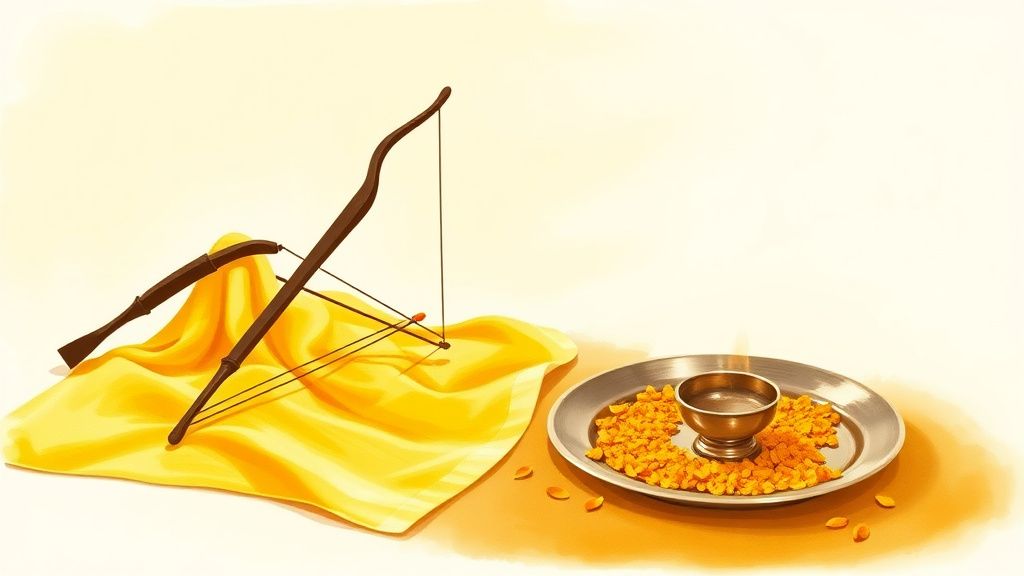
Parashurama is the sixth of the ten principal avatars (dashavatara) of Vishnu in Hindu tradition, the brahmin sage who wielded a parashu (battle-axe) granted to him by Shiva. The story is told principally in the Mahabharata’s Aranya Parva (chapters 115-117) and Shanti Parva (chapter 49), the Bhagavata Purana (Skandha 9, chapters 15-16), and the Brahmanda Purana. Parashurama is one of the seven chiranjivis (immortals) of Hindu tradition, said to be still alive on the Mahendragiri mountain in Odisha, awaiting the end of Kali Yuga when he will be the martial guru of Kalki, the final avatar. He is the only avatar said to overlap with another avatar (he appears in the Ramayana, where he confronts Rama, and in the Mahabharata, where he is the guru of Bhishma, Drona and Karna).
The lineage and the birth
Parashurama was born to the sage Jamadagni and his wife Renuka, in the Bhrigu gotra. Jamadagni was a son of Richika, who was the son of Aurva, who was the son of Bhrigu, one of the seven Saptarishis. Renuka was a princess of the Ikshvaku dynasty, daughter of Renuka the king of Vidarbha. Parashurama was the youngest of five sons (his elder brothers: Rumanvant, Sushena, Vasu, Vishvavasu). The birth narrative in the Bhagavata Purana describes Parashurama as taking birth specifically to lift the burden of unrighteous kshatriyas from the earth, the standard purpose-statement (yada yada hi dharmasya) of each Vishnu avatar.
The killing of Renuka
The pivotal early episode is the killing of Renuka. Renuka, while fetching water from the river one morning, lingered too long observing the play of a gandharva couple. Jamadagni, with his yogic vision, saw the lingering and read it as a momentary lapse from absolute chastity. He ordered each of his five sons in turn to kill their mother. Four sons refused; Parashurama alone obeyed and beheaded Renuka with the axe. Jamadagni then offered Parashurama a boon for his obedience, and Parashurama asked that Renuka be brought back to life and that no memory of her death remain with her or with his brothers. The wish was granted. The episode is the textual basis for Parashurama’s reputation as the avatar of absolute paternal obedience and absolute dharmic discipline, qualities that subsequent Hindu thought has wrestled with.
The killing of Kartavirya Arjuna
The central narrative arc is Parashurama’s vendetta against the kshatriya class. The Haihaya king Kartavirya Arjuna, a thousand-armed warrior, visited Jamadagni’s ashram while hunting. Jamadagni hospitably fed the king’s entire army using the Kamadhenu, the divine cow gifted to him by Indra, which produced abundance on demand. Kartavirya Arjuna coveted the cow and seized it by force. When Parashurama returned and learned of this, he pursued the king, defeated his thousand-armed force, and killed him. Kartavirya Arjuna’s sons later avenged their father by killing Jamadagni in the ashram while Parashurama was away. Returning to find his father dead, Parashurama vowed to rid the earth of kshatriyas. The Mahabharata’s account describes him circling the earth twenty-one times, killing all kshatriyas he encountered, and filling five great pools at Samanta Panchaka (modern Kurukshetra) with their blood.
The encounter with Rama
The Ramayana’s Bala Kanda records Parashurama’s appearance after Rama broke Shiva’s bow at Sita’s swayamvara. Parashurama, hearing of the bow-breaking, came in fury to confront Rama. He carried Vishnu’s bow (the Vaishnava chapa, parallel to Shiva’s bow Pinaka). Parashurama challenged Rama to string Vishnu’s bow as he had strung Shiva’s. Rama strung the bow, fitted an arrow, and asked Parashurama where he should let the arrow fly. Parashurama, recognising Rama as a Vishnu avatar and the moment of his own mission’s completion, withdrew to Mahendragiri to perform tapas. The episode is theologically delicate: two Vishnu avatars meet, the older yielding to the younger as the era turns from kshatriya-cleansing to dharmic kingship.
The Mahabharata teachers
In the Mahabharata, Parashurama is the guru of three pivotal warrior figures: Bhishma, Drona and Karna. He taught Bhishma the supreme arts of arms, leading to the famous Bhishma-Parashurama duel when both refused to yield in the cause of Amba; the duel ended without a victor when the gods intervened. He taught Drona, who later passed the same arts to the Pandavas and Kauravas. He taught Karna by mistakenly admitting him as a brahmin disciple (Karna concealed his kshatriya birth); discovering the deception, Parashurama cursed Karna that his weapons would fail him in his hour of greatest need, a curse that took effect at the climactic moment of Karna’s duel with Arjuna.
The creation of Konkan-Malabar
A regional Sthala Purana tradition holds that Parashurama, after the 21-fold campaign, repented and gave away the earth he had conquered to the sage Kashyapa. Left without land, he threw his axe into the sea from the cliffs of the Western Ghats. The sea retreated to the spot where the axe fell, and the newly emerged land became the Konkan-Malabar coast (modern Maharashtra, Goa, Karnataka coast and Kerala). This is the Sthala Purana of Parashurama Kshetra, with Parashurama as the patron saint of the seven Konkan and Malabar Brahmin communities (Karhade, Chitpavan, Saraswat, Goud Saraswat, Daivajna, Havyaka, Namboothiri).
Parashurama in living practice
For what it’s worth, the most striking thing about Parashurama in popular religion is the relative absence of widespread temple worship for an avatar of such dramatic narrative. There are major Parashurama temples (Pajaka Kshetra in Karnataka, Parashurama Temple at Chiplun in Maharashtra, the Akhandalamani temple in Odisha which is associated with him), but the bhakti movement that produced widespread Rama and Krishna devotion did not produce a comparable Parashurama devotion. The figure is more honoured than worshipped, more invoked in invocations to Vishnu’s avatars than petitioned directly. The exception is among the seven coastal Brahmin communities for whom he is the lineage progenitor; here he is invoked routinely in ancestral rituals.
The theological problem
Parashurama is the avatar whose violence is most extensively detailed in the textual record, and the most difficult to assimilate into the bhakti-tradition reading of avatars as expressions of divine compassion. The 21-fold cleansing of kshatriyas, the killing of his own mother on his father’s order, the curse of Karna for a sin of birth-concealment, all stand against the model of avatars as protectors of dharma through compassionate violence. The classical commentarial response, in works like Madhva’s Mahabharatatatparyanirnaya, is to read Parashurama as the avatar of dharma’s harshness, the divine instrument when the situation requires excision rather than reform. The classical reading is intelligible; the popular religious imagination has nonetheless tended to keep Parashurama at the perimeter rather than the centre.
Common questions
Is Parashurama still alive?
The tradition lists Parashurama among the seven chiranjivis (immortals): Hanuman, Vibhishana, Vyasa, Ashvatthama, Bali, Kripa and Parashurama. The verse “Ashvatthama Balir Vyaso Hanumamsh cha Vibhishanah / Krpah Parashuramashcha sapt aite chiranjivinah” (recited daily in some Brahmin households) names the seven. Parashurama is held to be alive on Mahendragiri mountain in Odisha, awaiting the appearance of Kalki at the end of Kali Yuga, when he will train Kalki in the arts of arms.
Where is Mahendragiri?
Mahendragiri is a peak in the Eastern Ghats, 1,501 m high, in Gajapati district, Odisha. The peak is associated with Parashurama by Puranic tradition; modern Mahendragiri (in Tamil Nadu, the missile-testing range) is a different location entirely. The Eastern Ghats Mahendragiri has a small temple complex near its summit and is accessible by a forested trek; it is rarely visited.
Is Parashurama the patron of any martial art?
Yes. Kalaripayattu, the traditional Kerala martial art (one of the oldest continuously practised combat traditions in the world), traces its origin to Parashurama in regional tradition. The art’s southern style (Vadakkan Kalari, predominant in Malabar) honours him as the founder. The northern style (Vadakkan style as well) has variant origin stories. Parashurama is depicted in some kalari practitioners’ annual puja as the source of the system.
One limitation worth noting
This article focuses on the textual narrative as reconstructed from the Mahabharata, Bhagavata Purana, Brahmanda Purana and Ramayana. Regional Sthala Puranas at specific Parashurama temples have additional details and sometimes locally distinctive narrative threads that are not covered here. For temple-specific narratives, the temple’s own published Sthala Purana is the appropriate reference. Sanskrit-source scholarly works on the avatar (R.C. Hazra’s Studies in the Puranic Records, F.E. Pargiter’s Ancient Indian Historical Tradition) remain the academic standard.
For wider reading see the Parashurama entry on Wikipedia and the Dashavatara article for the avatar sequence.
