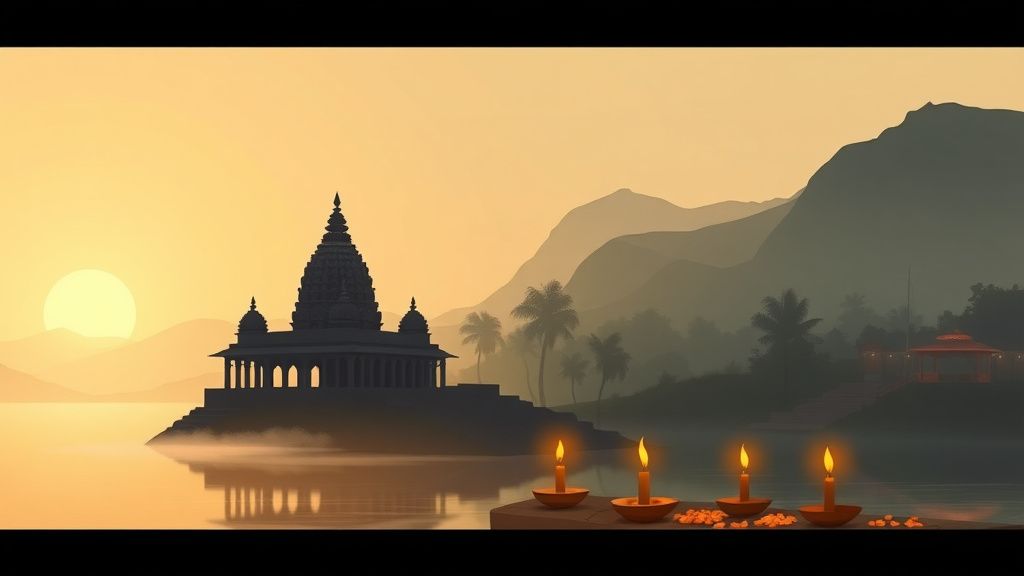
The Jagannath Temple at Puri, Odisha, restricts entry to Hindus and to members of the recognised Indic religions (Buddhists, Jains, Sikhs) as a longstanding policy of the temple’s hereditary administration. The restriction is enforced by signage at the four entrance gates (Singha Dwara, Hathi Dwara, Vyaghra Dwara, Ashwa Dwara) and by a panel of sevayats stationed at each. Indira Gandhi in 1984 and Queen Elizabeth’s daughter-in-law in 2005 were among the high-profile visitors turned back at the gates. The policy is not pan-Indian (most large temples admit foreigners); it sits within Puri’s particular history as one of the four Char Dhams and its 12th-century reconstruction under Anantavarman Chodaganga of the Eastern Ganga dynasty.
When the restriction was put in place
The exact date of the original restriction is not documented in the temple’s surviving records. The first epigraphic mention of a closed-door practice dates from the early 16th century, after a series of raids on the temple by Muslim armies (Kalapahad’s raid in 1568 being the most catastrophic, in which the deities were temporarily relocated by the Gajapati king for safety). The closed-door practice solidified after the 17th century and was formally written into the temple’s Mukti Mandapa (the council of pundits) bye-laws by the early 19th century. The current strict enforcement dates from a 1958 administrative order by the Shri Jagannath Temple Administration.
The textual basis
The Madala Panji, the temple’s own historical chronicle written in Oriya and maintained continuously since the 16th century, records that the deities Jagannath, Balabhadra and Subhadra had to be hidden several times during invasions. The Mukti Mandapa’s interpretation reads the restriction as a protective continuity of those experiences; the deities and the temple are treated as a household whose access is regulated by the family elders, not as a public museum. The Skanda Purana’s Utkala Khanda, an Odisha-region addition to the Purana, lists rituals specific to the Puri temple but does not formally bar non-Hindus; the policy is administrative rather than scriptural in origin.
Who counts as a Hindu for the purposes of entry
The temple’s interpretation of “Hindu” follows the broad Indic-religions construction used in Article 25 of the Indian Constitution and in the 1955 Hindu Marriage Act: Hindus, Buddhists, Jains and Sikhs are recognised as Hindu for the entry purpose. Non-Indic religions (Christianity, Islam, Judaism, Zoroastrianism, Baha’i Faith) are categorically barred. The temple does not check on entry for most South Asian-looking pilgrims; it does check for foreigners, Indian Christians and Indian Muslims, who are asked at the gate. A signed declaration of Hindu faith is sometimes accepted but more often the gate sevayats consult among themselves and make a case-by-case decision.
High-profile refusals
- Indira Gandhi (1984): prime minister of India, married into a Parsi family, was refused entry on the grounds that her marriage placed her outside Hindu social registration. The refusal was a national news event and the temple’s stance was upheld.
- Bhumika Tekchandani case (1996): the wife of a Sindhi Hindu was initially refused; admitted after evidence of Hindu marriage and worship at home.
- Sarah Crewson (2005): a member of the British royal family was barred; the Odisha government issued a clarification.
- Several foreign Hindus by conversion have been admitted after producing evidence of conversion and worship.
What non-Hindus can see and do
Non-Hindu visitors are welcome at Puri town and the temple’s exterior. The recommended substitutes:
- The Raghunandan Library terrace, immediately south of the temple, offers a wide view of the temple’s structure and is open to all.
- Ratha Yatra (the annual chariot festival), on Ashadha Shukla Dwitiya (June/July), is the principal occasion when the deities are brought out of the temple onto the Bada Danda main street and to the Gundicha Temple. The procession is fully accessible to all visitors. Ratha Yatra is the deliberate, scriptural moment when Jagannath leaves the temple for darshan by everyone, irrespective of restriction.
- The Gundicha Temple, the destination of the chariot festival, has historically had laxer entry rules during the festival week; check with local sevayats.
- The Anand Bazaar outside the temple sells Mahaprasad (the food prepared in the temple kitchen) and is open to all.
The controversy and its defenders
For what it’s worth, the restriction is among the more difficult cultural-policy issues in modern India. The principled liberal position is that public religious sites maintained partly with state funds (the temple is administered under the Shri Jagannath Temple Act, 1955) should not gatekeep entry by religion. The principled traditional position is that the temple is a hereditary community institution preserving a specific worship community’s continuous practice, and that the public-funds question is incidental to the underlying community ownership. The Odisha government has not chosen to challenge the temple administration on this, and the Supreme Court has declined to intervene in earlier petitions.
Common questions
Can a foreigner who has converted to Hinduism enter?
The temple has admitted converts in past cases when they have produced documentation: a name change in the gazette of India, a written affidavit, a registered visit to a recognised ashram, sometimes a letter from a Hindu acharya. The gate sevayats decide case-by-case and the threshold is not low. ISKCON devotees, despite ISKCON’s roots in Gaudiya Vaishnavism (the same tradition as Puri’s), have been admitted and refused at different times; the inconsistency is part of the institution’s pattern.
What is the deity’s wood, and why does it matter?
The Jagannath, Balabhadra and Subhadra murtis are carved from the wood of the daru-brahma tree (neem), and are ritually replaced every 12 or 19 years in the Nabakalebara ceremony, in which the old murtis are buried inside the temple’s Koili Vaikuntha and new ones are consecrated. This ritual replacement and the constant “living” nature of the deities is part of the institutional defence of the restricted entry; the deities are treated as embodied family members rather than installed idols.
When is the next Nabakalebara?
The previous Nabakalebara was performed in 2015. The interval depends on the placement of an Adhika Masa (intercalary Hindu lunar month) in the Ashadha–Shravana window; the next ceremony is expected in 2034 or 2035 depending on the panchanga calculation. The ceremony is among the most logistically complex Hindu rituals and is preceded by months of search for a suitable daru-brahma neem tree marked by the temple’s vanyatra committee.
One limitation worth noting
The temple’s internal documents (Madala Panji entries, Mukti Mandapa rulings, gate-sevayat handbooks) are not all in the public domain. The dating of the original restriction is therefore an inference from scattered evidence rather than from a single sourceable order. Visitors who want a clear answer on a specific entry case in advance are best served by writing to the temple administrator’s office in Puri or to the SJTA (Shri Jagannath Temple Administration) via the Odisha government’s portal.
For the temple’s history see Jagannath Temple, Puri on Wikipedia and the Ratha Yatra article for the festival when restrictions ease.
