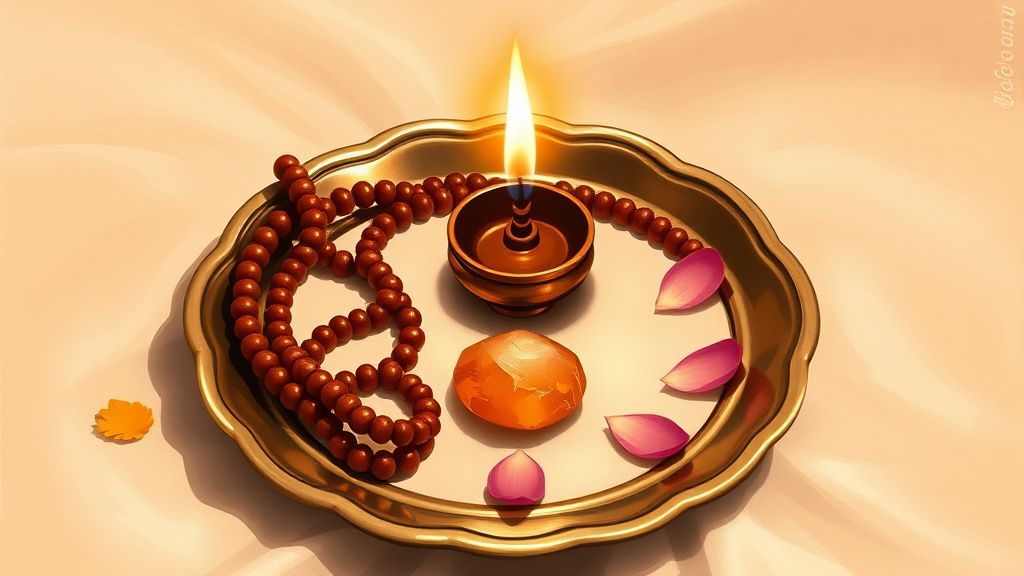
Gemstone activation (pran pratishtha or ratna abhimantrana) is the ritual procedure by which a newly purchased jyotisha stone is prepared for first wearing. The process combines a specific weekday (one for each of the nine grahas), an auspicious muhurta within that day, a soaking ritual using cleansing liquids, and the recitation of the planet’s beej mantra a specified number of times. The classical references for the procedure include Brihat Samhita of Varahamihira and Garga Samhita; modern jyotisha gemmology textbooks codify the practical steps. The principle is that the stone, treated as an inert physical object on purchase, is consecrated through ritual into its astrological function.
The planetary weekdays for activation
- Sunday (Surya): Ruby and red garnet (Sun stones).
- Monday (Chandra): Pearl and moonstone (Moon stones).
- Tuesday (Mangal): Red coral and carnelian (Mars stones).
- Wednesday (Budh): Emerald and peridot (Mercury stones).
- Thursday (Guru): Yellow sapphire, citrine, and yellow topaz (Jupiter stones).
- Friday (Shukra): Diamond, white sapphire, and zircon (Venus stones).
- Saturday (Shani): Blue sapphire, amethyst, and iolite (Saturn stones). Also used for Rahu (hessonite) in many traditions.
- Saturday/Wednesday for Rahu (Gomed/hessonite): traditions vary; some use Saturday, others use Wednesday.
- Tuesday or Thursday for Ketu (chrysoberyl cat’s eye): some traditions use Saturday based on Ketu’s Mars-associated readings.
The classical principle is that each weekday belongs to a graha. Activation on the matching weekday is read as aligning the stone with its source planet’s vibrational signature. Activation on a non-matching day is not strictly forbidden in most schools but is read as suboptimal.
Muhurta selection within the day
- Tithi: shukla paksha (waxing moon) is preferred. Specifically, the 2nd to 11th tithis are favoured.
- Nakshatra: a nakshatra associated with the relevant planet, or an unconditionally auspicious nakshatra (Pushya, Hasta, Rohini), is preferred.
- Hora: within the chosen day, the hora (one-hour planetary period) associated with the relevant graha is the most precise window.
- Avoid: Rahu Kalam, Yamaganda, and Gulika Kalam on that day; eclipses; the death anniversaries of close family.
For what it’s worth, perfect muhurta is rarely achievable. A reasonable practice is to pick the right weekday, time the wearing to early morning during shukla paksha, and avoid the obvious daily inauspicious windows. Strict muhurta calculation is often a refinement that matters most for stones with strong effects like blue sapphire.
The soaking ritual
The stone, already set in its ring or pendant, is soaked overnight (or for at least 30 minutes) before the chosen wearing time. A common cleansing mixture is panchamrita: raw cow’s milk, curd, honey, ghee, and sugar. A simpler version uses raw milk and Ganga jal. The soaking is intended both as physical cleansing (removing any negative energy attributed to the stone’s prior handling, mining, cutting, and trading) and as ritual preparation.
- Step 1: Place the ring in a clean copper or silver bowl.
- Step 2: Add raw milk and Ganga jal to cover the stone.
- Step 3: Leave overnight or for 30 minutes minimum.
- Step 4: Wash the ring with clean water and dry with a fresh cloth before wearing.
Mantra recitation
The beej mantra for the relevant graha is recited 108 times before the first wearing, either by the wearer or by a priest performing the activation. The standard beej mantras are:
- Surya (Sun): Om Hraam Hreem Hraum Sah Suryaya Namah.
- Chandra (Moon): Om Shram Shreem Shraum Sah Chandraya Namah.
- Mangal (Mars): Om Kraam Kreem Kraum Sah Bhaumaya Namah.
- Budh (Mercury): Om Braam Breem Braum Sah Budhaya Namah.
- Guru (Jupiter): Om Graam Greem Graum Sah Gurave Namah.
- Shukra (Venus): Om Draam Dreem Draum Sah Shukraya Namah.
- Shani (Saturn): Om Praam Preem Praum Sah Shanaischaraya Namah.
- Rahu: Om Bhraam Bhreem Bhraum Sah Rahave Namah.
- Ketu: Om Sraam Sreem Sraum Sah Ketave Namah.
Each mantra is recited 108 times, traditionally using a tulsi or rudraksha mala to count. The recitation can be done by the wearer or by a priest at a temple of the relevant deity (Surya temple for ruby, Hanuman temple for coral, Shani temple for blue sapphire, etc.).
Common questions
Can a priest activate the stone on the wearer’s behalf?
Yes; priestly activation is the most common modern practice. The wearer brings the new stone to a temple of the corresponding deity (a Surya temple for ruby, a Hanuman or Mars temple for red coral, a Shani temple for blue sapphire), and the priest performs the recitation and abhishekam. The stone is then handed back for wearing on the chosen weekday and hora.
Does the stone need to be re-activated periodically?
Most schools do not require routine re-activation. Re-activation is suggested if the stone is removed for an extended period (months), if it is repaired or reset in a new ring, if a major chart-significant event occurs (marriage, new dasha period), or if the stone visibly cracks or chips. The pearl and coral, being organic, are sometimes re-activated annually because of their softer constitution.
What if I miss the chosen muhurta?
A missed muhurta is set aside and a fresh muhurta is selected for the following week (or sooner if the stone is needed urgently). The classical principle is that the activation is the moment of energetic alignment; if the alignment window passes, the wearer simply waits. Wearing an unactivated stone “just because” is not the traditional practice and is read as missing the point of the ritual.
One limitation worth noting
Gemstone activation is an interpretive jyotisha tradition, not an empirically validated procedure. The mantras and muhurtas are documented in classical Sanskrit texts and are internally consistent within Vedic astrology; the energetic effects of activation have not been demonstrated in controlled testing. Treat the ritual as a culturally meaningful preparation that frames the wearing of the stone, not as a mechanical procedure with guaranteed measurable outcomes.
For background see Navaratna on Wikipedia and Mantra on Wikipedia.
