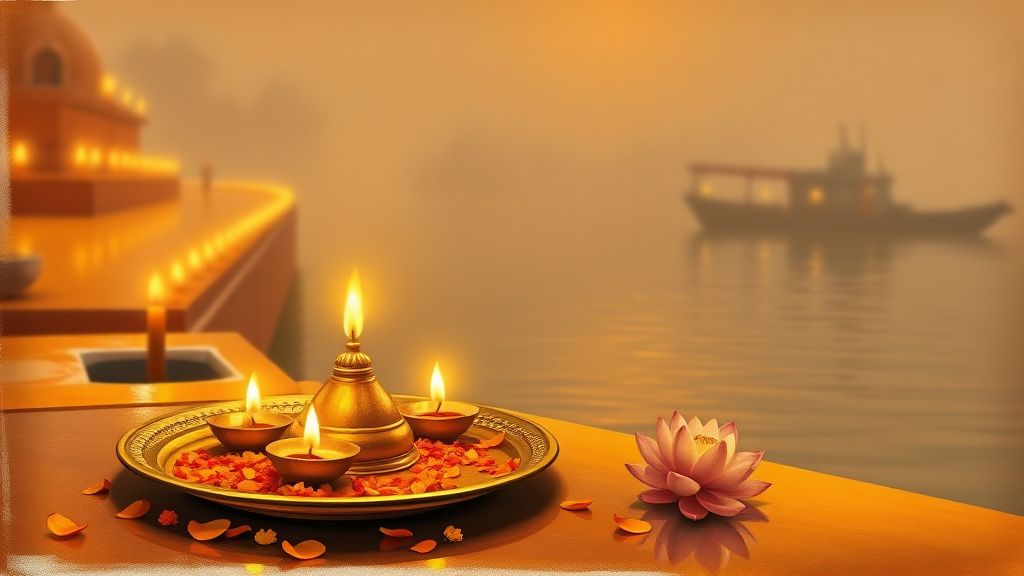
The Ganga Aarti is the evening lamp-and-bell ritual performed for the river Ganga, most prominently at Varanasi (Dashashwamedh Ghat), Haridwar (Har ki Pauri) and Rishikesh (Parmarth Niketan, Triveni Ghat). It is a relatively modern ritual in its current organised form: the synchronised, multi-priest staging that is now copied across riverfront aartis was institutionalised at Varanasi from 1991 by the Gangotri Seva Samiti. The aarti is performed daily at sunset, with seven or five priests on raised platforms making sequential offerings of conch, incense, lamps, fans and flowers to the river. This article covers the procedure, the items used, the differences across the three principal venues, and the puranic frame behind the ritual.
The procedure in sequence
The aarti runs in eight or nine ritual movements. Each item is passed along the line of priests so that all of them perform the same offering in synchrony, facing the river:
- Shankh (conch) blowing: three blasts announce the aarti and call the audience to attention.
- Achaman and sankalpa: the lead priest takes water in the palm, sips, and recites the day, place and intent; this part is brief and often inaudible at distance.
- Dhoop (incense): resin and sandal incense circled in front of the river.
- Karpur deepak (camphor lamp): a smaller camphor flame, made in a single brass plate.
- Panchmukhi or sapta-mukhi deepak (five- or seven-flame lamp): the principal large brass lamp, the visual signature of the aarti.
- Morpankhi (peacock-feather fan): waved in dedication.
- Chamara (yak-tail whisk): traditionally used to fan a royal deity, offered to the river.
- Pushpa (flower) and akshat (rice): petals and turmeric-rice grains showered toward the water.
- Closing bells and bhajan: the priests circle in place with brass hand bells while the closing aarti song is sung.
The full sequence runs 40-50 minutes. The Adi Shankara Ganga Stotra (“Devi sureshvari bhagavati gange, Tribhuvanatarini tarala-tarange”) and select Ramcharitmanas verses are the standard musical layer; at Haridwar the Gayatri Mantra is also recited in chorus toward the end.
The items used
- Panchmukhi deepak: a brass lamp with five wicks soaked in ghee; the wicks are arranged in a quincunx pattern. At Varanasi a seven-flame (sapta-mukhi) variant is also used.
- Conch (shankh): a right-spiralled dakshinavarta conch is the prescribed variety, though the larger Turbinella pyrum from the Bay of Bengal is what is normally used.
- Brass bell (ghanta): a heavy hand-bell sized for one-handed circular swing.
- Peacock-feather fan and chamara whisk: sized for the river offering, larger than household versions.
- Incense holder: a long-handled brass holder with a coal-and-resin cup; the smoke is the key visible offering.
- Lota (water pot): the brass pot from which water is taken for sankalpa.
Variations across venues
The three principal venues run the same essential sequence with local variations:
- Varanasi (Dashashwamedh Ghat): seven priests on seven raised wooden platforms; run by Gangotri Seva Samiti; loud sound system; large boat audience on the river side. Duration about 45 minutes.
- Haridwar (Har ki Pauri): performed by the Ganga Sabha priests, often three or five in number rather than seven; smaller in visual scale than Varanasi but the actual bathing ghat is much closer to the aarti platform, so the audience is more participatory. Diya leaf-boats are floated through the river before the aarti starts.
- Rishikesh (Parmarth Niketan, Triveni Ghat): the Parmarth aarti is led by ashram disciples and is more participatory, with the audience chanting along; the Triveni Ghat aarti is closer to the Haridwar format. Both are smaller in scale than Varanasi.
For what it’s worth, the Rishikesh Parmarth aarti is the easiest first introduction for someone unfamiliar with the ritual. The chanting is participatory rather than performative and the venue is calmer than either Varanasi or Haridwar on a crowded evening.
The puranic frame
The Ganga as goddess appears in the Mahabharata (Anushasana Parva 134, the Ganga Sahasranama) and is the subject of the Ganga Mahatmya sections of the Padma Purana and Skanda Purana. The descent (avatarana) of the river from Vishnu’s foot through Shiva’s matted hair to the plains, in response to Bhagiratha’s tapasya, is told in the Ramayana (Bala Kanda 38-44) and the Bhagavata Purana (9.9). The aarti as a daily ritual to the river is not specified in these texts; what is specified is the daily snana (bath) and the offering of water (tarpana) at sunrise and sunset. The current evening aarti is a 20th-century elaboration that draws on temple-aarti formats.
Floating diyas and the post-aarti
After the principal aarti, devotees float their own small leaf-cup diyas (pushpanjali) on the river, with a flower, a wick, and a smear of ghee. The vendors who sell these line the ghat steps; rates are nominal (Rs 10-30 per diya). The river is dotted with these floating lamps for an hour after the aarti closes. Note that Haridwar and Rishikesh have stricter rules than Varanasi about the type of diya allowed (no plastic, no thermocol), enforced under NGT directions.
Common questions
Can a household perform the Ganga Aarti?
Yes, but the household version is normally a single-flame lamp aarti to a Ganga photograph or murti at the home shrine, accompanied by the recitation of the Adi Shankara Ganga Stotra. The full multi-priest platform format is specific to the riverfront venues and is not normally attempted at home. The simpler home version is performed at sunset on a Wednesday or Thursday or on Ganga Saptami (Vaishakh Shukla Saptami) and Ganga Dussehra (Jyeshtha Shukla Dashami).
Is there a morning aarti?
Yes. The Subah-e-Banaras at Assi Ghat and the morning aarti at Triveni Ghat in Rishikesh are pre-sunrise rituals, much smaller in scale than the evening, with one or two priests and a focus on Surya Namaskar and Gayatri recitation. The morning aartis run roughly an hour earlier at the same ghats than the typical sunrise; figure 5:00-5:30 AM in summer and 5:30-6:00 AM in winter.
Photography rules?
Photography from the ghat steps and boats is permitted at all three principal venues. Flash is discouraged; the aarti is well-lit and modern cameras handle the scene without flash. Tripods are blocked at the front of the ghat on crowded evenings. Drone use is restricted at all three sites and requires a permit.
One limitation worth noting
The aarti sequence varies between venues, between priests on a given evening, and between regular and festival nights. The eight or nine-movement structure described above is the most common but is not a fixed liturgical canon; some venues compress the chamara and morpankhi into a single movement, and others add an extra closing bhajan. The clock times shift with sunset, by up to an hour through the year.
For background see Ganga Aarti on Wikipedia and the Uttarakhand Tourism portal.
