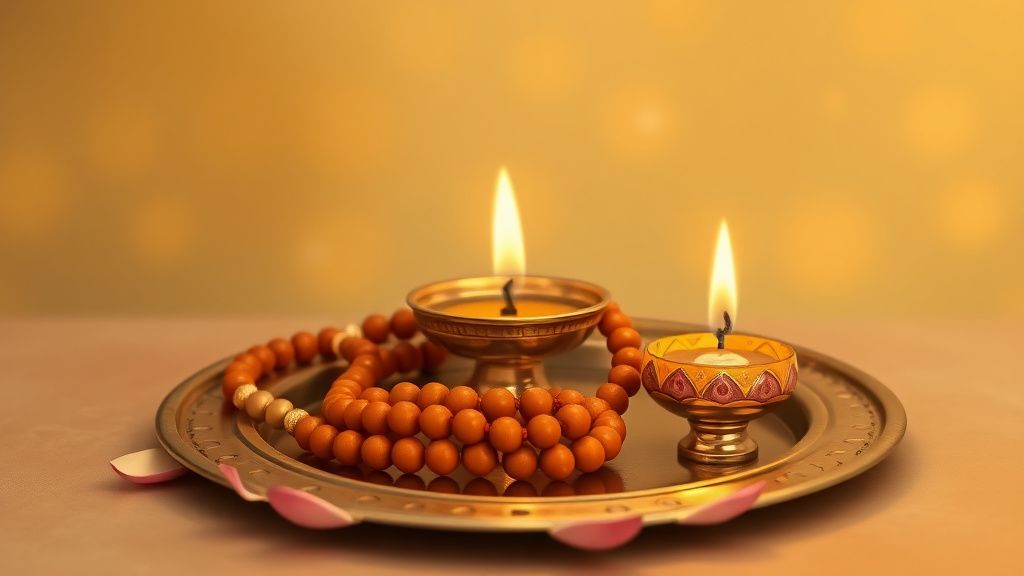
Anushthana is the Sanskrit term for a structured spiritual undertaking with a fixed target, typically the recitation of a specific mantra or stotra a specific number of times within a specific time period, governed by a formal vow (sankalpa) declared at the start. The standard household anushthana is shorter than the formal purascharana: while purascharana involves the full multiplication of mantra syllables by 100,000, an anushthana is a smaller defined commitment, often 11 days, 21 days, or 40 days, with a daily target the practitioner can sustain. The anushthana sits between casual daily japa and the full purascharana in the spectrum of mantra practice. This article describes the structure, the standard periods, the disciplines, and the closing procedures.
What anushthana means
The Sanskrit word anushthāna derives from the root sthā- (to stand) with the prefix anu- (along with, following). The literal sense is “carrying through” or “performing in completion”. In the technical mantra-yoga sense, anushthana names a defined practice undertaken with a clear start, a clear daily target, a clear end, and a stated intention. The intention may be devotional (sustained relationship with the deity), petitionary (a specific outcome in the practitioner’s life), or expiatory (atonement for a specific act).
The anushthana sits in a graded sequence of mantra commitments:
- Casual daily japa: no fixed sankalpa, no fixed count, sustained as devotional habit.
- Daily formal japa: a fixed daily count (typically 108) with no fixed end date.
- Anushthana: a fixed daily count, a fixed period, a stated sankalpa. The standard middle-distance commitment.
- Purascharana: the full formal mantra-perfection sadhana, with the count of mantra syllables multiplied by 100,000.
- Mahapurascharana: repeated purascharana cycles, undertaken by serious practitioners.
Standard anushthana periods
- 11 days: the entry-level vow, often undertaken for a specific short-term intention (a household event, a difficult week, a recovery period). Common daily target: 1 mala (108).
- 21 days: a three-week observance, often associated with specific deity vrata cycles. Common daily target: 3 malas (324).
- 40 days (one mandala): the most widely used period across Indian devotional traditions. The 40-day mandala corresponds to a standard observance cycle and is treated as the minimum length for substantive change. Common daily target: 1 to 3 malas.
- 48 days: the standard length for the Ayyappa vratam, with daily recitation of specific stotras. The Sabarimala pilgrimage cycle uses this period.
- 90 days: a quarter-year anushthana, often for major intentions. Daily target typically scaled to 5-11 malas.
- One year (mandalakala): the year-long anushthana, treated as substantial sadhana. Daily target sustained across the full year.
The structure of an anushthana
The standard structure of a formal anushthana has five elements:
- Selection of mantra and intention: the mantra is chosen, ideally received from a teacher; the intention is named, ideally in writing in a vow notebook.
- Sankalpa on the start day: the formal vow, declared aloud or silently, naming the date (tithi, paksha, masa, samvatsara), the place, the practitioner, the mantra, the daily count, the duration, and the intention. Traditionally undertaken on an auspicious tithi.
- Daily sessions: a fixed time, a fixed seat, a fixed direction, with the daily count completed without interruption.
- Concomitant disciplines: dietary restraint, simplification of speech, regular bath, and other observances as determined by the lineage and the practitioner’s circumstances.
- Closing on the end day: a final session on the end day, traditionally with additional count, an offering or small fire ritual, the formal dissolution of the sankalpa, and a feeding of Brahmins or the poor.
For what it’s worth, the most useful starting point for a new practitioner contemplating anushthana is a 40-day commitment to a single public mantra (Gayatri, Om Namah Shivaya, the Mahamrityunjaya, the Hare Krishna mahamantra) at one mala per day, with a written sankalpa and a written daily log of completion. This pattern, completed once and then renewed, builds the habit of structured practice. Larger anushthanas grow naturally from this base.
Tracking the count
For an anushthana, the daily count is conventionally tracked in two ways: the mala for the session itself (108 beads per round), and a separate written log for cumulative daily and total counts. A typical log entry: “Day 12 of 40. Mantra: Om Namah Shivaya. Today: 3 malas (324). Total to date: 3,888.”
The log serves two functions: it makes missed days visible, and it provides a record at the end of the anushthana for the closing havan or feeding ritual (which is sized to the total count). Some lineages use a tally counter (sumiran) that advances one click per mala completed, kept beside the mat during the chanting session.
What happens when the anushthana is broken
If the practitioner misses a day, the standard lineage rule is to add the missed day’s count to a subsequent day, completing the original total within the original period. If illness or unavoidable interruption prevents this, two lineage approaches: the strict approach prescribes restart of the vow from day one; the practical approach treats the gap as an expiation and continues from the next day, with the closing ritual adjusted.
If the anushthana is abandoned in the middle, the traditional response is to declare the abandonment formally, with a short prayer of apology to the deity, and to resume the practice in some lesser form. The teacher’s instruction governs in any specific case. The principle is that an unfinished anushthana is not a moral failure but an incomplete piece of work to be picked up later.
Examples of common anushthanas
- Hanuman Chalisa anushthana: 11 daily recitations for 11 days, often undertaken on the eve of a major examination or undertaking.
- Mahamrityunjaya anushthana: 108 daily for 40 days, undertaken during illness or for protection of a family member.
- Gayatri anushthana: 1,008 daily (10 malas) for 90 days, a substantial spiritual undertaking; about 2.5 hours daily.
- Ayyappa anushthana: the 41-day vratam ending in pilgrimage to Sabarimala, with specific dietary, dress and conduct disciplines.
- Navaratri anushthana: recitation of the Devi Mahatmya or a Devi chalisa across all nine nights of the autumn or spring Navaratri.
- Ramayana parayana: reading of the Ramcharitmanas (in Hindi-speaking areas) or the Valmiki Ramayana (in Sanskrit-reading households) within 9 days, 30 days or 365 days as a structured anushthana.
Common questions
Is initiation required for an anushthana?
For Tantric mantras with specific bija syllables, yes; formal initiation from a qualified teacher is required, and the anushthana is undertaken with the teacher’s guidance. For public devotional anushthanas (Hanuman Chalisa, Durga Chalisa, the Vishnu Sahasranamam, the public Gayatri) initiation is not strictly required; many practitioners undertake these as household commitments. The choice scales with the formality of the mantra.
Can anushthanas be done for someone else?
Yes. A common pattern is the family member who undertakes an anushthana on behalf of a sick relative, an absent child, or a deceased parent. The sankalpa at the start names the person on whose behalf the practice is being undertaken. The merit is conventionally treated as transferable in the bhakti tradition.
How does an anushthana differ from a vrata?
A vrata is a broader category of religious vow that may include fasting, pilgrimage, specific worship, abstentions and ritual observances, often tied to specific days of the lunar calendar (the Ekadashi vrata, the Pradosha vrata, the Shivratri vrata). An anushthana is more specifically a mantra-recitation commitment within a defined frame. Many anushthanas are undertaken in conjunction with vrata observances; the categories overlap rather than exclude.
One thing this article does not claim
Specific outcomes promised for specific anushthanas in popular devotional manuals (this mantra for this many days for this result) vary widely by source and by lineage. The article above presents the structural frame; the specific outcome promises are part of the popular literature, with widely varying levels of textual grounding. Practitioners undertaking an anushthana for a specific intention should hold the intention as a sankalpa but should hold the outcome more loosely, treating the practice itself as the primary work.
For broader textual context, see the entries on Japa at Wikipedia and on Vrata.
