The Mahamrityunjaya Mantra is a Rigvedic verse addressed to Tryambaka (three-eyed Shiva, also called Rudra), petitioning release from death and the gift of longevity. It appears at Rigveda 7.59.12 in a hymn attributed to the rishi Vasishtha, and recurs in the Yajurveda (Taittiriya Samhita 1.8.6.i and Vajasaneyi Madhyandina 3.60). The hymn is classified as a moksha mantra, a liberation mantra, and is the most widely chanted Shaiva mantra after Om Namah Shivaya. The recitation is associated with healing, longevity and protection during illness, with one round of 108 repetitions on a mala being the standard daily commitment.
The full verse
ॐ त्र्यम्बकं यजामहे सुगन्धिं पुष्टिवर्धनम् ।
उर्वारुकमिव बन्धनान् मृत्योर्मुक्षीय मामृतात् ॥
IAST transliteration: oṃ tryambakaṃ yajāmahe sugandhiṃ puṣṭi-vardhanam / urvārukam iva bandhanāt mṛtyor mukṣīya mā ‘mṛtāt.
Stephanie Jamison and Joel Brereton render the verse: “We sacrifice to Tryambaka the fragrant, increaser of prosperity. Like a cucumber from its stem, might I be freed from death, not from deathlessness.”
Word-by-word meaning
- Tryambakam (त्र्यम्बकं): “the three-eyed one”, a name of Shiva-Rudra. The three eyes traditionally read as sun, moon and fire.
- Yajāmahe (यजामहे): “we sacrifice to”, “we worship”. First-person plural middle-voice present tense.
- Sugandhim (सुगन्धिं): “the fragrant one”. The adjective qualifies Tryambaka.
- Puṣṭi-vardhanam (पुष्टिवर्धनम्): “the increaser of nourishment”, “the one who augments well-being”. A compound term.
- Urvārukam iva (उर्वारुकमिव): “like a cucumber” or, more precisely, the ripe gourd-fruit that detaches by itself from the vine. The simile is botanical and specific.
- Bandhanāt (बन्धनात्): “from the stem”, “from the bondage”. The fruit’s attachment point.
- Mṛtyor (मृत्योः): “from death”. Genitive-ablative of mṛtyu.
- Mukṣīya (मुक्षीय): “may I be released”. First-person singular optative middle voice from the root muc-.
- Mā ‘mṛtāt (मामृतात्): “not from amṛta“, “not from deathlessness”. The negation here is the key: the petition is for release from death, not from immortality.
The cucumber simile and what the mantra actually asks
The urvāruka simile is the most striking image in the verse. The ripe gourd detaches from its vine on its own, without force, when the fruit and the stem are both ready. The petition is for that kind of release: not a violent extraction from life, but a ripening that allows the bond to fall away cleanly. The grammatical pivot is the contrast between mṛtyu (death) and amṛta (deathlessness, the deathless state). The chanter does not ask to be freed from amṛta; the chanter asks to be freed from mṛtyu and into amṛta. The mantra is, in this technical sense, a moksha mantra rather than a longevity mantra alone.
Traditional contexts of chanting
- During illness: chanted at the bedside of a sick person or by the patient, traditionally 108 times per day as part of a healing observance. The Rudrabhishekam, the ceremonial bathing of a Shiva linga with milk, water, ghee and other dravyas, includes Mahamrityunjaya chanting in the priest-led version.
- At the start of a major undertaking: as a protective invocation before a journey, a wedding, the building of a house, or the beginning of a course of study.
- During eclipses: the mantra is one of the standard chants during solar and lunar eclipses, when many Hindu households suspend ordinary activity and undertake japa.
- At the end of life: recited in the room of the dying as part of the antima samskara preparations, with the intention that the transition be marked by the mantra.
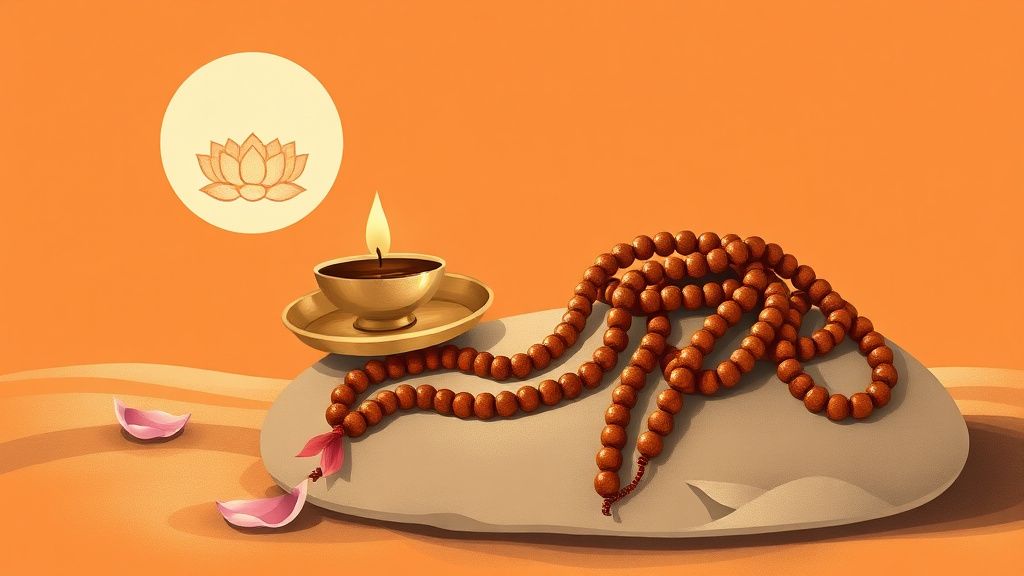
- Daily personal japa: one mala (108 repetitions) at sunrise or sunset, often on a rudraksha mala, is the typical householder commitment.
What practitioners report and what is documented
Practitioners traditionally report that regular Mahamrityunjaya recitation produces a settled mental state, an experienced sense of protection, and easier acceptance of difficulty. The phenomenology of mantra-japa generally has been studied to a limited extent in modern psychology and integrative medicine, with small studies suggesting reductions in subjective anxiety and improvements in heart-rate variability in regular practitioners. The literature is thin and the effect sizes are modest; the traditional claims about Mahamrityunjaya are specifically theological and ritual rather than clinical.
For what it’s worth, the most defensible framing of the mantra’s effect on body and mind is that the act of focused, slow, vocally measured Sanskrit recitation, repeated daily, settles the breath and the attention. Whether the further claims (cure of disease, prevention of accidents, longevity beyond ordinary span) hold is a question on which traditional and clinical literatures simply do not agree. The mantra retains its place in Shaiva practice on the strength of the textual lineage and the lived experience of practitioners, not on the strength of trial data.
The Rudrabhishekam connection
In the Rudrabhishekam ritual performed at Shaiva temples (Kashi Vishwanath in Varanasi, Mahakaleshwar in Ujjain, Trimbakeshwar near Nashik) and at home shrines, the Mahamrityunjaya is one of the principal chants. Devotees sponsor the ritual on Mondays, on Maha Shivratri, on birthdays, during illnesses, and during periods of astrological transition such as sade-sati (the seven-and-a-half-year transit of Saturn). The standard fee at a major temple ranges from a few hundred to several thousand rupees depending on the duration and the number of priests; the Trimbakeshwar temple in Nashik is one of the principal centers for the longer Mahamrityunjaya homam.
Common questions
Is the Mahamrityunjaya the same as the Tryambakam mantra?
Yes. Mahamrityunjaya is a descriptive name meaning “the great conqueror of death”, referring to Shiva in the role the mantra invokes. Tryambakam is the opening word of the verse and is sometimes used to name the mantra itself. The two names refer to the same Rigveda 7.59.12 verse.
Is the mantra restricted to particular practitioners?
Unlike specific tantric bija mantras that require formal initiation, the Mahamrityunjaya is a Vedic public mantra. It is chanted across Shaiva and Smarta traditions, by men and women, and is widely included in domestic puja manuals. Some lineages prefer that the mantra be received from a teacher for serious sadhana, but daily devotional recitation is broadly open.
Can it be chanted for someone else?
Yes. A common practice in the household is chanting on behalf of a sick relative, with the practitioner stating the relative’s name and gotra in the sankalpa at the start of the session. The temple homam version, where the priest performs on behalf of a sponsor whose name is named in the ritual, is the formal expression of the same principle.
One thing this article does not claim
The mantra is not a substitute for medical treatment. The traditional literature, including the Shiva Purana and the standard Shaiva manuals that prescribe Mahamrityunjaya recitation during illness, also assumes the use of contemporary remedies, dietary disciplines and physician care. Practitioners who treat the mantra as a sole intervention for a serious medical condition are working against both the textual frame and ordinary prudence.
For the textual references and translations, see the entry on the Mahamrityunjaya Mantra at Wikipedia. The original Rigvedic context is at Mandala 7 of the Rigveda, hymn 59, attributed to the lineage of Vasishtha.