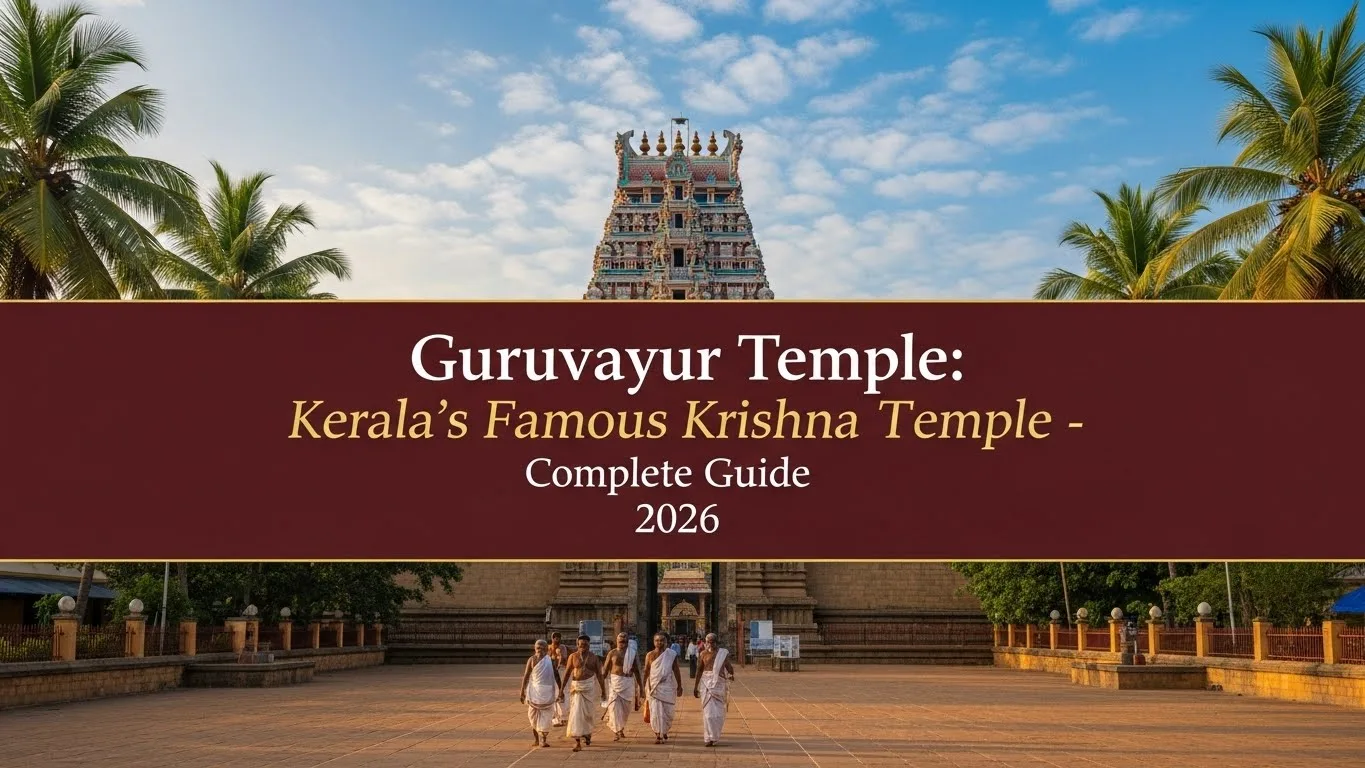
Guruvayur Temple, located in Thrissur district of Kerala, is one of India’s most sacred and important Krishna temples, revered as “Bhuloka Vaikunta” (Heaven on Earth) and often called the “Dwarka of the South”. The temple houses a unique four-armed standing idol of Lord Krishna (Guruvayurappan) holding a conch (shankha), discus (chakra), mace (gada), and lotus (padma), believed to have been originally worshipped by Lord Vishnu himself in Vaikunta and later by Lord Krishna in Dwarka before the city’s legendary submersion.
According to temple mythology, the deity was consecrated at Guruvayur by Guru (Brihaspati, the teacher of gods) and Vayu (the wind god), from whose names the town derives its name “Guru-vayur”. The temple attracts millions of devotees annually who believe that worshipping Guruvayurappan grants blessings for health, prosperity, marriage, childbirth, and spiritual liberation, making it one of the busiest pilgrimage sites in India with elaborate daily rituals beginning at 3:00 AM and continuing until 10:00 PM.
The temple enforces strict entry regulations including mandatory traditional dress code (men must wear white mundu/dhoti without shirts; women must wear sarees, churidars, or traditional Kerala attire) and complete prohibition of non-Hindus from entering the temple premises. The current temple structure was rebuilt in 1638 CE by the Zamorin rulers of Calicut, though the temple’s origins are believed to date back over 5,000 years, with intricate carvings, towering gopurams, and the enchanting Deepastambam (pillared light towers) reflecting Kerala’s architectural heritage. Special pujas including Nirmalyadarshanam (3:00 AM viewing after the deity’s rest), Seeveli (ceremonial procession), Deeparadhana (lamp offerings), and numerous daily offerings make Guruvayur a living center of continuous Vaishnavite worship and devotion.
This comprehensive guide explores the temple’s legendary origins and sacred deity, architectural features, detailed darshan timings for 2026, strict dress codes and entry rules, special pujas and offerings (vazhipadu), major festivals, practical visiting information, nearby temples, and why Guruvayur holds such profound significance in Hindu philosophy as Lord Krishna’s most powerful earthly abode.
The Sacred Deity: Guruvayurappan
Mythological Origins
The Guruvayur deity’s sanctity stems from its extraordinary divine lineage:
Originally Worshipped in Vaikunta: According to temple legend, the idol was first worshipped by Lord Mahavishnu (Maha Vishnu) himself in Vaikunta (the celestial abode)
Gifted to Brahma: The divine idol was subsequently passed to Brahma (the creator deity), who treasured it as a sacred object
King Sutapas and Prishni: Brahma then gifted the idol to King Sutapas and his consort Prishni:
- This royal couple performed intense devotional austerities
- Pleased by their devotion, Lord Vishnu granted them a unique boon
- They would have the privilege of worshipping this idol through three successive births
- This blessing would culminate in the Dwapara Yuga (the third cosmic age)
Krishna Birth Connection: In their third birth during the Dwapara Yuga, Sutapas and Prishni were reborn as Vasudeva and Devaki:
- Lord Vishnu took birth as their son—Lord Krishna
- The same sacred idol they had worshipped across births was now embodied in their divine child
- Krishna himself later worshipped this same idol at Dwarka, his famed capital city
Guruvayur Temple The Journey to Guruvayur
After Krishna’s departure from Earth, the idol’s journey continued:
Dwarka’s Submersion: Following Lord Krishna’s departure from earthly life, the entire city of Dwarka was submerged into the sea
Divine Rescue Mission: Before the submersion, Guru (Brihaspati, the preceptor of the gods) and Vayu (the wind god) were divinely instructed to rescue the sacred idol
Search for Installation Site: The two celestial beings carried the idol searching for an appropriate location to install it:
- They sought a place of extreme sanctity and spiritual power
- The location needed to be worthy of housing such an ancient and holy deity
- They traveled across many regions before reaching Kerala
Consecration at Guruvayur: Guru and Vayu finally installed the idol at Guruvayur, consecrating it with proper Vedic rituals:
- The town’s name “Guruvayur” literally derives from “Guru” + “Vayu” + “ur” (place/town)
- The deity thus came to be known as “Guruvayurappan” (Lord of Guruvayur)
Connection to Shiva: According to tradition, Guru and Vayu performed the installation in the presence of Lord Shiva and Goddess Parvati at the nearby Mammiyur Mahadeva Temple:
- This explains why Mammiyur Temple (dedicated to Shiva) is considered inseparable from Guruvayur
- Devotees traditionally visit Mammiyur before or after Guruvayur darshan
- The two temples represent the perfect union of Vaishnavite and Shaivite traditions
The Deity’s Unique Form
The Guruvayurappan idol possesses distinctive iconographic features:
Four-Armed Standing Posture: Unlike many Krishna images showing him as a child (Balakrishna) or in playful poses, Guruvayurappan stands in a majestic four-armed form representing Vishnu’s cosmic sovereignty
Sacred Attributes Held:
- Shankha (Conch): Symbolizing the primordial sound “Om” and divine voice
- Chakra (Discus): Representing protection and destruction of evil
- Gada (Mace): Symbolizing strength and mental/physical power
- Padma (Lotus): Representing purity, beauty, and spiritual liberation
Material and Craftsmanship: The idol is made of a unique combination of materials following ancient Vedic specifications, with the exact composition remaining a closely guarded temple secret
Size and Appearance: The deity stands approximately four feet tall, with a dark complexion (indicating Vishnu’s cosmic all-pervading nature), adorned with jewels, flowers, and traditional decorations
Bhuloka Vaikunta: Heaven on Earth
Guruvayur is uniquely designated as “Bhuloka Vaikunta”:
Literal Meaning: “Vaikunta on Earth” or “Heaven on Earth”
Theological Significance: This title indicates that:
- Worshipping at Guruvayur equals visiting Lord Vishnu’s celestial abode
- The spiritual merit gained here matches or exceeds that of heavenly pilgrimage
- The deity’s presence creates a sacred zone where earthly and divine realms merge
- Devotees experience direct divine grace equivalent to Vaikunta itself
Why This Designation: The temple earned this supreme title because:
- The idol was originally from Vaikunta and worshipped by Vishnu himself
- The deity’s extraordinary antiquity and divine lineage
- The powerful spiritual energy and countless miraculous experiences reported by devotees
- The continuous elaborate worship maintained for millennia
Temple History and Architecture
Historical Timeline
Ancient Origins: The temple is believed to be at least 5,000 years old according to traditional accounts
Medieval Period: Historical records become clearer from medieval times:
- The temple flourished under various South Indian dynasties
- Received patronage from Chera, Chola, and Pandya rulers
- Accumulated vast wealth through royal donations
1638 CE Reconstruction: The current central shrine structure was rebuilt in 1638 CE:
- Earlier structures may have been damaged by time, invasions, or natural disasters
- The Zamorin rulers of Calicut (Kozhikode) undertook major reconstruction
- This forms the core of the present temple complex
Colonial Period Challenges: The temple faced various challenges during European colonial expansion in Kerala
Modern Era: In the 20th and 21st centuries:
- Temple administration came under the Guruvayur Devaswom Board
- Massive infrastructure development to handle millions of pilgrims
- Introduction of systematic darshan systems and online services
- Major renovations while maintaining traditional architectural integrity
Architectural Features
Gopurams (Entrance Towers): The temple features towering gopurams with intricate sculptural work depicting scenes from Krishna’s life and Puranic legends
Deepastambam (Light Pillars): The enchanting Deepastambams are distinctive pillared structures designed to hold countless oil lamps during festivals, creating spectacular illumination
Central Shrine (Sreekovil): The inner sanctum follows traditional Kerala temple architecture:
- Circular plan with conical roof covered in copper sheets
- Simple yet elegant design focusing devotional attention on the deity
- Restricted access with only priests permitted to enter
Nalambalam (Surrounding Corridor): The covered circumambulatory passage (pradakshina patha) around the sanctum:
- Allows devotees to perform ritual circumambulation
- Features pillared architecture with intricate carvings
- Provides shelter during Kerala’s heavy monsoon rains
Mandapams (Halls): Various pillared halls for:
- Gathering large congregations during festivals
- Conducting special pujas and ceremonies
- Devotees waiting for darshan
Temple Pond (Kulam): Sacred water tank for ritual ablutions
Subsidiary Shrines: Dedicated to:
- Various forms of Lord Vishnu
- Krishna’s manifestations
- Associated deities in the Vaishnavite tradition
Architectural Style: Classic Kerala temple architecture characterized by:
- Sloping roofs adapted to heavy rainfall
- Wooden construction combined with laterite stone
- Intricate wood carvings and murals
- Copper sheet roofing on main structures
- Natural ventilation and lighting
Temple Timings and Darshan Schedule 2026
Daily Opening Hours
Afternoon Closure: 1:00 PM to 4:30 PM (temple closes for midday rest)
Total Operating Hours: Approximately 14.5 hours daily split between morning and evening sessions
Detailed Puja and Darshan Schedule
Early Morning (3:00 AM – 1:00 PM):
| Time | Event | Darshan Status |
|---|---|---|
| 3:00 AM | Temple opens | |
| 3:00-3:10 AM | Nirmalyadarsanam (viewing deity after overnight rest) | Open for darshan |
| 3:10-3:40 AM | Thailabhishekam (oil ablution), Vakacharthu | |
| 3:40-4:15 AM | Malar Naivedyam | Closed |
| 4:15-4:30 AM | General darshan | Open |
| 4:30-5:00 AM | Usha Naivedyam (dawn offering) | Closed |
| 5:00-5:30 AM | General darshan | Open |
| 5:30-6:15 AM | Ganapathy Homam, Ethirettupooja | |
| 6:15-7:00 AM | Seeveli (ceremonial procession) | Closed |
| 7:00-7:40 AM | General darshan | Open |
| 7:40-9:00 AM | Palabhishekam (milk ablution), Pantheeradi Pooja | |
| 9:00-11:30 AM | General darshan | Open |
| 11:30 AM-12:30 PM | Uchapooja (noon worship) | Closed |
| 12:30-1:00 PM | General darshan | Open |
| 1:00 PM | Temple closes |
Evening (4:30 PM – 10:00 PM):
| Time | Event | Darshan Status |
|---|---|---|
| 4:30 PM | Temple reopens | |
| 4:45-5:00 PM | Seeveli | |
| 5:00-6:00 PM | General darshan | Open |
| 6:00-6:30 PM | Deeparadhana (lamp offering) | |
| 6:30-7:20 PM | General darshan | Open |
| 7:20-8:00 PM | Athazha Pooja (night worship) | |
| 8:00-8:30 PM | General darshan | Open |
| 8:45-10:00 PM | Seeveli, Chuttuvilakku, Olavayana Thrippuka | |
| 10:00 PM | Temple closes |
Best Times for Darshan:
- Early morning (3:00-4:00 AM): Least crowded, peaceful Nirmalyadarsanam experience
- Evening (5:00-6:00 PM): Good crowd management, pleasant weather
- Avoid: Late morning (9:00 AM-12:00 PM) when crowds peak
Special Darshan for Senior Citizens
Benefits:
- Separate queue with less waiting time
- More comfortable access without excessive crowds
- Designated time slots ensuring smoother experience
Eligibility: Typically 60+ years, though requirements may vary
Festival Variations
Important Note: Temple timings may vary during major festivals:
- Ashtami Rohini (Krishna Janmashtami – Krishna’s birthday)
- Udayasthamana Pooja (special day-long continuous worship)
- Ekadashi (eleventh day of lunar fortnight)
- Other significant temple festivals
During Peak Festivals:
- Extended hours possible
- Special darshan arrangements
- VIP darshan may be suspended to accommodate larger crowds
- Plan to verify timings before visiting during festival periods
Dress Code and Entry Restrictions
Mandatory Traditional Dress Code
Required:
- White Mundu (Dhoti): Traditional Kerala cloth wrapped around the waist
- Bare chest: Covering the upper body with shirts is strictly prohibited
- Angavastram permitted: A small upper cloth may be carried on the shoulder but cannot cover the chest
Strictly Prohibited:
- Shirts, T-shirts, or any upper body covering
- Pants, jeans, trousers
- Banyan (undershirt)
- Pajamas
- Lungi (casual wrapped cloth)
- Chequered clothes
- Western attire of any kind
Permitted:
- Saree: Traditional Indian draped garment
- Set Mundu: Traditional Kerala two-piece attire
- Churidar/Salwar Kameez: North Indian traditional dress with dupatta
- Half Saree: Long skirt with blouse (traditional South Indian style)
Strictly Prohibited:
- Jeans, leggings, pants
- Western clothing (skirts, dresses, shorts)
- Any modern casual wear
- Revealing or form-fitting clothes
Dress Code Enforcement
Strict Checking: Temple authorities enforce the dress code very strictly at entrance gates
Improperly Dressed Visitors:
- Will be denied entry regardless of distance traveled or circumstances
- No exceptions made for foreigners, VIPs, or special cases
Dress Rental and Deposit:
- Paid counters outside the temple provide traditional clothing rental
- Items can be deposited safely while visiting
- Modest rental fees (typically ₹10-50)
Practical Advice:
- Come prepared wearing traditional dress from accommodation
- If uncertain, err on the side of more conservative/traditional attire
- Bring appropriate clothing even if visiting Kerala for other purposes
Entry Restrictions
Strict Religious Restriction: Entry to Guruvayur Temple premises is strictly prohibited for all non-Hindus
Declaration Requirement: Visitors may be asked to:
- Sign a declaration confirming Hindu faith
- Provide assurance of belief in Hindu religious practices
Reasoning: The temple maintains this restriction based on:
- Traditional customs governing temple sanctity
- Protection of ritual purity in sacred spaces
- Respect for orthodox Vaishnavite worship practices
Similar Restrictions: This policy mirrors restrictions at several major Hindu temples including:
- Jagannath Puri Temple (Odisha)
- Padmanabhaswamy Temple (Kerala)
- Certain shrines within larger temple complexes
Controversy: While some view this as discriminatory, temple authorities and many devotees argue it’s:
- Part of constitutionally protected religious freedom
- Necessary to maintain sacred atmosphere
- Voluntary association rights of religious communities
Additional Restrictions
- Cameras and photography equipment (photography strictly banned inside)
- Mobile phones (must be deposited at counters)
- Leather items (shoes, belts, bags)
- Food items
- Tobacco and intoxicants
- Large bags and luggage
Footwear: Must be removed before entering temple premises and deposited at designated counters
Behavior Expectations:
- Maintain silence and reverence
- Follow queue discipline during darshan
- No touching of deity or temple structures
- Respect priestly instructions
- Avoid loud conversations or disruptive behavior
Special Pujas and Offerings (Vazhipadu)
Major Sevas and Rituals
Nirmalyadarsanam (3:00-3:10 AM):
- Most sacred darshan of the day
- Viewing the deity immediately after the night’s rest
- Adorned with the previous day’s flowers and decorations (nirmaly)
- Considered highly auspicious and spiritually powerful
- Least crowded time offering intimate darshan experience
Thailabhishekam (Oil Ablution):
- Sacred bathing of the deity with medicated oils
- Performed early morning as part of daily rituals
- Devotees can sponsor this powerful abhishekam
Palabhishekam (Milk Ablution):
- Ceremonial bathing with milk
- Considered extremely auspicious
- Performed mid-morning
- Devotees sponsor to gain blessings for health, prosperity, childbirth
Seeveli (Ceremonial Procession):
- Multiple processions throughout the day (morning, evening, night)
- The deity is taken in ceremonial procession around the temple
- Accompanied by traditional music, elephants, and pageantry
- Devotees can sponsor or simply witness these spectacular events
Deeparadhana (Lamp Offering):
- Evening lamp ceremony around 6:00-6:30 PM
- Offering of sacred lamps to the deity
- Beautiful and spiritually uplifting ritual
- Devotees can participate by sponsoring lamps
- Main midday offering and worship
- Elaborate preparations and decorations
- Major naivedyam (food offerings) presented
Common Vazhipadu (Offerings)
Devotees can book various offerings online or at temple counters:
Tulabharam: Weighing the devotee (often newborn children) against:
- Gold, silver, or other precious materials
- Grains, fruits, flowers, or jaggery
- The equivalent weight is offered to the deity
- Popular for thanksgiving after childbirth or recovery from illness
Ganapathy Homam: Fire ritual to Lord Ganesha performed before temple entry, removing obstacles to successful darshan
Pushpanjali: Flower offerings to the deity
Nivedyam: Food offerings including:
- Appam: Sweet rice pancakes (Lord Krishna’s favorite)
- Various traditional Kerala prasadam preparations
Kalasam: Sacred pot worship
Choroonu: First rice-feeding ceremony for infants (popular thanksgiving ritual)
Udayasthamana Pooja: Special all-day continuous worship (particularly sought for fulfilling important wishes)
Lakshadeepam: Offering 100,000 oil lamps (during major festivals)
Online Booking
Convenience: Vazhipadu can be booked online through the official Guruvayur Temple website, allowing:
- Advance booking from anywhere in the world
- Selection of specific dates and puja types
- Online payment
- Confirmation and receipt
- Avoiding long queues at temple counters
Popular Services:
- Daily sevas and abhishekams
- Special occasion pujas
- Festival offerings
- Thanksgiving rituals
Major Festivals at Guruvayur
Ashtami Rohini (Krishna Janmashtami)
Most Important Festival: Celebrating Lord Krishna’s birth
Timing: August-September (Shravana/Bhadrapada month, eighth day after new moon)
Special Observances:
- Midnight celebrations marking Krishna’s birth moment
- Elaborate decorations and illumination
- Special abhishekams and pujas throughout the day
- Massive crowds requiring special arrangements
- Extended temple hours
- Cultural programs and devotional music
Spiritual Significance: Celebrating the divine incarnation that the Guruvayur deity represents
Ekadashi
Frequency: Twice monthly (eleventh day after new moon and full moon)
Observance:
- Particularly sacred for Vaishnavites
- Devotees observe fasting and special prayers
- Enhanced temple rituals
- Larger crowds than regular days
Guruvayur Ekadasi
Annual Grand Celebration: November-December (Vrishchika month)
Ten-Day Festival: Elaborate celebrations including:
- Daily processions with decorated elephants
- Temple elephants participate in ceremonies
- Classical music and dance performances
- Thousands of pilgrims converge
- Special sevas and elaborate decorations
Vishu
Malayalam New Year: April (first day of Medam month)
Celebration:
- Auspicious beginning of the new year
- Special darshan and offerings
- Vishukkani (first sight of the deity on New Year morning) considered highly auspicious
Navaratri
Nine-Night Goddess Festival: September-October
Observance:
- While primarily a Devi (goddess) festival, Guruvayur celebrates with special programs
- Culminates in Vijayadashami
- Cultural performances and spiritual discourses
Ulsavam (Annual Temple Festival)
Traditional Temple Festival: Specific dates according to Malayalam calendar
Features:
- Processions with caparisoned elephants
- Traditional Kerala temple arts (Kathakali, Ottanthullal)
- Panchari melam (traditional percussion ensemble)
- Elaborate illumination
- Special sevas and community feasts
Nearby Temples and Pilgrimage Circuit
Mammiyur Mahadeva Temple
Distance: Walkable distance from Guruvayur (approximately 2 km)
Deity: Lord Shiva
Connection to Guruvayur: Considered inseparable from Guruvayur Temple based on the legend that Guru and Vayu installed the Guruvayur deity in the presence of Lord Shiva at Mammiyur
Traditional Practice: Devotees traditionally visit Mammiyur either:
- Before Guruvayur: Seeking Shiva’s blessings to ensure successful darshan
- After Guruvayur: Completing the pilgrimage circuit
Significance: Represents the harmonious integration of Vaishnavite (Vishnu worship) and Shaivite (Shiva worship) traditions
Parthasarathy Temple
Distance: 1.3 km from Guruvayur
Deity: Lord Krishna as Parthasarathy (Arjuna’s charioteer from the Mahabharata)
Significance: Another important Krishna shrine in the region
Thiruvenkitam Temple
Distance: 2.1 km from Guruvayur
Deity: Lord Venkateswara (Vishnu)
Style: South Indian Vaishnavite temple architecture
Recommended Pilgrimage Circuit
Full Spiritual Experience:
- Start at Mammiyur Mahadeva Temple (Shiva’s blessings)
- Proceed to Guruvayur Temple (main pilgrimage)
- Visit Parthasarathy Temple (Krishna’s martial form)
- Complete at Thiruvenkitam Temple (Vishnu’s grace)
Total Time: Plan for 4-6 hours to comfortably visit all four temples including travel time
Practical Visiting Information 2026
How to Reach Guruvayur
By Air:
- Kochi International Airport, Nedumbassery: 79 km away
- Calicut International Airport: 82 km away
- Both airports have good connectivity to major Indian and international cities
- Taxi, cab services, and buses available from airports to Guruvayur
By Train:
- Thrissur Railway Station: 27 km away (nearest major station)
- Guruvayur Railway Station: Direct station in the temple town
- Direct trains available from all parts of India to Thrissur
- Local transport readily available from stations to temple
By Road:
- Thrissur Bus Station: 26 km away
- Shoranur: 44 km away
- Well-connected by state and private buses from across Kerala and neighboring states
- Good road network making car/taxi travel convenient
Accommodation
Range of Options:
- Devaswom Board Guest Houses: Managed by temple administration, affordable, basic facilities
- Private Hotels: Ranging from budget to luxury
- Homestays: Kerala hospitality experience with local families
- Ashrams and Dharmashalas: For economical spiritual seekers
Booking: Advanced booking recommended, especially during:
- Weekends and holidays
- Major festivals (Ashtami Rohini, Ekadasi)
- School vacation periods
- Pilgrimage seasons
Location: Most accommodations are within:
- Walking distance (1-3 km) of the temple
- Easy auto-rickshaw or taxi ride
- The temple town is compact and pilgrim-friendly
Food and Amenities
Prasadam: The temple offers traditional Kerala prasadam including:
- Appam and other sweet preparations
- Distribution at specific times
- Can be purchased at temple counters
Restaurants: Numerous vegetarian restaurants in Guruvayur town:
- Pure vegetarian (no meat, eggs, alcohol)
- South Indian cuisine (dosas, idlis, Kerala meals)
- North Indian options
- Traditional Kerala sadhya (feast) available at some places
Shopping:
- Religious items (idols, pictures, puja materials)
- Traditional clothing (mundu, sarees)
- Local handicrafts and souvenirs
ATMs and Banking: Adequate facilities in temple town
Medical: Basic medical facilities available; Thrissur has major hospitals (27 km away)
Best Time to Visit
Weather Considerations:
October to February (Winter):
- Pleasant weather (20-30°C)
- Comfortable for temple visits and pilgrimages
- Peak tourist season
- Guruvayur Ekadasi festival in November-December
March to May (Summer):
- Hot and humid (28-38°C)
- Early morning or evening visits recommended
- Fewer crowds than winter
- Vishu festival in April
June to September (Monsoon):
- Heavy rainfall typical of Kerala
- Cooler temperatures but wet conditions
- Temple functioning continues normally
- Fewer foreign tourists, mostly domestic pilgrims
- Ashtami Rohini usually falls in August-September
Tips for First-Time Visitors
Preparation:
- Book vazhipadu online in advance to save time
- Arrange traditional clothing before reaching temple
- Carry minimal belongings (most items prohibited inside)
- Plan for 4-6 hours minimum for complete temple visit and nearby shrines
Darshan Strategy:
- Arrive early (3:00-5:00 AM) for peaceful Nirmalyadarsanam and shorter queues
- Avoid mid-morning rush (9:00 AM-12:00 PM)
- Check festival calendar and plan accordingly based on crowd preference
Cultural Sensitivity:
- Respect the Hindu-only entry policy
- Follow dress code strictly (enforcement is non-negotiable)
- Maintain silence and reverence inside temple
- Follow queue discipline and priestly instructions
- No photography inside temple premises
Health and Comfort:
- Stay hydrated (Kerala’s humidity can be intense)
- Wear comfortable footwear you can easily remove (will walk barefoot inside)
- Bring small towel for wiping feet after ritual ablutions
- Be prepared for long standing during darshan queues
Frequently Asked Questions
What are Guruvayur Temple timings in 2026?
The temple opens at 3:00 AM and closes at 10:00 PM daily with a midday break from 1:00-4:30 PM. Morning darshan begins at 3:00 AM with Nirmalyadarsanam, continues until 1:00 PM with various pujas including Thailabhishekam, Seeveli, and Palabhishekam. Evening darshan resumes at 4:30 PM and continues until 10:00 PM with Deeparadhana and night ceremonies. The best times for less crowded darshan are early morning (3:00-5:00 AM) or evening (5:00-6:00 PM).
What is the dress code for Guruvayur Temple?
Men must wear white mundu (dhoti) without shirts – covering the chest is strictly prohibited, though a small angavastram (shoulder cloth) is permitted. Women must wear sarees, churidars/salwar kameez, set mundu, or half sarees. Modern clothing including pants, jeans, T-shirts, leggings, western wear, banyan, pajamas, lungi, and chequered clothes are strictly prohibited for both genders. Dress rental facilities are available outside the temple.
Can non-Hindus visit Guruvayur Temple?
No, entry to Guruvayur Temple premises is strictly prohibited for all non-Hindus. This restriction applies to the temple complex itself; non-Hindus can visit the surrounding Guruvayur town. Visitors may be asked to sign declarations confirming Hindu faith. This policy is maintained based on traditional customs governing temple sanctity and is similar to restrictions at other major Hindu temples like Jagannath Puri and Padmanabhaswamy Temple.
What is special about the Guruvayur deity?
The Guruvayur deity (Guruvayurappan) is a four-armed standing form of Lord Krishna believed to have been originally worshipped by Lord Vishnu himself in Vaikunta, then by Brahma, and later by Lord Krishna in Dwarka. After Dwarka’s submersion, the deity was rescued and installed at Guruvayur by Guru (Brihaspati) and Vayu (wind god), from whose names the town derives its name. The temple is called “Bhuloka Vaikunta” (Heaven on Earth), signifying that worshipping here equals visiting Vishnu’s celestial abode.
How to book Guruvayur Temple seva online?
Special pujas and offerings (vazhipadu) can be booked online through the official Guruvayur Temple website (guruvayurtemple.org), allowing advance booking from anywhere in the world. Popular offerings include Palabhishekam (milk ablution), Seeveli sponsorship, Tulabharam (weighing ceremony), Ganapathy Homam, Nivedyam, and special occasion pujas. Online booking provides convenience, confirmation receipts, and helps avoid long queues at temple counters. Payment can be completed online with specific dates selected for the seva.
What is Nirmalyadarsanam at Guruvayur?
Nirmalyadarsanam is the most sacred darshan of the day, conducted at 3:00-3:10 AM immediately after the temple opens. During this time, devotees view the deity still adorned with the previous day’s flowers and decorations (nirmaly) before the morning rituals begin. It’s considered the most auspicious and spiritually powerful darshan, offering an intimate experience with minimal crowds. Many devoted pilgrims specifically plan their visits to experience this early morning blessing.
What festivals are celebrated at Guruvayur Temple?
Major festivals include Ashtami Rohini (Krishna Janmashtami in August-September) celebrating Lord Krishna’s birth with midnight ceremonies and elaborate celebrations. Guruvayur Ekadasi (November-December) is a ten-day grand festival with elephant processions, classical performances, and special sevas. Ekadashi is observed twice monthly as particularly sacred for Vaishnavites. Other celebrations include Vishu (Malayalam New Year in April), Navaratri (September-October), and the annual Ulsavam featuring traditional Kerala temple arts, percussion ensembles, and cultural programs.
What is the significance of Mammiyur Temple near Guruvayur?
Mammiyur Mahadeva Temple (dedicated to Lord Shiva) is at walkable distance from Guruvayur and considered inseparable from it. According to legend, Guru and Vayu installed the Guruvayur deity in the presence of Lord Shiva at Mammiyur, creating a sacred connection between the two temples. Devotees traditionally visit Mammiyur before or after Guruvayur darshan, seeking Shiva’s blessings to ensure successful pilgrimage. The practice represents the harmonious integration of Vaishnavite (Vishnu worship) and Shaivite (Shiva worship) traditions.
Conclusion
Guruvayur Temple stands as one of Kerala and India’s most spiritually powerful Krishna shrines, where an extraordinary deity with divine lineage stretching from Vaikunta through Dwarka to Kerala receives continuous elaborate worship from millions of devoted pilgrims seeking blessings, healing, prosperity, and ultimate liberation. The temple’s designation as “Bhuloka Vaikunta” (Heaven on Earth) reflects not merely devotional hyperbole but centuries of spiritual experiences, miraculous interventions, and the palpable divine presence that devotees encounter when standing before Guruvayurappan’s sacred form—the same idol worshipped by Vishnu himself, carried across cosmic ages, and now offering grace to all who approach with faith and devotion.
The rigorous traditional practices maintained at Guruvayur—strict dress codes requiring men to wear white mundu without shirts and women to dress in traditional attire, the Hindu-only entry restriction, the elaborate daily ritual schedule from 3:00 AM Nirmalyadarsanam through 10:00 PM closing ceremonies, and the numerous specialized pujas and offerings—create an intensely focused spiritual environment that preserves ancient Vaishnavite worship traditions while serving contemporary devotees’ needs through modern conveniences like online booking and systematic queue management. These seemingly restrictive practices actually enhance the sacred atmosphere, demanding that pilgrims consciously transform from worldly to spiritual consciousness through external conformity that facilitates internal devotion.
The temple’s extraordinary popularity—attracting millions annually despite entry restrictions and demanding protocols—testifies to Guruvayurappan’s perceived spiritual power and the countless personal testimonies of blessings received, particularly for childbirth (Guruvayur is famous for childless couples receiving blessings), health recovery, and overall life prosperity. The integration with nearby Mammiyur Mahadeva Temple demonstrates Hindu philosophy‘s comprehensive vision where Vaishnavite and Shaivite traditions complement rather than compete, creating complete spiritual circuits that honor the divine in its multiple manifestations.
For 2026 visitors planning Guruvayur pilgrimage, success requires practical preparation (traditional clothing, early arrival for darshan, online seva booking, festival calendar awareness) combined with spiritual openness to the transformative experience that genuine devotion in this sacred space can create. Whether seeking the peaceful intimacy of 3:00 AM Nirmalyadarsanam,
the spectacular pageantry of festival processions, the blessing of Tulabharam thanksgiving, or simply the darshan of Krishna’s eternal form standing with conch, discus, mace, and lotus—Guruvayur offers that rare pilgrimage destination where heaven truly descends to earth, where the divine becomes tangible, and where faith finds fulfillment through the grace of Guruvayurappan, the Lord of Guruvayur who has blessed devotees for millennia and continues offering refuge to all who sincerely cry “Swamiye Saranam Ayyappa” in their hearts.
About the Author
Aryan Mishra – Cultural Heritage & Temple Architecture Specialist
Aryan Mishra is an accomplished writer and researcher specializing in Hindu festivals, temple architecture, and India’s rich cultural traditions. With a Master’s degree in Indian Art History from Maharaja Sayajirao University, she has extensively documented pilgrimage sites, temple iconography, and folk traditions across India. Her work focuses on making India’s spiritual heritage accessible to contemporary audiences while preserving authentic cultural narratives.