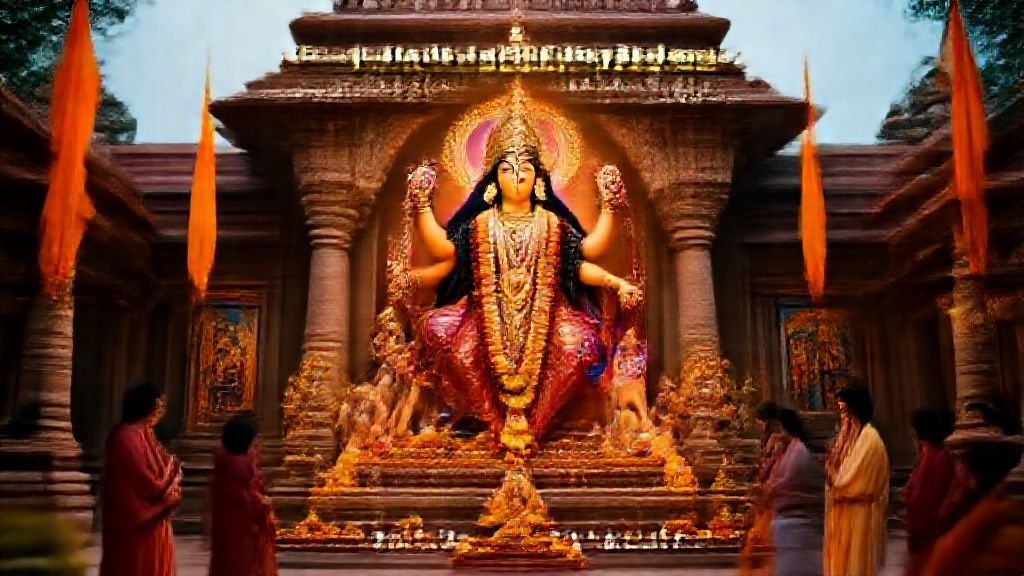
Sharad Navratri 2026 is a nine-night Hindu festival celebrating the divine feminine power, Devi Durga, commencing Friday, October 9, 2026, and culminating Sunday, October 19, 2026, with Vijayadashami. This auspicious period venerates the victory of Dharma over Adharma, embodying spiritual purification and renewed divine energy.
| Attribute | Details |
|---|---|
| Deity | Adi Shakti (Durga), in her nine forms (Navadurga) |
| Location/Origin | Pan-Indian, with regional variations; rooted in Vedic traditions |
| Key Festival | Sharad Navratri (Autumn Navratri) |
| Date (2026) | Starts: Friday, October 9, 2026 (Pratipada) Ends: Sunday, October 19, 2026 (Vijayadashami) |
| Scripture Reference | Devi Mahatmyam (Markandeya Purana), Devi Bhagavata Purana, Kalika Purana |
The Auspicious Descent of Divine Energy: Sharad Navratri 2026
Sharad Navratri, a profound celebration within Sanatan Dharma, is not merely a festival of nine nights but a sacred journey into the heart of Hindutva.online‘s spiritual essence. It is the most significant of the four annual Navratris, heralded by the autumn equinox, marking a pivotal time for spiritual aspirants to connect with the cosmic energy of Devi. During these nine nights and ten days, the universe pulsates with the vibrations of the Divine Mother, who manifests in her various forms (Navadurga) to bestow strength, knowledge, and prosperity upon her devotees. This period is a potent reminder of the inherent power within each being, a microcosm of the boundless energy of the Adi Shakti. As the natural world transitions, so too are we called to shed old patterns and embrace inner renewal, guided by the protective and nurturing grace of Devi.
Puranic History and the Legend of Mahishasura Mardini
The genesis of Sharad Navratri is enshrined in the timeless narratives of our Itihasas and Puranas, primarily the Devi Mahatmyam within the Markandeya Purana and the Devi Bhagavata Purana. These scriptures meticulously recount the epic saga of Devi Durga’s manifestation to vanquish the formidable buffalo-demon, Mahishasura.
Mahishasura, through severe austerities, had acquired an unparalleled boon from Brahma, making him invincible to any male deity, human, or beast. Emboldened by this power, he unleashed terror upon the three worlds (Triloka), displacing the Devas from Swargaloka. Faced with this existential threat, the distraught Devas, led by Indra, implored the Trimurti – Brahma, Vishnu, and Shiva – for salvation. From their collective effulgence, immense rage, and divine energies, a brilliant light emerged, coalescing into the resplendent form of Goddess Durga. She was adorned with weapons contributed by each deity: Shiva offered His Trishula, Vishnu His Sudarshana Chakra, Vayu His bow and arrows, Agni His spear, and so forth, symbolizing the integrated power of the entire divine pantheon.
Mounted on her lion, Devi engaged Mahishasura in a fierce, nine-day battle, culminating in his ultimate defeat on the tenth day, Vijayadashami. This victory symbolizes the triumph of Dharma over Adharma, of divine order over chaos, and of purity over all forms of negativity and ego. Each of the nine nights of Navratri is thus dedicated to a specific form of Durga, representing a particular stage in this cosmic battle and a facet of her divine energy, guiding devotees through their own inner struggles against ignorance and illusion.
The Cosmic Architecture of Navratri: A Path to Self-Realization
While Navratri is a festival rather than a temple, its structure reveals a profound cosmic and spiritual architecture, meticulously designed to facilitate inner transformation. The nine nights are consecrated to the Navadurga – nine distinct manifestations of the Divine Mother, each embodying specific virtues and powers. This progression is not arbitrary but a carefully orchestrated ascent towards spiritual liberation, mirroring the journey of the soul.
- Day 1: Shailaputri ( शैलपुत्री ) – Daughter of the Himalayas, representing purity and the foundation of spiritual journey.
- Day 2: Brahmacharini ( ब्रह्मचारिणी ) – The ascetic form, symbolizing penance, devotion, and discipline.
- Day 3: Chandraghanta ( चंद्रघंटा ) – Adorned with a half-moon, she bestows peace, tranquility, and courage.
- Day 4: Kushmanda ( कूष्माण्डा ) – The creator of the universe with her gentle smile, representing cosmic energy.
- Day 5: Skandamata ( स्कंदमाता ) – Mother of Kartikeya (Skanda), symbolizing motherly affection and wisdom.
- Day 6: Katyayani ( कात्यायनी ) – The warrior goddess, embodying strength and justice, known for vanquishing Mahishasura.
- Day 7: Kalaratri ( कालरात्रि ) – The dark night, destroying ignorance and fear, representing fearlessness.
- Day 8: Mahagauri ( महागौरी ) – The benevolent, pure, and luminous form, signifying purification.
- Day 9: Siddhidatri ( सिद्धिदात्री ) – The bestower of all Siddhis (supernatural powers) and liberation.
This sequential veneration guides the devotee through stages of spiritual awakening: from grounding oneself (Shailaputri) to disciplined practice (Brahmacharini), gaining inner peace (Chandraghanta), understanding cosmic creation (Kushmanda), nurturing wisdom (Skandamata), fighting inner demons (Katyayani), overcoming fear (Kalaratri), attaining purity (Mahagauri), and finally achieving ultimate liberation and perfection (Siddhidatri). The cosmic design of Navratri is thus a potent yantra for self-realization.
Rituals & Puja Vidhi for Sharad Navratri
Observing Sharad Navratri with devotion involves a series of rituals that purify the mind, body, and spirit. The primary observance is the daily puja to Devi, alongside fasting and chanting. Here’s a general guide:
- Ghatasthapana ( घटस्थापना ): On the first day (Pratipada), devotees perform Ghatasthapana, a ritual invoking Devi. A kalash (pot) filled with water, covered with mango leaves, and a coconut, is placed on a bed of mud mixed with Saptadhanya (seven grains). This symbolizes the universe and the womb of creation.
- Daily Puja: Each day, the specific form of Durga associated with that day is worshipped. This includes offering flowers, incense (dhoop), lamps (deep), fruits, sweets, and specific Prashad. Devotees also offer red chunri (scarf) to Devi.
- Fasting (Vrat): Many devotees observe fasts, either partial (fruits, milk, specific grains like Kuttu, Singhara) or full (nirjala – without water), for some or all nine days.
- Recitation of Devi Mahatmyam: Chanting the Devi Mahatmyam (or Durga Saptashati) is highly auspicious, narrating the glories and victories of Devi.
- Akhand Jyoti ( अखंड ज्योति ): Many keep an unbroken lamp burning for all nine days, symbolizing the continuous presence of Devi’s light.
- Kanya Pujan ( कन्या पूजन ): On the eighth (Ashtami) or ninth (Navami) day, young girls (Kanya) are worshipped as manifestations of Devi. Their feet are washed, and they are offered food (puri, chana, halwa) and gifts.
- Hawan ( हवन ): A fire ritual (Yajna) is performed, especially on Ashtami or Navami, to invoke the Devas and Devi, offering oblations to the sacred fire.
- Visarjan ( विसर्जन ): On Vijayadashami, after the culmination of the Navratri rituals, the Kalash and the idol (if installed) are immersed in water, symbolizing Devi’s return to her abode.
Mantras & Chants for Divine Connection
Chanting during Navratri amplifies the spiritual vibrations and connects the devotee directly to the Divine Mother.
The Moola Mantra for Devi Durga:
ॐ ऐं ह्रीं क्लीं चामुण्डायै विच्चे ||
Om Aim Hreem Kleem Chamundayai Vichche ||
(This is the famous Navarna Mantra, a powerful nine-letter mantra.)
A simple yet potent mantra for invoking Devi’s blessings:
या देवी सर्वभूतेषु शक्ति-रूपेण संस्थिता। नमस्तस्यै नमस्तस्यै नमस्तस्यै नमो नमः॥
Ya Devi Sarvabhuteshu Shakti-Roopena Samsthita | Namastasyai Namastasyai Namastasyai Namo Namah ||
(Salutations to the Devi who resides in all beings as Shakti, the divine energy.)
For specific forms, the mantras vary. For instance, for Maa Shailaputri:
वन्दे वाञ्छितलाभाय चन्द्रार्धकृतशेखराम् । वृषारूढां शूलधरां शैलपुत्रीं यशस्विनीम् ॥
Vande Vanchhitalabhaya Chandrardhakritashekharam | Vrisharudham Shuladharam Shailaputrim Yashasvinim ||
(I bow to the illustrious Shailaputri, who fulfills desires, adorns a crescent moon, rides a bull, and holds a trident.)
Dos and Don’ts During Navratri
- Do: Observe purity (shaucha), maintain celibacy (brahmacharya), and practice self-restraint (samyama).
- Do: Engage in daily puja, aarti, and meditation.
- Do: Recite Devi mantras and devotional hymns regularly.
- Do: Help the needy and offer charity (daan).
- Do: Keep the home clean and pure, decorating the puja altar.
- Don’t: Consume non-vegetarian food, alcohol, or tobacco.
- Don’t: Engage in negative thoughts, gossip, or arguments.
- Don’t: Cut hair or nails if observing strict fasts.
- Don’t: Use leather products, especially during puja.
- Don’t: Interrupt the Akhand Jyoti once lit.
What is the significance of the nine days of Navratri?
The nine days of Navratri symbolize the nine manifestations of Devi Durga (Navadurga), each venerated for specific divine attributes and powers. This period represents a spiritual journey, mirroring Devi’s nine-day battle against Mahishasura, culminating in the victory of good over evil. Each day offers a unique opportunity for devotees to purify themselves, shed negativity, and align with a particular divine energy, ultimately leading to inner transformation and spiritual growth, as elucidated in the Devi Bhagavata Purana.
Why is Sharad Navratri considered the most important?
Sharad Navratri, occurring in the autumn season, is deemed the most significant among the four annual Navratris (Chaitra, Sharad, Magha, Ashadha) due to its auspicious timing for spiritual practices and its deep cultural resonance. Historically and scripturally, it is the period associated with Devi Durga’s victory over Mahishasura, making it a powerful time for invoking her protective and transformative energies. Its timing also coincides with the harvest season, bringing an added layer of gratitude and prosperity to the celebrations across India, fostering widespread participation and devotion.
Can men observe Navratri fasts and pujas?
Absolutely. While Devi is often associated with feminine energy, her worship transcends gender. Men are equally encouraged to observe Navratri fasts, perform pujas, and engage in spiritual practices to seek the blessings of the Divine Mother. The benefits of spiritual purification, mental clarity, and divine grace are universal, available to all sincere devotees regardless of gender, who approach Devi with faith and devotion. Many great Yogis and Rishis, as described in various scriptures, have performed Devi tapasya.
Why This Matters for Every Hindu
Sharad Navratri is far more than a mere religious observance; it is a profound reaffirmation of Sanatan Dharma’s core principles and a powerful catalyst for individual and collective spiritual evolution. In an age often overshadowed by materialism and discord, these nine nights offer a sacred pause, a chance to reconnect with the eternal source of power, wisdom, and compassion that is Devi. By participating in its rituals, chanting its mantras, and understanding its profound history, devotees do not just celebrate a festival; they actively engage in upholding Dharma, strengthening their faith, and purifying their inner being. This annual resurgence of divine energy reminds us that within each of us resides a spark of the Adi Shakti, capable of overcoming all obstacles and leading us towards Hindutva.online‘s vision of a spiritually enriched life. It is a period for introspection, for gratitude, and for invoking the strength necessary to face life’s challenges with unwavering faith in the Divine Mother’s boundless grace.
