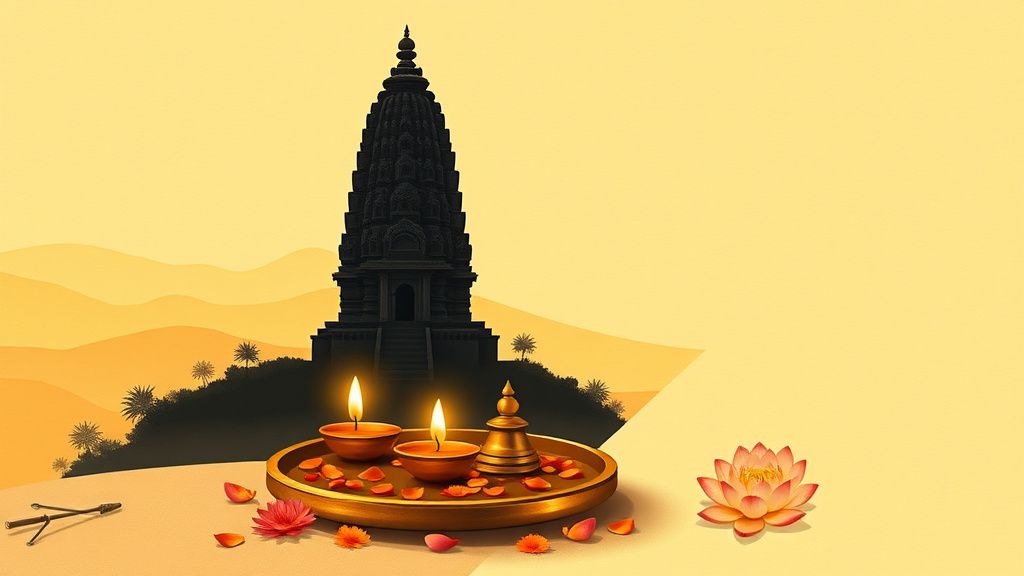
Srikanteshwara Temple at Nanjangud, known locally as Dakshina Kashi, “the Kashi of the south”, sits on the right bank of the Kapila river in Mysuru district, Karnataka, and is dedicated to Shiva in his Nanjundeshwara form (the god who drank the poison from the Samudra Manthana). The sanctum is open daily from 6:00 AM to 1:30 PM and from 4:00 PM to 9:00 PM on Monday to Saturday; on Sundays the temple stays open through the day from 6:00 AM to 10:00 PM without the afternoon break. This article covers timings, the layered architectural history across Gangas, Cholas, Hoysalas and Wodeyars, and how to fit Nanjangud into a Mysore pilgrimage.
Daily timings
- Mon-Sat morning: 6:00 AM to 1:30 PM
- Mon-Sat evening: 4:00 PM to 9:00 PM
- Sundays and special days: 6:00 AM to 8:30 PM continuously (no afternoon closure)
On Mahashivaratri, on the Karthika Deepam observances, and on the major festival weeks the temple extends its hours. For a non-festival Mon-Sat visit, the afternoon 1:30 PM to 4:00 PM closure is consistent and you cannot enter the sanctum during that window.
Why “Nanjundeshwara”, the Samudra Manthana legend
The name Nanjundeshwara means “the one who drank the poison”. In the Samudra Manthana, the churning of the milk ocean by the devas and asuras for the nectar of immortality, the first product of the churning was Halahala, a terrible poison capable of destroying creation. Shiva drank the poison to save the universe; his throat turned blue, earning him the additional name Neelakantha (“blue-throated”). At Nanjangud, Shiva is venerated specifically in this form.
The Nanjangud tradition extends this association: the temple is regarded by devotees as a healing centre, with the deity invoked for relief from illness, especially diseases of the throat and bloodstream. The temple’s prasadam includes the locally famous Nanjangud Tooth Powder, a herbal preparation produced near the temple and traditionally used by devotees.
Architecture across a thousand years
The temple has continuously expanded since the Ganga dynasty (8th–10th century), with major additions by successive ruling powers. The chronology, in approximate order:
- Garbhagriha (sanctum): Ganga or early Chola period, the oldest structure in the complex.
- Anterior mandapa: added in the 13th century, in the Hoysala period.
- Brick and mortar shikhara: added during the Vijayanagara period.
- Brick and mortar gopuram: 1845, under the Mysore Wodeyars.
The Wodeyar patronage of the 19th century gave the temple its current public face. The Wodeyars themselves were active devotees, and the temple’s prominence in the broader Mysore region dates from this period of royal patronage.
How Nanjangud fits a Mysore trip
Nanjangud is ~24 km south of Mysuru (Mysore) city on the road to Ooty. A practical itinerary:
- Mysore city in the morning (Mysore Palace, Chamundi Hills temple).
- Drive south to Nanjangud after lunch (about 45 minutes).
- Sunday hours fit best because the afternoon closure on Mon-Sat would otherwise force you to wait until 4:00 PM at Nanjangud.
For what it’s worth, Nanjangud is often the most underrated stop on a Karnataka temple circuit. The temple’s scale (it is among the largest Shiva temples in Karnataka, with a gopuram visible from kilometres) and its layered architectural history make it more rewarding than many of the smaller hilltop temples that draw more tourist attention. Allow 90 minutes minimum for the visit.
Reaching Nanjangud
- From Mysuru: 24 km south. KSRTC buses run frequently; private vehicles take about 40–45 minutes.
- From Bengaluru: 170 km. About 3 hours via Mysuru.
- By rail: Nanjangud Town railway station is on the Mysuru–Chamarajanagar line.
- By air: Mysore Airport is the nearest small airport; Bengaluru Kempegowda International is the nearest major airport.
Common questions
Is there an entry fee?
General darshan is free. The temple is administered under the Karnataka Muzrai (Endowments) department, which manages most major Hindu temples in the state. Specific sevas, abhishekam, archana, kalyanotsavam, are paid; the seva counter inside the temple lists the current rates.
Are there accommodation options near the temple?
Yes; the Muzrai-managed Yatri Nivas and a small set of private hotels are within walking distance. Most visitors stay in Mysuru and travel down for the day; Mysuru has a far wider hotel inventory and is only 45 minutes away. Same-day return to Mysuru is the standard pattern.
When is the major festival?
Maha Shivaratri (February or March) is the largest single-day observance. The Annual Rathotsava (chariot festival) in Chaitra/April draws large crowds. The Kartika Deepam observance in November or December is another major day, with the entire temple complex lit with oil lamps.
One limitation worth noting
Specific seva fees and special-darshan options are revised periodically by the Karnataka Muzrai administration. Festival dates shift by a day or two each year depending on the panchang. For current information, the temple counter on the day of visit is the authoritative source.
For background see Srikanteshwara Temple Nanjangud on Wikipedia.
