Kartik Purnima, the full moon day of the sacred Kartik month, stands as the most spiritually potent and religiously significant Purnima in the Hindu calendar. Celebrated with unparalleled devotion and fervor, this auspicious day commemorates multiple divine events simultaneously—Lord Shiva’s cosmic victory over Tripurasura, Lord Vishnu’s appearance in the Matsya (fish) avatar, and the birth of Lord Kartikeya, the commander of celestial armies.

In 2025, as millions of devotees gather at sacred rivers and temples across India, Kartik Purnima continues to exemplify the profound Hindu understanding that certain temporal moments create extraordinary opportunities for spiritual advancement, karmic purification, and divine communion. The convergence of celestial alignments, mythological significance, and prescribed ritual practices makes Kartik Purnima what ancient scriptures call “the Full Moon of Liberation”—a night when the boundaries between human and divine realms dissolve, allowing unprecedented access to transcendent consciousness.
Understanding why Kartik Purnima holds such supreme sanctity requires exploring the rich tapestry of mythological narratives, theological principles, and ritual traditions that have sustained this celebration across millennia of Hindu civilization. The day embodies the principle that time itself possesses qualitative dimensions—certain moments carry heightened spiritual potency enabling transformative experiences unavailable during ordinary circumstances.
The Sacred Month of Kartik: Foundation for the Most Holy Purnima
Before examining Kartik Purnima specifically, understanding the month itself provides essential context for this culminating celebration. Kartik month, occurring between October and November, is revered as the holiest month in the Hindu calendar, entirely dedicated to intensified devotional practices, spiritual austerities, and worship of Lord Vishnu in his most merciful form.
Damodar Maas: The Month of Krishna’s Binding
Kartik is also known as Damodar Maas, referring to Lord Krishna’s childhood pastime of being bound (dama) by Mother Yashoda on Diwali day within this month. This name celebrates Krishna’s supreme sweetness—the Lord of the Universe allowing himself to be tied with ropes by his mother’s love, demonstrating that pure devotion binds even the unbindable Supreme Consciousness. The Padma Purana declares that religious acts performed during Kartik month provide results equivalent to visiting all pilgrimages combined, making every day of this month spiritually potent.
Vishnu’s Sacred Month
Hindu tradition recognizes Kartik as particularly dear to Lord Vishnu, who awakens from his four-month cosmic sleep (Yoga Nidra) on Prabodhini Ekadashi during this month. This awakening marks the end of Chaturmas and the beginning of the auspicious period for weddings and major ceremonies. Throughout Kartik, devotees perform special observances including lighting lamps before Tulsi plants each evening, offering ghee lamps to Krishna and singing Damodarastakam, reading or hearing Srimad Bhagavatam, performing extra rounds of mantra chanting, and undertaking charitable activities and food donation (anna daan).
The Culmination: Kartik Purnima
Kartik Purnima represents the glorious culmination of this entire month of intensified spiritual practice. All the devotional merit accumulated throughout Kartik reaches its zenith on this full moon night, when cosmic energies align to create maximum receptivity for spiritual transformation. The full moon itself symbolizes consciousness at complete illumination, free from the shadows of ignorance that wax and wane like lunar phases.
Multiple Divine Events: Why Kartik Purnima Is Multiply Sacred
The extraordinary sanctity of Kartik Purnima derives from its commemoration of several momentous divine events occurring simultaneously or on this same auspicious day according to Hindu sacred chronology.
Lord Shiva’s Victory Over Tripurasura
The primary mythological foundation involves Lord Shiva’s destruction of Tripurasura—three demon brothers who created three invincible moving cities (made of gold, silver, and iron) and terrorized the cosmos. Protected by Brahma’s boon that they could only be killed simultaneously by a single arrow, the brothers seemed invincible until Kartik Purnima, when their cities aligned momentarily under the auspicious Rohini Nakshatra.
Lord Shiva, assuming the cosmic form of Tripurantaka, destroyed all three cities with one divine arrow, restoring dharmic balance. This event, known as Tripura Samhara, symbolizes the annihilation of ego’s triple fortress—false self-identification, attachment, and delusion. The celestial deities celebrated this victory by descending to earth and illuminating Varanasi’s ghats with countless lamps, establishing the Dev Diwali tradition observed on Kartik Purnima.
Lord Vishnu’s Matsya (Fish) Avatar
Kartik Purnima also commemorates Lord Vishnu’s first avatar appearance as Matsya—the divine fish who saved the Vedas from the demon Sankhāsura and protected King Satyavrata (Manu) during the cosmic deluge. According to Puranic accounts, the demon Sankhāsura stole the Vedas—repositories of all divine knowledge—and hid them in the ocean’s depths. To retrieve sacred knowledge and preserve creation’s continuity, Vishnu manifested as a tiny fish that grew to enormous size, ultimately guiding Manu’s boat through the devastating floods while recovering the stolen Vedas from the demon. This avatar demonstrates Vishnu’s role as preserver of dharma and protector of sacred knowledge, with Kartik Purnima marking the day of this divine manifestation.
Birth of Lord Kartikeya (Skanda)
Kartik Purnima is also celebrated as the birthday of Lord Kartikeya (also called Murugan, Skanda, Subrahmanya), the son of Lord Shiva and Goddess Parvati. According to Puranic narratives, Kartikeya was born specifically to defeat the demon Tarakasura, who had received a boon that he could only be killed by Shiva’s son. The six divine sparks from Shiva, nurtured by the Krittikas (Pleiades constellation) and fused into one by Parvati, manifested as the six-headed Kartikeya. His birth on Kartik Purnima represents the emergence of divine warrior energy dedicated to destroying forces opposing dharma, making this day sacred to devotees of Murugan, particularly in South India.
The Convergence of Divinity
The simultaneous commemoration of Shiva’s victory (destruction aspect), Vishnu’s protective manifestation (preservation aspect), and Kartikeya’s birth (regenerative aspect) makes Kartik Purnima a rare synthesis of the complete divine trinity’s functions. This convergence creates what Hindu theology recognizes as a uniquely powerful temporal moment—a sacred opening between human and divine dimensions where spiritual practices yield multiplied results.
The Sacred Bath: Kartik Snaan and Its Transformative Power
The central ritual observance of Kartik Purnima is the sacred bath (Kartik Snaan) taken in holy rivers, lakes, or sacred water bodies during the auspicious muhurat. This practice carries profound theological significance and promises extraordinary spiritual benefits.
The Scriptural Injunction
The Skanda Purana and other sacred texts prescribe ritual bathing on Kartik Purnima as supremely meritorious, declaring that a single bath on this day equals the spiritual merit of bathing in all sacred rivers throughout the entire year. The bath should ideally occur during Brahma Muhurta (pre-dawn) or at moonrise, times when cosmic energies align optimally with human consciousness for maximum purificatory effect.
Geographic Significance: Most Sacred Bathing Sites
While bathing in any clean water body on Kartik Purnima carries merit, certain locations are considered especially auspicious:
Varanasi (Kashi): Bathing in the Ganges at Varanasi on Kartik Purnima is deemed most sacred, as Shiva’s own city becomes the gathering place for celestial deities celebrating his victory. Hundreds of thousands of pilgrims descend on Varanasi’s 84 ghats for this holy bath, creating a spectacular congregation of devotion.
Pushkar, Rajasthan: The only naturally occurring lake dedicated to Lord Brahma, Pushkar Lake receives special sanctity on Kartik Purnima. The famous Pushkar Fair culminates on this day, combining religious observance with the world’s largest livestock fair. Devotees believe that bathing in Pushkar Lake on Kartik Purnima cleanses all sins and grants liberation.
Prayagraj (Allahabad): The sacred confluence (Sangam) of Ganges, Yamuna, and mystical Saraswati rivers at Prayagraj draws massive crowds for Kartik Purnima bathing, as the triple river junction amplifies purificatory power.
Ganga Sagar (Bengal): Where the Ganges meets the Bay of Bengal, this location attracts devotees who combine Kartik Purnima observance with honoring the ocean as Varuna’s domain.
Local Rivers and Tanks: Hindu tradition recognizes that sincere devotion sanctifies any water body, allowing devotees unable to reach major pilgrimage sites to observe Kartik Snaan locally while maintaining spiritual authenticity.
The Purificatory Theology
Hindu theological understanding holds that sacred waters carry inherent purifying power amplified during auspicious astronomical alignments like full moons, particularly the Kartik full moon. Immersion in such waters during proper timing creates several simultaneous effects: physical cleansing through contact with flowing water, energetic purification as water absorbs and carries away negative karmic impressions, spiritual renewal through conscious ritual participation with focused intention, and divine blessing as the act demonstrates faith and devotional surrender.
The bath should be accompanied by specific mantras, prayers to the Sun God and water deities, offerings of flowers and sesame seeds, and charitable donations to Brahmins and the poor following the bath, completing the ritual cycle.
Lamp Offering and Light Worship
Beyond the sacred bath, Kartik Purnima observances include elaborate lamp lighting ceremonies that transform the landscape into a realm of radiant illumination, symbolizing the victory of consciousness over ignorance.
Deepdan: The Gift of Light
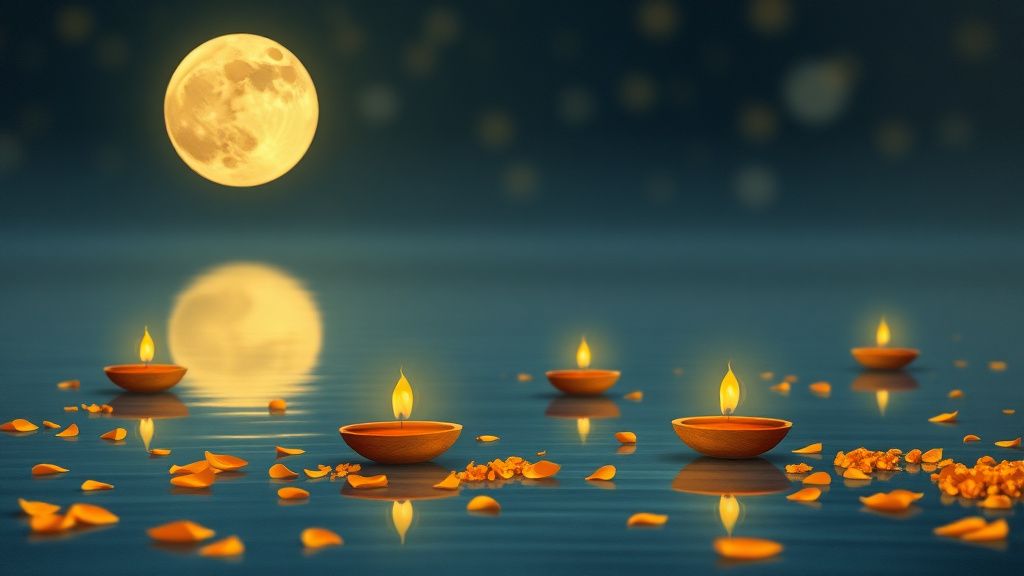
Devotees light and offer earthen oil lamps (diyas) to rivers, especially the Ganges, allowing them to float downstream carrying prayers and blessings. This practice, called Deepdan (gift of light), symbolizes offering one’s own consciousness—the inner light—to the divine flow of existence. In Varanasi, over a million lamps illuminate the ghats during Dev Diwali on Kartik Purnima, creating what is considered one of the most spectacular visual displays in Hindu religious practice.
Tulsi Lamp Offering
Many devotees also light lamps before Tulsi plants (Holy Basil) maintained in their homes, as Kartik month is particularly associated with Tulsi worship. The combination of the sacred month’s culminating day and devotional lamp offering creates powerful spiritual merit.
Symbolic Significance
The lighting of lamps on Kartik Purnima carries multiple layers of meaning: each lamp represents an individual soul; the flame symbolizes consciousness or divine presence within; collective illumination demonstrates how individual spiritual efforts contribute to universal enlightenment; offering light to darkness mirrors the removal of ignorance through divine knowledge; and the full moon itself becomes the cosmic lamp illuminating creation.
Kartik Purnima 2025: Date, Timings, and Observances
For devotees planning their 2025 Kartik Purnima celebrations, understanding precise dates and auspicious timings ensures proper observance of this sacred day.
Kartik Purnima 2025 Date
Kartik Purnima in 2025 falls on Wednesday, November 5th, marking the conclusion of the sacred Kartik month and the culminating celebration of extended Diwali festivities.
Purnima Tithi Timings 2025
- Purnima Tithi Begins: November 4, 2025 at 10:36 PM IST
- Purnima Tithi Ends: November 5, 2025 at 6:48 PM IST
- Moonrise on November 5: 5:11 PM IST
Auspicious Bathing Muhurats
- Brahma Muhurta (Most auspicious): 4:45 AM – 6:15 AM
- Morning Bathing Period: Sunrise (6:35 AM) to 12:00 PM
- Moonrise Bathing: 5:11 PM onwards (especially sacred)
Recommended Observances
Wake during Brahma Muhurta and prepare for holy bath; proceed to river, lake, or local water body during auspicious timing; take ritual bath with prayers and mantras; offer sesame seeds, flowers, and water oblations; make charitable donations (especially food, clothes, educational materials); light earthen lamps and offer them to water; perform puja to Lord Vishnu, Lord Shiva, and Lord Kartikeya; observe fast (complete or partial) until moonrise; break fast after evening worship and lamp offering; and participate in community celebrations including Dev Diwali if in Varanasi.
Charitable Acts and Dana: Multiplied Merit
Kartik Purnima is considered supremely auspicious for performing charitable acts (dana), which carry multiplied spiritual merit on this sacred day.
Prescribed Donations
Traditional texts recommend specific charitable acts for Kartik Purnima: Anna Daan (food donation)—providing meals to the poor, brahmins, or supporting community kitchens; Vastra Daan (clothing donation)—distributing clothes to those in need; Go Daan (cow donation)—supporting cow protection or donating toward cow welfare; Vidya Daan (educational donation)—supporting education for underprivileged children; Jal Daan (water provision)—establishing water facilities in public places; and Deepa Daan (lamp donation)—providing oil lamps or resources for temple illumination.
The Theology of Kartik Month Charity
Hindu scriptures declare that donations made during Kartik month, particularly on Kartik Purnima, bring multiplied results extending across multiple lifetimes. The charitable act performed with proper consciousness becomes a spiritual investment yielding eternal dividends through increased merit, pleasing Lord Krishna in his Damodar form, supporting dharmic activities and institutions, bringing blessings for family prosperity and harmony, and accumulating positive karma that influences future incarnations.
Modern charitable organizations emphasize that donations on Kartik Purnima carry both spiritual merit and practical benefits, with many NGOs offering tax deductions under Section 80G while ensuring efficient distribution to those most in need—hospital patients’ families, orphaned children, school meal programs, and vulnerable communities.
Regional Variations and Cultural Celebrations
While Kartik Purnima’s core significance remains consistent across India, diverse regional expressions add richness to this pan-Hindu celebration.
North India: Dev Diwali and Ganga Aarti
In Uttar Pradesh, Bihar, and surrounding regions, Kartik Purnima manifests as Dev Diwali—the spectacular illumination of Varanasi’s ghats with over a million lamps and the grand Ganga Aarti ceremony. The emphasis is on sacred bathing, lamp offerings, and witnessing the divine celebration.
Rajasthan: Pushkar Fair Culmination
The famous Pushkar Fair reaches its spiritual and commercial climax on Kartik Purnima, combining religious observance with the world’s largest camel and livestock trading fair. Thousands of pilgrims bathe in Pushkar Lake while traders conclude business transactions under auspicious timing.
South India: Karthigai Deepam
In Tamil Nadu, Karnataka, and parts of Andhra Pradesh, Kartik Purnima is celebrated as Karthigai Deepam, particularly dedicated to Lord Murugan (Kartikeya). The festival includes lighting rows of lamps in homes and temples, special worship of Murugan, and in Tamil Nadu, the lighting of a massive lamp atop Tiruvannamalai mountain representing Shiva as the infinite pillar of light.
East India: Boita Bandana
In Odisha, Kartik Purnima is celebrated as Boita Bandana, commemorating the state’s ancient maritime trading heritage. Devotees float miniature boats made of banana stem, paper, or cork in rivers and ponds, remembering the brave sailors (sadhabas) who undertook overseas trading voyages.
West India: Tripuri Purnima
Maharashtra and Gujarat observe Kartik Purnima as Tripuri Purnima, emphasizing Shiva’s victory over Tripurasura. Special prayers to Shiva, lighting of lamps, and sacred bathing mark the observance.
Theological Significance: The Full Moon of Liberation
Beyond specific mythological narratives and ritual practices, Kartik Purnima embodies profound theological principles central to Hindu spiritual understanding.
The Concept of Sacred Time
Kartik Purnima exemplifies the Hindu recognition that time possesses qualitative dimensions beyond mere chronological sequence. Certain moments—determined by astronomical alignments, lunar phases, and divine associations—create portals of heightened spiritual receptivity. The full moon of Kartik represents such a portal, when the boundaries between ordinary and transcendent reality thin, allowing unprecedented access to divine consciousness.
Moksha and Karmic Purification
Ancient texts call Kartik Purnima “the Full Moon of Liberation” because properly observed rituals on this day are believed to burn away accumulated karmic impressions from multiple lifetimes. The combination of sacred bathing, lamp offering, charitable acts, and focused devotion creates a comprehensive spiritual practice addressing all dimensions of karmic bondage—physical, energetic, mental, and causal.
Light as Consciousness
The emphasis on lamp lighting throughout Kartik month, culminating in the spectacular illumination of Kartik Purnima, teaches that light symbolizes consciousness itself. Just as physical light dispels darkness, spiritual consciousness removes the ignorance that obscures our true divine nature. The full moon represents consciousness at complete illumination, free from the waxing and waning of limited understanding.
Divine Accessibility
The belief that gods descend to earth on Kartik Purnima to celebrate and bathe in sacred rivers demonstrates the theological principle that certain spatio-temporal conditions create extraordinary divine accessibility. The normal separation between human and celestial realms dissolves, allowing devotees to literally bathe alongside descending deities, temporarily transcending the ordinary boundaries of existence.
Frequently Asked Questions About Kartik Purnima
Why is Kartik Purnima the most sacred full moon?
Kartik Purnima is considered the most sacred Purnima because it simultaneously commemorates multiple divine events: Lord Shiva’s victory over Tripurasura, Lord Vishnu’s appearance as Matsya avatar, and Lord Kartikeya’s birth. It culminates the holiest month (Kartik) dedicated to intensified devotion, and ancient scriptures declare it “the Full Moon of Liberation” when rituals yield multiplied spiritual merit. The day creates a unique temporal portal when gods descend to earth, making divine communion most accessible.
What is the significance of taking a holy bath on Kartik Purnima?
The sacred bath (Kartik Snaan) on Kartik Purnima is believed to wash away sins accumulated through multiple lifetimes, providing spiritual purification equivalent to bathing in all sacred rivers throughout an entire year. Bathing at Varanasi in the Ganges or at Pushkar Lake is considered especially meritorious. The bath should occur during Brahma Muhurta (pre-dawn) or at moonrise, accompanied by mantras, offerings, and charitable donations for complete spiritual benefit and karmic cleansing.
When is Kartik Purnima in 2025 and what are the timings?
Kartik Purnima 2025 falls on Wednesday, November 5th. The Purnima Tithi begins at 10:36 PM on November 4th and ends at 6:48 PM on November 5th. The most auspicious bathing times are Brahma Muhurta (4:45 AM – 6:15 AM) and at moonrise (5:11 PM onwards). Devotees should perform holy bath, lamp offerings, charitable donations, and worship during these auspicious periods for maximum spiritual merit.
What is the story of Lord Vishnu’s Matsya avatar connected to Kartik Purnima?
Lord Vishnu’s first avatar as Matsya (fish) manifested on Kartik Purnima to save the Vedas stolen by demon Sankhāsura and protect King Satyavrata (Manu) during cosmic deluge. Vishnu appeared as a tiny fish that grew enormous, guided Manu’s boat through devastating floods, recovered stolen Vedas from ocean depths, and restored sacred knowledge to creation. This avatar demonstrates Vishnu’s role as preserver of dharma and protector of divine wisdom.
Why is Kartik month so important in Hinduism?
Kartik month is revered as the holiest month in the Hindu calendar, entirely dedicated to Lord Vishnu worship in his Damodar form. Also called Damodar Maas, it commemorates Krishna’s binding by Mother Yashoda’s love. Scriptures declare that religious acts during Kartik provide results equal to all pilgrimages combined. The month includes major festivals like Dev Prabodhini Ekadashi, Tulsi Vivah, Dev Diwali, and culminates in Kartik Purnima, making it supremely auspicious for spiritual practices, fasting, charity, and devotional activities.
What charitable acts should be performed on Kartik Purnima?
Kartik Purnima is highly auspicious for charitable donations (dana) which carry multiplied spiritual merit. Recommended acts include Anna Daan (food donation to poor and hungry), Vastra Daan (clothing distribution), Go Daan (supporting cow welfare), Vidya Daan (educational support), and Deepa Daan (lamp offerings). Donations to certified NGOs receive tax benefits under Section 80G while ensuring efficient distribution. Charitable acts on this day please Lord Vishnu and accumulate positive karma extending across multiple lifetimes.
How is Kartik Purnima celebrated differently across India?
Kartik Purnima manifests through diverse regional expressions: North India celebrates Dev Diwali with million-lamp illumination in Varanasi; Rajasthan concludes the Pushkar Fair with sacred bathing and livestock trading; South India observes Karthigai Deepam honoring Lord Murugan with lamp rows; Odisha celebrates Boita Bandana floating miniature boats commemorating maritime heritage; and Maharashtra-Gujarat observe Tripuri Purnima emphasizing Shiva’s victory. Despite variations, all regions maintain core practices of holy bathing, lamp offerings, and charitable donations.
What is the connection between Kartik Purnima and Dev Diwali?
Dev Diwali (Diwali of Gods) is celebrated on Kartik Purnima in Varanasi, commemorating the descent of celestial deities to earth to celebrate Lord Shiva’s victory over Tripurasura. The gods illuminated Varanasi’s ghats with countless lamps establishing this tradition. On Kartik Purnima, over a million earthen lamps light up the 84 ghats, creating spectacular visual display. Devotees believe that bathing in Ganges on this night occurs alongside descending gods, making it the most auspicious day for Kartik Snaan.
About the Author
Dr. Aryan Mishra – PhD in Vedic Studies and Ancient Indian History
Dr. Aryan Mishra is a distinguished scholar specializing in ancient Indian history, Vedic traditions, and Hindu cultural practices. With over 15 years of research experience focused on decolonizing historical narratives, he has published extensively on Hindu cosmology, lunar calendar systems, pilgrimage traditions, and the theological significance of sacred time in Hindu philosophy. His work bridges academic rigor with accessible presentation, making complex historical, astronomical, and philosophical concepts understandable to contemporary audiences seeking authentic knowledge about Hindu civilization’s sophisticated understanding of cosmic rhythms and spiritual practice.