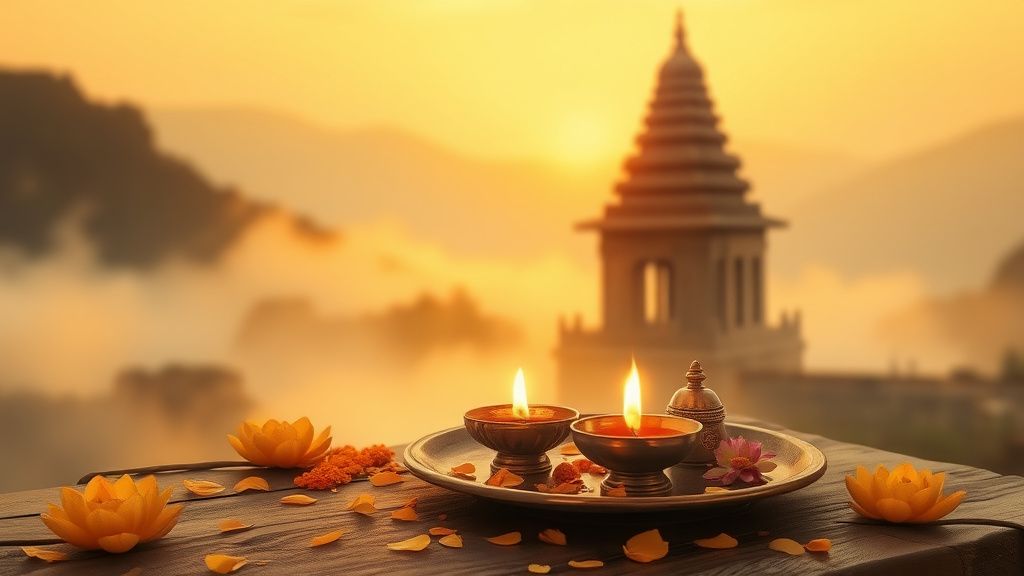
A Hindu home pooja room (also called the mandir or devasthanam) is the dedicated space at home for daily prayer, lamp lighting, and routine seva of household deities. By Vastu Shastra convention, the ideal placement is the north-east corner of the house (the Ishaan Kona), with the worshipper facing east or north while praying. The deities face the worshipper, so they look west or south at the time of darshan; the deities themselves are placed against the western or southern wall of the pooja space. Lighting and air-flow matter as much as orientation. This article walks through the Vastu-recommended placement, the practical setup, the items of a basic mandir, and a few real-world choices for apartment-living families where Vastu cannot be strictly followed.
The Vastu-recommended placement
- Direction of the pooja room: north-east (Ishaan Kona) of the house; second choice east or north
- Direction the worshipper faces: east (primary) or north (acceptable)
- Direction the deities face: west (when worshipper faces east) or south (when worshipper faces north)
- Deity placement on the wall: against the western or southern wall of the pooja space, set back at least 1 inch from the wall
- Avoid: the southern direction for the pooja room itself, the basement, the bedroom, near or against a toilet wall, under a staircase, or directly under a beam
The Vastu reasoning ties to the diurnal sunlight cycle. The north-east receives the first sun in the morning, which traditional commentary holds is the most sattvic light of the day. The east and north are the standard prayer directions of Vedic ritual. The south is associated with Yama (death) and is avoided for the pooja room placement (though the deities can be placed facing south when the alternative arrangement requires it).
A practical setup
A basic home mandir has these elements:
- A wooden or stone chowki / platform: raised 6 to 12 inches from the floor; the deities sit on this, not directly on the floor
- The principal deity / deities: one or more murtis or framed pictures; the principal deity is at the centre, the others to the right and left
- An oil lamp (diya): brass or copper, single-wick or multi-wick, lit at puja times
- An incense holder (dhoop / agarbatti): for the aroma offering
- A bell (ghanta): rung at the start of puja and at aarti
- A small kalasha (water vessel): for sanctified water
- A puja thali (plate): with kumkum, akshat (rice), sandal, flowers, agarbatti
- A camphor stand / aarti diya: for the closing aarti
- A puja book / pothi: the family’s standard slokas, mantras, or aarti texts
- A small stool for the worshipper: aasana, traditionally of woollen or cotton fabric, never plastic
Choice of deities
Most households include a combination of the Pancha-devata (the five principal deities of household worship per the Smarta tradition): Ganesha, Shiva, Vishnu, Devi (or Lakshmi), and Surya. Specific traditions add their own ishta-devata: Krishna for Vaishnavas, Murugan for Tamil Saivites, Hanuman for the Vaishnava-Saiva borderline households, Saraswati for student-heavy homes, and the kuladevata (family deity) for tradition-conscious families. The ishta-devata is centred; the rest flank.
Items to avoid
- Broken or chipped murtis: traditionally retired by immersion in flowing water (visarjan), not kept at home
- More than one murti of the same deity: Vastu convention says one murti per deity; multiple identical murtis disperse the focus
- Photographs of deceased family members in the pooja room: the pooja room is for devata worship; ancestor photographs traditionally go in a separate space
- Storage or unrelated items: the mandir is not a shelf for general household goods; keep it dedicated
- Footwear or impure substances: never near the pooja space; remove footwear at the entry
Apartment-living adjustments
Most modern apartments do not allow a separate pooja room; the family allocates a corner of the kitchen or living room. Vastu-conscious arrangements in this case:
- Choose the most north-east of the available corners
- Use a wall-mounted wooden mandir (the “carved temple cabinet” style) at chest height, not floor-level
- Provide a small light or single LED diya for early-morning visibility without disturbing the rest of the room
- Keep an aasana (mat) at the front for the daily worshipper to sit
- Locate the mandir on a non-shared wall, never sharing a wall with the toilet or the kitchen wash area
A practical opinion on Vastu vs reality
For what it’s worth, perfect Vastu compliance is rarely possible in modern Indian housing, and the consistency of daily seva matters more than the orientation of the room. A clean, well-maintained mandir in any corner of the home, attended to morning and evening with sincere intent, is more important than a perfectly north-east placement that the family neglects for weeks. The Vastu prescription is a guidance, not a rigid requirement; treat it as a preference and adjust to the practical floor plan.
Common questions
Can the pooja room be in the kitchen?
Yes, the pooja corner can be in the kitchen, and it is traditional in many South Indian and East Indian households to combine the two. The constraint is that the mandir wall should not back onto the sink or the toilet wall, and the gas stove should not be directly in front of the deities. A small north-east corner of the kitchen, set back from the cooking and washing areas, works well; many flats use this exact arrangement.
When to do the daily puja?
The traditional two slots are the Brahma muhurta (about 90 minutes before sunrise) and the evening Sandhya (around sunset). Most modern households do a short morning aarti at 6:00 to 7:30 AM and an evening lamp lighting at 6:30 to 7:30 PM. The consistency matters more than the exact slot; a brief daily lamp and aarti is more aligned with tradition than a long weekly puja with empty weekdays in between.
Should the deity face the bedroom?
By Vastu convention, the pooja room and the bedroom should not share a wall, and the deities should not face directly into a bedroom. A door or partition between the two is the standard solution where the wall sharing is unavoidable. Keep the pooja space curtained or enclosed at night if it sits in a multi-purpose room.
One limitation worth noting
Vastu Shastra has many regional and sectarian variations. The guidance above follows the common northern and central Indian Smarta convention; Tamil Saiva, Bengali Shakta, and Kerala households often have their own prescriptions, particularly for the choice of ishta-devata, the daily seva routine, and the items at the mandir. The general principle of clean placement, sincere intent, and consistent daily seva is shared across traditions; the details vary.
For background reading, the Vastu chapter in the Brihat Samhita of Varahamihira is the classical source for direction-based ritual placement; a modern summary is available on Vastu Shastra on Wikipedia.
