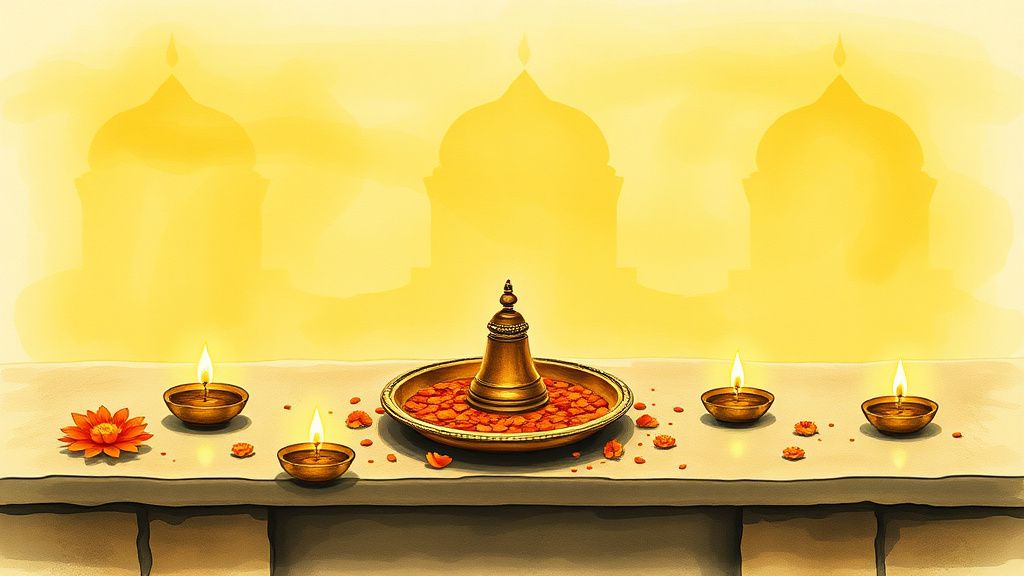
Vastu Shastra places the pooja room in the northeast (Ishanya) corner of the home, the zone presided by Ishana (a form of Shiva) in the Vastu Purusha Mandala. The rationale is climatic and symbolic together: the northeast receives the softest morning light, the lowest afternoon heat, and is read in the Mayamatam as the threshold between the human and divine zones of the house. When a dedicated northeast room is not possible, the next preferred placements are the east or the north walls. Idols face west (so the worshipper faces east), with a base raised six to ten inches above floor level and no idol taller than nine inches in a domestic shrine.
Why northeast is the prescribed direction
The northeast quadrant collects three things that classical vastu treats as auspicious.
- Light quality: in the northern hemisphere the first sunlight of the day enters from the east and northeast at a low diffuse angle, ideal for reading scripture or sitting in meditation without glare.
- Cool microclimate: the northeast wall heats up the least over the day, so the room stays the coolest in summer and is the least uncomfortable for morning sit.
- Vastu Purusha geometry: the Vastu Purusha is described as lying face down with his head in the northeast. The head zone receives the puja, the heaviest mass goes in the southwest at the feet, the kitchen sits at the navel-fire location of southeast.
Direction the worshipper faces
The worshipper sits facing east or north during puja, which means the idols are placed against the west or south wall of the room. East-facing is the primary preference, since the rising sun is itself read as the universal form of the divine. North-facing is the secondary option, often used when the room layout makes east-facing inconvenient.
The idols and pictures should not face south. The space behind the idols should be a solid wall, not a window. A small ventilator or jali above the altar is acceptable and traditionally encouraged so that the smoke of incense and the aagarbatti has an exit. The room itself should not share a wall with a toilet, and the pooja room should not sit directly below a toilet on an upper floor.
Practical layout for a home shrine
- Threshold: a small step or raised threshold (kerb) at the door of the pooja room marks it as a separate ritual space. A curtain or door is preferred but not mandatory.
- Altar height: the base of the idols should be at the worshipper’s chest height when seated, roughly 18-24 inches above the floor for an adult sitting cross-legged on a mat.
- Idol size: domestic shrine idols are traditionally kept below 9 inches in height. Anything taller is considered temple-grade, with implications for daily ritual obligations the householder may not be able to maintain.
- Lamp position: the oil lamp sits to the southeast of the altar (the Agni corner), at the right side as the worshipper faces the idols.
- Storage: puja items below the altar in a closed cabinet are acceptable, but no footwear, leather or stored food in the room. The kalasha or water vessel sits in the northeast corner of the shrine itself.
What to keep, what not to keep
The classical rules on items in a pooja room are restrictive on a few specific points and flexible on the rest.
- No images of dead ancestors in the active worship area. Photographs of departed family members belong in a separate location, traditionally on a south-facing wall elsewhere in the home.
- No broken idols. A chipped or cracked idol is immersed in flowing water and not kept on the altar.
- No duplicate idols of the same deity in identical form. A single Ganesha, a single Lakshmi, a single Devi is the convention; multiple forms of the same deity (Bala Krishna and Venugopala, for example) are acceptable.
- No Shiva linga taller than the thumb of the householder. The standard domestic Shiva linga is roughly an inch high; larger lingas are temple-grade and bring stricter ritual obligations.
Pooja room in a small flat
In a one-bedroom or studio flat where a dedicated room is not possible, a wall-mounted shrine in the northeast corner of the living area is the standard adaptation. A small wooden cabinet, opened during puja and closed otherwise, is acceptable. A shrine in a kitchen is permitted only if no other location works, and it should sit against the northeast wall of the kitchen, not facing the stove. A shrine in a bedroom is the least preferred option but is permitted with a curtain that screens it during sleep hours.
A practical opinion on home shrines
For what it’s worth, the size and content of a domestic shrine should match what the household will actually maintain. A maximalist shrine with twenty idols, daily abhishekam and an extensive offerings routine becomes a burden in a working household, and unmaintained shrines accumulate the very dust and neglect that vastu treats as inauspicious. A small clean shrine with three or four chosen deities, a daily lamp, a weekly fresh-flower change and a monthly thorough clean is more sustainable and more honest than an elaborate one that the family cannot keep up with.
Common questions
Can the pooja room be in the bedroom?
It is permitted but not preferred. Vastu reasoning is that the bedroom is a space of rest and intimacy, and the pooja room is a space of focused worship; the two functions clash. If unavoidable, the shrine sits in the northeast corner of the bedroom with a curtain or cupboard door that closes it during sleep hours. The shrine should not be visible from the bed.
What direction should idols face?
Idols traditionally face west or south so that the worshipper faces east or north. East-facing worship is the primary preference. The exception is Hanuman, who is sometimes placed facing south (the direction of Lanka in the Ramayana narrative) in some traditions. The general rule is to seat the worshipper in the direction of incoming light.
Should the pooja room have a door?
A door is preferred, and a two-panel door (opening outward) is the classical configuration. The threshold is raised by an inch or two to mark the room as a separate ritual space. A curtain is acceptable in a small home, especially where the room doubles as a study or quiet corner. The door is opened in the morning for puja and closed at night.
One limitation worth noting
Vastu prescriptions for the pooja room are well attested in the Mayamatam and the Manasara, but they assume a free-standing courtyard house in a tropical Indian climate. Applying them strictly to a north-facing flat in a modern apartment building forces a series of compromises, and different vastu consultants will recommend different adjustments. The core rules (northeast preferred, east-facing worship, idols against a solid wall, no toilet adjacency) hold up reasonably well; the more elaborate prescriptions about precise distances and colour schemes are interpretive.
For background see Puja on Wikipedia and the entry on Vastu shastra.
