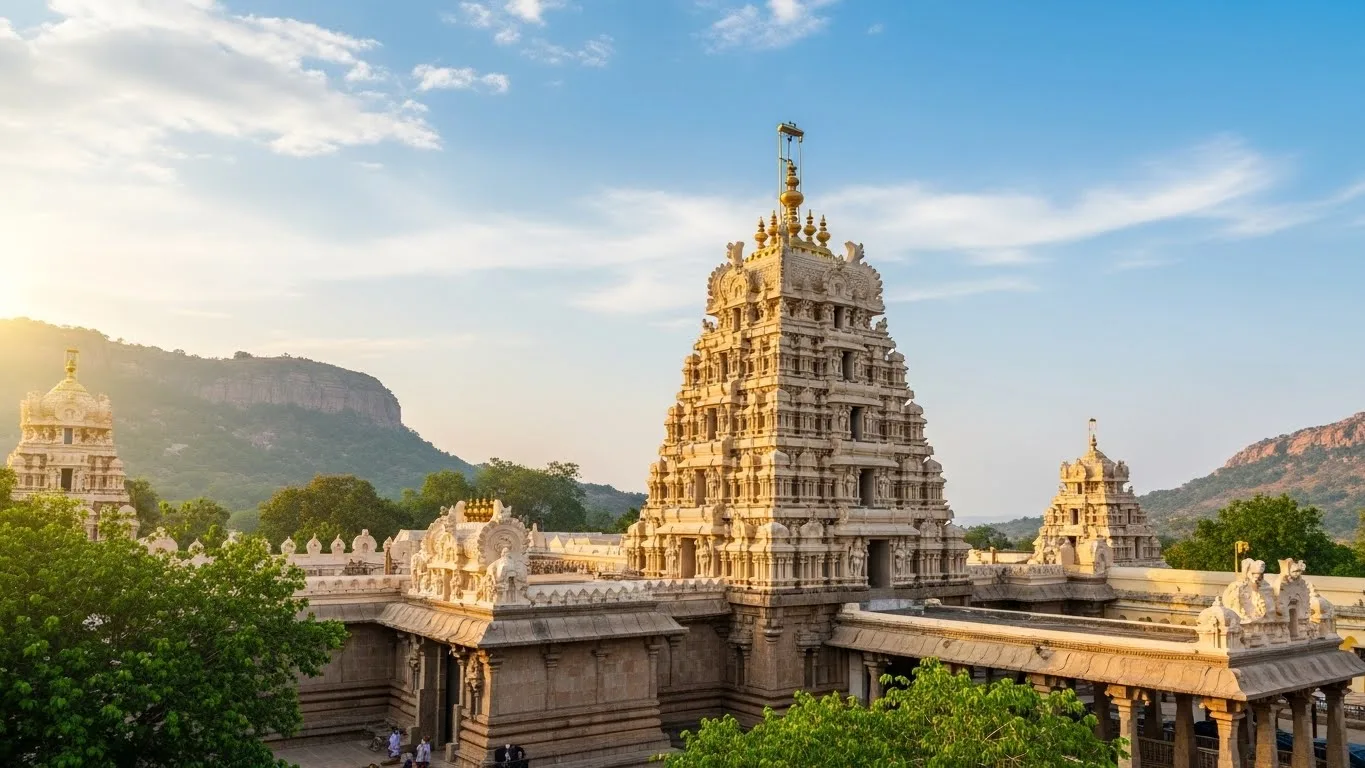
Mallikarjuna Temple in Srisailam—the second of twelve sacred Jyotirlingas and simultaneously one of eighteen Maha Shakti Peethas—represents the only temple in India where both Shiva’s infinite light pillar and Goddess Shakti’s divine presence coexist under one roof, creating dual sanctity unmatched at any other pilgrimage site, with Wikipedia’s authoritative documentation confirming that Lord Shiva manifests here as Mallikarjuna (worshipped with jasmine flowers) while Goddess Parvati resides as Bhramaramba (the Goddess of Bees), both established at this sacred spot on the Nallamala Hills to remain eternally close to their son Kartikeya who retreated to nearby Mount Krauncha in hurt after losing the wedding competition to his brother Ganesha [web:733][web:737].
According to the legend narrated in the Koti Rudra Samhita of Shiva Purana, when Shiva and Parvati declared that whichever son circled the universe seven times first would be married first, Kartikeya immediately mounted his peacock and flew away while Ganesha simply circled his parents seven times explaining “You both are my entire universe”—his intelligence pleased the divine couple who married him to Siddhi and Buddhi, but when Kartikeya returned years later to discover he’d lost, he fled in anger to Palani, prompting his remorseful parents to follow and establish their presence at Srisailam to remain forever close [web:733][web:739].
The extraordinary spiritual convergence validates profound significance: as the 2025 spiritual guide explains, Srisailam is not merely a temple but a complete spiritual center combining Jyotirlinga (Shiva’s energy manifestation), Shakti Peetha (where Sati’s upper lip fell during Shiva’s cosmic grief dance), sacred tirthas (Patalaganga on Krishna River accessed via 852 steps), and Swayambhu linga (self-manifested, discovered by a cowherd woman whose cows mysteriously offered milk to a glowing divine linga), making it second only to Kashi Vishwanath in combined sanctity [web:737][web:740].
The architectural magnificence documented by Inheritage Foundation reveals Vijayanagara emperor Krishnadevaraya’s 14th-16th century contributions including the majestic main gopuram with intricate mythological carvings, multiple mandapas (pillared halls), and the exquisite Veerasiro Mandapam depicting Mahabharata scenes, while Satavahana inscriptions prove the temple’s existence from 2nd century CE, and the shrine housing Mallikarjuna dates to 7th century [web:733][web:743].
As millions undertake pilgrimage to this “Kailash of the South” nestled in mystical Nallamala forests beside the Krishna River—with modern infrastructure including ropeway to Patalaganga, online darshan booking, and APTDC Haritha hotels—understanding the complete legend, spiritual significance, architectural heritage, and practical visiting guide becomes essential for meaningful Hindu pilgrimage [web:737]https://hindutva.online. This comprehensive article presents Mallikarjuna Temple’s sacred story, dual Jyotirlinga-Shakti Peetha significance, Vijayanagara architectural features, darshan timings and ticket booking, how to reach from Hyderabad, accommodation options, nearby sacred sites, and complete pilgrimage preparation tips.
The Legend: Ganesha-Kartikeya Wedding Competition
The Marriage Discussion
The dilemma: Both parents loved their sons equally and couldn’t decide which one to marry first [web:739][web:742].
The Competition: Seven Circles Around the Universe
To resolve the dilemma fairly, they devised a plan and called both sons to discuss it [web:742].
The challenge announced [web:739][web:742]:
- “Whoever successfully goes around the entire universe seven times and returns first would be married first”
Kartikeya’s response [web:742]:
- Being confident and believing in fair competition, immediately mounted his peacock vehicle
- Flew away to circumambulate the entire universe seven times
- His journey would take many years to complete
Ganesha’s wisdom [web:733][web:739]:
- Recognized the impossible nature of physically circling the universe
- Used his exceptional intelligence and deep devotion
- Circled his parents seven times slowly and respectfully
- Folded his hands and explained: “You both are my entire universe—circling you is equivalent to circling the whole cosmos”
Ganesha’s Wedding
The marriage [web:733][web:734]:
- Since Kartikeya would take years to return, Shiva and Parvati decided to proceed with Ganesha’s wedding
- They married Ganesha to Siddhi (spiritual power) and Buddhi (intellect), the daughters of Prajapati Viswarupa
- The wedding was celebrated with grand joy and splendor
Kartikeya’s Anguish and Retreat
Kartikeya’s response [web:733][web:734]:
- Felt betrayed by his parents’ decision
- Left Mount Kailash in anger
- Went to Mount Krauncha in Palani (Tamil Nadu)
- Took the name Kumara Brahmachari (eternal celibate youth)
- Decided to stay alone forever
Shiva and Parvati’s Pursuit
The divine parents’ resolution [web:733][web:737]:
- When Kartikeya saw his father approaching, he tried to move to another location
- On the request of the Devas (celestial gods), Kartikeya agreed to stay close by
- Shiva and Parvati decided to establish their permanent abode nearby
- The place where Shiva and Parvati stayed came to be known as Srisailam
- Lord Shiva manifested as Mallikarjuna Jyotirlinga
- Goddess Parvati manifested as Bhramaramba Shakti Peetha
Dual Sanctity: Jyotirlinga and Shakti Peetha
The Unique Convergence
It is the only temple where the Shakti Peetha and Jyotirlinga reside under one roof [web:734]. This makes Srisailam one of the holiest pilgrimage sites in India [web:737].
Jyotirlinga Significance
Mallikarjuna Jyotirlinga [web:733][web:734]:
- Second among the twelve sacred Jyotirlingas
- Listed in Shiva Purana’s Jnanasamhita
- Lord Shiva appeared here on Amavasya (new moon) as Arjuna
- Goddess Parvati appeared on Poornima (full moon) as Mallika
- Worshipped with Mallika (jasmine) flowers, hence the name Mallikarjuna
Shakti Peetha Significance
Srisailam Sri Mallikarjuna Swamy Temple is one of the 18 Maha Shakti Peetha [web:733].
The Daksha Yaga legend [web:733]:
- After Sati’s self-immolation at Daksha’s yagna, grief-stricken Shiva carried her corpse
- As he performed the cosmic Tandava dance, parts of Sati’s body fell across the subcontinent
- Each location became a Shakti Peetha
- At Srisailam, Sati’s upper lip (thoppudu) fell, establishing Bhramaramba temple [web:736]
The Swayambhu (Self-Manifested) Linga
Discovery Legend
The cowherd woman’s discovery [web:740]:
- A devout cowherd woman living in an ashram noticed something unusual
- A herd of cows from her ashram would go missing every evening and return next morning, completely milked
- Curious, she followed them one day
- She discovered the cows were offering their milk to a divine Linga glowing with ethereal light
- Amazed by this miracle, she realized it was a self-manifested form of Lord Shiva
- Overwhelmed with devotion, she built a shrine around the Jyotirlinga
- This later became the Srisailam Mallikarjuna Swamy Temple
Temple History and Architecture
Ancient Origins
Historical timeline [web:733]:
- 2nd century CE: Satavahana inscriptions prove temple’s existence
- 7th century: The shrine housing Mallikarjuna dates to this period (oldest structure)
- 12th-13th centuries: Reddy dynasty constructed Veerasiro Mandapam and Patalaganga steps
- 14th-16th centuries: Vijayanagara Empire made most modern additions
Vijayanagara Architectural Magnificence
Krishnadevaraya’s contributions [web:743]:
- The majestic main gopuram (tower) at entrance—towering example of Vijayanagara style
- Intricate carvings depicting scenes from Hindu mythology
- Several mandapas (pillared halls) for religious gatherings and rituals
- Inscriptions bearing his name throughout the complex
- Construction of Veerasiro Mandapam adorned with exquisite Mahabharata sculptures
Architectural features [web:743]:
- Extensive use of locally available granite
- Towering gopurams with intricate carvings
- Spacious mandapas supported by ornate pillars
- Prevalence of sculptures depicting mythological narratives
- Sophisticated building techniques including corbelling
- Monolithic carving in many pillars
- Advanced water management systems
Temple Complex Layout
The temple complex covers two hectares and houses four gateway towers known as gopurams [web:733].
Key structures [web:733]:
- Main shrines: Mallikarjuna and Bhramaramba
- Mukha Mandapa: Hall built during Vijayanagar period leading to sanctum with intricately sculpted pillars
- Enclosure walls: 183m x 152m, 8.5m tall
- Center mandapam: Multiple pillars with huge Nadikeshwara idol
- Sahasra Linga: 1,000 lingas believed commissioned by Lord Rama
- Five lingams: Believed commissioned by Pandavas
- Mirror Hall: First precinct with Nataraja images
- Temple faces east
Sacred Sites Within Srisailam Complex
Patalaganga (Krishna River)
Krishna River here is called Patal Ganga—one has to go down 852 stairs to reach the river [web:733].
Spiritual significance [web:750]:
- Sacred stretch of Krishna River at base of Nallamala Hills
- Pilgrims take holy dip before temple darshan
- Water used for bathing the Shiva Linga
- Ritual cleansing considered essential
Access and activities [web:747][web:750]:
- Ropeway operates: 6:00 AM to 6:00 PM
- Breathtaking views of Nallamala Hills and Krishna River during descent
- Boating available: Short, leisurely ride to Srisailam Dam and back
- Tickets available separately or combined for ropeway + boating
Shikareshwaram Temple
Other Important Sites
- Sakshi Ganapati Temple: First stop before main darshan
- Hatakeswaram Temple
- Sri Lalitha Devi Peetam
- Paladara Panchadara: Sacred water sources
- Sikharam: Hilltop viewpoint
Temple Timings and Darshan Information
Temple Timings
Srisailam Temple Timings [web:741]:
- Morning: 6:00 AM – 3:30 PM
- Evening: 5:30 PM – 9:00 PM
Alternative source [web:738]:
- Daily: 4:30 AM – 10:00 PM
Aarti Timings
- Maha Mangala Aarti (Morning): 5:15 AM – 6:30 AM
- Maha Mangala Aarti (Evening): 5:20 PM – 6:00 PM
Annadanam (Free Meals) Timings
Annadanam Timings [web:741]:
- Morning: 11:00 AM – 3:00 PM
- Evening: 7:00 PM – 9:00 PM
Online Darshan Booking
Official website: srisailadevasthanam.org [web:738]
Ticket counter timings: 6:00 AM – 8:00 PM [web:738]
Pro tip: Book online to skip queues [web:738]
How to Reach Srisailam
Location Details
Distance from major cities:
- Hyderabad: 213 km (5-6 hours drive through forests and hills) [web:733][web:738]
- Kurnool: 180 km [web:733]
By Road (Recommended)
By Road: ~200 km from Hyderabad (5-6 hours drive through forests & hills) [web:738]
Srisailam Ghat Road Timings [web:741]:
- Open: 6:00 AM – 9:00 PM
- Closed: 9:00 PM – 6:00 AM
Bus services:
- Regular state buses from Hyderabad, Vijayawada, Tirupati
- Direct buses from AP & Telangana [web:741]
By Train
Nearest Railway Stations:
- Markapur Road: 85 km (2-2.5 hours by road) [web:733][web:738]
- Nandyal: 180 km [web:733]
- Kurnool: 180 km [web:733]
- Giddalur: 139 km (Kacheguda-Guntur passenger passes through) [web:733]
By Air
Nearest Airports:
- Hyderabad: Primary airport [web:733][web:738]
- Kurnool: Secondary option [web:733]
Accommodation in Srisailam
Haritha Hotel (APTDC)
Room rates [web:746]:
- 2 Bed AC Executive Room: ₹2,400 + ₹120 taxes
- 2 Bed AC Deluxe Room: ₹1,900 + ₹95 taxes
- 2 Bed AC Room: ₹1,700 + ₹85 taxes
- 2 Bed Non-AC Deluxe Room: ₹1,100 + ₹55 taxes
Facilities:
- CCTV cameras, hot water, LCD TV
- Parking and restaurant available
- Flexible check-in: 12:00 PM, check-out: 11:00 AM
Booking: YatraDham.org (Authorized APTDC Partner) [web:746]
Pilgrimage Tips
Best Time to Visit
- October to March: Pleasant weather
- Avoid monsoon: Roads can be challenging
Essential Tips
- Book darshan tickets online to avoid long queues
- Reach early morning for peaceful darshan
- Visit Patalaganga: Take holy dip before temple darshan
- Experience ropeway: Best at sunrise or sunset
- Try Annadanam: Free prasadam meals available
- Plan full day: Temple + Patalaganga + Srisailam Dam + nearby shrines
- Dress modestly: Traditional attire recommended
Dress Code
- Men: Dhoti or traditional wear preferred
- Women: Saree or salwar kameez
Frequently Asked Questions
Why is Mallikarjuna Temple called “Kailash of the South”?
What is the legend behind Mallikarjuna Temple?
Is Mallikarjuna both Jyotirlinga and Shakti Peetha?
Yes, it’s the only temple where both Jyotirlinga (Mallikarjuna) and Shakti Peetha (Bhramaramba—where Sati’s upper lip fell) coexist [web:734].
What are the temple timings?
Morning: 6:00 AM – 3:30 PM; Evening: 5:30 PM – 9:00 PM [web:741].
How to reach Srisailam from Hyderabad?
What is Patalaganga?
Krishna River at Srisailam accessed via 852 steps or ropeway; pilgrims take holy dip before temple darshan [web:733][web:750].
When was the temple built?
Where to stay in Srisailam?
Haritha Hotel (APTDC) located 550m from temple offers AC/non-AC rooms from ₹1,100-2,400 [web:746].
Conclusion
Mallikarjuna Temple in Srisailam—the sacred second Jyotirlinga where Lord Shiva and Goddess Parvati established eternal presence to remain close to their heartbroken son Kartikeya after the legendary Ganesha-Kartikeya wedding competition, creating India’s only temple combining both Jyotirlinga and Maha Shakti Peetha under one roof—stands as profound testament to parental love transcending divine authority, with Wikipedia’s documentation confirming dual sanctity through Mallikarjuna’s self-manifested linga discovered by a cowherd woman whose cows mysteriously offered milk to the glowing divine form, and Bhramaramba’s Shakti Peetha where Sati’s upper lip fell during Shiva’s cosmic grief dance [web:733]https://hindutva.online.
What distinguishes Srisailam’s extraordinary significance is its convergence of spiritual dimensions (Jyotirlinga + Shakti Peetha + Swayambhu linga + Patalaganga tirtha), legendary depth (Shiva Purana’s Koti Rudra Samhita narrating Ganesha’s intelligence circling parents as universe versus Kartikeya’s literal cosmic journey), architectural magnificence (Vijayanagara emperor Krishnadevaraya’s 14th-16th century majestic gopuram with mythological carvings, Veerasiro Mandapam with Mahabharata sculptures, while Satavahana inscriptions prove 2nd century existence and 7th century Mallikarjuna shrine), and complete pilgrimage infrastructure (ropeway to Patalaganga’s 852 steps, online darshan booking at srisailadevasthanam.org, APTDC Haritha hotels from ₹1,100, annadanam free meals, 6 AM-9 PM temple timings) [web:733][web:737][web:740][web:743].
By understanding this “Kailash of the South” nestled in mystical Nallamala forests beside Krishna River—accessed from Hyderabad via scenic 213 km forest drive, combining darshan with holy dip at Patalaganga, ropeway rides offering breathtaking Nallamala views, and visits to Sakshi Ganapati and Shikareshwaram temples—pilgrims access the transformative spiritual journey that ancient Hindu wisdom established as supreme convergence of Shiva-Shakti energies, parental devotion, and divine compassion [web:738][web:747]https://hindutva.online.
About the Author
Kavita Nair – Certified Yoga Therapist & Spiritual Wellness Expert
Kavita Nair is a certified yoga therapist with over 18 years of experience specializing in Hatha Yoga, pranayama, meditation, and traditional shatkarma purification practices. He holds advanced certifications in yoga therapy and has trained extensively in classical yogic texts including the Hatha Yoga Pradipika and Gheranda Samhita. Kavita Nair integrates ancient yogic wisdom with Ayurvedic principles to help students achieve optimal physical health and spiritual growth through authentic practices. His teaching focuses on making traditional techniques accessible to modern practitioners while maintaining the depth and transformative power of the original methods. He has guided thousands of students through systematic yoga sadhana at leading institutions and retreat centers across India and internationally.
