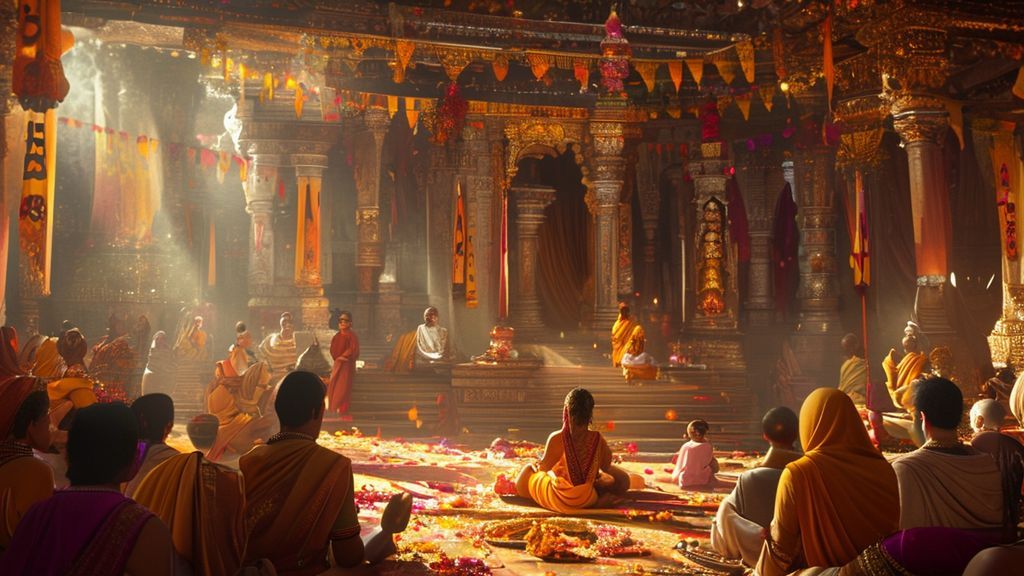
Seemantham (सीमान्तोन्नयनम्) is a sacred Vedic samskara, a prenatal ceremony performed during the 4th, 6th, or 8th month of pregnancy, primarily to ensure the physical, mental, and spiritual well-being of both the expectant mother and the developing fetus. It is deeply rooted in ancient Hindu traditions, invoking divine blessings for a healthy, intelligent, and `dharmic` child.
| Attribute | Details |
|---|---|
| Deity Invoked | Prajapati, Vishnu, Saraswati, Lakshmi, and various Mother Goddesses (Matrikas) for protection and blessings. |
| Purpose/Origin | A `Garbhasamskara` (prenatal ceremony) from ancient India, designed to purify the womb, stimulate fetal intellect, and protect mother and child from negative influences. |
| Key Timing | Typically performed in the 4th, 6th, or 8th month of pregnancy, aligning with periods of significant fetal brain development. |
| Scripture Reference | `Atharvaveda`, various `Grihya Sutras` (e.g., `Gobhila`, `Paraskara`, `Ashvalayana`), `Garbhopanishad`, `Sushruta Samhita`. |
Introduction: The Sacred Journey of New Life
In Sanatan Dharma, the journey of bringing a new life into the world is not merely a biological process but a profound spiritual undertaking, consecrated by a series of `samskaras`, or purifying rituals. Among these, Seemantham, also known as `Seemantonnayana`, holds a pivotal place as a vital prenatal ceremony. It is not merely a “baby shower” in the contemporary sense, but a deeply significant Vedic rite designed to empower the expectant mother and impart positive influences directly to the developing fetus. This `samskara` underscores the profound Vedic understanding of fetal development and the subtle interplay between the mother’s state of mind, the environment, and the child’s future disposition.
The term `Seemanta` refers to the parting of the hair, and `Uunayana` means to raise or elevate. Symbolically, this act of parting the hair, often with auspicious implements, signifies the removal of negative energies and the invocation of divine blessings to protect the mother and child. It is a powerful affirmation of life, intellect, and spiritual well-being, paving the way for a child endowed with `sattva guna` (quality of goodness and purity).
Puranic History & Vedic Roots: Tracing the Lineage of Protection
The practice of Seemantham is not merely a cultural custom but finds its authoritative grounding in the most ancient Vedic texts and subsequent Dharma Shastras. The concept of `Garbhasamskara` – the holistic education of the fetus in the womb – is deeply embedded in Hindu philosophy, predating modern psychological understanding of prenatal development by millennia. The `Atharvaveda` contains hymns (e.g., Kanda 5, Sukta 25) that invoke blessings for a healthy pregnancy and safe delivery, setting the foundational intent for ceremonies like Seemantham.
The `Grihya Sutras`, which elaborate on domestic rituals, provide detailed instructions for `Seemantonnayana`. For instance, the `Gobhila Grihya Sutra` (2.7) and `Paraskara Grihya Sutra` (1.15) explicitly describe the rites, specifying the timing, mantras, and materials to be used. These texts emphasize the importance of soothing the mother’s mind, stimulating the child’s intellect, and ensuring the protection of both from adverse influences (`rakshoghna karma`). It is believed that during this period, the senses of the fetus are developing, making it highly receptive to external stimuli, particularly sound and vibration. Therefore, chanting of Vedic mantras and recitation of elevating narratives are central to the ceremony.
The `Garbhopanishad`, part of the `Atharvaveda`, offers a remarkable exposition on embryology and fetal consciousness, stating that “the child develops from the union of `Shukra` (sperm) and `Shonita` (ovum), with the entry of the `Jiva` (soul).” It further describes the monthly development, asserting that in the fifth month, the mind becomes active, and in the sixth, the intellect. This detailed understanding underscores the precise timing of Seemantham, coinciding with these crucial stages of brain and mental development, aiming to imprint positive samskaras onto the nascent consciousness.
Vedic Science & Spiritual Efficacy: The Subtle Mechanics of Blessing
While Seemantham is not tied to architectural marvels, its “scientific” basis lies in the profound Vedic understanding of subtle energies (`prana`), sound vibrations (`mantra shakti`), and their impact on physical and mental well-being. This `samskara` is a testament to the sophisticated psycho-spiritual technology developed by ancient `rishis`.
The core principle is that the mother’s emotional, mental, and spiritual state directly influences the unborn child. By performing specific `yajnas` (fire rituals), chanting powerful Vedic mantras, and engaging in auspicious activities, the environment around the mother is saturated with positive vibrations. The `Grihya Sutras` prescribe the recitation of hymns, playing of musical instruments (like `Veena`), and the chanting of specific `Riks` from the `Sama Veda` to soothe the mother and stimulate the fetal intellect. The act of parting the hair with a porcupine quill (`shankhini`) or darbha grass, as prescribed, is not merely symbolic; these materials are believed to possess specific energetic properties that help in drawing and retaining positive energies while dispelling negative ones.
Furthermore, the offerings made into the sacrificial fire during Seemantham are believed to purify the atmospheric vibrations, creating a protective sheath (`kavacha`) around the mother and child. This aligns with the principles of `Ayurveda` and `Jyotisha`, where planetary positions and subtle energies are acknowledged to influence human physiology and psychology. The ceremony aims to harmonize these influences, ensuring a harmonious and healthy gestation. For more insights into such practices, consider exploring the resources on Hindutva.online.
Rituals & Puja Vidhi: A Step-by-Step Guide
The `Seemantonnayana` ceremony, while varying slightly by regional `Grihya Sutra` traditions, generally follows a prescribed sequence to ensure maximum efficacy:
- Sankalpa (Intention Setting): The ritual begins with the parents, particularly the expectant mother, taking a solemn vow (sankalpa) to perform the ceremony for the well-being, longevity, and intelligence of the unborn child, seeking blessings from the ancestors and deities.
- Punyaha Vachanam & Ganesha Puja: Chanting of `Punyaha Vachanam` (hymns for auspiciousness) and performing `Ganesha Puja` to remove obstacles (`Vighneshwara`).
- Kalasha Sthapanam & Avahanam: Installation of a `Kalasha` (pot filled with water, mango leaves, and coconut) representing divine presence, and invocation of various deities, including Prajapati, Vishnu, and Saraswati.
- Homa (Fire Ritual): A central `Homa` is performed, with offerings (`ahutis`) of ghee, grains, and sacred herbs made into the fire while chanting specific Vedic mantras. These mantras invoke protection from malevolent forces and blessings for the health of mother and child.
- Hair Parting Ceremony: The most distinctive part, where the husband gently parts the wife’s hair three times (or an odd number of times) using specific implements like a porcupine quill, `darbha` grass, or a `veena` string, symbolizing the division of the scalp into paths for vital energies. While doing so, mantras are chanted for the intellectual development of the child.
- Recitation and Musical Offerings: Vedic scholars (Brahmins) recite verses from the Vedas, particularly those glorifying creation and life. The playing of `Veena` or other classical music is often incorporated to soothe the mother and stimulate the fetal senses, fostering a cultured environment for the child.
- Blessings from Elders: The mother seeks blessings from elders, who apply `kumkum` and `haldi` (turmeric) and offer gifts, symbolizing their good wishes and prosperity for the future.
- Aarti & Prasadam: Concluding with `Aarti` (waving of lamps) and distribution of `Prasadam` (sacred food offerings) to all present.
Mantras & Chants: Invoking Divine Vibrations
The efficacy of Seemantham lies greatly in the power of sacred sound. Here are some mantras commonly chanted:
- For the Welfare of Mother and Child:
ॐ भूर्भुवः स्वः तत् सवितुर्वरेण्यं भर्गो देवस्य धीमहि धियो यो नः प्रचोदयात् ॥ (Om Bhur Bhuvah Svah Tat Savitur Varenyam Bhargo Devasya Dhimahi Dhiyo Yo Nah Prachodayat)
This `Gayatri Mantra` is universally chanted for wisdom, protection, and overall well-being, invoking the illuminating power of the Sun God. Its vibrations are believed to stimulate the intellect.
- For Protection (from the `Atharvaveda`):
यास्ते राका यास्ते सिनीवाली या ते देवी सरस्वती । सा त्वां गर्भेण सह गर्भिणि सं दधातु प्रजापतिः ॥
(Yāste Rākā yāste Sinīvālī yā te devī Sarasvatī | Sā tvāṁ garbheṇa saha garbhiṇi saṁ dadhātu Prajāpatiḥ ||)
This mantra invokes Raka (full moon deity), Sinivali (new moon deity), and Saraswati (goddess of wisdom) along with Prajapati (lord of creation) to protect the pregnant woman and her fetus.
- For Healthy Progeny:
ॐ पुमान्पुमांसं परिपातु विश्वतः पुमान् पुमांसं परिपातु सर्वतः ॥
(Om Pumān Pumāṁsaṁ Paripātu Vishvataḥ Pumān Pumāṁsaṁ Paripātu Sarvataḥ ||)
This mantra seeks the protection of the male principle (symbolizing strength and progeny) from all directions.
Dos and Don’ts: Upholding the Sanctity of Pregnancy
- Do:
- Maintain a positive and serene mental state. Engage in meditation, prayer, and reading uplifting scriptures.
- Listen to Vedic chants, classical music, and spiritual discourses (`Satsang`).
- Consume `sattvic` (pure, wholesome) food.
- Engage in light physical activities like walking and prenatal yoga (under guidance).
- Seek blessings from elders and spiritual mentors.
- Don’t:
- Engage in arguments, gossip, or negative conversations.
- Consume `tamasic` (stale, heavy) or `rajasic` (spicy, over-stimulating) foods.
- Expose oneself to frightening or violent media.
- Over-exert physically or mentally.
- Enter polluted or inauspicious environments.
When is Seemantham typically performed?
Seemantham is generally performed in the 4th, 6th, or 8th month of pregnancy. The `Grihya Sutras` specify these periods as significant for fetal development and receptivity to `samskaras`. Astrological considerations are also taken into account to choose an auspicious day (`muhurta`) within these months.
What is the significance of sound (music/mantras) in Seemantham?
Vedic tradition emphasizes the profound impact of sound vibrations (`Nada Brahma`) on consciousness. During Seemantham, Vedic mantras are chanted to generate purifying and protective frequencies. Classical music, especially the soothing tones of the `Veena`, is believed to stimulate the intellectual development of the fetus, calm the mother’s mind, and imbue the environment with positive energy, fostering a predisposition for artistic and intellectual pursuits in the child. This aligns with modern research on prenatal auditory stimulation.
Is Seemantham only for the first pregnancy?
While `Seemantonnayana` is traditionally considered particularly important for the first pregnancy to initiate the `samskara` for the family’s lineage, many traditions observe it for subsequent pregnancies as well. The core intent remains the same: to ensure the well-being of the mother and child and to invoke blessings for a `dharmic` progeny, irrespective of birth order.
Dharmic Significance: Nurturing the Future of Sanatan Dharma
Seemantham is far more than a celebratory event; it is a profound commitment to the future of `Sanatan Dharma`. By consciously shaping the environment and consciousness of the expectant mother and the unborn child, this `samskara` aims to nurture a generation rooted in `Dharma`, `Satya` (truth), and `Jnana` (knowledge). It is an act of spiritual parenting that begins even before birth, recognizing the child as a divine spark (`Atman`) embarking on its earthly journey. This ancient wisdom reminds us that the responsibility of creating virtuous, intelligent, and spiritually inclined individuals rests not just on formal education, but on the sacred foundation laid through `samskaras` like Seemantham. It is how the values and traditions of our eternal faith are preserved and propagated, ensuring a continuous stream of `dharmic` lives. We invite you to delve deeper into these timeless traditions and their profound wisdom on Hindutva.online.
