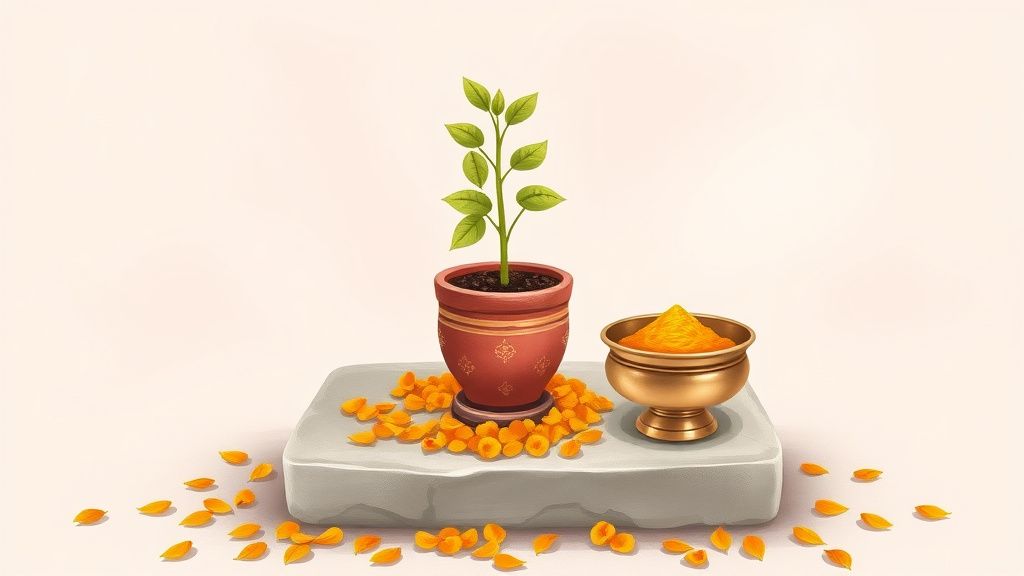
Walking clockwise around a Tulsi plant, the daily household ritual of pradakshina around the courtyard or doorway plant, sits at the intersection of three traditions. Theologically, Tulsi is venerated as a form of Lakshmi, so the circumambulation is a domestic temple practice scaled down. Physiologically, Tulsi (Ocimum tenuiflorum) releases volatile aromatic compounds that have documented antibacterial and respiratory effects, so the morning walk around the plant is also a mild aromatherapeutic act. And procedurally, pradakshina around Tulsi mirrors the same clockwise convention used at every Hindu temple. This article unpacks each layer, the prescribed number of circumambulations, and where the popular online claims overstate the case.
What pradakshina means and why clockwise
The Sanskrit word pradakṣiṇa combines pra (“forward”), da (“give”) and dakṣiṇa (“right side”). The compound is read as “moving forward while keeping the [object of veneration] on the right side”. The right side is conventionally the auspicious side in Vedic practice; clockwise circumambulation keeps the murti, the fire, the guru, the parent, or the plant on the devotee’s right throughout the walk. The same convention applies whether you walk around a Shiva linga, a sacred fire at a wedding, your parents, or a Tulsi plant.
The number of pradakshinas around Tulsi
The traditional counts for Tulsi pradakshina:
- 3 pradakshinas: the daily minimum, said to invoke the three forms of Lakshmi (Mahalakshmi, Mahasaraswati, Mahakali).
- 7 pradakshinas: the most commonly performed count in Vaishnava households, corresponding to the seven dvipas (continents in puranic geography).
- 11 pradakshinas: performed on Kartik Purnima, on the day of Tulsi Vivah (the ritual marriage of Tulsi to Shaligram), and on other Vaishnava observance days.
- 108 pradakshinas: a vow-level count, undertaken for a specific intention (recovery from illness, success in a major undertaking).
Whichever count is performed, the convention is to begin with the body in good ritual state, bathed, in clean clothes, ideally before sunrise or in the early evening, and to maintain mental presence rather than rushing the count to completion.
Tulsi in the household devotional structure
In a traditional Hindu household, the Tulsi plant occupies a defined ritual position:
- Placement: in the central courtyard of an old-style house, or by the front door of a flat or smaller home. North-east is the preferred direction.
- The Tulsi vrindavan: a small raised stone or masonry structure (the vrindavan) often holds the pot. The vrindavan is itself treated as a small shrine.
- Daily ritual: water in the morning, a small oil lamp lit at dusk, a brief mantra or namaskaram, and the pradakshina.
Tulsi is treated theologically as a form of Lakshmi, specifically, as the form Lakshmi takes to remain in the household. The puranic story is of Vrinda, a devoted woman, whose chastity made her a form of the goddess; on her death she manifested as the Tulsi plant. The Tulsi Vivah festival, falling on Kartik Shukla Ekadashi or Dwadashi, ritually marries Tulsi to Vishnu (in his Shaligram form), and is the formal start of the Hindu wedding season in many North Indian traditions.
The physiological effect, honestly described
Tulsi (Holy Basil, Ocimum tenuiflorum) has been studied for several documented effects:
- Antibacterial: tulsi leaves contain eugenol and related phenolic compounds with documented antibacterial activity on common pathogens.
- Aromatherapeutic: the volatile oils released by the leaves (most strongly in the early morning) include linalool and methyl eugenol, with mild calming and respiratory effects.
- Adaptogenic: clinical research treats tulsi as a mild adaptogen, with effects on cortisol and on the stress response in small studies.
The popular claim, that walking around Tulsi “absorbs the oxygen the plant releases at night”, overstates the science. Tulsi, like most plants, performs photosynthesis (oxygen-releasing) during daylight and respiration (oxygen-consuming) at night; the night-oxygen claim is sometimes confused with the peepal tree’s CAM-pathway metabolism. The genuine effect of walking around a Tulsi plant in the morning is the gentle inhalation of volatile aromatic compounds released by the leaves in the warmth of the rising sun, which is a real if modest aromatherapeutic event.
A practical opinion on the ritual
For what it’s worth, the daily Tulsi pradakshina is one of the most defensible household rituals in Hindu practice across both theological and secular framings. Theologically, it centres the household around a daily acknowledgement of the divine feminine. Secularly, it builds a morning routine, fresh air, a few minutes of low-intensity movement, mild aromatic exposure, that has documented mental-health and circadian benefits. Rituals that work at both levels tend to be the ones that survive across generations.
Common questions
Who can perform Tulsi pradakshina?
Any member of the household, adult or child, may perform the daily Tulsi pradakshina. The traditional restriction in some communities was that menstruating women avoid direct contact with the plant during the menses; the practice on this varies considerably across regions and is increasingly considered optional. There is no caste-based or gender-based restriction in the standard household practice.
What is the right time of day?
The traditional and physiologically optimal time is sunrise, after the morning bath, before breakfast. Evening pradakshina at dusk, after the lamp is lit, is the secondary convention. Either or both daily is consistent with traditional practice; the morning slot is the more emphasised one.
What if there is no Tulsi plant at home?
The household practice can be initiated by planting a Tulsi at the front door or in a balcony pot. Tulsi is hardy, grows readily from cuttings, and asks little: morning sunlight, light watering, and pruning of seed heads to keep it bushy. The plant is considered to “respond” to attention and to wither in households where it is neglected; whether this is a metaphor or an observation is left to the household.
One limitation worth noting
Specific claims attributed to “ancient scriptures” about exact health benefits of Tulsi pradakshina are common in popular writing and are not always textually grounded. The four traditional pradakshina counts (3, 7, 11, 108) and the broad strokes of Tulsi’s place in household ritual are well attested in the Skanda Purana and the Padma Purana. Specific medical claims, “cures asthma”, “balances all three doshas”, are extrapolations, sometimes useful as practical guidance but not as scriptural fact.
For background see Tulsi in Hinduism on Wikipedia and the botanical entry on Ocimum tenuiflorum.
