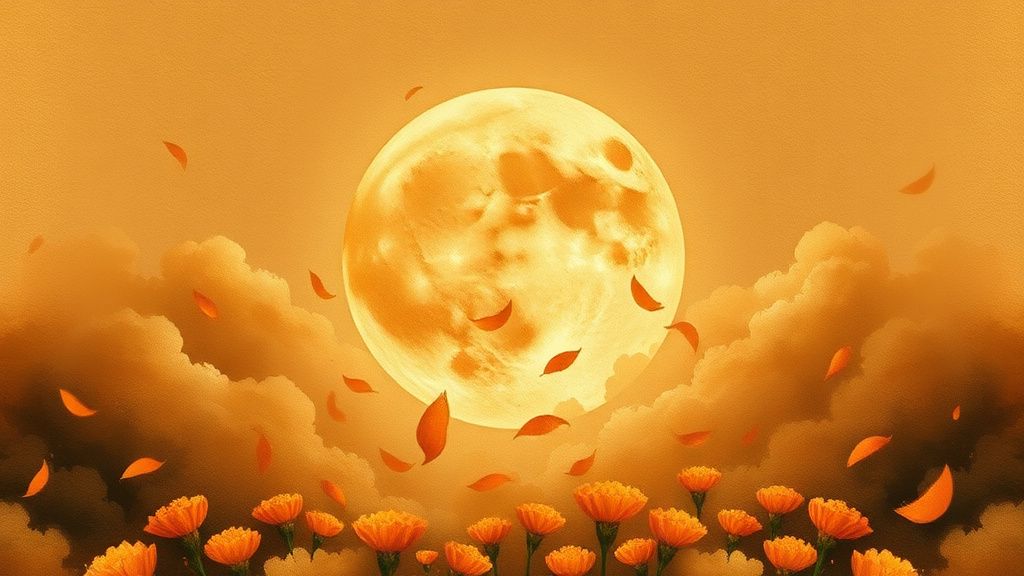
Karva Chauth is the day-long Nirjala fast observed by married Hindu women, principally in north India, for the longevity and well-being of their husbands. The fast falls on the fourth day of the dark half of the Hindu month of Kartik, nine days before Diwali. In 2026 the festival falls on Thursday, 29 October. The vrati (the fasting woman) takes the pre-dawn meal of Sargi before sunrise, observes a full Nirjala fast through the day, and breaks the fast only after sighting the moon in the evening, typically between 7:30 PM and 8:30 PM in north India in late October. The name combines “Karva” (an earthen pot, the festival’s ritual vessel) and “Chauth” (the fourth lunar day).
The day’s full sequence
- Sargi (pre-dawn meal): taken before sunrise, between 3:30 AM and 5:00 AM. The Sargi traditionally comes from the vrati’s mother-in-law (saas) and contains pheni (a thin vermicelli), seviyan, parathas, fruits, mathri, nuts, and a sweet (often coconut-based). The Sargi is the day’s only food and water; once sunrise occurs the Nirjala fast begins.
- Day-long Nirjala fast: from sunrise to moonrise. No food, no water, no liquid. The fast is approximately twelve to thirteen hours in late October at north Indian latitudes.
- Evening preparation: the vrati bathes in the late afternoon, applies mehndi if not done earlier, dresses in red or maroon traditional clothing (sari, lehenga, or salwar-kameez), and wears the sixteen ornaments (solah shringar). The household women gather around 4:00 PM at one home for the collective puja.
- The collective puja (around 5:00 PM): women sit in a circle around the puja thali; the eldest married woman of the gathering recites the Karva Chauth Vrat Katha (the story of Karva, of Veervati, of Draupadi). After each verse, the women pass their thalis to the left and rotate the thalis seven times in a clockwise circle, in a ritual called “Karva Pheri”.
- The moon sighting: after sunset, the women wait for the moon to rise. The moonrise time is published in the Hindu Panchang for each city; in north India in late October it is typically 8:00 PM to 8:30 PM. When the moon is sighted, each vrati goes to her terrace, courtyard or balcony with her thali.
- The chalni darshan: the vrati looks at the moon first through a sieve (chalni), then turns and looks at her husband through the same sieve. The husband stands facing her.
- Argha to the moon: the vrati offers water (jal arghya) to the moon from the karva, the small earthen pot, three or seven times.
- Fast breaking: the husband then offers his wife the first sip of water and the first bite of food (usually a small piece of mithai or a sip of sherbet), formally ending the Nirjala fast. A full meal is taken afterward.
The Karva Chauth puja thali
The thali is the festival’s principal ritual object. The standard items:
- Earthen karva (small spouted pot): the festival’s namesake. Filled with water, sometimes with a piece of cloth on top, used for the moon argha.
- Sieve (chalni): a small metal sieve used to view the moon and the husband.
- Diya: a lit oil lamp.
- Roli and akshat: for tilak.
- Mithai: for the fast-breaking.
- Glass of water: for the offering and the fast-breaking.
- Sindoor box: sometimes the husband applies sindoor on the vrati’s hair-parting as part of the fast-breaking.
- Bindi, bangles, mehndi pattern hand: the woman’s symbols of married status.
- Photo or image of Karva Mata, Shiva-Parvati or Ganesha: the deity worshipped during the collective puja.
The Vrat Katha stories
Three principal stories are recited during the Karva Chauth puja. The Vrat Katha collection used in north Indian households contains all three, with one selected for the main recitation by the eldest:
- The story of Veeravati: a young queen, the only sister of seven brothers, observed her first Karva Chauth at her parents’ house. By evening she was weak with hunger and thirst. Her brothers, unable to bear her suffering, lit a lamp on top of a peepal tree to make her think the moon had risen. She broke her fast believing the false moon had risen. As soon as she ate her first bite, news reached her of her husband’s death. With Parvati’s guidance, she observed the fast strictly through the year on subsequent Chauths, and her husband was restored to life. The story is read as the source of the strict moon-sighting requirement.
- The story of Karva: a devoted woman whose husband was attacked by a crocodile while bathing in the river. Karva tied the crocodile with a yarn of cotton thread and called on Yama, the god of death, to take the crocodile and spare her husband. Yama, impressed by her devotion, granted her wish. The story gives the festival its name (Karva, the woman) and its central theme (the wife’s spiritual power to protect the husband).
- The Draupadi story: in the Mahabharata, when Arjuna was away in penance, Draupadi, anxious about him, sought Krishna’s counsel. Krishna recommended the Karva Chauth Vrat. Draupadi observed it, and Arjuna returned safely. The story positions the festival in the epic period and validates its observance through Krishna’s recommendation.
Why the sieve
The chalni darshan (looking through the sieve) has two layered readings:
- The traditional reading: a married woman in conservative north Indian custom does not look directly at her husband in the public eye; the sieve becomes a symbolic barrier (like a veil) through which the gaze passes. The sieve’s perforations also distribute the view so that the husband is seen many times multiplied, a small visual joke about marital attention.
- The practical reading: the moon at late evening can be hazy or partially obscured by clouds; the sieve provides a small framing tool that helps locate the moon and confirm its sighting before the argha is offered.
For what it’s worth, the most defensible reading of the chalni is the one most often cited by older women in the tradition: the sieve catches and filters the moon’s light, just as the marriage relationship filters and orders the wider world. The reading is poetic; the structural function is the framing of the moon and the husband as the day’s two principal visual events.
Regional and recent shifts
- Punjab and Haryana: the festival’s traditional core. The Sargi is sent specifically from the mother-in-law and contains regional specialties (paratha, pheni, mathri).
- Uttar Pradesh and Delhi: the festival follows the same pattern; the urban collective puja is often organised in apartment complexes or neighbourhood community centres.
- Rajasthan: the festival is observed with regional variations; the Karva Mata image is more prominent.
- Maharashtra and Gujarat: the festival has spread post-1990s via Hindi cinema and television; it is not a traditional Maharashtrian or Gujarati observance but is now observed in urban populations exposed to the north Indian form.
- Contemporary practices: some couples now observe a joint fast, with the husband also fasting for the wife. The reciprocal version is not in the classical Vrat Katha but is increasingly common. Many career women observe a modified phalahar form rather than strict Nirjala.
Common questions
Is Karva Chauth only for the first year of marriage?
No. The festival is observed annually for the duration of the marriage by the vrati. The first Karva Chauth (often called the “Pehla Karva Chauth”) is treated as more elaborate, with the woman often returning to her parents’ home and receiving the Baya (a special gift basket from the parents-in-law), but the observance is annual after that.
What if the moon is not visible?
Cloud cover or rain can hide the moon. The classical permission is to wait for as long as practical (until 9:30 PM or 10:00 PM at the latest), then to break the fast at the published moonrise time even without direct sighting, offering argha in the moon’s direction. The substance is the offering; the visibility is secondary. Some households install a small image of the moon for symbolic darshan in such cases.
Is the fast required to be Nirjala?
Traditional observance is Nirjala. The classical permission for medical constraints (pregnancy, diabetes, hypertension, kidney conditions) is the phalahar form. The substance of the vrat is the Sankalpa, the recitation of the Vrat Katha, the puja, and the moon argha; the dietary austerity is the most-cited form but is not the sole element. Consult a physician if there are pre-existing conditions.
A limitation worth noting
Moonrise times shift by city longitude and by minutes; the 2026 north India moonrise on 29 October is approximately 8:13 PM in Delhi per Drik Panchang and shifts by up to thirty minutes for southern or western cities. The Sargi composition and the Vrat Katha collection vary between Punjabi, Marwari and Uttar Pradesh households; the structure above is the broad north Indian pattern. For an overview see the Wikipedia entry on Karva Chauth.
