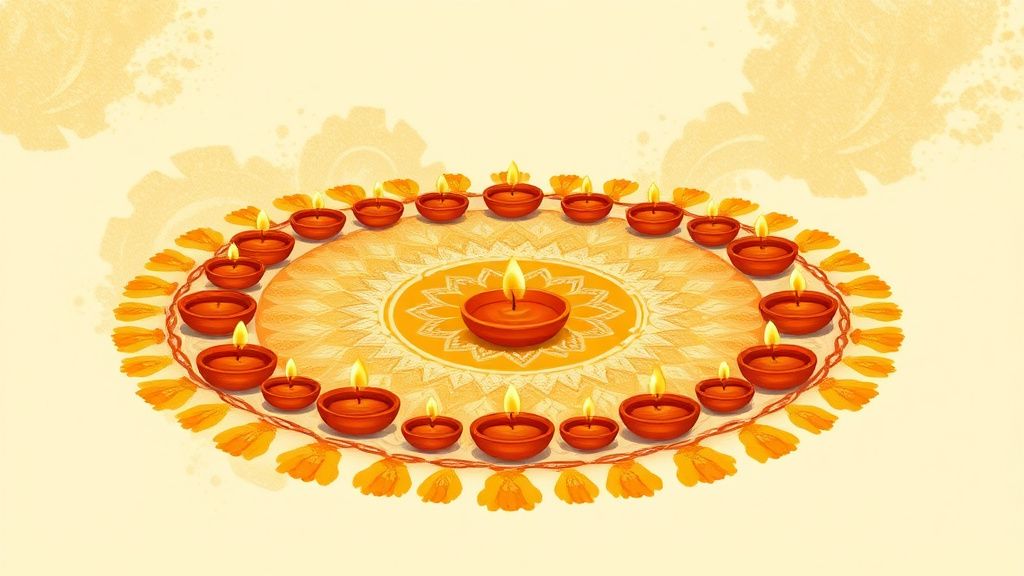
Traditional Diwali decoration at home turns on four elements: a rangoli at the threshold, a torana (door-hanging) of fresh mango leaves and marigolds, rows of clay diyas placed in odd numbers (5, 7, 11, 21), and a clean, well-lit puja corner for Lakshmi-Ganesha. The festival of lights falls on the new-moon night (Amavasya) of Kartika; the 2026 main Lakshmi Puja date is November 8. This article covers the specific traditional elements, the symbolism behind each, what to place where, and the practical points that come up when setting things up at home.
Rangoli at the entrance
The rangoli is the most visible Diwali decoration and the one that carries the most ritual weight. Drawn at the threshold of the house, it acts as a welcome for Lakshmi and a barrier against inauspicious energies. The traditional medium is rice flour, sometimes coloured with natural pigments (turmeric for yellow, vermilion for red, indigo for blue, dried hibiscus for pink).
- Geometric patterns: squares, triangles, circles, and the eight-petaled lotus (ashtadala kamala) are the most common in classical practice.
- Mandala designs: concentric circular forms centred on a dot (bindu), often radiating outward in petal patterns.
- Sacred symbols: Om, Swastika, Sri Yantra, footprints of Lakshmi pointing into the house (not out).
- Floral rangolis: marigold, rose, and chrysanthemum petals laid in patterns, with diyas placed in the gaps.
In Tamil and Telugu households the threshold pattern is called kolam and is drawn fresh every morning during the Diwali week, not just on the main day. In Bengal the equivalent is alpana, traditionally drawn with a rice-paste paint applied with the fingers rather than dry powder.
Toranas and door decorations
The torana is the strung garland hung across the top of the main door. The classical materials are fresh mango leaves and marigold flowers, often alternated. Mango leaves are associated with Kamadeva and are thought to absorb and neutralise inauspicious energies entering through the doorway. Marigold (genda) is the flower of Lakshmi and dries slowly, holding its colour for the full festival week.
Other traditional door elements:
- A short string of bells (ghungroo) hung in the centre of the torana, so visitors are announced and the sound is itself considered auspicious.
- Small earthen pots (kalash) flanking either side of the doorway, filled with water, topped with mango leaves and a coconut.
- Footprints of Lakshmi painted in vermilion or rice paste leading from the door into the puja room.
- A small swastika painted above the door in turmeric and kumkum.
Diyas: number, placement, oil
The clay diya (oil lamp) is the irreducible element of Diwali, and the festival takes its name from the row (avali) of lamps (deepa). Traditional practice prefers terracotta lamps over wax candles for the puja and main display, with mustard oil or pure cow ghee as the fuel and a cotton wick.
On placement, the standard count is odd numbers: 5, 7, 11, 21, or 51 lamps in a set. The principal locations are:
- A pair on either side of the main door, on the floor or on small platforms.
- A row along the parapet, balcony or window sills facing the street.
- A single large diya before the Lakshmi-Ganesha picture in the puja room, kept lit through the night.
- Small diyas at the foot of the tulsi plant in the courtyard.
- One diya placed at the rear or south side of the house, traditionally for Yama (the deity of death), kept lit on the eve of Diwali as a protective gesture for the household.
Ghee diyas give a steadier flame and are preferred in the puja itself; mustard oil diyas burn longer and are used for the outdoor display. For what it’s worth, mixing the two is sensible: ghee inside, oil outside.
The puja altar setup
The Lakshmi-Ganesha altar is the ritual centre of the Diwali decoration. Ganesha sits to the left of Lakshmi (from the worshipper’s perspective), and Saraswati, when included, sits to the right of Lakshmi. The traditional setup runs in a small north or east-facing corner.
The required elements on the altar:
- A clean cloth (red or yellow) covering the platform.
- The idols or framed pictures, placed on a small wooden plank (chowki).
- A kalash (water pot) topped with five mango leaves and a coconut.
- A silver coin or fresh currency notes placed before Lakshmi for the Sharda Pujan element.
- Akshata (rice mixed with turmeric and a little water) for offering.
- Fresh flowers, particularly lotus (Lakshmi’s flower), if available.
- Bhog: kheer, panjiri, batasha, or homemade sweets.
- Incense (dhoop), camphor (kapur), and a small bell.
Lighting beyond diyas
Contemporary Diwali lighting includes electric strings, but the traditional layered approach is still common in older households:
- Akash kandil: the paper lantern hung from the balcony or veranda, particularly in Maharashtrian and Karnataka households. It is lit nightly from Vasubaras through Bhai Dooj.
- Aakash deep: the sky-lamp tradition of Kashi and parts of eastern UP, where a small lamp is hoisted on a bamboo pole during the month of Kartika.
- Camphor lamps: small clay pots with camphor tablets, used briefly during the puja aarti.
- String lights: the modern addition, draped along walls, around windows and over plants.
Auspicious colours and materials
Five colours dominate traditional Diwali decoration:
- Red: for power, the colour of kumkum and of Lakshmi’s sari.
- Yellow: for prosperity, the colour of turmeric, marigold and Ganesha.
- Gold: for wealth, used in fabrics and metal ornaments.
- Orange: for warmth, often the second floral colour alongside yellow.
- White: for purity, used sparingly in rangoli accents and altar cloths.
Materials run heavily to natural: brass and copper utensils polished to a shine; terracotta diyas; cotton wicks; fresh flowers; banana stems flanking the puja area; rice paste for alpana. The shift to plastic torana strings and electric candles is a recent change and many older households still avoid both.
Common questions
Should diyas be lit through the night?
The single large diya before Lakshmi-Ganesha in the puja room is traditionally kept lit through Amavasya night. Outdoor diyas are lit at dusk and topped up if oil runs out; most households let them burn out naturally over four to five hours. The Yama-deepa at the back of the house is lit on Naraka Chaturdashi (the day before main Diwali) and left to burn out.
Can rangoli be drawn with chemical colours?
Traditional practice prefers rice flour as the base, coloured with natural pigments. The reason is functional as much as ritual: rice flour rangoli is meant to be edible for ants and birds, which is part of the giving the festival enjoins. Modern synthetic powders are bright and convenient but lack this dimension. A reasonable compromise is to outline the rangoli in synthetic colour and fill the centre with rice flour and flower petals.
Which direction should the puja altar face?
The standard direction is north or east, so that the worshipper faces north or east when seated before the idols. The reasoning is from Vastu, which associates these directions with Kubera (north, wealth) and the rising sun (east, beginnings). If the layout of the room does not permit either, north-east is the next preference; south-facing puja is generally avoided.
What about decorations after Diwali ends?
Most households keep the torana up through Bhai Dooj (the fifth day) and remove it after. The rangoli is refreshed daily; the puja kalash water and coconut are immersed in a clean water body after the festival rather than thrown in regular waste. Diya wicks and leftover oil are often kept for use through Kartika month, particularly for the lighting on Tulsi Vivah (around 12 days after Diwali).
A limitation worth noting
This article covers the common North and West Indian traditional Diwali decoration pattern. South Indian Deepavali (celebrated mainly as Naraka Chaturdashi, a day earlier) follows a different sequence with an oil-bath at dawn and a different altar setup; the Bengali Kali Puja held on the same Amavasya has its own decoration vocabulary centred on the goddess rather than Lakshmi. For these regional traditions, household elders or the local temple priest are the better source than a general guide.
For background on the festival and its observances, see the Diwali entry on Wikipedia and the entry on Rangoli.
