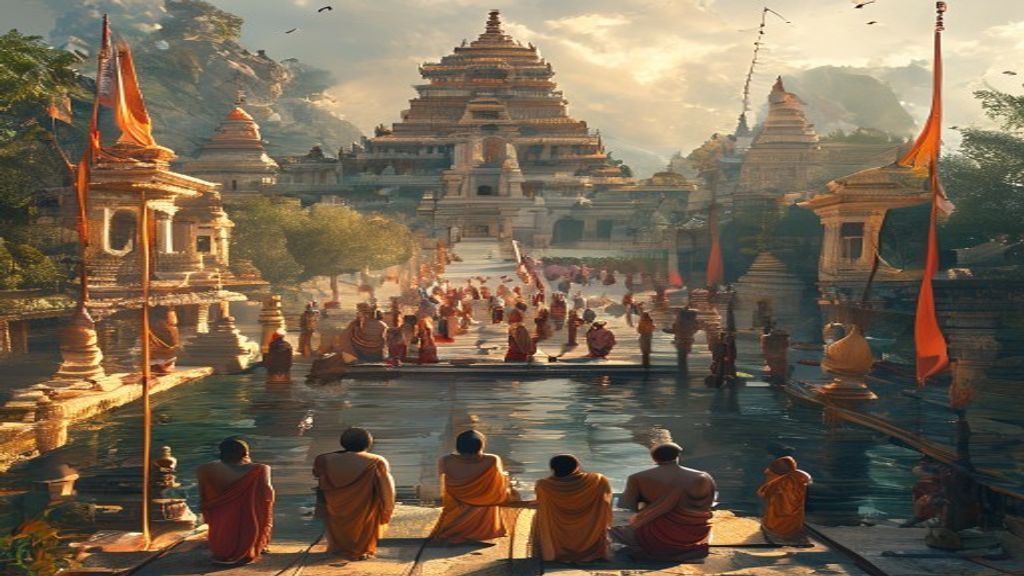
Narmada River Parikrama is a sacred circumambulation of the Narmada River, one of Bharatavarsha’s seven holy rivers, revered as Devi Narmada, daughter of Lord Shiva. This profound spiritual journey, spanning thousands of kilometers, is undertaken to accumulate immense spiritual merit, attain moksha, and purify sins accumulated across countless lifetimes, drawing devotees closer to divine realization.
| Attribute | Details |
|---|---|
| Deity | Devi Narmada (Reva, Kanya Narmada, Shiva Sutri) |
| Location/Origin | Amarkantak, Anuppur District, Madhya Pradesh. Flows westward through Madhya Pradesh, Maharashtra, and Gujarat into the Gulf of Khambat (Arabian Sea). |
| Key Festival | Narmada Jayanti (Magha Shukla Saptami, typically in February), celebrated with grand pujas and cultural events along its banks. |
| Scripture Reference | Skanda Purana (Reva Khanda), Matsya Purana, Vayu Purana, Mahabharata, Markandeya Purana. |
Introduction: The Eternal Flow of Dharma
The Narmada River, revered as Maa Narmada, holds an unparalleled position in Sanatan Dharma. Unique among major Indian rivers, she flows westwards, a phenomenon attributed to Her divine will and a potent symbol of spiritual reversal – turning the tide of material existence towards liberation. Unlike other rivers whose purity is often contingent on human veneration, Narmada is considered inherently sacred and self-purifying, declared by the Rishis as स्वयंभू (svayambhū) – self-born and eternally pure. The very pebbles from her riverbed, known as Banalingams, are worshipped as manifestations of Lord Shiva, embodying the dictum: “Narmada ke kankar, utne Shankar” (every pebble of Narmada is Shiva Himself). Undertaking the Narmada Parikrama is not merely a physical journey; it is a profound spiritual odyssey, a rigorous Tapasya that cleanses the soul, fortifies faith, and connects the devotee directly with the divine energy of this sacred river and the myriad holy sites along her banks. It is a testament to unwavering devotion, a living tradition that has sustained countless seekers for millennia, guiding them towards ultimate truth and liberation.
Puranic History & Legend: The Divine Daughter of Shiva
The genesis of Devi Narmada is steeped in profound Puranic lore, primarily detailed in the glorious Reva Khanda of the Skanda Purana, as well as in the Matsya and Vayu Puranas. According to these scriptures, Lord Shiva, in a moment of deep meditation on Mount Kailash, felt an intense joy, from which a beautiful daughter manifested. Her divine form exuded such bliss that Shiva named her Narmada, meaning “giver of delight” (Narm + Da). She was also called Reva, signifying “one who leaps,” reflecting her dynamic and joyful nature.
From her very birth, Narmada displayed an extraordinary ascetic temperament. She undertook severe penance at the sacred Amarkantak mountain, praying to her father, Lord Shiva, for a unique boon: to remain eternally pure, to have the power to cleanse all sins by mere sight, and never to be subject to the ravages of time or pollution. Pleased by her unwavering devotion, Lord Shiva granted her these boons, declaring that while Ganga cleanses through bathing, Yamuna through sight, and Saraswati through recitation, Narmada purifies by mere Darshan (sight), and her waters would always remain pristine and unpolluted, even in the Kali Yuga. This divine promise elevates Narmada to a status unparalleled among rivers, making her a living manifestation of purity and liberation.
Another significant legend from the Markandeya Purana recounts Narmada’s role in saving the Naga race. She was destined to marry King Purukutsa, an ancestor of Lord Rama. Through this sacred union, she rescued the Nagas from the curse of Sage Utanka, who had condemned them for consuming the Gandharvas. Her divine power and purity made her instrumental in restoring balance and dharma, reinforcing her identity as a protector and purifier. Throughout the ages, countless Rishis, including Markandeya, Bhrigu, Kapil, and Dattatreya, have performed Tapasya on her banks, further sanctifying her course and drawing a continuous stream of devotees to her life-giving waters. Her legends are a constant source of inspiration for those seeking spiritual solace, and are richly detailed on Hindutva.online.
Geographical & Spiritual Marvels: The Western Flow and Banalingams
While not an architectural marvel in the traditional sense, the Narmada River itself is a geographical and spiritual marvel, manifesting divine architecture through its unique characteristics. Her most striking feature, the westward flow into the Arabian Sea, defies the general eastward trajectory of most major Indian rivers. This anomaly is not merely geological but is deeply intertwined with Puranic narratives, signifying a spiritual path less traveled, a turning away from the mundane towards the transcendental.
The entire Narmada basin is rich in geological significance, particularly for the formation of the famed Banalingams. These naturally occurring, smooth, elliptical stones are found exclusively in the Narmada riverbed, particularly around Omkareshwar. They are revered as swayambhu (self-manifested) Shiva Lingams, imbued with the cosmic energy of Lord Shiva and Devi Narmada. Unlike man-made Lingams, Banalingams do not require formal consecration (pran pratishtha) and are immediately ready for worship, making them highly prized by devotees and ascetics. Their smooth, polished surface is a result of the river’s constant flow, a testament to nature’s artistry and divine presence.
Along her 1,312 km journey, Narmada graces innumerable sacred sites, each pulsating with spiritual energy. Omkareshwar, home to one of the twelve Jyotirlingams, is located on an island shaped like the ‘Om’ symbol, where the Narmada splits into two channels, forming a confluence with the Kaveri River. Further downstream, Maheshwar, once the capital of Rani Ahilyabai Holkar, boasts magnificent ghats and temples, reflecting exquisite Maratha architecture and a deep sense of devotion. The grandeur of these ghats, built with robust stone, offers pilgrims sacred bathing spots (snan ghats) and platforms for performing daily rituals, connecting human spiritual endeavor with the enduring flow of the divine river.
Rituals & Puja Vidhi for Narmada Parikrama
The Narmada Parikrama is a rigorous spiritual discipline, demanding immense faith, physical endurance, and mental fortitude. It is a profound Puja Vidhi where the entire journey becomes the act of worship itself.
Preparation for Parikrama
- Sankalpa (Vow): The journey begins with a firm resolve and a formal vow taken at a sacred ghat, often Omkareshwar or Amarkantak. Offer prayers to Lord Ganesha, Devi Narmada, and Lord Shiva for strength and guidance.
- Physical & Mental Readiness: The Parikrama involves walking thousands of kilometers. Pilgrims must be physically fit and mentally prepared for austerities, simple living, and facing challenges.
- Simple Living: Pilgrims are advised to travel light, wear simple clothes (often saffron or white), and carry minimal possessions, embodying detachment.
The Parikrama Route & Rules
- Starting Point: Traditionally, pilgrims start from Amarkantak (the source) or Omkareshwar.
- Dakshinavarta (Clockwise Circumambulation): The most crucial rule is to always keep the Narmada River to your right (Dakshinavarta). This means one must walk upstream from the mouth to the source on one bank, and then downstream from the source to the mouth on the other bank, without ever crossing the river.
- River Crossing Prohibition: Crossing the Narmada River itself is strictly forbidden during the Parikrama, as it is akin to crossing the divine Mother. Only its tributaries may be crossed. Pilgrims must travel along one bank to the sea, then travel back along the opposite bank to the source.
- Bathing & Daily Rituals: Daily ritualistic bathing (snan) in the Narmada is essential for purification. Simple Pujas, Aarti, and Japa (mantra recitation) are performed morning and evening.
- Food & Shelter: Pilgrims rely on alms (bhiksha) or offerings from local villagers and ashrams along the route. Meals are simple, sattvic, and consumed only once or twice a day. Shelter is often in dharmashalas, temples, or under trees.
- No Accumulation: Pilgrims are encouraged not to accumulate wealth or possessions during the journey, focusing solely on spiritual advancement.
- Completion: The Parikrama is considered complete upon returning to the starting point, where a final puja and Bhandara (community meal) are often performed. The traditional duration is 3 years, 3 months, and 13 days, though many complete it in shorter periods like 1 year, or perform symbolic shorter sections.
Mantras & Chants for Devi Narmada
Chanting the sacred names and mantras of Devi Narmada is an integral part of the Parikrama, invoking her blessings and purifying the mind. The most celebrated hymn is the Narmada Ashtakam, which begins:
स्नानार्थं तव तीर्थेषु कोटितीर्थं लभेन्नरः ।
तीर्थेषु तव स्नानेन शिवलोके महीयते ॥
नमामि देवि नर्मदे! सर्वदेवि नमामि ते ॥
Another popular invocation is: नमामि देवि नर्मदे! (Namāmi Devi Narmade!) – “I bow to Devi Narmada!”
For deeper meditation and purification, devotees may chant the powerful Bija Mantra:
ॐ ह्रीं क्लीं श्रीं क्लीं ऐं क्लीं सौः नर्मदायै नमः ॥
(Om Hrim Klim Shrim Klim Aim Klim Sauh Narmadayai Namah)
Reciting these mantras with devotion cultivates a profound connection with the divine energy of Narmada Maa, assisting pilgrims through the challenges of their journey and filling their hearts with peace.
Dos and Don’ts for the Narmada Parikrama
Adhering to strict spiritual and cultural etiquette is paramount for a successful and spiritually rewarding Narmada Parikrama.
Dos:
- Maintain Brahmacharya (celibacy) throughout the journey.
- Consume only Sattvic food, preferably vegetarian and simple.
- Walk barefoot or with minimal footwear, wherever possible, to connect with the sacred earth.
- Offer daily prayers (Puja, Aarti) to Devi Narmada and other deities encountered.
- Show respect to all beings – humans, animals, and nature.
- Practice humility and compassion; offer help to fellow pilgrims and locals.
- Observe silence (Maun Vrat) for periods, fostering introspection.
- Carry a small vessel for Narmada water and drink from it daily.
Don’ts:
- Do not cross the Narmada River itself at any point during the Parikrama.
- Do not indulge in gossip, criticism, or negative speech.
- Avoid intoxicating substances, non-vegetarian food, and unnecessary comforts.
- Do not accumulate wealth or engage in financial transactions beyond basic needs.
- Do not pollute the river or its banks; maintain cleanliness.
- Avoid staying in one place for more than three nights, encouraging movement and detachment.
- Do not brag about your pilgrimage or seek praise.
What is the significance of the Narmada River flowing west?
The westward flow of the Narmada River is considered a profound spiritual and geographical anomaly, unique among India’s major rivers. Puranically, it signifies Devi Narmada’s divine will and special boons received from Lord Shiva, allowing her to defy conventional geographical patterns. Spiritually, it represents a ‘reversal’ of the worldly flow, guiding devotees inwards towards liberation (moksha), rather than outwards towards material pursuits. This unique direction symbolizes the extraordinary power and inherent sanctity of the river, capable of granting liberation to those who seek her blessings.
How long does the Narmada Parikrama traditionally take?
Traditionally, the full Narmada Parikrama is a demanding pilgrimage spanning 3 years, 3 months, and 13 days. However, due to modern constraints, many devotees undertake it in shorter, yet still rigorous, durations such as 1 year, or even symbolic shorter circuits over a few months or weeks. The emphasis remains on the spiritual intent, discipline, and devotion, rather than strictly adhering to the exact traditional timeline, though longer periods are considered to yield greater spiritual merit.
Are there specific offerings for Devi Narmada?
Yes, devotees offer a variety of items to Devi Narmada, primarily focusing on purity and simplicity. Common offerings include flowers (especially lotus and hibiscus), incense (agarbatti), lamps (deepak) with ghee or oil, fruits, sweets, coconuts, and a piece of cloth (sari) as a symbol of reverence. The most significant offering is a heart full of devotion and a sincere intention for spiritual purification. Many also offer a few drops of milk (dugdh abhishek) into her waters as a sign of respect and gratitude.
Can women undertake the Narmada Parikrama?
Absolutely, women are fully encouraged to undertake the Narmada Parikrama and have done so for centuries, often with great spiritual fortitude. While traditionally, some practical concerns like safety and physical endurance might have been raised, with modern support systems and the availability of fellow pilgrims, women undertake this sacred journey with immense devotion. It is essential for women to ensure their safety, preferably traveling in groups or with companions. The spiritual benefits and blessings of Devi Narmada are equally available to all sincere seekers, irrespective of gender, reinforcing the inclusive nature of Sanatan Dharma, as frequently elaborated on Hindutva.online.
Dharmic Significance: A Path to Moksha and Cultural Preservation
The Narmada River Parikrama is far more than a pilgrimage; it is a living embodiment of Sanatan Dharma itself. It fosters an unparalleled connection with nature, treating the river as a divine mother (Prakriti Swaroopini) and teaching profound ecological reverence. This arduous journey cultivates unwavering faith (Shraddha), self-discipline (Tapasya), detachment (Vairagya), and humility (Namrata) – virtues essential for spiritual growth. By embracing a life of simplicity and reliance on divine grace, pilgrims shed their ego and material attachments, experiencing the truth of interdependence. The Parikrama preserves ancient traditions, oral histories, and the sacred geography of Bharatavarsha, ensuring that the wisdom of the Rishis continues to flow through generations. It is a testament to the enduring power of Bhakti and a tangible path to Moksha, affirming the timeless truths of Hindu philosophy and enriching the spiritual tapestry of our civilization.
