Guru Purnima is the full-moon day of the Hindu month of Ashadha, observed in 2026 on Wednesday, 29 July. The day honours one’s teacher (guru) in the broad sense the tradition uses the word: spiritual instructor, scriptural commentator, family preceptor, and, by extension, the line of teachers behind them. It is also called Vyasa Purnima, after the sage Veda Vyasa, traditionally credited with arranging the four Vedas and composing the Mahabharata, and held in scripture to have been born on this tithi.
What the day commemorates
Three strands sit inside Guru Purnima:
- Vyasa Jayanti. The Hindu strand. Veda Vyasa is treated as the adi-guru, the first teacher of the Vedic textual tradition. His Brahma Sutras and the Mahabharata (which contains the Bhagavad Gita) are still the spine of Vedanta study, and Vyasa Puja is performed in monasteries within the Dashanami and Sri Vaishnava lines on this day.
- Buddha’s first sermon. The Buddhist strand. Theravada tradition places the Buddha’s first sermon at the Deer Park in Sarnath, the Dhammacakkappavattana Sutta, on the same Ashadha full moon. Buddhists call the day Asadha Puja or Dharma Day.
- Jain reverence. Jains observe the day as the start of Chaturmas, when Mahavira is said to have made his first disciple, Indrabhuti Gautama.
The convergence is not accidental in cultural memory: the full moon of Ashadha sits at the beginning of the four-month monastic retreat (Chaturmas) in both Hindu and Jain monastic traditions, when wandering ascetics settle for the rains and resume sustained teaching. Honouring the teacher at the start of that period is structural to the calendar.
How the day is observed at home
For lay practitioners the day usually runs in a fixed shape:
- An early bath and clean clothes, white or off-white by preference. Many households fast partially, taking only milk, fruit and one main meal.
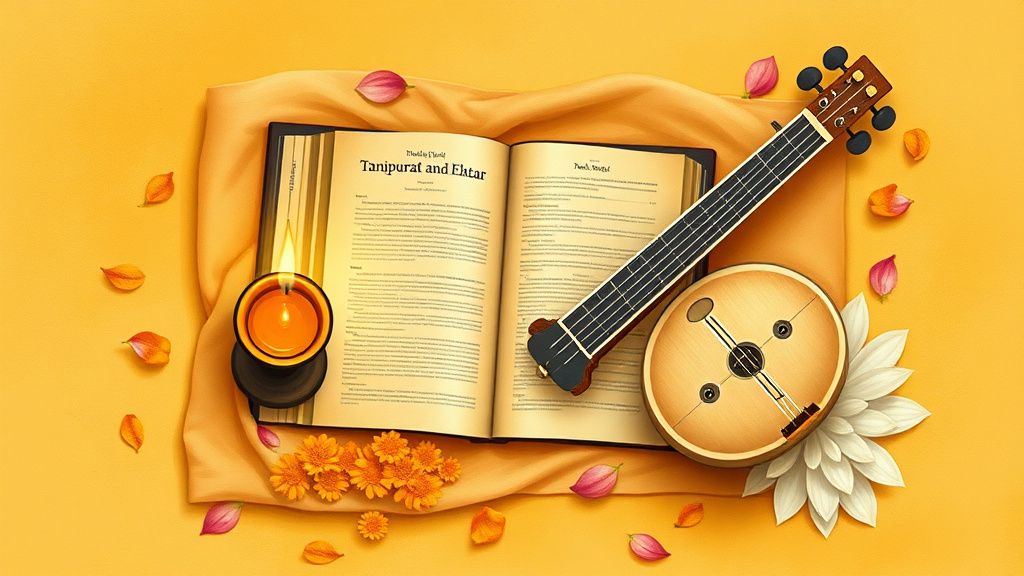
- Vyasa Puja at a home altar. A picture of one’s own guru, or of Vyasa, is placed on a clean cloth, garlanded, and offered flowers, a lamp, and fruit. A short Guru Stotra is recited, most commonly the verses beginning Gurur Brahma Gurur Vishnu Gurur Devo Maheshvarah.
- Pranama and dakshina. Practitioners who have a living guru visit the teacher, prostrate, and offer dakshina (a gift), traditionally fruit, a piece of cloth, or money, according to means.
- Charanamrita. In some lines the disciple receives charanamrita, water sanctified by being touched to the guru’s feet, taken as prasad.
- Svadhyaya. The day’s evening is typically given to recitation or reading of the guru’s preferred text, or of the Bhagavad Gita and Vishnu Sahasranama, both attributed to Vyasa.
Households without a formal initiating guru honour their parents, school teachers, or any figure who has acted in that role. The Hindu definition of guru is wider than the monastic one, and most families read it that way on this day.
The Guru Stotra most people recite
The two-verse stotra commonly recited on the day comes from the Guru Gita, a section of the Skanda Purana:
Gurur Brahma Gurur Vishnu Gurur Devo Maheshvarah |
Guruh Sakshat Parabrahma Tasmai Shri Gurave Namah ||
Akhanda mandalakaram vyaptam yena characharam |
Tat padam darshitam yena tasmai Shri Gurave Namah ||
The first verse identifies the guru as the three principal deities (Brahma, Vishnu, Shiva) and, ultimately, with the Absolute (Parabrahman). The second salutes the guru as the one who has revealed the all-pervading reality. Both are recited together at the start of Vyasa Puja.
Regional and sampradaya variants
- Smarta / Vedanta lines follow Vyasa Puja with formal recitation of the guru parampara, naming the chain of teachers back to Shankaracharya (8th century CE) and, behind him, to Vyasa.
- Sri Vaishnava households read selections from the Divya Prabandham and offer at the picture of their acharya, with Ramanuja (1017-1137 CE) as the line-defining teacher.
- ISKCON and other Gaudiya Vaishnava lines perform Vyasa Puja on this day in honour of their initiating guru as a representative of Vyasa. The Founder-Acharya of ISKCON, A. C. Bhaktivedanta Swami Prabhupada, instituted an elaborate Vyasa Puja format used across the movement.
- Nath sampradaya and many tantric lines hold Guru Purnima as the year’s principal initiation day; new disciples are formally accepted into the lineage on or near this date.
- Sai Baba devotees in Shirdi observe Guru Purnima as one of the three biggest festival days of the year, alongside Ramnavami and Vijayadashami.
Practical points worth knowing
For what it’s worth, the most defensible way to observe Guru Purnima if one does not have a formal initiating guru is to read one chapter of the Bhagavad Gita with attention, sit silently for ten minutes, and visit or call the one teacher in one’s life who genuinely changed how one thinks. The ritual scaffolding around the day is meaningful, but the day’s purpose is to acknowledge an actual line of transmission rather than to perform a generalised gratitude.
Households that perform Satyanarayan Puja in their tradition often combine it with Vyasa Puja on this full moon, since both ride the Ashadha Purnima tithi. Either is performed in the evening; the Satyanarayan Katha (from the Reva Khanda of the Skanda Purana) sits comfortably alongside Vyasa Puja in the same sitting.
Common questions
Can the day be observed without a formal guru?
Yes. The Hindu reading of guru is broad. The teaching tradition treats parents (matri-devo bhava, pitri-devo bhava, acharya-devo bhava) and school teachers as gurus in their own right, and many households honour them on Guru Purnima with a token offering and a touching of the feet (charana sparsha). For practitioners interested in lineage initiation, Guru Purnima is the conventional day to begin formal study with a teacher.
What is the right dakshina to offer?
Traditional dakshina is symbolic rather than transactional: a fruit, a coconut, a piece of new cloth, or a small sum of money handed in a betel leaf. The Mahabharata’s Sambhava Parva treats Ekalavya’s offering of his right thumb to Drona as the upper limit of the principle: dakshina is the disciple’s own substance, not the market price of the teaching. In practice an offering proportionate to the disciple’s means is the standard.
Is fasting required?
No. Most households observe a light fast (a single sattvic meal, no onion, no garlic, no grains until evening) but a strict nirjala fast is not part of the standard observance. Practitioners on a particular vrat already may continue it. Children and older relatives who attend the puja are not expected to fast.
Why does the date shift in the Gregorian year?
Guru Purnima rides the Hindu lunisolar calendar, falling on the full moon of Ashadha. Because the Hindu lunar year and the solar Gregorian year diverge by roughly eleven days, the festival drifts within a window of late June to mid-July across years. 2026: 29 July. 2025: 10 July. 2024: 21 July.
A limitation worth noting
Specific puja procedures vary substantially between sampradayas; the format described above is the broad Smarta-Vedanta one. Sri Vaishnava, Gaudiya Vaishnava, Nath, Tantric and Buddhist observances each have their own structured liturgies that this overview does not reproduce. For the exact procedure inside a specific lineage, the disciple’s own guru or sampradaya manual remains the authority.
For background on the festival’s pan-traditional observance see the Wikipedia entry on Guru Purnima, and for Vyasa’s place in the Hindu tradition see the entry on Vyasa.