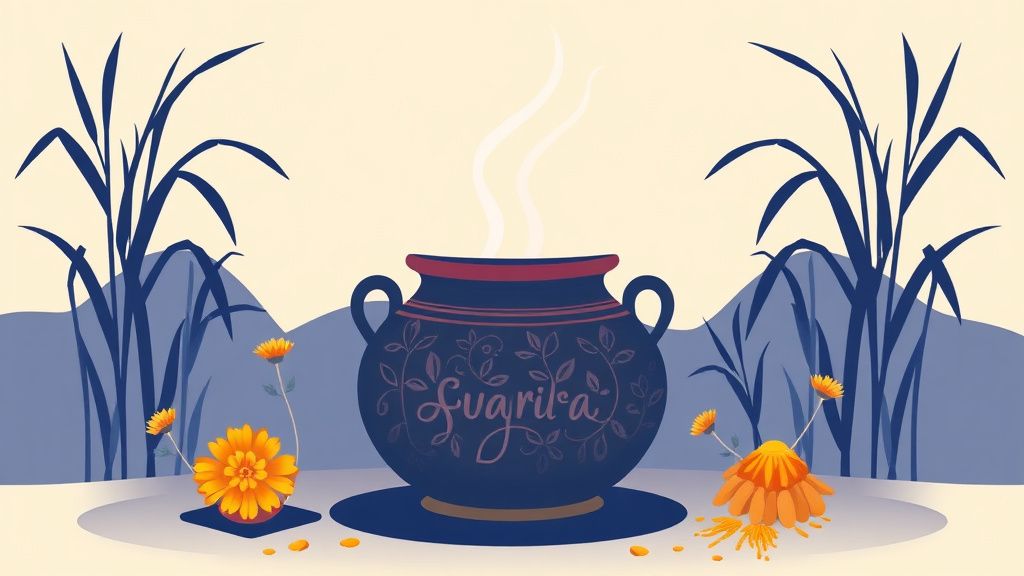
Home BlogPongal Festival 4-Day Celebration Guide and Recipes

Pongal Festival 4-Day Celebration Guide and Recipes

by Priya Sharma
29 minutes read
A+A-
Reset

The festival of Pongal Festival – Tamil Nadu’s grandest harvest celebration from Tamil [translate:பொங்கல்] (Pongal) meaning “to boil over” referring to ritual of cooking rice until it overflows pot symbolizing abundance – represents one of India’s most joyous, agriculturally significant, and culturally rich festivals where Tamil people across four sacred days express gratitude to Sun God ([translate:சூரியன்] Suryan) for successful harvest, honor cattle for their tireless agricultural labor, discard old possessions welcoming fresh beginnings, and celebrate family unity through elaborate rituals including intricate floor designs ([translate:கோலம்] Kolam) created with rice flour at doorsteps inviting prosperity, cooking iconic sweet dish Sakkarai Pongal ([translate:சர்க்கரைப் பொங்கல்] sweet rice-jaggery pudding) and savory Ven Pongal ([translate:வெண் பொங்கல்] ghee-pepper rice) in earthen pots under open sky witnessing

Pongal Festival

boiling-over moment when families joyfully shout “[translate:பொங்கலோ பொங்கல்]” (Pongalo Pongal) celebrating overflow symbolizing prosperity’s arrival, decorating cattle with painted horns, flower garlands, and colorful beads before worshipping them, and participating in traditional events like Jallikattu ([translate:ஜல்லிக்கட்டு] bull-embracing sport), folk dances, and community feasts creating vibrant atmosphere of thanksgiving, renewal, and cultural pride. Unlike purely religious festivals confined to temple worship or domestic rituals, Pongal uniquely celebrates tangible agricultural cycle directly honoring natural elements – sun providing life-giving energy, rain watering crops, earth yielding harvest,

cattle powering farming – creating deeply practical thanksgiving tradition where spirituality intertwines with agrarian economics recognizing farmers’ dependence on cosmic forces and animal labor beyond human control, with festival coinciding with winter solstice’s completion when sun begins northward journey ([translate:உத்தராயணம்] Uttarayanam) marking auspicious period as days grow longer bringing warmth essential for crop maturation making astronomical timing crucial to Pongal’s agricultural significance. The complete four-day observance encompasses understanding Day 1 Bhogi ([translate:போகி] discarding old items in bonfire symbolizing leaving behind past troubles welcoming fresh start), Day 2 Thai Pongal/Surya Pongal (main day honoring Sun God through cooking ceremonial sweet Pongal outdoors letting it boil over while family members excitedly celebrate overflow indicating prosperity), 

Day 3 Mattu Pongal ([translate:மாட்டுப் பொங்கல்] cattle worship day thanking bulls, cows, and oxen for agricultural service decorating them beautifully performing puja, includes Jallikattu celebrations), and Day 4 Kaanum Pongal ([translate:காணும் பொங்கல்] family reunion day with picnics, outings, gift exchanges especially for women and children strengthening social bonds), detailed authentic recipes for both iconic Pongal varieties – temple-style Sakkarai Pongal requiring raw rice, moong dal, jaggery, generous ghee, aromatic spices (cardamom, edible camphor, nutmeg, cloves), cashews and raisins creating divinely fragrant sweet offering, and equally beloved Ven Pongal combining rice-dal with black pepper, cumin, ginger, curry leaves,

liberal ghee producing comforting savory dish perfect for breakfast or temple prasadam, cultural practices including elaborate Kolam rangoli designs drawn daily with rice flour and colored powders creating geometric patterns, sugarcane decorations symbolizing sweetness and prosperity, traditional attire especially new clothes ([translate:புத்தாடை] Puthadu) worn on Thai Pongal morning, and regional variations across Tamil Nadu plus diaspora adaptations in Sri Lanka, Malaysia, Singapore, and worldwide Tamil communities maintaining cultural continuity through modified yet authentic observances. For celebrants in 2025 

whether lifelong Tamil families maintaining ancestral traditions through multi-generational Pongal cooking sessions teaching younger members precise techniques and sacred significance, urban professionals balancing modern schedules with cultural observances perhaps simplifying rituals while preserving essence, agricultural communities for whom Pongal holds deepest practical meaning directly thanking forces determining their livelihood success, Tamil diaspora abroad recreating traditional celebrations using available ingredients and adapted methods while teaching children about heritage,

environmentally conscious individuals appreciating festival’s eco-friendly natural materials and sustainable agricultural values, or simply curious observers wanting to understand this visually stunning culturally profound celebration beyond superficial tourist perspective, recognizing Pongal as complex multidimensional tradition embodying gratitude, renewal, agricultural wisdom, animal welfare consciousness, family unity, and cultural identity enables approaching festival with complete appreciation for its significance transcending simple harvest thanksgiving toward comprehensive worldview honoring interdependence of humans, nature, animals, and cosmic forces in sustaining life and prosperity.

Origins, Timing, and Deep Significance

Understanding festival’s historical roots reveals profound agricultural and spiritual dimensions.

The Name: Pongal’s Meaning

Etymology:

[translate:பொங்கல் (Pongal)] = To boil, overflow, bubble up

From Tamil Verb:

“In Tamil, Pongu means ‘to boil over’ and it is from this term that Pongal was derived.”

Literal and Symbolic:

Literal: Rice-milk mixture boiling and overflowing from pot during cooking

Symbolic: Abundance, prosperity, blessings overflowing beyond capacity

The Ritual:

Cooking Pongal until it boils over is intentional – desired outcome creating celebratory moment.

When Is Pongal Celebrated?

Tamil Solar Calendar:

Month: Thai (தை) – 10th month

Significance: “Thai Pongal also marks the beginning of the Tamil auspicious month, Thai as per the Tamil solar calendar.”

Popular Tamil Saying:

“Thai pirandhal vazhi pirakkum” (தை பிறந்தால் வழி பிறக்கும்)

Meaning: “When Thai month arrives, new paths/opportunities open”

Gregorian Calendar:

Fixed Dates: Typically January 14-17 annually

2025 Dates:

  • Bhogi: January 13, 2025
  • Thai Pongal: January 14, 2025
  • Mattu Pongal: January 15, 2025
  • Kaanum Pongal: January 16, 2025

Astronomical Significance Pongal Festival:

Uttarayanam (Northward Journey):

“The four-day event that is dedicated to the Sun God marks the Sun’s journey northward, Uttarayan.”

Winter Solstice Completion:

Around December 21-22, sun reaches southernmost point (winter solstice), then begins moving north.

By mid-January: Northward movement clearly established.

Agricultural Importance:

Days lengthening = More sunlight = Crop maturation

Warmth increasing = Spring approaching = New planting season

Connection to Makar Sankranti:

“Thai Pongal on January 14 corresponds with the Makar Sankranti, the harvest festival that is celebrated across India under various regional names.”

Pan-Indian Celebration:

Same astronomical event celebrated differently:

  • Tamil Nadu: Pongal
  • North India: Makar Sankranti
  • Punjab: Lohri, Maghi
  • Assam: Magh Bihu
  • Gujarat: Uttarayan

All honoring: Sun’s northward journey, harvest, new agricultural cycle.

Ancient Origins

Sangam Period Roots:

Historical evidence suggests Pongal celebrated for over 1,000 years.

Sangam Literature References:

Ancient Tamil texts mention harvest festivals with similar characteristics.

Dravidian Tradition:

Predates Aryan influence; indigenous Tamil harvest thanksgiving.

Evolution:

Later incorporated into Hindu religious framework with Surya worship while maintaining agricultural core.

The Profound Significance

1. Gratitude to Sun God

Primary Purpose:

“Sun God is worshipped on Thai or Surya Pongal day.”

Why Sun Worship?

Agriculture’s Foundation:

Without sunlight:

  • Photosynthesis impossible
  • Crops cannot grow
  • Harvest fails
  • Famine results

Sun = Life itself

Direct Thanks:

Farmers directly acknowledging that despite their labor, success depends on sun’s energy.

2. Honoring Nature’s Elements

Complete Ecosystem Recognition:

Beyond sun alone:

  • Rain: Provided water for crops
  • Earth: Yielded the harvest
  • Cattle: Plowed fields, transported goods
  • Farmers: Human labor

Holistic Thanksgiving:

All elements working together create abundance.

3. Harvest Celebration and Agricultural Cycle

Timing:

January = Post-harvest period for key crops (rice, sugarcane, turmeric)

The Relief:

After months of hard work:

  • Crops safely harvested
  • Stored in granaries
  • Financial security ensured
  • Family fed for coming year

Pure Joy:

Pongal expresses farmers’ relief, gratitude, celebration.

4. New Beginnings and Renewal

Bhogi’s Discarding:

Symbolically leaving behind:

  • Old troubles
  • Past failures
  • Accumulated negativity

Fresh Start:

New clothes, cleaned homes, fresh agricultural cycle beginning.

5. Social and Family Unity

Kaanum Pongal:

“Families get together on the fourth or Kaanum Pongal Day to have a grand meal.”

Strengthening Bonds:

Festival brings dispersed family members together.

Community Celebration:

Shared joy, collective thanksgiving, social cohesion.

Regional Prevalence

Primary:

Tamil Nadu – State festival, grand celebrations everywhere

Also Celebrated:

“The festival is also celebrated in Karnataka, Andhra Pradesh, and Puducherry.”

Names:

  • Karnataka: Makara Sankranti/Ellu Bella
  • Andhra Pradesh: Bhogi, Sankranti (different names, similar dates)

Tamil Diaspora:

“It is also celebrated among the Tamil diaspora across the world, especially in Sri Lanka, Malaysia and Singapore.”

Global Spread:

Wherever Tamil communities exist – USA, UK, Canada, Australia, Gulf countries.

The Complete 4-Day Celebration Guide

The detailed observance follows prescribed sequence across four sacred days.

Day 1: Bhogi Pongal (போகி பொங்கல்)

Date: January 13, 2025

The Theme: Discarding old, welcoming new

Main Ritual: Bhogi Mantalu (Bonfire)

The Practice:

“People discard their old materials and replace them with new items on Bhogi day.”

What’s Discarded:

  • Old clothes
  • Worn utensils
  • Broken furniture
  • Useless household items
  • Agricultural waste (dried leaves, straw)

The Bonfire:

Early Morning:

Items collected and burned in bonfire.

Symbolism:

Leaving behind:

  • Past year’s troubles
  • Accumulated negativity
  • Old patterns
  • Making space for new

Community Gathering:

Neighbors gather around bonfire:

  • Singing songs
  • Dancing
  • Celebrating fresh start

Home Preparation:

Deep Cleaning:

“The house and surroundings are scrupulously cleaned.”

Entire home:

  • Swept thoroughly
  • Washed and wiped
  • Decluttered
  • Painted (some families)

Decorating:

  • Kolam designs started
  • Mango leaves hung
  • Fresh flowers arranged

Cattle Care:

Begin preparing cattle for next day’s worship:

  • Bathing them
  • Cleaning stables

Day 2: Thai Pongal / Surya Pongal (தை பொங்கல் / சூரிய பொங்கல்)

Date: January 14, 2025

THE MAIN DAY

The Theme: Honoring Sun God, cooking ceremonial Pongal

Morning Kolam:

Elaborate Designs:

Kolams or decorative patterns are drawn at the entrance of the house.”

Traditional Practice:

Women wake early (before sunrise) to create:

  • Intricate geometric patterns
  • Using rice flour (traditional)
  • Colored powders (modern addition)
  • Largest, most elaborate design of year

Pongal Kolam Specialty:

Often features:

  • Pot (symbolizing Pongal vessel)
  • Sugarcane stalks
  • Sun motifs
  • Flowers

Purpose:

  • Welcoming prosperity
  • Auspiciousness
  • Decorative beauty

Outdoor Cooking Setup:

Traditional Method:

Location:

Courtyard, terrace, or open space under sky (facing sun)

Equipment:

  • New earthen pot (traditional) or bronze/copper vessel
  • Three stones/bricks forming stove
  • Firewood for cooking
  • Alternatively: outdoor stove

Why Outdoors?

Facing sun while cooking – direct worship

Boiling over needs space without mess concerns

Community visibility – neighbors witness and celebrate

The Sacred Cooking Ritual:

Ingredients Assembled:

For Sakkarai Pongal (sweet version):

  • Newly harvested rice
  • Fresh milk
  • Jaggery
  • Cardamom, nuts, raisins

The Procedure:

1. Auspicious Timing:

Often synchronized with sunrise or calculated muhurtam (auspicious time)

2. Family Gathers:

Everyone present for sacred moment

3. First Ingredients:

Milk poured first, then rice added

4. Cooking:

Stirred continuously while chanting prayers

5. The Boiling Over Moment:

When milk-rice mixture bubbles and overflows:

The Celebration:

“The overflow of the milk is seen as a symbol of prosperity and abundance.”

“People celebrate this moment by shouting ‘Pongalo Pongal’.”

The Cry:

Pongalo Pongal!” (பொங்கலோ பொங்கல்!)

Repeated three times with joy, clapping, ululation

Meaning:

“May this prosperity overflow!” / “May abundance flow!”

Offerings:

To Sun God:

Sugarcane, vegetables, and spices are also offered to God.”

Traditional Offerings:

  • Cooked Pongal (both sweet and savory)
  • Fresh sugarcane (with leaves)
  • Bananas
  • Turmeric plant
  • Betel leaves and nuts
  • Coconut

Arrangement:

Placed on plantain (banana) leaf
Offered facing east (sun’s direction)

Prayer:

“Thank you, Sun God, for this abundant harvest. Bless us with continued prosperity.”

New Clothes:

Puthadu (புத்தாடை):

Traditional new clothes worn:

  • After morning bath
  • Before Pongal cooking/eating
  • Symbolizes fresh start

Feasting:

After offering to gods:

  • Family eats Pongal together
  • Both Sakkarai and Ven Pongal served
  • Special vegetarian feast prepared

Unmarried Women’s Penance:

Traditional Practice:

“It is believed that unmarried girls observe penance as they pray for the agricultural prosperity of the country.”

The Vow:

“They take bath early in the morning and do not consume milk or other dairy products.”

Purpose:

  • Praying for nation’s agricultural success
  • Personal prayer for good husband
  • Spiritual discipline

Duration:

Throughout Margazhi month (Dec-Jan) culminating in Pongal.

Day 3: Mattu Pongal (மாட்டுப் பொங்கல்)

Date: January 15, 2025

The Theme: Honoring cattle

The Significance:

“The cattle or ‘maatu’ is worshipped on the Maatu Pongal day.”

Why Worship Cattle?

Agricultural Backbone:

Bulls and oxen:

  • Plow fields
  • Transport harvest
  • Provide manure (fertilizer)
  • Power sugarcane crushers
  • Essential to farming

Gratitude:

“People show their veneration to the work they do on the farmlands.”

Without them, traditional farming impossible.

Cattle Decoration:

Beautiful Adornment:

“The cattle look more beautiful with polished horns, and they are made to wear flower garlands, beads and bells.”

The Process:

1. Bathing:

Cattle bathed thoroughly, cleaned

2. Horn Decoration:

Painted with bright colors:

  • Turmeric yellow
  • Kumkum red
  • Multicolor patterns

Polished to shine

3. Ornaments:

  • Flower garlands around neck
  • Beads strung
  • Bells attached (tinkle while moving)
  • Colored cloth draped

4. Forehead Marking:

Kumkum and turmeric tilak applied

The Worship:

Puja Ritual:

  • Aarti performed for cattle
  • Pongal offered to them
  • Prayers for their health and strength
  • Seeking forgiveness for burden imposed

Special Feed:

Cattle fed:

  • Sweet Pongal
  • Jaggery mixed with rice
  • Fresh grass and fodder
  • Special nutritious meal

Jallikattu Tradition:

The Sport:

Jallikattu (a game involving bulls)”

[translate:ஜல்லிக்கட்டு (Jallikattu)] = Bull embracing

What Is It?

Traditional Sport:

Participants attempt to:

  • Grab bull’s hump
  • Hold on while bull runs
  • Prove courage and strength

Historical Significance:

Ancient practice dating back 2,000+ years (evidence in Indus Valley seals)

Purpose:

  • Demonstrating bravery
  • Selecting strong breeding bulls
  • Traditional masculinity test
  • Cultural sport

Controversy:

Animal welfare concerns led to bans (2014) then revival (2017) with regulations:

  • Safety measures for bulls
  • Veterinary oversight
  • Controlled conditions

Locations:

Famous Jallikattu held in:

  • Madurai (Alanganallur)
  • Palamedu
  • Other Tamil villages

Other Traditional Games:

Vazhukku maram (slippery pole), mallar kambam (a mix of gymnastics and yoga), Uri Adithal (breaking a hanging mud pot, blindfolded), and Kabaddi (a team sport).”

All celebrating:

Physical prowess, traditional skills, community entertainment.

Day 4: Kaanum Pongal (காணும் பொங்கல்)

Date: January 16, 2025

The Theme: Family reunion, social bonding

The Name:

[translate:காணும் (Kaanum)] = To view, to meet

Significance:

Day to meet family members, visit relatives.

Family Gatherings:

Grand Meals:

“Families get together on the fourth or Kaanum Pongal Day to have a grand meal.”

Picnics and Outings:

Traditional to:

  • Visit temples
  • Picnic by riverbanks
  • Outing to relatives’ homes
  • Community gatherings

Folk Performances:

Mayilattam and Kolattam – the traditional folk dances – are performed on this day.”

Mayilattam (மயிலாட்டம்):

Peacock dance – graceful, colorful

Kolattam (கோலாட்டம்):

Stick dance – rhythmic, energetic

Women’s Day:

Special Focus:

Traditional day for:

  • Women visiting parents’ homes
  • Sisters meeting brothers
  • Gift exchanges
  • Special attention to women and girls

Kanu Pidi:

Tamil Tradition:

Women place:

  • Colored rice
  • Cooked sweet Pongal
  • Betel leaves
    On turmeric leaves in courtyard

For whom:

  • Birds (especially crows)
  • Symbolically for brothers’ welfare

Prayer:

For brothers’ prosperity and long life.

Pongal Mela (Fairs):

Pongal Mela or fairs exhibit and sell sarees, ethnic jewellery, handicrafts, and pottery.”

Festival Markets:

Special bazaars with:

  • Traditional items
  • Festival shopping
  • Entertainment
  • Community gathering spaces

Authentic Pongal Recipes

The iconic dishes define the festival through taste and aroma.

Sakkarai Pongal (Sweet Pongal) – Temple Style

[translate:சர்க்கரைப் பொங்கல் (Sakkarai/Chakkara Pongal)] = Sweet Pongal

The Iconic Dish:

Sakkarai pongal recipe, a temple style flavorful sweet pongal with jaggery, edible camphor, cardamom, cloves, essential ghee and cashew nuts.”

When Made:

“Sweet pongal is made in many occasions other than pongal festival. For a Friday offering, aadi perukku, Ganesh chaturthi, Varalakshmi viradham etc.”

Common temple prasadam

Why This Recipe Is Special:

“Rice and dal cooked with the secret ingredients like edible camphor, nutmeg and clove make it smell and taste DIVINELY.”

“This turns out very close to the sacred temple offerings, tasty and flavorful.”

Ingredients:

Main:

  • ½ cup Raw rice
  • 2 tablespoon Moong dal (split yellow lentils)
  • ¾ cup Jaggery (can increase to 1 cup for sweeter)
  • 2½ cups Water
  • 3 tablespoon Ghee (clarified butter)
  • 1 pinch Salt

For Flavor:

  • 6 Cashews
  • 2 tablespoon Raisins
  • 1 Cardamom
  • 1 Clove
  • 1 pinch Nutmeg powder
  • 1 Edible camphor (fenugreek seed size)

Step-by-Step Procedure:

1. Roast Dal:

“Take pressure cooker/pan, add ¼ teaspoon ghee and roast the moong dal.”

Until lightly fragrant (1-2 minutes)

2. Cook Rice-Dal:

“Add water, washed rice and salt. Pressure cook for 4 whistles.”

3. Mash:

Mash it once done. If it is thick, add 1 more cup hot water to make it loose.”

Should be soft, slightly mushy consistency.

4. Prepare Jaggery Syrup:

Powder jaggery and heat it with water just to immerse it and bring to boil.”

“Let the jaggery completely dissolve and filter it

Filtering Important:

Removes impurities from jaggery

5. Combine:

“Add [filtered jaggery syrup] to the mashed rice in the cooker.”

6. Fry Nuts:

“In a separate pan, heat a teaspoon of ghee and roast cashews to golden and add raisins to it.”

“Once it fluffs up, transfer it and keep aside.”

7. Roast Spices:

“In the same pan, add cloves, cardamom and switch off the stove.”

“Add nutmeg powder, give a quick stir.”

8. Powder Cardamom:

“Take out cardamom and powder it

Why:

“At times, the cardamom rice is not black and wont get powdered at all. While eating it comes in mouth which some people find it annoying.”

9. Add Aromatics:

“Add the powdered cardamom, edible camphor, cloves along with nutmeg powder to the pongal.”

10. Final Cooking:

Mix well and cook in medium flame for 5 minutes.”

“Add ¼ cup water or milk if it gets dry while cooking.”

Drizzle ghee little by little while cooking.”

The Ghee:

Liberal amounts essential for authentic temple taste and texture.

11. Add Nuts:

“Lastly add the fried cashews and raisins.”

How to Know It’s Done:

“The pongal will have a shine from the jaggery coating the rice. So keep cooking until then.”

Divine smelling + tasting pongal is what you have now! The whole house smell divinely.”

Expert Tips:

Jaggery Quality:

“The measurements given will be perfect, but some jaggery are less sweet or more sweet depending on it’s quality.”

Adjust quantity based on taste test.

Camphor Amount:

“The trick is to add just the right amount, if you add more, it will be overpowering. So add very very little to get the best flavour.”

Mustard seed size or smaller.

Ghee:

“Use good quality ghee. I always use homemade ghee.”

Makes enormous difference in taste.

Serving:

Serve hot for best taste and texture.

Ven Pongal (Savory Pongal) – Khara Pongal

[translate:வெண் பொங்கல் (Ven Pongal)] = White Pongal

Alternate Names:

Khara Pongal, Ghee Pongal

The Comfort Food:

Equally beloved as Sakkarai Pongal, often preferred for breakfast.

Ingredients:

Main:

  • 1 cup Raw rice
  • ¼ cup Moong dal
  • 3-4 cups Water
  • Salt to taste
  • ½ teaspoon Turmeric powder

Tempering:

  • ¼ cup Ghee (generous amount essential)
  • 1 teaspoon Cumin seeds
  • 1 teaspoon Black peppercorns (crushed)
  • 10-12 Cashews
  • Few Curry leaves
  • 1 inch Ginger (chopped fine)
  • 1 Green chili (optional)

Procedure:

1. Roast Dal:

Dry roast moong dal until fragrant.

2. Cook Together:

Pressure cook rice, dal, water, salt, turmeric for 3-4 whistles.

3. Mash:

Mash while hot to porridge-like consistency.

4. Prepare Tempering:

Heat ghee generously:

  • Add cumin, let splutter
  • Add crushed pepper
  • Cashews, fry golden
  • Ginger, green chili
  • Curry leaves (careful of splatter)

5. Combine:

Pour hot tempering over mashed rice-dal.

Mix thoroughly.

6. Adjust Consistency:

Add hot water if too thick; cook briefly if too thin.

Serving:

Serve hot with:

  • Coconut chutney
  • Sambar
  • Ghee drizzled on top

Temple Prasadam:

Common offering in South Indian temples.

Frequently Asked Questions

What’s the difference between sweet and savory Pongal?

Two distinct dishes sharing name and basic technique: Sakkarai/Sweet Pongal uses rice-dal base sweetened with jaggery (never white sugar traditionally), flavored with cardamom, edible camphor, nutmeg, enriched with ghee, cashews, raisins creating dessert-like consistency – offered to gods, served after meals, temple prasadam

Ven/Savory Pongal (Khara Pongal) uses same rice-dal base but flavored with black pepper, cumin, ginger, curry leaves, generous ghee creating savory comfort food – breakfast staple, simple meal, also temple offeringBoth: Cooked to soft, slightly mushy consistency (unlike separate-grain rice); name “Pongal” from cooking method (boiling over) rather than specific flavor. Festival: Sweet Pongal more iconic for Thai Pongal celebration though both made. Recommendation: Make both – sweet for offering/dessert, savory for hearty breakfast experiencing complete Pongal culinary tradition.

Can Pongal be made in regular pot or must it be earthen pot?

Earthen pot traditional and ideal but alternatives acceptable: Traditional preference: New earthen pot used for Thai Pongal outdoor cooking – porous clay allows gradual heat distribution, prevents burning, adds earthy aroma, eco-friendly, disposable after festival maintaining purity concept. Symbolic: Earthen pot connects to agricultural roots, natural materials, traditional methods. 

Practical modern alternatives: 1. Bronze/brass pot – traditional metal alternative, excellent heat conductor, reusable, authentic appearance; 2. Stainless steel pressure cooker – most practical for everyday cooking, saves time, consistent results; 3. Regular cooking pot – any heavy-bottomed vessel works for actual cooking. For ceremonial Thai Pongal outdoor ritual: Earthen pot strongly recommended for authentic experience and symbolic significance. For regular home cooking: Any pot works fine – taste depends on ingredients/technique not vessel type. Compromise: Use earthen pot for festival day symbolic cooking, regular vessels for everyday Pongal preparation.

Why must Pongal boil over and what if it doesn’t overflow?

Boiling over is THE defining ritual moment: Symbolic significance: Overflow represents abundance, prosperity, blessings exceeding capacity – desired auspicious sign that coming year brings more than enough. The celebration: Moment of overflow triggers family’s joyful “Pongalo Pongal!” cry – climactic festival moment everyone awaits. Intentional: Not cooking mistake but designed outcome – hence milk added to rice (foams more), pot kept only ¾ full, heat maintained high. 

If doesn’t overflow: Don’t worry – not bad omen, just means: 1. Pot too large for quantity, 2. Heat too low – increase flame, 3. Not enough liquid – can add more milk during cooking, 4. Watched too anxiously – “watched pot never boils” phenomenon. Solution: Keep cooking, add splash of milk if needed, increase heat – it will overflow. Spiritual perspective: Sincere devotion matters more than mechanical overflow; God sees intention not just external result. Modern adaptation: Some simply declare “Pongalo Pongal” when bubbling vigorously even if not dramatically overflowing.

Is Jallikattu essential to Pongal or optional cultural event?

Optional regional tradition, not mandatory religious requirement: Status: Jallikattu is cultural sport associated with Pongal (especially Mattu Pongal) but NOT essential religious ritual everyone must observe. Who participates: Primarily rural Tamil Nadu villages with bull-rearing traditions; urban areas generally don’t practice. Pongal completeness: Can observe completely authentic Pongal without any Jallikattu involvement – core rituals are Sun worship, cooking Pongal, cattle decoration, family gathering

Controversy: Animal welfare concerns, injuries, deaths led to legal battles – many Tamils don’t support it. Cultural significance: For supporters, represents Tamil pride, traditional bravery, agricultural heritage, bull breeding preservationModern debate: Deeply divisive issue – some view as essential cultural preservation, others as outdated cruelty. Your choice: Pongal celebration entirely valid focusing on harvest thanksgiving, family unity, spiritual gratitude without engaging Jallikattu aspect. Respect diversity: Tamil community itself divided; no single “correct” position.

What flowers and materials are used for Kolam during Pongal?

Primarily rice flour with optional enhancements: Traditional base: White rice flour – ground to fine powder, creates white designs on cleaned floor, eco-friendly (birds/ants eat leftover flour – intentional charity). Pongal special additions: 1. Colored powders – Red (kumkum), yellow (turmeric), other natural/commercial colors create multicolor designs; 2. Flower petals – Marigold, roses, hibiscus arranged within Kolam patterns; 3. Kolam powder – Commercial pre-made colored powders (easier than grinding rice). 

Common Pongal Kolam motifs: Pot/vessel (representing Pongal cooking), sugarcane stalkssun designsgeometric patterns (circles, squares, intricate interlocking shapes), floral patternsSize: Pongal Kolam typically larger and more elaborate than daily Kolams – sometimes covering entire courtyard. Materials needed: Rice flour, colored powders, flowers, steady hand, practice! Learning curve: Beginners start simple geometric patterns, advance to complex designs. Modern tools: Stencils available but traditional freehand drawing most valued. Daily practice: Kolam drawn fresh each morning during Pongal, washed away evening, new design next day.

Can non-vegetarians eat meat during Pongal festival?

Generally avoided during main Pongal days, practices vary: Traditional preference: Pongal being harvest thanksgiving and Sun worship festival, vegetarian food strongly preferred showing purity, non-violence, sattvic qualities. Specific days: Thai Pongal (Day 2) especially: Strictly vegetarian – day of Sun worship, Pongal offering preparation. Mattu Pongal (Day 3): Also vegetarian respecting cattle worship day – contradiction to honor cows then eat meat. 

Regional variations: Some Tamil communities maintain strict vegetarianism all four days; others only Day 2-3, resuming normal diet Day 4. Religious vs cultural: Devout Hindus likely maintain vegetarianism; secular celebrants may be flexible. Practical: Festival foods (Pongal, traditional dishes) all vegetarian anyway; natural to maintain throughout. Personal choice: Modern urban Tamils may not follow strictly – individual/family decision. Respect: If attending others’ Pongal celebrations, follow host family’s practices – don’t bring non-veg food to vegetarian household during festival. The spirit: Temporary vegetarianism shows reverence for nature, animals, agricultural cycle Pongal honors.

How do Tamil people outside India celebrate authentic Pongal?

Diaspora maintains core rituals with creative adaptations: Community organization: Tamil associations in Malaysia, Singapore, Sri Lanka, USA, UK, Canada, Australia organize collective Pongal celebrations – renting halls, temples, outdoor spaces for community gathering. Kolam: Create using available materials – rice flour shipped from Indian stores or substitutes; smaller apartment-friendly designs vs. large courtyard Kolams. Pongal cooking: Indoor adaptation most common – can’t have outdoor bonfire/cooking in apartments; use regular kitchen stove but maintain ritual of cooking fresh, boiling over moment, “Pongalo Pongal” cry. 

Ingredients: Indian grocery stores stock rice, dal, jaggery; if unavailable, brown sugar substitutes jaggery (less authentic but workable). Cattle worship: Obviously impossible in cities; symbolic recognition through pictures, stories to children, donations to animal welfare. Traditional attire: Wearing silk sarees, veshti (dhoti) maintaining cultural dress. Cultural programs: Folk dances, music, traditional games, teaching children. Food: Elaborate vegetarian feast even if simplified from village-style celebrations. The essence: Teaching next generation about heritage, maintaining emotional connection to Tamil identity and agricultural roots despite geographical distance. Challenges overcome through commitment.

What’s the significance of sugarcane in Pongal celebrations?

Multiple symbolic and practical meanings: Harvest representation: Sugarcane major Tamil Nadu crop harvested around Pongal time – displaying fresh sugarcane with leaves, roots attached shows successful harvest. Sweetness symbolism: Life sweetness – praying coming year be sweet like sugarcane; prosperity’s sweetness. Offering to Sun God: Fresh sugarcane among traditional Thai Pongal offerings acknowledging sun’s role in crop growth. 

Decorative: Sugarcane stalks used to decorate entrances, Pongal cooking area – tied on sides creating auspicious arch, sometimes with mango leaves. Jaggery connection: Jaggery (main sweetener in Sakkarai Pongal) comes from sugarcane – cooking Pongal with sugarcane-derived jaggery while displaying sugarcane stalks creates complete symbolic circle. Economic importance: Sugarcane farming crucial Tamil Nadu economy – honoring this crop specifically acknowledges farmers’ livelihoods. Traditional practice: After festival, sugarcane distributed among children, neighbors – sharing harvest’s sweetness. Practical note: Must be fresh sugarcane with leaves/roots not just cut pieces – wholeness symbolizes completeness, vitality.

Can Pongal be prepared day before festival or must be fresh on Thai Pongal day?

Fresh preparation on Thai Pongal essential for ritual, reheating acceptable otherwise: For ceremonial Thai Pongal Day 2 ritual: MUST be cooked fresh – entire significance lies in cooking process, boiling over moment, family witnessing, “Pongalo Pongal” celebration – defeats purpose if made previous day reheated. Timing: Early morning Thai Pongal day after Kolam, before eating anything else – freshly cooked Pongal first offering/food of auspicious day. 

Other days: Can prepare advance for practical convenience – make large batch, refrigerate, reheat for subsequent meals. Temple offerings: Always fresh – prasadam prepared same day morning. Busy families: Understandable to make day before for regular consumption but try preserving at least small symbolic amount cooked fresh on Thai Pongal morning maintaining ritual essence even if simplified. The principle: Process matters as much as product – Pongal isn’t just food but ritual act where cooking itself is worship, overflow is blessing, freshness is purity. Compromise: Make main quantity advance for convenience, cook small fresh pot ceremonially on Thai Pongal morning for ritual authenticity. Storage: Pongal keeps refrigerated 3-4 days; reheats well with splash of milk/water.

Conclusion

The magnificent festival of Pongal represents extraordinary synthesis of agricultural thanksgiving, solar worship, family unity, and cultural identity – embodying Tamil Nadu’s soul through four-day celebration where entire population regardless of urban or rural location unites expressing gratitude to Sun God whose life-giving energy enables harvest, honoring cattle whose tireless labor powers traditional farming, discarding old possessions symbolically releasing past year’s troubles welcoming fresh beginnings, and cooking iconic sweet Sakkarai Pongal in earthen pots under open sky witnessing joyful boiling-over moment

when families ecstatically shout “Pongalo Pongal” celebrating overflow representing abundance exceeding capacity and prosperity’s arrival creating deeply meaningful tradition connecting spiritual devotion with practical agricultural economics recognizing farmers’ ultimate dependence on cosmic forces and animal labor beyond human control. Understanding complete framework – that four-day sequential observance from Bhogi’s bonfire discarding worn items through Thai Pongal’s climactic Sun worship and ceremonial cooking to Mattu Pongal’s cattle decoration and Jallikattu celebrations

culminating in Kaanum Pongal’s family reunions creates multifaceted experience engaging spiritual devotion, aesthetic appreciation through elaborate Kolams, culinary mastery producing both divinely fragrant sweet and comforting savory Pongal varieties, social bonding through collective celebrations, and cultural pride maintaining ancestral traditions, that festival’s astronomical timing coinciding with winter solstice’s completion when sun begins northward journey bringing lengthening days and warming temperatures essential for crop maturation demonstrates sophisticated ancient understanding of celestial cycles’ agricultural implications,

that detailed authentic recipes for temple-style Sakkarai Pongal requiring precise spice combinations (cardamom, edible camphor, nutmeg, cloves) and generous ghee creating divinely aromatic offering plus equally beloved Ven Pongal’s pepper-cumin-ginger savory richness enable experiencing complete Pongal culinary heritage connecting taste and devotion, that profound significance encompasses gratitude for tangible harvest success, recognition of interdependent ecosystem (sun-rain-earth-cattle-humans), renewal symbolism through fresh starts and new beginnings, and social cohesion through family gatherings and community celebrations demonstrating

holistic worldview honoring all elements sustaining agricultural prosperity, and that contemporary relevance for Tamil diaspora worldwide recreating traditional observances through adapted methods while teaching subsequent generations about heritage ensures living tradition’s continuity across geography and time maintaining emotional connection to homeland and cultural identity – enables approaching Pongal with complete appreciation for this remarkable celebration’s multidimensional significance transcending simple harvest thanksgiving toward comprehensive philosophy recognizing humanity’s place within natural cycles and cosmic order.

As you engage with Pongal in 2025, whether lifelong Tamil family maintaining ancestral traditions through elaborate outdoor Pongal cooking sessions recreating childhood memories of joyful boiling-over moments and “Pongalo Pongal” celebrations, urban professional adapting rituals to apartment constraints cooking indoors yet preserving essential spirit through fresh preparation and overflow moment, agricultural family for whom Pongal holds deepest practical meaning directly thanking forces determining livelihood success after months of hard labor culminating in successful harvest,

Tamil diaspora abroad teaching children about heritage through modified celebrations using available ingredients and simplified rituals while maintaining cultural continuity, environmentally conscious individual appreciating festival’s eco-friendly natural materials (rice flour Kolams, earthen pots, biodegradable offerings) and sustainable agricultural values, food enthusiast exploring authentic South Indian cuisine through temple-style Sakkarai Pongal and savory Ven Pongal recipes discovering divine aromas and comforting tastes, or simply curious observer understanding

this visually stunning culturally profound celebration beyond superficial tourist perspective recognizing sophisticated integration of astronomy, agriculture, spirituality, family values, and artistic expression, remember that tradition’s ultimate value emerges when ancient wisdom meets contemporary engagement where celebrations maintaining core essence (gratitude to sun and nature, honoring cattle and farmers, family unity, cultural pride, joyful abundance) while adapting practical details to modern contexts prove far more meaningful than rigid mechanical replication losing spirit through obsessive form-preservation, that Pongal’s remarkable achievement creating secular cultural celebration transcending religious sectarianism where harvest thanksgiving connects

all Tamils regardless of Hindu-Christian-Muslim affiliation demonstrates wisdom about differentiation between cultural identity markers and religious exclusivity boundaries offering model for pluralistic modern societies, and that whether preparing elaborate outdoor ceremonial Pongal with earthen pot and traditional ingredients experiencing authentic boiling-over moment surrounded by family, creating simplified indoor version maintaining fresh-cooking ritual and overflow symbolism, drawing intricate Kolam designs welcoming prosperity, wearing traditional attire honoring occasion, teaching children about Sun God’s importance and cattle’s tireless service, or simply appreciating this magnificent festival’s profound beauty and significance, approaching Pongal with understanding

its complete multidimensional meaning – agricultural roots, astronomical timing, spiritual devotion, culinary excellence, ecological consciousness, and social harmony – transforms potentially superficial festivity into conscious engagement with living tradition connecting past wisdom with present joy and future continuity celebrating eternal gratitude for sun’s life-giving energy, earth’s generous yields, nature’s abundant blessings, and human capacity for recognizing our place within cosmic order with humility, thanksgiving, and joyful celebration embodied beautifully in Tamil Nadu’s beloved harvest festival where cooking rice until it boils over becomes sacred act of worship, gratitude, and hope for overflowing prosperity in year ahead.

[translate:॥ பொங்கலோ பொங்கல் (Pongalo Pongal) – May Prosperity Overflow॥]


About the Author

Priya Shama – South Indian Traditions, Temple Rituals, and Cultural Practices Expert

Priya Shama is a distinguished scholar and practitioner specializing in South Indian Hindu traditions, temple worship practices, regional festival celebrations, and the intersection of agricultural cycles with spiritual observances particularly examining how Tamil, Telugu, Kannada, and Malayalam cultures express devotion through distinctive regional forms while maintaining underlying Vedic and Puranic philosophical foundations.

Drawing from personal Tamil Brahmin heritage growing up in Thanjavur where elaborate Pongal celebrations formed annual highlights involving multi-generational outdoor cooking sessions, intricate Kolam competitions among neighborhood women, temple visits receiving prasadam, and grandmother’s secret techniques for achieving perfect temple-style Sakkarai Pongal aroma through precise edible camphor and nutmeg proportions, combined with academic training in South Indian temple architecture, ritual procedures, and agricultural festival traditions, her work examines

how festivals like Pongal encode sophisticated understanding of astronomical cycles, agricultural economics, ecological sustainability, and social cohesion through accessible cultural forms transmitted across generations through family participation, oral traditions, and embodied practices rather than textual scholarship alone.

Priya has extensively researched Pongal’s evolution from ancient Dravidian harvest celebrations through Sangam literature references to contemporary diaspora adaptations documenting how core gratitude themes and ritual structures persist while specific practices modify according to geographical, economic, and social contexts, temple prasadam preparation techniques across major South Indian shrines revealing how sacred cooking combines precise recipes with devotional mindset creating distinctively divine taste transcending mere ingredients,

Kolam art’s mathematical sophistication and ritual significance as daily spiritual practice maintaining household purity and welcoming prosperity, and comparative analysis of pan-Indian solar festivals (Makar Sankranti, Lohri, Bihu) sharing Pongal’s astronomical timing yet expressing through distinctive regional cultural vocabularies. She regularly teaches courses on South Indian ritual traditions explaining elaborate temple procedures, domestic worship practices, and festival celebrations helping participants appreciate sophisticated theological concepts embedded in accessible cultural forms, conducts cooking workshops on authentic

South Indian prasadam recipes preserving traditional techniques threatened by modernization and fast food culture, creates intricate Kolam designs teaching mathematical patterns and symbolic meanings, and facilitates dialogues between orthodox traditional practitioners and contemporary urban/diaspora Tamils seeking meaningful engagement with heritage finding balanced approaches honoring both authenticity and practical adaptation. Her teaching emphas

You May Also Like

Leave a Comment

Adblock Detected

We noticed you're using an ad blocker. Hindutva.online is committed to providing quality content on Hindu heritage and culture. Our ads help support our research and writing team. Please consider disabling your ad blocker for our site to help us continue our mission.