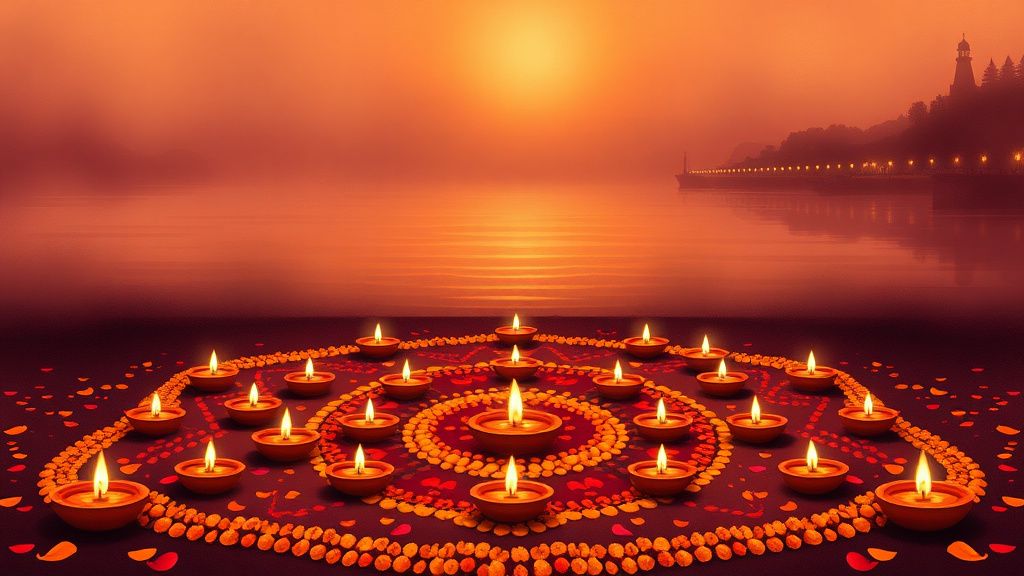
Dev Diwali (Dev Deepawali, “the Diwali of the gods”) is the evening of Kartik Purnima observed at Varanasi as the city’s signature festival, falling in 2026 on Tuesday, 24 November. On the night, the eighty-four ghats of the Ganga at Varanasi are lit with several lakh earthen lamps; the Ganga Aarti is performed simultaneously on the main ghats; and floating diyas cover the river. The festival has become Varanasi’s largest non-fair tourist draw of the year alongside Mahashivratri, with the Uttar Pradesh Tourism Department estimating attendance in the high hundreds of thousands.
Why “of the gods”
The Puranic story behind the name connects Dev Diwali to the destruction of Tripurasura by Shiva. The Matsya Purana and the Linga Purana both narrate the episode: three asuras, Tarakaksha, Vidyunmali and Kamalaksha, perform tapas, receive from Brahma the boon of three flying cities (Tripura) that can be destroyed only when aligned on a single moment and only by a single arrow, and then turn to adharma. Shiva, mounted on a chariot whose pieces are the various devas, fires that single arrow when the cities align and Tripura is reduced to ash. The devas then descend to Varanasi to bathe in the Ganga and to celebrate the victory by lighting lamps along the ghats. The Kartik Purnima night fifteen days after the Diwali of humans came to be called the Diwali of the gods.
A second tradition, tied to the same date, says Vishnu rose from his four-month yoga nidra on Devuthani Ekadashi (the eleventh day of waxing Kartik); Kartik Purnima is read as the celebration that follows. Several other Vaishnava strands of meaning ride the same night.
The ghat layout you actually see
The festival’s visual structure follows the line of the Ganga at Varanasi. The eighty-four named ghats run roughly four kilometres from Assi Ghat in the south to Rajghat in the north, with the heaviest density of activity between Assi and Dashashwamedh:
- Assi Ghat: the southern starting point. Subah-e-Banaras (the morning concert) here is replaced by an extended evening programme during Dev Diwali.
- Tulsi, Bhadaini and Janaki Ghats: the middle stretch with concentrated diya rangoli.
- Dashashwamedh Ghat: the most photographed point; the main Ganga Aarti is performed here, intensified for Dev Diwali with extra priests, larger lamps and a synchronised choreography across panel after panel.
- Manikarnika and Harishchandra: the cremation ghats; uniquely on Dev Diwali night these too are lit with lamps, a rare departure from the year-round austere atmosphere.
- Panchganga Ghat: where five rivers symbolically meet, the lamp display continues through the night.
- Rajghat: the northern endpoint and the location of the main fireworks display in some years.
The river itself is part of the spectacle: thousands of floating diyas, released by pilgrims onto leaves or small clay platters, drift across the water in the current.
The ritual sequence of the evening
The evening runs to a fixed shape across most ghats:
- Pre-sunset: rangoli of rice flour and flower petals laid out along the ghat steps; lamps placed in geometric patterns and filled with oil; volunteers organise the wicks.
- Sunset: the priests of each ghat begin lighting the first lamps. The Ganga Aarti starts at the Dashashwamedh and at Assi at approximately 6:00 PM, varying by exact sunset.
- Aarti hour: seven or more priests on raised wooden platforms perform a fully synchronised aarti, moving through the conch, deepa, dhupa, chamara and chhatra in unison. The Ganga Seva Nidhi has run the Dashashwamedh aarti format that is now widely copied.
- Post-aarti: deepa daan, the release of floating lamps by individual pilgrims onto the river.
- Mid-evening: the Akashdeep, a special lamp hoisted on long bamboo poles at most ghats, is lit. The tradition is that the Akashdeep lights guide the ancestors and the devas back to their realms.
- Late evening: fireworks at selected ghats and over the river; classical music concerts at the Akhada Ghat and at Tulsi Ghat run late into the night.
How to watch: from the river vs from the ghats
The festival is best seen from one of three vantage points:
- By boat on the river, ideally between Assi and Rajghat: this captures the full sweep of the ghats. Boat hire is heavily booked weeks in advance and rates are several multiples of the year-round price.
- From the opposite (eastern) bank of the Ganga (Reti): a long-distance view of the entire western shoreline lit up; the most photogenic vantage but logistically harder.
- From a specific ghat itself: the experience here is the local intimacy of the aarti, the lamp lighting, and the chanting; you trade the panoramic view for being inside the ritual.
For what it’s worth, a Dev Diwali first visit is best spent on a boat between 5:30 PM and 7:30 PM and on Tulsi or Kedar Ghat between 8:00 PM and 10:00 PM. The boat captures the scale; the ghat captures the texture. Either alone undersells the festival.
Practical points
- Accommodation in the old city near the ghats sells out two months in advance; hotels along the cantonment and on the Sigra side remain available longer but require longer commutes through closed roads on the night itself.
- Road closures are extensive: the entire Godowlia to Dashashwamedh stretch is pedestrian only from afternoon onward. The Cantonment side is the limit for vehicles.
- Boat hire is to be confirmed in advance; the Uttar Pradesh State Tourism Development Corporation runs official boats and aarti-viewing packages. Independent boat agreements at the ghats on the day itself attract heavily inflated rates.
- The Kashi Vishwanath darshan queue is also long that day. Plan that for the morning of 24 November, not the evening; the evening is given to the ghats.
- Sarnath, the Buddhist site twelve kilometres north of Varanasi, also holds a parallel Kartik Purnima observance commemorating the Buddha’s first sermon at Deer Park; this is quieter and worth a daytime visit.
Common questions
Is Dev Diwali the same as the main Diwali?
No. The main Diwali (Lakshmi Puja) falls on Amavasya, the new moon of the Hindu month of Kartik (in 2026, 8 November). Dev Diwali falls on the Purnima, the full moon of the same month, exactly fifteen days later (24 November in 2026). The festivals are tied by name and by month but are separate observances. Diwali honours Lakshmi and the return of Rama to Ayodhya; Dev Diwali honours Shiva’s victory over Tripurasura and the celebration of the gods on the Ganga.
Is Dev Diwali only observed at Varanasi?
The lighting of the ghats at Varanasi is the most spectacular observance; the underlying festival (Kartik Purnima / Tripuri Purnima) is observed across India. Other major centres include Pushkar in Rajasthan (Kartik Mela), Garhmukteshwar in Uttar Pradesh, Sonepur in Bihar, the Krishna temples of Vrindavan, and the Brahmaputra in Guwahati. Inside Tamil Nadu the same date is Kartikai Deepam, with hill lamps at Tiruvannamalai.
What is the Akashdeep?
Akashdeep (“sky lamp”) is a lamp lit on a tall bamboo pole, traditionally raised through the entire month of Kartik in front of homes and at temples. It is held up to guide the souls of the ancestors. On Dev Diwali itself the Akashdeep is lit by every household that has been observing the practice through the month; the full row of bamboo lamps along the ghats forms one of the night’s signature elements.
A limitation worth noting
Exact boat ride rates, Ganga Aarti seat prices, and accommodation availability all shift each year and surge during Dev Diwali; this article does not quote rupee figures because those go stale by the next festival cycle. The Uttar Pradesh Tourism Department’s annual Dev Deepawali advisories on uptourism.gov.in are the only reliable current source for the official aarti schedule and registered boat operators. For the historical and Puranic background see the Wikipedia entry on Dev Deepawali.
