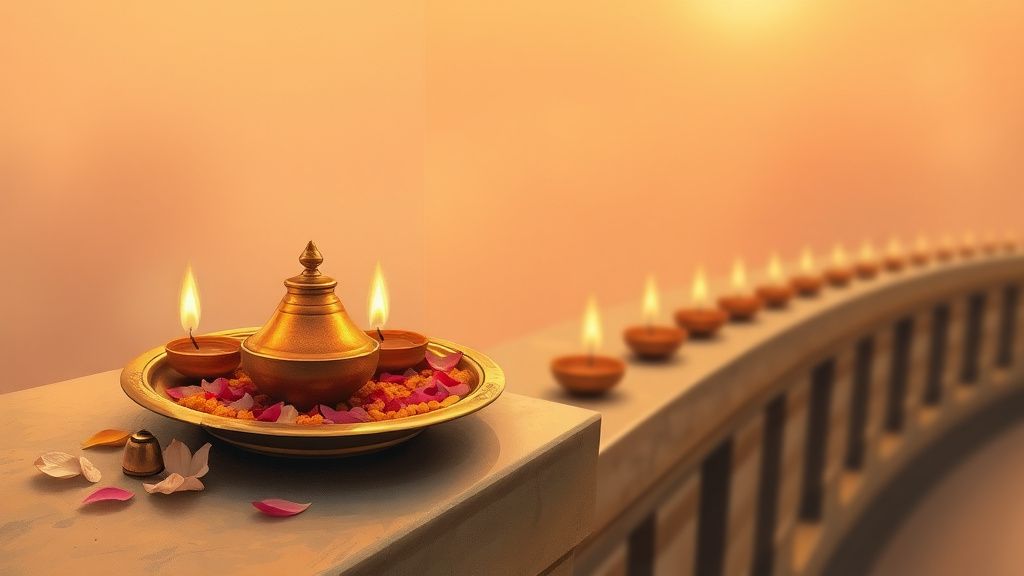
The pooja room in Vastu Shastra is placed in the northeast (Ishanya) corner of the house, since the northeast is governed by Ishana and is the most sacred quadrant of the Vastu Purusha Mandala. The worshipper sits facing east or north while at the shrine, with the principal deity image installed on the east or north wall of the pooja room. The Manasara, Mayamatam and Vishwakarma Vastu Shastra all designate the northeast for the household shrine. The pooja room should be small (a closet-sized room is acceptable; a corner alcove is acceptable) but dedicated, with no other use of the space. The threshold has a small raised step, and the room remains uncluttered.
Why the northeast
- Ishana’s quadrant: the northeast is governed by Ishana, a form of Shiva, and is the most sacred zone in the directional grid. The household shrine sits in the deity’s own quadrant.
- Morning sun: the northeast receives the first light of the rising sun, which suits the daily morning puja.
- Light energy: the northeast is the lightest quadrant in the Vastu Purusha Mandala (least amount of structural weight, most amount of light, water and openness). The shrine in the light zone is the classical reading.
- Water-element compatibility: the abhishekam (ritual water bathing of the deity) involves water flowing over the murti and into a small drainage. The water element belongs in the northeast.
The pooja room layout
- Principal deity: installed on the east or north wall, with the deity facing west or south. The worshipper sits facing east or north while looking at the murti.
- Worshipper’s seat: in the centre or west side of the pooja room, facing east or north. The seating is on a mat or a low wooden plank, not a chair.
- Diya and oil lamp: at the south of the shrine (the worshipper’s right hand while facing east). The oil lamp is the standing pillar lamp, lit at the daily morning and evening puja.
- Incense holder and bell: at the south or southeast of the shrine. The bell is rung at the start of the puja.
- Water vessel: a small kalasha in the northeast corner of the pooja room, filled with fresh water daily.
- Storage: a small cabinet below or beside the shrine for puja items (camphor, kumkum, flowers, sacred thread, scriptures).
- Floor: wooden or marble. The pooja room floor should not have a drain or a step downward; the room is elevated slightly above the rest of the house.
Deity placement on the shrine
The classical arrangement places the family’s principal deity (Ishta Devata) in the centre of the shrine. To the right of the Ishta Devata (the worshipper’s left as the worshipper sits) is the deity associated with the household’s lineage or kula devata. To the left of the Ishta Devata is Ganesha (always installed first, since Ganesha is the remover of obstacles and is invoked at the beginning of every puja). Smaller subsidiary deities (the family’s chosen avatars, lineage gurus, ancestor photographs) are placed in tiered shelves above or to the side of the central row. The murti should be no taller than 9 inches for a home shrine; large temple-scale images are not for home installation. Cracked, chipped or damaged murtis should be retired and replaced, with the old murti given to flowing water or to a temple.
What to keep out of the pooja room
- Photographs of departed ancestors in the same row as the deities. Ancestor photographs are placed below the deity row or in a separate corner.
- The shoes of the family outside the door of the pooja room. Shoes are removed before entering the shrine room.
- Television, computer or electronic clutter. The pooja room is dedicated to worship.
- Storage of unrelated household items. The pooja room is not a general storage room.
- A bathroom on the other side of the shrine wall, sharing a common wall with the pooja shrine. The elimination zone behind the deity is the strongest avoidance.
- The pooja room directly above or below a bathroom in a multi-storey house. The vertical adjacency is the same dosha as the horizontal one.
- Broken or damaged deity images. A cracked murti is read as completed and should be retired.
When the northeast is unavailable
In a small flat where the northeast is taken by another room, the pooja room moves to the east or north of the house, in that order. The east-placed shrine is acceptable; the north-placed shrine is acceptable. The west and south placements are the avoidances, since these are the heavier quadrants and do not match the lightness of the deity-zone reading. The least preferred placement is the south, since the south is the direction of ancestors and is reserved for ancestor offerings rather than for the principal household worship. A small wall-mounted shrine in the east or north wall of the kitchen is a common modern compromise in studio apartments; the kitchen-pooja combination is acceptable as a fallback but the dedicated room is the classical preference.
A practical opinion on pooja room rules
For what it’s worth, the most useful pooja room rule is the dedication of the space itself. A small dedicated alcove with one deity image, a small lamp and a clean mat is more conducive to daily worship than an elaborate ornate shrine in a room that doubles as a storage closet. The classical preference for the northeast is worth following where the layout permits; where it does not, the east or north fallback is fine. The compass orientation matters less than the cleanliness, the daily lighting of the lamp and the unbroken daily practice of the puja.
Common questions
Should there be a door on the pooja room?
Traditional preference is for double-leaf wooden shutters that can be closed when the room is not in use and opened during the daily puja. The shutters protect the shrine from dust and from casual viewing. In small flats a curtain on a rod is the modern alternative; a single-leaf door is also acceptable. The full-closed shrine cabinet is the smallest modern adaptation, suitable for studio apartments where a dedicated room is not possible.
Can the pooja room be in a bedroom?
The classical preference is the pooja in its own room, not in a bedroom. Where the bedroom-pooja combination is unavoidable, the shrine is placed on the east or north wall, in the lightest corner of the room, with a cabinet that closes when not in use. The shrine should not face the bed; the worshipper should not pray with the bed visible behind the deity. A small folding screen between the bed and the shrine is the standard household compromise.
What direction should the deity face?
The deity faces west or south, since the worshipper faces east or north. The classical reading is that the deity and the worshipper face each other across the shrine. A deity facing east (same direction as the worshipper, both looking the same way) is the avoidance, since the worshipper would then see only the back of the murti. The standard configuration is the deity on the east or north wall, facing west or south into the room, with the worshipper sitting on the opposite side of the room facing the deity.
One limitation worth noting
These are traditional architectural conventions for household worship, not empirically validated predictors of religious experience. The directional reading is the classical tradition’s way of encoding the seriousness of the household shrine: a clean dedicated space, a settled time of day, a particular orientation that recurs across generations. The defensible part of the prescription is the dedication of the space and the regularity of the daily practice; the compass detail is interpretive scaffolding that supports the practice.
For background see Ishana on Wikipedia and the entry on Vastu shastra.