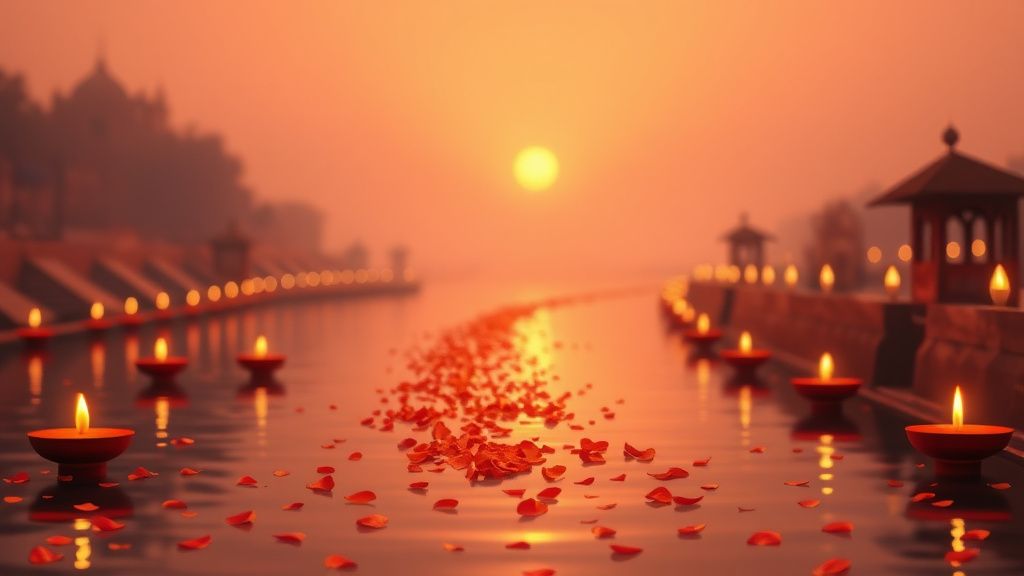
The Haridwar Kumbh Mela is one of the four Kumbh sites in the twelve-year rotation, held when Jupiter is in Aquarius and the Sun enters Aries. The next full Haridwar Kumbh is in 2033; the Ardh Kumbh (half-Kumbh, held six years after the full Kumbh) is scheduled for 14 January to 20 April 2027. The principal bathing ghat is Har Ki Pauri on the Ganga, the spot at which the city is traditionally believed to have received one of the four drops of amrita that fell during the Samudra Manthana. Below is the upcoming 2027 Ardh Kumbh schedule, the history of the mela, and the practical structure of a Haridwar Kumbh visit.
The 2027 Ardh Kumbh: dates and structure
- Mela opens: Thursday, 14 January 2027 (Makar Sankranti).
- Mela closes: Tuesday, 20 April 2027 (Chaitra Purnima).
- Duration: 96 days, the standard Ardh Kumbh window.
- Principal shahi snan (royal bath): Bhramkund at Har Ki Pauri, on specified dates.
- Akharas: all 13 recognised akharas of the Naga sadhu tradition lead the shahi snans in established processional order.
The state government’s Kumbh Mela administration publishes the specific shahi snan dates a few months before the mela opens; the standard ones for a Haridwar Kumbh are Makar Sankranti (14 January), Mauni Amavasya (mid-January), Basant Panchami (early February), Maghi Purnima (late February), and Chaitra Purnima at the close.
The Samudra Manthana origin
The Kumbh tradition originates in the Samudra Manthana story, narrated in the Vishnu Purana, Bhagavata Purana and the Mahabharata. The devas and asuras churned the cosmic ocean with Mount Mandara as the churning rod and the serpent Vasuki as the rope. Dhanvantari emerged with the pot (kumbha) of amrita. During the deva-asura struggle for the pot, four drops fell on earth at Prayagraj, Haridwar, Nashik-Trimbakeshwar, and Ujjain, sanctifying these four sites for periodic Kumbh celebration.
The astronomical timing is set by Jupiter’s twelve-year orbit through the zodiac. When Jupiter occupies Aquarius and the Sun enters Aries, the Haridwar Kumbh is held. Each of the four sites has its own Jupiter-Sun combination. The Ardh Kumbh is held six years after the full Kumbh, with reduced but still substantial scale.
The history of the Haridwar Kumbh
The earliest documentary reference to a Haridwar Kumbh-like gathering is in the Khulasat-ut-Tawarikh (1695) and Chahar Gulshan (1789), both of which describe twelve-yearly gatherings of sadhus at Haridwar. The name “Kumbha Mela” is first attested in these texts. The Buddhist Chinese pilgrim Xuanzang in the 7th century describes a large gathering at Haridwar that some historians read as a Kumbh predecessor, though the identification is contested.
Through the colonial period the British administration enumerated and policed the mela; the 1892 Kumbh saw the first British census of pilgrims (then approximately 4 lakh). Post-independence the scale has grown by an order of magnitude with each cycle. The 2010 Haridwar Kumbh drew an estimated 1.5 to 4 crore pilgrims across the 96 days; the 2021 Kumbh was scaled down because of the COVID pandemic. The 2027 Ardh Kumbh is expected to draw 5 to 7 crore on the most optimistic estimates.
Har Ki Pauri and Bhramkund
Har Ki Pauri is the most sacred ghat of Haridwar, at the point where the Ganga emerges from the Shivalik foothills onto the plains. Bhramkund, embedded within Har Ki Pauri, is the specific stretch of the river where Vishnu is said to have left his footprint and which carries the strongest Kumbh association. The shahi snans of the Naga sadhus take place here, in a strict processional order led by the senior akharas (Mahanirvani, Niranjani, Juna).
The Ganga Aarti at Har Ki Pauri runs daily at sunset throughout the year, with thousands of lit diyas floated downstream. During Kumbh the aarti is held with enhanced security and crowd control. The Haridwar Municipal Corporation deploys a Kumbh-specific traffic plan that closes the main bazaar road to vehicles.
Practical points for a Kumbh visit
- Accommodation: Haridwar dharmashalas, hotels and ashram guest houses are booked six months ahead for shahi snan dates. The mela administration sets up tent cities (kumbh nagri) with pre-allocated accommodation pods, bookable through the official Kumbh portal once it opens.
- Travel: Haridwar Railway Station is the principal arrival point, with the Delhi-Haridwar Shatabdi taking ~4 hours. Roads are heavily restricted during shahi snans; Indian Railways adds special trains.
- Bathing: the Bhramkund is for the akharas in procession; ordinary pilgrims bathe at Har Ki Pauri at adjacent ghats. Cold (winter Kumbh) water temperature is 8 to 12 degrees Celsius; bring a change of warm clothing immediately afterward.
- Documents: carry Aadhaar; mela registration is now standard, with QR-code passes for many shahi snan ghats.
For what it’s worth, the non-shahi-snan days at Haridwar Kumbh are far easier to navigate than the shahi snan days themselves. A pilgrim who can travel mid-mela rather than on the principal bathing dates often gets a more contemplative experience without sacrificing the religious frame.
Common questions
Is the Ardh Kumbh smaller than the full Kumbh?
In scriptural status, the Ardh Kumbh is a parallel observance at the six-year midpoint. In practical scale it is smaller than the full Kumbh, with fewer shahi snan dates and lower attendance. The 2010 Haridwar full Kumbh drew higher numbers than the 2016 Ardh Kumbh. The 2027 Ardh Kumbh is expected to be one of the largest in recent decades because of post-pandemic pilgrim build-up.
What is a shahi snan?
The shahi snan (“royal bath”) is the formal processional bath of the akharas. Each akhara, in seniority order, leads its Naga sadhus and disciples to the Bhramkund. The procession is choreographed by the akhara council and the mela administration. Ordinary pilgrims bathe at adjacent ghats outside the shahi snan window; the central section is reserved.
Can foreign pilgrims attend?
Yes; Haridwar Kumbh is open to all. Foreign nationals require a tourist visa for India and standard registration through the mela administration. The Uttarakhand Tourism Board publishes English-language Kumbh guidance and several tour operators run Kumbh packages aimed at international visitors.
One limitation worth noting
The specific 2027 Ardh Kumbh booking flow, dharmashala allocation, accommodation rates and shahi snan schedule are published by the Uttarakhand state government’s Kumbh Mela Adhikari office closer to the mela. The figures and dates above are based on the published schedule as of the 2027 announcement; check the official Kumbh Mela portal for any revisions.
For background see Wikipedia on Haridwar Kumbh Mela and Wikipedia on Har Ki Pauri.
